
Sales Funnel Optimization Services That Close More Revenue
- Map stages, capture baseline, benchmark each transition.
- One change per stage. Two to four week read window.
- Visit-to-lead and opportunity-to-close underperform most.
- Fair pricing: $2,500 to $8,000 per month.
- Vanity metrics hide bottlenecks. Fix the dashboard first.
- Diagnosing an underperforming sales funnel without guessing
- Sales funnel optimization strategies by stage
- Ecommerce sales funnel optimization specifics
- When to bring in a sales funnel optimization agency
- A real sales funnel optimization case
- How to hire the right sales funnel optimization partner
- Running it internally versus outsourcing
- Common mistakes to avoid in sales funnel optimization
- Wrapping up sales funnel optimization
Sales funnel optimization is the work of raising conversion at every step from first touch to closed revenue without buying more traffic. You already have visitors, leads, demos, and quotes moving through your site. The job is to find the two or three stages where the drop-off is bigger than it should be, fix those, and re-measure. That is the whole discipline in one paragraph, and every consulting hour we bill on this comes back to it. You are reading this because your funnel is producing revenue but not enough of it, or because a specific stage feels broken and you cannot tell which one.
This guide is the exact playbook we run on Redefine Web client accounts, benchmarks included, so you can apply it yourself or brief your team on what a serious sales funnel optimization engagement looks like. Read straight through in about twelve minutes and you get a diagnosis pattern you can put to work this week.
Diagnosing an underperforming sales funnel without guessing
An underperforming sales funnel is a funnel where at least one transition is losing 15 to 30 percentage points more than the benchmark. Sales funnel drop-off is not a moral failure. It is a measurement gap. Find the underperforming stage first, then fix the cause. Do not guess.
The audit we run on the first two weeks of every engagement is 12 checks across the funnel. Half are technical and half are behavioral. The technical checks catch the boring stuff that kills conversions silently. The behavioral checks catch the copy, offer, and pricing decisions that were made once and never revisited. Both categories matter, and neither one wins if you skip the other.
- Page load time above 3 seconds on mobile
- Form has more than 6 fields for a first touch
- Primary CTA below the fold on mobile
- Contact page missing a phone number or missing a click-to-call link
- Thank-you page missing a next step
- Lead notification email routing to a shared inbox with no owner
- Follow-up cadence slower than 5 minutes on inbound demo requests
- Proposal template longer than 6 pages
- Pricing hidden behind a discovery call for a low-consideration offer
- No retargeting on cart abandonment or form abandonment
- Discovery call script that pitches instead of qualifies
- No handoff document between marketing and sales
Technical fixes that recover the most percentage points
Site speed on mobile is the biggest technical driver. A page that loads in 4.2 seconds on a 4G phone converts about 40 percent worse than the same page loading in 2.1 seconds. Form length is second. Cutting a 9-field form to 4 fields usually raises submission rate by 20 to 35 percent. Missing click-to-call links on mobile is third, and adding one to a service business site often recovers 10 to 15 percent of hand-raisers who otherwise bounced.
Behavioral fixes that compound over time
Speed-to-lead is the biggest behavioral driver. Inbound demo requests followed up within 5 minutes convert to opportunity at 3 to 8 times the rate of requests followed up within 24 hours. Second is proposal quality. Six-page proposals close about 30 percent higher than 22-page proposals for deals under $20,000. Third is pricing transparency, where showing a starting price on the page qualifies out tire-kickers before they take an hour of your sales team’s time.
Sales funnel optimization strategies by stage
You want one strategy per stage, not a mixed bag applied everywhere. Top of funnel needs traffic quality control. Middle needs offer and nurture strength. Bottom needs speed and clarity. Sales funnel optimization strategies stack, they do not blend. Pick one per stage and run it clean.
The five strategies below are the ones we reach for most often across client accounts. Each maps to a specific stage. You will not run all five in the same 90-day window. You will run the one that matches the stage you diagnosed as farthest from benchmark. If two stages are tied, run the earlier-stage strategy first because it feeds every stage below it.
Strategy one, traffic quality control
If visit-to-lead is below benchmark, the problem is often traffic quality, not the page. Cut the bottom 20 percent of your paid keywords by intent match. Kill the display placements sending sub-30-second sessions. Refocus organic content on buyer-intent queries instead of top-funnel awareness. This alone can raise visit-to-lead by 40 to 70 percent inside 60 days without touching the site.
Strategy two, offer strength
If page conversion is below benchmark and traffic quality is fine, the offer is the problem. Rewrite the primary offer to be more specific. “Book a free consultation” converts worse than “Get a $500 same-week SEO audit for $0.” Specificity beats generic every time. Test two offers over a two-week window with equal traffic, keep the winner.
Strategy three, nurture cadence
If lead-to-opportunity is below benchmark, the nurture is broken or missing. Build a 5-touch email sequence that runs over 21 days, plus one phone call on day 3 and one on day 14. Add SMS if the lead opted in. Measure open, click, reply, and booked meeting rate at each touch. Cut the touches with reply rates under 1 percent, double down on the ones above 3 percent.
Ecommerce sales funnel optimization specifics
Ecommerce sales funnel optimization runs on different math than services. You have shorter stages, higher volume, and a checkout step that alone can absorb 15 to 30 percent of your revenue. Cart abandonment, checkout friction, and payment failure rates are your top three drivers. Fix those three before you touch anything else.
Ecommerce funnels also carry a wildcard that services funnels do not, shipping cost surprise at checkout. Roughly 48 percent of cart abandonment traces to unexpected costs at the checkout step, per the Baymard Institute cart abandonment research. Show the total including shipping earlier in the flow. Product page, cart page, and checkout should all display the same total. If they diverge, users assume they are being tricked and leave.
Cart abandonment fixes that actually move the number
Cart abandonment recovery emails, sent 1 hour, 24 hours, and 72 hours after abandonment, recover 8 to 12 percent of abandoned revenue on average. Adding SMS as a fourth touch adds another 3 to 5 percent recovery. On-site exit-intent overlays with a small first-purchase discount recover another 2 to 4 percent. Stack all three and you can add 15 to 20 percent to closed revenue without changing a thing on the store itself.
Reducing checkout friction
Guest checkout should always exist as an option. Forcing account creation drops checkout completion by 20 to 35 percent. Apple Pay, Google Pay, and PayPal reduce time-to-payment by 40 to 60 percent versus manual card entry. Field count matters. A checkout with 14 form fields converts about 25 percent worse than a checkout with 8 fields. If you run Shopify or WooCommerce, most of these fixes are a settings toggle away, not a dev sprint. Our Ecommerce Marketing Agency for DTC and Shopify Brands handles this work regularly across DTC accounts.
Every week we get a discovery call that opens with “we tried Facebook Ads and it did not work.” Then we ask how the funnel converts and the answer is silence. Facebook Ads worked. The funnel did not. The ads dropped 8,000 people on a page that loads in 5.4 seconds, asks for 11 fields, and hides the phone number in the footer. If your funnel converts, the ads work. If your funnel does not convert, no ad platform on earth will bail you out.
Marketing tracks clicks. Sales tracks closed deals. Nobody watches the 3 stages in between. Pull the funnel now and find the widest gap. That's your fix.
When to bring in a sales funnel optimization agency
Bring in outside help when your team has run three cycles without moving the number, when the diagnosis crosses two or more functions, or when you need results inside 60 days. A sales funnel optimization agency earns fees by replacing guesswork with measured improvement.
What a good sales funnel optimization agency actually does in the first 30 days: audit the current instrumentation, capture 90 days of baseline transition rates, identify the two stages farthest from benchmark, propose one change per stage with predicted delta, and set up the measurement to read the delta cleanly. If the pitch skips the audit and jumps to a redesign, keep interviewing. That is the tell of a shop selling their process instead of solving your problem.
Agency versus sales funnel optimization consultants
Sales funnel optimization consultants tend to be solo operators who diagnose fast and hand off execution to your team. An agency does the diagnosis and the execution end to end. Consultants cost less, move faster on strategy, and put the burden on your team to build and push changes live. Agencies cost more, take longer to onboard, but own the outcome. Pick the model that matches the internal capacity you actually have, not the one you wish you had.
Pricing expectations
Fair market pricing for full-service sales funnel optimization services runs $2,500 to $8,000 per month depending on funnel complexity, traffic volume, and how much execution work sits inside scope. Standalone consultants run $200 to $400 per hour or $4,000 to $12,000 for a defined audit-plus-recommendations project. Anything under $1,500 per month is usually just a monthly report, not real optimization work. Anything over $15,000 per month should include dedicated developer time on your codebase, not just marketing.
A real sales funnel optimization case
Rocket Software, Inc. came to us with a subscriber-acquisition tool that had a 7 percent activation rate and a broken onboarding flow. Their top-of-funnel was fine. Their sign-up rate was fine. The activation stage, where a new signup becomes an active user, was the choke point. That is a textbook underperforming sales funnel with a well-defined single stage to fix.
We rebuilt the onboarding flow, added automated drip campaigns for the first 14 days, and coordinated a 4-channel launch. Activation rate climbed 300 percent inside the first month. The launch acquired the first 3,000 customers in week one and settled into a steady 400-plus new subscribers per day. Every one of those numbers came from fixing one stage cleanly, then rolling the results into the acquisition math.
What worked in the Rocket Software account
Three moves carried most of the gain. The onboarding flow got cut from 9 steps to 4, which raised activation by roughly 180 percent on its own. The drip campaigns re-engaged signups who stalled on day 2 or day 5, adding another 60 to 80 percent. The 4-channel launch fed the top of the funnel with better-qualified traffic, which raised the baseline activation rate the fixes were operating against. Layered fixes, one per stage, measured cleanly.
What we tried that did not work
A pricing test between two tiers moved nothing. A referral loop with a $10 credit incentive returned less than the cost of the credits. A live chat widget on the onboarding page raised support cost without raising activation. The value of running one change per stage is that the losers are visible. They get cut before they burn time. Any engagement that reports only wins is either brand new or hiding the losses.
How to hire the right sales funnel optimization partner
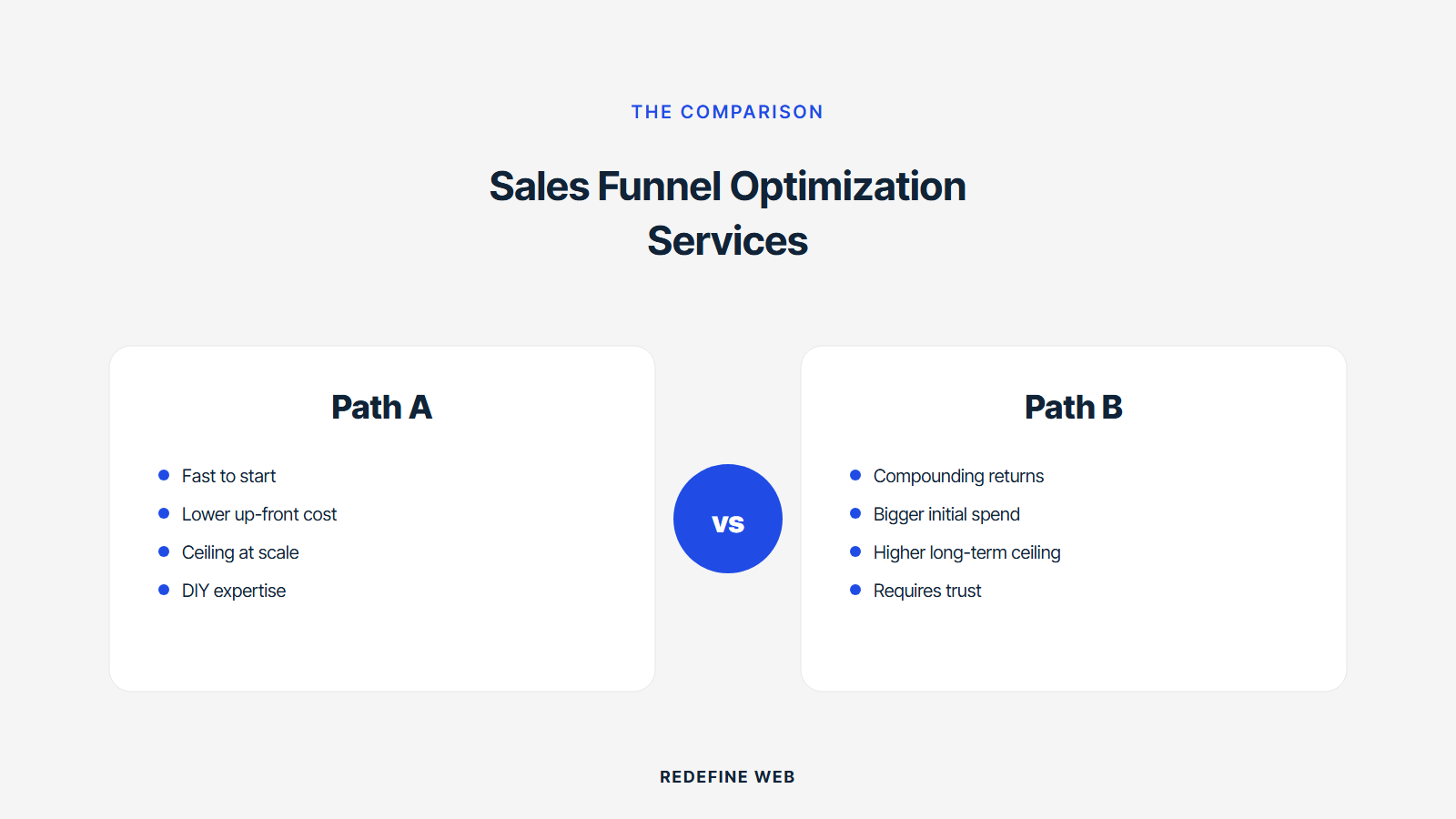
Ask four questions on the first call. What does your first 30 days look like. What baseline data do you need from me. Which stage would you look at first. What have you cut from a client account that did not work.
Ask for two references from clients whose engagement ended in the last 12 months, not just current clients. A good sales funnel optimization consultant or agency will have both wins and finished engagements. Talk to at least one of each. The finished-engagement reference tells you the truer story because the client is no longer being managed. Any partner who cannot answer those specific questions on the first call is selling a template rather than a diagnosis.
Scope clarity in the contract
The contract should name the funnel stages inside scope, the tools you are running on, the reporting cadence, and the ownership of any code or copy the partner produces. Vague scope leads to vague results. If the contract says “grow revenue” without naming the stages, the partner will spend time on whichever stage is easiest for them and leave the hard ones alone.
Measurement agreement on day one
Agree on the numbers you will read together every two weeks before the engagement starts. Site visit to lead, lead to opportunity, opportunity to closed deal. Any metric a partner wants to add later usually softens the reporting. Any metric they want to drop from the baseline signals they are avoiding the stage where they are underperforming. Fix the definition on day one, then hold the line. Our Sales Funnel and Automation service runs on this exact reporting rhythm.
Running it internally versus outsourcing
You can run sales funnel optimization internally if you have a revenue operations lead, a marketer who understands events and attribution, and a developer with 10 hours a week free. Without those three, outsource the first two cycles and staff up while the partner runs. Trying to build the muscle from zero while also fixing the funnel usually means neither happens.
Internal ownership pays off long term because the person who ran the fix understands why it worked. That knowledge compounds. Every subsequent cycle gets faster because the baseline is understood, the tools are wired correctly, and the team knows how to hypothesize before they build a test. Outsourcing a first cycle is a cost. Outsourcing every cycle is a permanent tax on your revenue efficiency, and the tax gets more expensive as your traffic grows because the partner’s percentage of revenue scales with the account. Our B2B SaaS Marketing Agency Tied to Pipeline engagements often start with the outsourced first cycle model and hand the day-to-day off to the client team after cycle two, keeping oversight monthly. That is the pattern we see work best across roughly two-thirds of new engagements.
- Instrumentation audit: two weeks, one marketer, one developer for 10 hours
- Baseline capture: one week, pull 90 days of transition rates for every stage
- Diagnosis: three days, rank stages by gap to benchmark
- Change one at a time: two to four weeks per stage, measure delta cleanly
- Rollup: monthly report, share what worked and what got cut
Common mistakes to avoid in sales funnel optimization
Three mistakes wreck most optimization programs. Running too many changes at once. Skipping the baseline. Trusting reported numbers from platforms without cross-checking against the CRM. Any one of these blurs the read on what worked. All three together guarantee that the program produces nothing measurable in six months.
A fourth mistake, quieter but expensive, is optimizing a stage that is not the bottleneck. Every hour spent raising a 4 percent stage to 5 percent is an hour not spent raising a 12 percent stage to 22 percent. The bigger absolute win almost always sits on the stage with the widest gap to benchmark, not the stage with the friendliest team or the easiest test to build.
The redesign trap
Full-site redesigns get pitched as sales funnel optimization all the time. They rarely are. A redesign moves 30 variables at once and produces a number that could be up because the offer changed or down because the navigation changed and nobody can tell. If a partner suggests a full redesign in month one, ask them to name the specific stage the redesign fixes. If they cannot, the redesign is scope creep dressed up as strategy.
Vanity metrics that hide the truth
Bounce rate is a vanity metric. Time on page is a vanity metric. Session duration is a vanity metric. None of these move revenue on their own. The metrics that matter are the transition rates between stages and the absolute number of closed deals per week. If your reporting dashboard leads with bounce rate, the dashboard was built by someone who was measured on traffic, not revenue. Fix the dashboard first.
Wrapping up sales funnel optimization
Sales funnel optimization is not a mystery. Map the stages, capture the numbers, benchmark each transition, and fix the widest gap first. One change per stage, two to four weeks of clean measurement, then the next stage. Anything more complicated is a services pitch that is not aligned with your revenue.
If you want a second set of eyes on your current funnel, we run a 90-minute audit that identifies your two biggest gaps and predicts the delta of fixing each. That is the same audit we run on the first day of every engagement. Whether you keep the work in house or bring us in, the audit output is yours to run with.
Frequently asked questions
What is sales funnel optimization in one sentence?
Sales funnel optimization is the discipline of measuring every stage of your funnel, comparing transition rates against benchmarks, and running one focused change per stage until each transition hits a target rate. It is a measurement-first practice, not a creative one. The work sits in the diagnosis, not in the design. Most engagements start with a two-week instrumentation and baseline capture pass before any change gets built or tested, because you cannot optimize what you have not measured. Anything that skips the audit and jumps straight to a redesign is a redesign pitch dressed up as optimization work.
How much do sales funnel optimization services cost?
Full-service sales funnel optimization services run $2,500 to $8,000 per month depending on funnel complexity, traffic volume, and how much execution work sits inside scope. Standalone sales funnel optimization consultants run $200 to $400 per hour, or $4,000 to $12,000 for a defined audit and recommendations project. Anything under $1,500 per month is usually a monthly reporting service, not real optimization work. Anything over $15,000 per month should include dedicated developer time on your codebase, not just marketing hours. Match the pricing tier to the actual work scope, not the size of the retainer.
What are healthy sales funnel conversion rate benchmarks?
For B2B services, site visit to lead runs 2 to 5 percent, lead to marketing qualified lead runs 50 to 70 percent, MQL to sales qualified opportunity runs 25 to 40 percent, and opportunity to closed deal runs 20 to 35 percent. For ecommerce, site visit to lead runs 1.5 to 3 percent, add to cart to checkout start runs 40 to 60 percent, and checkout start to payment complete runs 50 to 75 percent. Overall visit to revenue is 0.5 to 2 percent for services and 1 to 2.5 percent for ecommerce. Build your own baseline within 90 days and chase your own delta.
How do I find an underperforming sales funnel stage?
Pull 90 days of stage transition rates from your CRM and analytics stack. Compare each transition to the benchmark median for your industry and stage. Any transition that falls 15 or more percentage points below the low end of the benchmark range is a target. Rank the gaps by size. Start with the earliest-stage gap because a fix there cascades into every stage below it. If two stages are tied for widest gap and one is technical while the other is behavioral, fix the technical one first because those changes usually take less time to build and measure cleanly.
How is ecommerce sales funnel optimization different?
Ecommerce funnels have shorter stages, higher volume, and a checkout step that can absorb 15 to 30 percent of revenue on its own. Cart abandonment recovery emails at 1 hour, 24 hours, and 72 hours recover 8 to 12 percent of abandoned revenue. Adding SMS recovers another 3 to 5 percent. Guest checkout should always exist as an option because forcing account creation drops completion by 20 to 35 percent. Show total including shipping earlier in the flow because shipping surprise at checkout drives roughly 48 percent of cart abandonment. Most fixes are settings toggles, not dev sprints.
When should I hire a sales funnel optimization agency?
Bring in outside help when your internal team has run three optimization cycles without moving the number, when the diagnosis crosses more than two functions inside your company, or when you need results inside 60 days and cannot pull people off existing work. Otherwise, keep the work in house. A sales funnel optimization agency earns its fees by replacing guesswork with measured improvement. Any agency that cannot describe their first 30 days in specifics, cannot name the stages they will diagnose first, and cannot show engagements they ended cleanly is selling a template. Interview at least three before you sign.
Can I run sales funnel optimization internally?
Yes, if you have a revenue operations lead, a marketer who understands events and attribution, and a developer with about 10 hours per week free. Without those three, outsource the first two cycles and staff up in parallel while the partner runs the work. Internal ownership pays off long term because the person who ran the fix understands why it worked. That knowledge compounds. Every subsequent cycle runs faster because the baseline is understood, the tools are wired correctly, and the team knows how to hypothesize before they build. Outsourcing every cycle forever is a permanent tax on your revenue efficiency.
Book your free 30-minute strategy call.
No spam, no sales rep. We use your email to schedule your call with a senior strategist. That is it.
More from the blog
View all articles → Digital Marketing
 Dental Marketing Tips That Compound Into New Patients
Read article Digital Marketing
 Ecommerce Marketing Strategies That Drive Real DTC Revenue
Read article Digital Marketing