
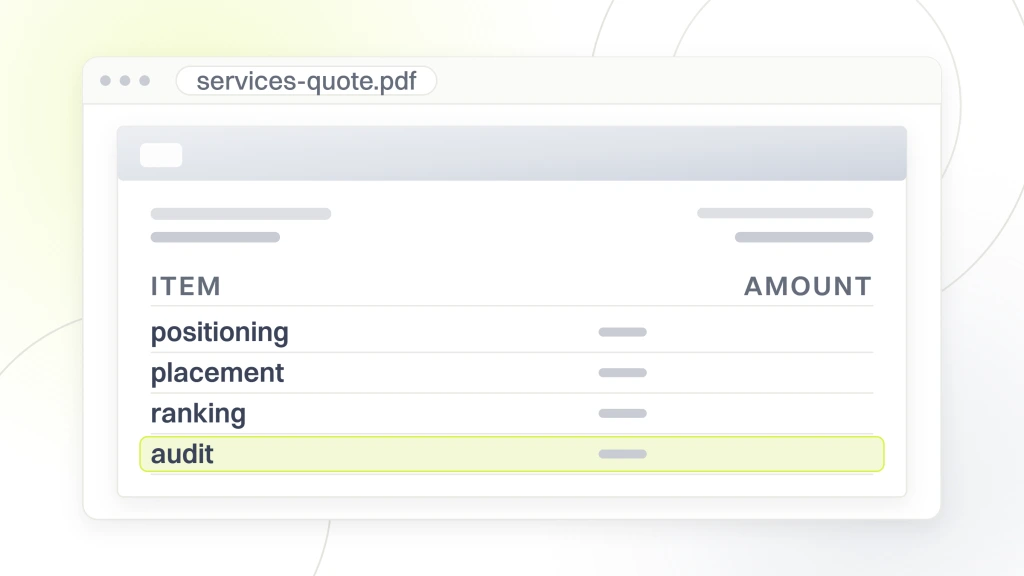
Search engine optimization services is the heading on the quote, and it is rarely the only phrase on it. Underneath it sit line items called positioning, placement, ranking and audit, and most buyers read those as four more things they are getting for the money. Open the deliverables listed under each one and the overlap is close to total. Three of the four are the same work wearing an older name.
We sell this work, so treat everything below as interested testimony and check it. That is why every claim here is either a sentence from Google’s own documentation or a quote from a provider page you can open in another tab. The useful question in this purchase is not which company to hire. It is which lines on the quote could be failed, and which are written so that failure is not possible.
What search engine optimization services are, once you take the label off
Google publishes a page for people about to hire someone to do this. It is short, and the part worth reading first is the list of what an SEO actually offers.
Four items. “Review of your site content or structure”. “Technical advice on website development: for example, hosting, redirects, error pages”. “Content development”. “Keyword research”. That is the whole category as described by the company whose results everybody is trying to appear in.
Hold that list against a quote and something becomes obvious. A menu of nine differently named services is not nine products. It is four kinds of work sliced up and relabeled, usually because a longer menu looks like better value and because each new name creates a line the buyer cannot price against anything. Speed, security and the rest of what a site gets judged on live beside this rather than inside it, which is what our website audit page sets out.
None of this makes the work worthless. Review, technical advice, content and keyword research are real, and done properly they are most of what moves a site. The problem starts where the naming stops matching the work, because that is the point at which you can no longer tell whether the month was delivered.
The names on one menu, and how many products they really are
Search the formal spelling and the results are national service pages and agency directories. Search the abbreviation and the same query fills with city pages and best-agency lists instead. Same work, two different shelves, and that alone tells you the phrase you type changes who gets to sell to you rather than what you end up buying. Which shelf you land on matters less than what the work consists of, and what actually moves the needle in a website audit is the more useful question to carry into any shortlist.
Now search the older names. Both return general SEO explainers rather than pages about a distinct service, and the placement results include two pages whose own URLs name positioning instead of placement. One provider ranks in the top three for both, serving that page from a URL ending in seo. The search engine treats the three phrases as one question. The market keeps selling them as three answers.
So the menu collapses. Optimization, positioning and placement are one product. Ranking services are frequently not a service at all, which the next sections show. An audit is the one genuinely separate purchase, and it is separate because it ends, which none of the others do.
Knowing that before the first call changes what you ask. You stop asking what each service includes, which invites a longer menu, and start asking which lines produce something that will exist at the end of the month.
Search engine positioning services, in the words of the people selling it
Rather than characterize the older labels secondhand, read what a provider currently ranking for one of them says it is.
Grizzly New Marketing’s page on the term defines it as “the process of optimizing a website’s visibility in search engine results pages (SERPs) to achieve higher rankings for specific keywords or phrases”, and says it “involves various strategies, including search engine optimization (SEO), content creation, link building, and technical improvements”.
Read that twice. The definition of positioning contains optimization as one of its ingredients, which means the seller is describing the outcome and listing the work underneath it. The steps the page goes on to name are keyword research, site scans and analysis, content creation, ongoing monitoring, progress reports and follow-up. Compare those to Google’s four. Research, review, content, and reporting on top.
There is nothing disreputable there. It is ordinary SEO, described competently, sold under a name that describes where you hope to end up rather than what somebody will do on Tuesday. The page publishes no price, which is consistent with a name that has no unit attached to it. You cannot quote per position, so you quote per month and the name does the selling.
Search engine placement services, and two deliverables Google names as spam
The second old label is worth more care, because on the page currently ranking first for it the deliverables have not been updated along with the industry.
Search Influence’s placement page describes services that “make your site rank well with search engines through web site optimization for increased traffic”, and lists what the packages include. Alongside keyword assessment, site optimization and reporting sit two further items, “Directory submissions” and “Link exchange with quality sites”.
Now read Google’s spam policies, which define link spam as “the practice of creating links to or from a site primarily for the purpose of manipulating search rankings” and give examples. Two of them are “Excessive link exchanges (“Link to me and I’ll link to you”) or partner pages exclusively for the sake of cross-linking” and “Low-quality directory or bookmark site links”.
Both sides carry a qualifier, excessive on one and quality on the other, so this is not proof that any particular provider is doing anything against the rules. What it is proof of is that a live page selling this label in 2026 still names two practices that appear, in a qualified form, on the list Google publishes of things that get sites penalized. Google’s hiring page puts it more bluntly, telling readers to “Avoid SEOs that talk about link popularity schemes or submitting your site to thousands of search engines”.
The practical instruction is small and it works on any quote. Where a line item names links, ask which links, from where, and what the editorial reason is for each one. A provider doing this well answers in specifics. A provider running a scheme answers in volume.
Website ranking services, where the search returns software rather than a service
This one is not a rebrand. It is a category error, and the search results make it visible in a way no article needs to argue.
Search for ranking services and most of what comes back is software. Rank tracking platforms, a grader tool, Google’s own documentation for developers, and a couple of agency directories mixed in. Very little of the page is an agency offering to do work. The market has answered the question by deciding that ranking is something you measure, not something you buy.
That matters when the phrase turns up on a quote, because it can mean two completely different charges. It can mean a subscription to a tracker, which has a list price you can look up and which you could buy yourself in ten minutes. Or it can mean an unspecified promise about where you will appear, which has no unit at all. Those are not close to each other, and the line item looks identical either way.
So ask which it is, and if the answer is a tool, ask whose login it is and what happens to the history when you leave. Our comparison of website checkers covers what these platforms return, and most of the tracking half of a retainer is one of them with a person reading the output.
Website audit service, the one item that is genuinely a different product
Out of everything on the menu, one purchase is structurally unlike the rest, and it is the only one worth buying before you know what you need.
An audit ends. It has a start, a scope, an output and a last day, which means it can be quoted as a fixed price, delivered, and judged against what was promised. Everything else on the menu is a month that renews, and a month that renews is judged on whether you feel like renewing it. Those are different commercial objects wearing the same word, services.
A website audit is also broader than an SEO audit, and the two names get used as if they were one. An SEO audit looks at what search engines make of the site. A website audit takes in the same ground plus how fast it delivers and whether it is safe to use, which are the two areas that cost money without ever showing up in a rankings report. If you are pricing the narrower version, our breakdown of what SEO pricing packages really run takes that purchase on its own terms.
The output is what separates a real audit from a sales document, and the test is whether a developer could start work from it without asking a question. Findings tied to specific URLs, ordered by what they cost you, with enough detail to estimate the fix. Our walkthrough of SEO performance step by step covers what that looks like one page at a time.
Outcome names and work names, and the test that sorts them
Everything above reduces to one distinction, and once you have it you can read any quote in this category in about four minutes.
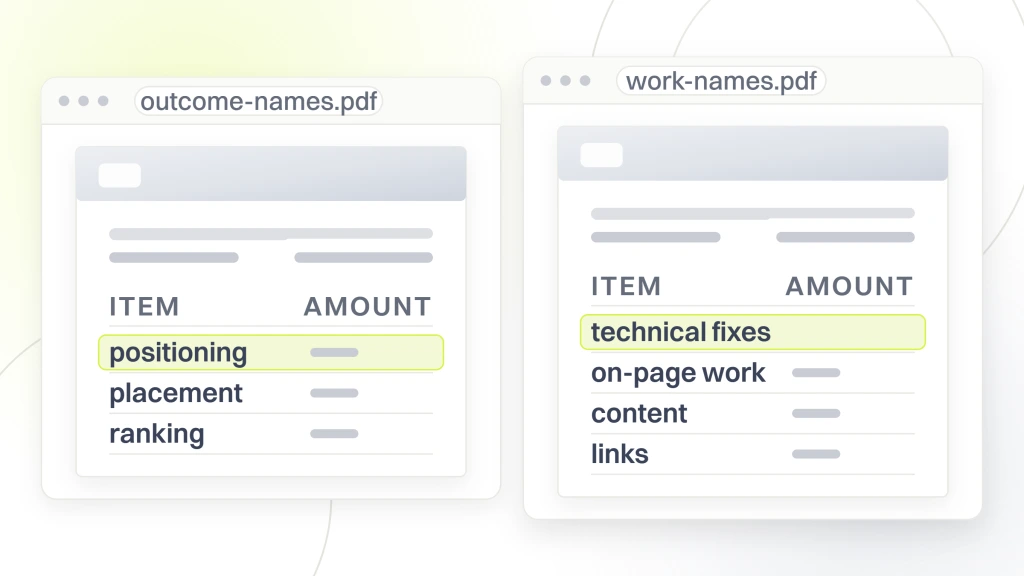
Some line items are named after work somebody does. Others are named after a result you hope arrives. A work name can be failed, because at the end of the month either the thing exists or it does not. An outcome name cannot be failed, because the provider never said when.
| Line item | Named after | What proves it happened |
|---|---|---|
| Technical audit | Work | A findings list with URLs and severities |
| Content development | Work | Pages that exist and did not before |
| Keyword research | Work | A map of one primary query per page |
| Search engine positioning | Outcome | Nothing, until an unnamed future date |
| Search engine placement | Outcome | Nothing, until an unnamed future date |
| Improved rankings | Outcome | Nothing, and it is not the provider’s to promise |
The rule that falls out of the table is not that outcome names are dishonest. Plenty of good providers use them because that is what the client asked for. The rule is that an outcome name has to be converted into a work name before it can appear on a contract, and if the provider will not do that conversion in front of you, the conversion is the thing you just learned.
What Google says an SEO does, and why the list is shorter than the menu
Go back to those four items, because the gap between Google’s list and a typical service menu is the most useful measurement in this whole purchase.
Review of content or structure. Technical advice on development, named as hosting, redirects and error pages. Content development. Keyword research. Four kinds of work, written by the party with no commercial interest in the menu being long.
Take a quote and map every line onto one of those four. Most will land. The ones that do not are worth a question each, and the question is the same every time, which of these four is it, or what is it instead. Some answers are perfectly good, because analytics work and conversion work are real and sit beside SEO rather than inside it. Other answers reveal that a single piece of work has been split across three lines so the menu reaches a length that justifies the number at the bottom.
This is also the fastest way to spot the reverse problem, a quote that is too short. If nothing on it maps to technical advice and nothing maps to content, you are buying reporting on work that nobody is doing.
The questions Google tells you to ask, and what the answers reveal
The same page carries a list of questions to put to a prospective provider. They are worth using verbatim, partly because they are sensible and partly because a provider’s reaction to being asked Google’s own questions is informative on its own.
- “Can you show me examples of your previous work and share some success stories?”
- “Do you follow the Google Search Essentials (previously known as Webmaster Guidelines)?”
- “What kind of results do you expect to see, and in what timeframe?”
- “What’s your experience in my industry?”
- “How long have you been in business?”
The third one is the one that does the work, because it forces a provider to attach a shape and a date to the outcome names on their own menu. An answer that names a metric and a window is a provider who has done this before. An answer that names a position is a provider telling you something nobody is in a position to tell you.
The second question sounds like a formality and is not. It converts a vague promise of good practice into a named public standard that either was or was not followed, which matters enormously if you ever need to unpick what somebody did to your site after they leave.
Why no line item can promise you a position
Every outcome name on the menu implies a promise, and there is a single published sentence that settles what any of them can actually commit to.
Google’s guidance for people hiring in this market states it in seven words. “No one can guarantee a #1 ranking on Google.” The same page tells readers to “Beware of SEOs that claim to guarantee rankings, allege a ‘special relationship’ with Google”.
That is the end of the argument about positioning and placement as products. Both names describe a destination, the only organization that controls arrival has said out loud that nobody can guarantee it, and a service cannot sell what it cannot commit to. What it can sell is the work that makes arrival more likely, which brings you back to the four items and to counting them.
Worth separating this from the question of who you hire. Whether the sign on the door says agency, firm, consultant or company is a different filter with its own failure modes, and our guide to choosing search engine optimization consultants takes the name of the supplier apart in the way this article takes apart the name of the work.
How to turn an outcome line into a work line
You do not need to reject a quote that uses outcome names. You need to convert it, and one question does the conversion.
Ask what will exist on the last day of the month that does not exist today. Not what will improve, what will exist. A findings list. Three rewritten pages. A keyword map. A redirect plan. A migration checklist. Artifacts have a count, an owner and a location, and every one of them survives the relationship ending, which is the real test of whether you bought anything.
Run that question down a menu and the lines sort themselves. Positioning produces no artifact and becomes, on inspection, some hours of on-page work and a report. Placement becomes links, which you then ask about specifically. Ranking becomes a tracker subscription. Audit produces a document. The menu shortens, the price stops being a mystery, and you can finally compare two quotes that were previously written in different languages.
The same conversion works on the broader website work that usually gets bought alongside this, where the naming is just as loose. Our guide to analyzing a website applies it to the build and speed side, where an outcome name hides an even larger range of possible scopes.
Buy the smallest scope that answers your question
There is an order to these purchases, and most people buy them backward because the largest one is what gets advertised.
The smallest scope that answers a real question is almost always the diagnosis. It is fixed price, it ends, it produces an artifact, and its output is the scope document for whatever you buy next. Buying the twelve month program first means agreeing to a plan written before anybody looked at the site, which is why so many of those plans turn out to be the same plan.
There is a real objection to this order, which is that a diagnosis you cannot act on is money spent on a document. That is true, and it is the one question to settle before you buy one. If nobody on your side can change the site this quarter, a findings list is a to-do list for a person who does not exist.
So the order has a condition attached. Diagnose first if you have hands available to act, and buy the hands and the diagnosis together if you do not. What almost never works is buying the hands first and letting whoever you hired decide, after the contract is signed, what the work should have been.
What we would check first
Put the quotes side by side and do one pass with a pen before anybody gets a call back.
Mark every line as work or outcome. Map every work line onto one of Google’s four. Write the artifact next to each one, and put a line through anything with no artifact and no count. What is left is the offer, and in most cases it is between a third and a half of the page you were sent, which tells you what the rest of the page was for.
Then ask the timeframe question in Google’s own words and write the answer down verbatim, because it is the sentence you will measure the engagement against in six months, and because providers remember having said it very differently than clients do.
If what you actually need is the diagnosis rather than the program, that is a smaller and more checkable thing to buy, and it is where we would start on an unfamiliar site. Our search engine optimization services page sets out the scopes and what each one hands back, in artifacts rather than in outcomes, which is the standard this whole article has been asking you to hold everybody else to.