
Published SEO services pricing sits between $499 a month at Third Marble Marketing’s Basic package and $9,200 a month at WebFX’s Diamond tier, and most quotes you will be shown land somewhere inside that. The figure on your proposal means nothing on its own. What makes it cheap or expensive is what it buys per counted unit, and where it places against numbers somebody has actually published.
You are probably holding one proposal and a browser tab full of ranges wide enough to swallow almost any quote. A range does not tell you whether to sign. What follows gives you four numbers you can produce yourself before you reply, a cost per published unit, the hourly rate your retainer implies, a placement against four published reference points, and the extra inquiries a month the fee has to win. If you are buying a build and search work together, our website design and SEO package is where the two sit side by side.
What SEO services pricing looks like when someone actually publishes it
Most SEO services pricing reaches you as a range, and the two largest ranges on the open web contradict each other without either page noticing.

Clutch puts the typical monthly fee for an SEO agency at $2,000 to $20,000. That guide is built from 65,550 listed SEO companies and the client reviews attached to them, the largest free dataset anybody publishes on this question.
Ahrefs went the other way and asked providers directly, polling 439 SEO service providers about what they charge. The most common monthly price point in that poll was $501 to $1,000, according to Ahrefs. Ahrefs puts the share of respondents naming that band at 20.4%.
Read both and you know less than when you started. Clutch’s floor sits above the band Ahrefs found most common, and neither page mentions the other. Neither is lying. They are counting two different populations, which is the entire explanation and it appears nowhere on either page.
So the useful thing here is not a number. It is that a published price only becomes legible when a published count sits next to it, and four vendors in this market publish both on one sheet.
The four pricing models you will be quoted on
When a provider sends you its SEO services and pricing sheet, the number arrives in one of four shapes, and the shape decides how much of it you can check.
A monthly retainer is the default. Collaborada puts monthly retainers at $1,000 to $5,000 and up. It is the hardest shape to grade, because nothing in the wording says how much work a month contains.
An hourly rate is the most checkable and the rarest to be offered. Nutshell puts hourly consulting at $100 to $300. Collaborada puts an expert consult at $250 to $400 an hour.
A fixed project is priced once for a scoped job. Collaborada puts a project-based engagement at $4,000 to $8,000. Nutshell puts project work at $5,000 to $30,000.
The fourth shape is per page, and almost nobody publishes one. Third Marble Marketing prices national work at $50 per page per month for 10 to 50 pages, dropping to $40 per page per month at 60 pages or more, after a setup month it publishes at $499. That is the only model here where the count is the price.
What a retainer should contain is a different question from what it costs, and our guide to picking an SEO service handles those components in full. From here on this article stays on the number.
SEO pricing packages, what the published tiers actually contain
SEO pricing packages are usually described rather than counted, which is how two sheets at the same price can contain wildly different amounts of work. A few vendors break that habit and publish numbers.
Four of them publish a price and a count on one page, so the last column below is arithmetic on their own two figures rather than a market estimate. Each division assigns the whole fee to a single unit, which makes it a ceiling on what that unit costs rather than an exact price. Two more vendors publish only half of the pair, and that half is the shape most proposals take.
| Vendor and tier | Published price | Published counts on the same sheet | Cost per unit, divided from that sheet |
|---|---|---|---|
| Third Marble Marketing, Basic | $499 a month | 6 low-authority links a quarter, no content | $83.17 a link |
| Third Marble Marketing, Enhanced | $1,299 a month | 3 medium and 18 low-authority links a quarter, 1,500 words a quarter | $61.86 a link |
| 1Digital Agency, Launch | $899 a month | 1 onsite blog, 1 offsite article | $449.50 a piece |
| 1Digital Agency, Premium | $4,499 a month | 3 onsite blogs, 2 long-form, 4 offsite articles | $499.89 a piece |
| SiteMile, Local | $699 a month | 3 backlinks, 5 keywords targeted | $233.00 a link |
| SiteMile, Professional | $1,499 a month | 10 backlinks, 30 keywords targeted | $149.90 a link |
| SiteMile, Enterprise | $1,999 a month | 15 backlinks, 50 keywords targeted | $133.27 a link |
| WebFX, Silver | $5,900 initial, then $2,900 a month | Up to 150 keyphrases, 30 pages optimized, 6 assets a quarter | $96.67 a page |
| WebFX, Diamond | $12,200 initial, then $9,200 a month | Up to 300 keyphrases, 60 pages optimized, 24 assets a quarter | $153.33 a page |
| OuterBox, Essentials | $2,000 a month | None published, categories only | Cannot be computed |
| Logical Position, Basic | Not published as page text | Up to 6 pages month one, then 2 long-form blogs and 2 offsite links a month | Cannot be computed |
Read down the last column rather than the second. Inside one vendor’s sheet that figure is the only number that survives the marketing. Across vendors it is not comparable at all, because one vendor’s unit is not another vendor’s unit.
The two rows with a gap in them are the finding. OuterBox publishes tier prices and lists contents by category with no numbers anywhere. Logical Position does the reverse, publishing a clean count ladder as page text while its tier prices sit inside an image.
Why SEO package prices spread so far across published sheets
SEO package prices vary by a factor most buyers assume is markup. On the published sheets it is mostly count.
At the bottom, Third Marble Marketing’s Basic package is $499 a month and buys 6 low-authority backlinks a quarter with no content at all. At the top, WebFX’s Diamond tier is $9,200 a month after a $12,200 two-month initial campaign investment, and buys up to 300 keyphrases and up to 60 pages optimized.
Three things move a price between those points. The first is how many units arrive. The second is the grade of the unit. Third Marble Marketing publishes three grades of backlink on one sheet, and only its Premier tier at $3,499 a month includes the top grade.
The third is who stands behind the price. In a pricing guide published in January 2023, Contractor Growth Network put agency monthly retainers at $2,500 to $10,000, consultants at $1,000 to $5,000 and freelancers at $500 to $2,000. Same market, near-identical proposal wording, three different cost bases.
What does not move the price visibly is quality, because no sheet publishes it. That is why the per-unit column matters. It is the only thing about a package you can check before you have paid for a month.
SEO agency pricing, what two large datasets say and why they disagree
SEO agency pricing has two public datasets behind it, and they answer the same question with numbers that refuse to sit together.
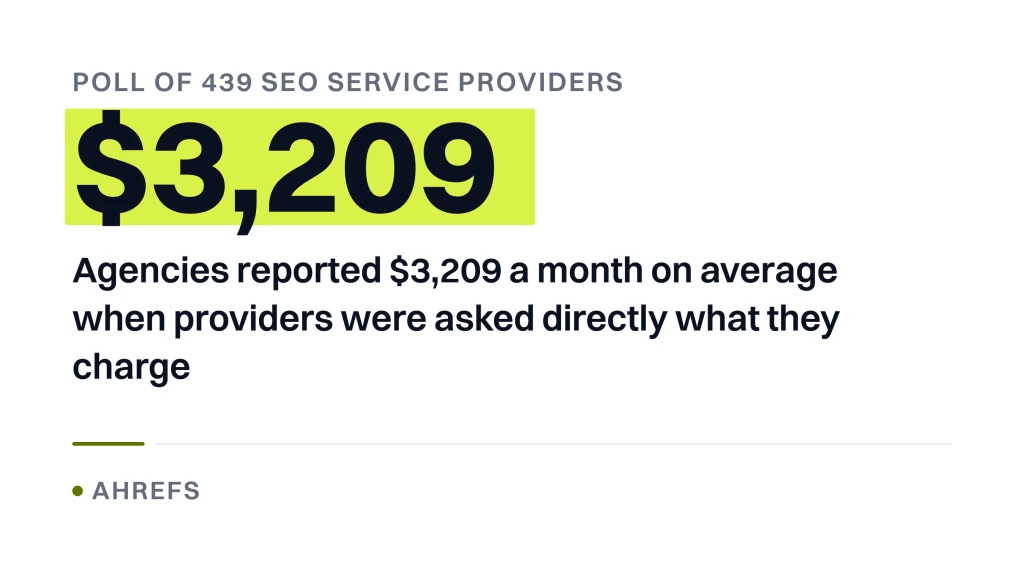
Ahrefs asked providers what they charge. Agencies reported $3,209 a month on average, according to Ahrefs. Freelancers reported $1,348.63 a month and consultants reported $3,250 a month, again per Ahrefs, with an overall average of $2,917 a month across everyone polled. Ahrefs also found that agencies charge 138% more than freelancers.
Clutch works from the other end, reading what clients actually paid. Clutch puts the typical agency monthly fee at $2,000 to $20,000, an average monthly cost of $3,199.19 and an average cost per project of $37,158.66.
The two averages, $3,209 from Ahrefs and $3,199.19 from Clutch, look like confirmation. They are not, and you should never blend them. Clutch’s number comes from firms that pay to be listed in a business directory and are then reviewed by clients with project budgets. Ahrefs’ number comes from providers describing themselves, freelancers included. Treat them as two rulers, not one reading taken twice.
One detail is worth stopping on. Ahrefs puts consultants above agencies, at $3,250 against $3,209, which is the reverse of what most buyers expect. If that surprises you, our guide to choosing an SEO consultant sets out what one person sells that a team does not. And if the open question is whether an agency is the right shape at all, our guide to picking an SEO agency is the one to read beside this page.
SEO monthly pricing, what thirty days buys at each published tier
SEO monthly pricing gets easier to read the moment you stop looking at the fee and start looking at what lands inside the month.
The published averages are a starting point. Ahrefs puts the average for local SEO at $1,557 a month. Nutshell puts local work at $500 to $2,500 a month and national work at $2,500 to $10,000 and up. Local budgets behave differently enough that what local SEO actually costs gets its own breakdown.
Averages still do not tell you what arrives in a monthly SEO service. Two vendors publish a count ladder that does.
| Vendor and tier | Published monthly price | Pages in month one | Ongoing each month after |
|---|---|---|---|
| 1Digital Agency, Launch | $899 | Up to 4 | 1 onsite blog, 1 offsite article |
| 1Digital Agency, Pro | $2,499 | Up to 10 | 1 onsite blog, 1 long-form, 3 offsite articles |
| 1Digital Agency, Plus | $3,299 | Up to 14 | 3 onsite blogs, 1 long-form, 3 offsite articles |
| 1Digital Agency, Premium | $4,499 | Up to 16 | 3 onsite blogs, 2 long-form, 4 offsite articles |
| Logical Position, Basic | Not published as text | Up to 6 | 2 long-form blogs, 2 offsite links |
| Logical Position, Standard | Not published as text | Up to 12 | 4 and 4 |
| Logical Position, Professional | Not published as text | Up to 18 | 6 and 6 |
Two things jump out. Month one is not a normal month on either ladder, because both front-load page work that never repeats. And on 1Digital Agency’s sheet, the climb from Launch at $899 a month to Premium at $4,499 a month buys more of the same two things.
So ask which month a monthly figure describes. The one worth pricing is the fourth, when setup is behind you and the recurring count is all that is left.
SEO plans and pricing, what actually changes as a tier steps up
SEO plans and pricing ladders look like volume discounts and mostly are not. Run the division on each rung and the direction of travel becomes visible.
WebFX publishes its Silver plan at $2,900 a month for up to 30 pages optimized, which is $96.67 a page on WebFX’s own two published figures. WebFX publishes its Diamond plan at $9,200 a month for up to 60 pages optimized, which is $153.33 a page from the same division on the same WebFX sheet. The page gets more expensive as you climb, not cheaper.
SiteMile runs the other way. SiteMile publishes its Local package at $699 a month for 3 backlinks, which is $233.00 a link. SiteMile publishes its Enterprise package at $1,999 a month for 15 backlinks, which is $133.27 a link. Same division, opposite slope.
Neither ladder is wrong. Each is telling you what the extra money is for. On the WebFX ladder the higher tiers also raise the keyphrase and asset counts, so the per-page figure alone does not describe the whole step.
Run this on whichever ladder you were shown, then ask what the step up genuinely adds. If the answer is more of the same unit at a higher unit price, you are buying capacity rather than a different kind of work. The same test works on build packages, which our guide to web design packages walks through tier by tier.
Fixed price SEO packages, when a set price protects you and when it hides the work
Fixed price SEO packages are sold as certainty, and they deliver it on exactly one side of the deal.
OuterBox publishes three of them. Essentials at $2,000 a month, Pro at $3,000 a month and Enterprise at $7,000 and up a month, billed month to month with no minimum contract, all per OuterBox. The prices are public, the terms are generous, and nowhere on that page is a number attached to what arrives.
That is not a complaint about OuterBox. It is the normal shape, and most proposals look exactly like it, a confident price against a list of categories.
A fixed price protects you when the count is fixed alongside it. Then the vendor carries the risk of a job running long. When the price is fixed and the scope is a paragraph, the risk moves to you, because the cheapest way to deliver an open scope is to deliver less of it.
Fixed one-time work behaves better, because the deliverable is a thing rather than a month. Nutshell puts fixed contract work at $1,500 to $25,000, a band wide enough that the same two words clearly cover several different products.
The workable version is the one Third Marble Marketing publishes, where $499 a month buys a stated 6 low-authority backlinks a quarter. You may not want that package. You can grade it in under a minute, which is more than most proposals allow.
Ecommerce SEO pricing, why a catalog costs more than a service site
Ecommerce SEO pricing sits above general pricing for one structural reason. A catalog multiplies URLs, and almost every unit a package counts is work performed on one URL.
Shopify puts ecommerce SEO at $2,000 to $10,000 a month and $150 to $500 an hour, above the general bands the same guides publish for everybody else. 1Digital Agency prices its ladder against catalog size and publishes custom tiers above 10,000 SKUs, the plainest admission on any of these sheets that URL count is the cost driver.
Now put that against your own store. 1Digital Agency’s Premium package is $4,499 a month and covers up to 16 pages of onsite work in month one. On a catalog running to thousands of product URLs, sixteen pages is a sample rather than a plan. That is the arithmetic every ecommerce buyer has to run and almost none of them do.
So on a catalog the question changes from how many pages a month to which pages. Work done once on a category or product template applies across many URLs at once, while a package counted in individual pages prices that identically to a one-off. Ask which counted pages are templates before you set two ecommerce quotes side by side.
How to work out the cost per unit on the proposal in front of you
This is the first of your four numbers and it takes about ten minutes. You need the fee and you need a count, and only one of those is printed on the document.
Rebuild the proposal as four columns. Copy every line item across exactly as written, then fill in the rest.
| Column | What goes in it | What a blank tells you |
|---|---|---|
| Line item | The wording from the proposal, unchanged | Nothing, this column is only the index |
| Unit | What the line would be counted in, if anybody counted it | No possible unit means a category heading, not work |
| Count for the month | The number the provider will commit to in writing | A blank here is the finding, not a formatting problem |
| Who performs it | A named role, and whether it is in house | You cannot price the hour behind the line |
Send the grid back and ask for the middle two columns. Much of what returns will still be blank, and that is a result rather than a delay.
Then divide. Say the proposal on your desk reads $1,800 a month. The provider comes back with six counted units for the month, four optimized pages and two published articles. Your own fee divided by your own count is $300 a unit.
Now you have something to set it against. SiteMile’s Professional package is $1,499 a month for 10 backlinks, which is $149.90 a link. Third Marble Marketing’s Enhanced package is $1,299 a month for 3 medium and 18 low-authority backlinks a quarter, which is $61.86 across those 21 links.
Those units are not interchangeable, which is the point. You are testing whether your own cost per unit buys something a published sheet charges a similar amount for, or a category heading with a price stapled to it.
How to work out the hourly rate your retainer implies
This is your second number and it is the one providers resist hardest. Ask how many hours the retainer contains, then divide the fee by the hours.
On that $1,800 a month proposal, if the answer is twelve hours, your implied rate is $150 an hour. If the answer is thirty hours, it is $60 an hour. Those are two entirely different businesses selling you the same looking document.
Now place the result. Six published rates give you something usable, because unlike the monthly bands they all describe the same unit.
| What the rate covers | Published rate | Who published it |
|---|---|---|
| Average across surveyed providers | $111 an hour | Ahrefs |
| Agencies based in the United States | $100 to $149 an hour | Clutch |
| Hourly consulting | $100 to $300 an hour | Nutshell |
| Out-of-scope work on its own packages | $185 an hour | 1Digital Agency |
| Expert consult | $250 to $400 an hour | Collaborada |
| Freelancers and consultants | $75 to $200 an hour | SEO.com |
An implied rate near the middle of that table is unremarkable. An implied rate of $40 an hour on your own division is not a bargain, it is information. Clutch publishes hourly bands under $25 an hour inside its own data, so somebody is buying that time somewhere cheaper.
None of this works if you cannot get an hour count, and plenty of providers will not give you one. Treat the refusal as a result. A provider who cannot say how many hours your money buys has not built the price up from the work.
If your shortlist is individuals rather than firms, the hour count is easier to get, which our guide to hiring search engine optimization consultants covers in detail.
How many extra inquiries a month your fee has to produce
This is the number that decides whether the previous three matter, and every input belongs to you rather than to any source on this page.
Take the monthly fee. Divide it by your average order value multiplied by your close rate. The result is the extra inquiries a month the work has to produce before it has paid for itself.
Worked through with roles rather than names. The owner of a service business has that $1,800 a month proposal on the desk. Average order value is $2,400 and the sales lead closes one inquiry in four. That puts an inquiry at $600 before costs. Divide the fee by that and the breakeven is three extra inquiries a month, every month.
Three is a number you can hold in your head during a sales call. Forty ends the conversation. Most owners never run this, which is why the fee gets argued over instead of the target.
Two refinements make it honest. Use gross profit rather than revenue inside the order value, because the fee comes out of margin and not out of turnover. And give the number a horizon, because nothing lands in month one.
Then track the leading indicator rather than the revenue, which arrives too late to steer anything. Our explanation of how SEO visibility is measured covers what moves before inquiries do.
What contract length and setup fees do to the price you were quoted
The monthly figure on a proposal is rarely the amount you are committing, and the difference lives in two places nobody reads.
Setup first. WebFX publishes a two-month initial campaign investment before the monthly rate on every tier, $5,900 on Silver and $12,200 on Diamond. 1Digital Agency publishes no setup fees at all. Third Marble Marketing says a one-time setup fee exists and does not publish the amount, which is worth asking about before you compare its monthly against anybody else’s.
Then the term. Logical Position publishes contract lengths of 6, 12 and 18 months, with a 5% discount at 12 months and a 10% discount at 18. 1Digital Agency publishes a six-month initial term and then month to month. Third Marble Marketing states that no long-term contracts are required, and SiteMile states no long lock-ins and cancel anytime.
A discount for a longer term is only a discount if the shorter term exists at the undiscounted price. Ask for both numbers. If the month-to-month price does not exist, the discount was the price.
Length on its own is not a warning. Clutch reports a typical engagement timeline of 12 months drawn from client testimonials.
One-time work lets you buy a diagnosis without buying a term. Shopify puts a one-time technical audit at $2,500 to $15,000 and a full website audit at $5,000 to $30,000. Nutshell puts a link profile or content audit at $500 to $7,500. What separates a useful one from an expensive PDF is set out in our guide to how to conduct a website audit, which covers writing findings somebody can actually act on.
What the cheapest packages leave out
Cheap packages are honest about their price and quiet about their ceiling, and on the published sheets you can see exactly where that ceiling sits.
Third Marble Marketing’s Basic package is $499 a month and includes 6 low-authority backlinks a quarter and no content at all. SiteMile’s Local package is $699 a month and targets 5 keywords. Neither vendor is hiding anything. Both are telling you in numbers that what you are buying is a maintenance product rather than a growth one.
The reason a low price can only reach so far is the cost of the input. Digital Elevator, citing Editorial.link, puts the average link price at around $509, with a real-world range of $150 to $2,000 and up per link. A whole month of the cheapest published package above costs less than one average link at that rate.
The other lever is where the hours come from. Collaborada puts overseas hiring at $5 to $10 an hour and marketplace freelancers at $20 to $50 an hour, and Clutch’s cheapest published hourly bands sit under $25 an hour. A cheap retainer is not magic, it is a different labor cost.
Verticals move the floor too. KickCharge, writing specifically about home services work such as plumbing and HVAC, puts basic local campaigns at $1,000 to $7,000 a month, a higher floor than the general guides publish. In a guide published in January 2023, Contractor Growth Network put the low end of the whole market at $50 a month, so the bottom has no floor at all.
If your budget sits at the bottom, buy less work and finish it. One counted thing delivered fully beats five categories delivered partly.
What we would do first with two quotes on your desk
We would not read either document front to back. We would run four divisions and send one email, in that order.
Rebuild both proposals as the four columns, send the identical grid to both providers on the same morning, and give them a deadline. While you wait, run the band placement, because that one needs only the fee. A quote at $1,800 a month sits above the $501 to $1,000 band Ahrefs found most common. It sits inside the wider band Ahrefs says most respondents occupy, which Ahrefs puts at $500 to $5,000. It sits below the $2,000 floor Clutch publishes for agency retainers, and below the $3,209 agency average Ahrefs reports. Four published reference points, one answer. It is a mid-market price that has not reached agency rates, which means the counts had better be real.
Then we would grade the replies rather than the proposals. The provider who fills in the count column has told you what your money buys. The one who explains why counts are reductive has told you something too, and it took a day instead of six months.
Do the divisions before you reply to anybody. Cost per unit, implied hourly rate, band placement, breakeven inquiries. Four numbers, one afternoon, and you will know more about both quotes than either sales call managed to tell you. If you would rather see how the work is shaped before grading somebody else’s version of it, our SEO services page sets out the shape of the work.