
Search Engine Optimization Services Pricing in Plain Numbers
- Local SEO retainers run $500 to $1,500 per month.
- Small business SEO retainers run $1,500 to $4,000 per month.
- Mid-market SEO retainers run $4,000 to $10,000 per month.
- Payback lands at 6 to 14 months for small businesses.
- Never sign guaranteed-ranking or 24-month lock-in contracts.
- Search engine optimization services pricing at a glance
- What actually drives search engine optimization services cost
- How search engine optimization service plans get structured
- Cost of search engine optimization services versus alternatives
- How to read a search engine optimization services proposal
- A real search engine optimization services pricing example
- The hidden costs of search engine optimization services
- Search engine optimization services prices by industry
- Search engine optimization services pricing red flags
- Negotiating search engine optimization services pricing
- Wrapping the pricing question
Search engine optimization services pricing sits on a wide range, and every vendor quotes it differently. Solo consultants charge $75 an hour. Boutique firms charge $2,500 a month. Enterprise agencies charge $18,000 a month. All three might use the same words on their proposal PDF. You need to know what the numbers really buy before you sign anything. This guide walks you through the exact math, tier by tier, so the next call you take feels like a conversation, not a menu you cannot decode.
You will get the retainer bands, the project fees, the hourly rates, the hidden costs the pitch decks skip, and the honest math on when SEO is worth it versus when you are better off running ads. Read straight through in about ten minutes. You will leave with a number in mind before your next agency call, which is the whole point. Bring the number to the call. Let the vendor react to it, not lead the pricing conversation with a menu they made yesterday.

Search engine optimization services pricing at a glance
Search engine optimization services pricing in 2026 falls into four honest bands. Local solo work runs $500 to $1,500 per month. Small business retainers run $1,500 to $4,000 per month. Mid-market retainers run $4,000 to $10,000 per month. Enterprise retainers run $10,000 to $30,000 per month. Anything cheaper is skimming.
The number that fits you comes from three inputs. How competitive is your market. How many pages does the site need. How big is the link and content budget you can sustain. A dental practice in a suburb of Cincinnati is not the same job as a national HVAC chain, and the pricing should not be either. If a vendor quotes you the same number they quoted the last three prospects, they are quoting on a menu, not on your job.
The $500 to $1,500 local band
This band buys you Google Business Profile management, a handful of local citations cleaned or built each month, a few on-page tweaks, and one blog post. You are not getting deep technical work or serious link building at this price. For a solo practitioner or a one-location small business in a non-competitive market, that can still move the map pack in 8 to 16 weeks. Below $500 usually means an offshore VA running through a citation checklist with no strategy behind it.
The $1,500 to $4,000 small business band
This is where most small business search engine optimization services sit. You get 2 to 4 blog posts a month, real on-page work across the money pages, monthly Google Business Profile posts, some link outreach, and a rankings dashboard that a human actually reviews. This band matches what you need for a two-location dental practice, a regional HVAC contractor, or a boutique ecommerce brand with 200 to 2,000 SKUs. Berks Plumbing sits in this band and their organic users climbed 75 percent while cost per lead fell 67 percent over the run. For niche verticals with heavier local intent, our Home Services SEO Built for Local Map Pack Dominance spells out how the retainer time gets split across map pack, service pages, and reviews.
What actually drives search engine optimization services cost
Search engine optimization services cost comes from three levers. Content depth, link acquisition, and technical scope. Everything else on a proposal is either wrapped inside one of those three or it is filler. Understand the three levers and you can read any SEO proposal in five minutes.
The three levers do not carry equal weight in every market. A local plumber wins on Google Business Profile, reviews, and a clean service-area page structure. A national SaaS competes on 400-page topical clusters and links from developer publications. A single-location med spa needs on-page schema, treatment pages that map to searcher intent, and about 25 to 40 fresh reviews per quarter. The retainer number reflects which lever you need to push hardest, not a generic package.
Content depth and cadence
Content is the biggest line item in most retainers. One 2,500-word blog post written by a strategist who understands the topic runs $600 to $1,200 all in, once you count research, drafting, editing, image work, and internal linking. If a vendor promises 8 posts a month for $1,200 total, someone is either writing at a scale that is not readable or you are getting AI copy with a light polish. Neither ranks in 2026. The Google Search Central spam policies updates made low-value AI content a demotion signal.
Link acquisition budget
Real editorial links from real publications run $250 to $2,000 each depending on domain rating. A well-run outreach campaign that lands 4 to 8 quality links per month lives inside a $2,000 to $6,000 per month slot. Below that, you are getting guest posts on low-traffic blogs or PBN links that either do nothing or actively hurt you. Ask the vendor for the last five domains they placed links on. If they will not share, they are hiding low quality.
How search engine optimization service plans get structured
Search engine optimization service plans come in four common shapes. Monthly retainer. Fixed-fee project. Hourly consulting. Performance-based. Each has a place and each has a trap. The retainer is the default because SEO is a compounding job that needs continuous attention.
Retainers work because search rankings do not respond to a one-time push. You need consistent content, consistent link work, and a human watching the analytics for algorithm shifts. Project work has a place for one-off audits and migrations. Hourly consulting fits when your in-house team runs the work and needs a strategist to point at problems. Performance-based pricing sounds appealing until you read the fine print on how performance is measured, which is where the pitch usually breaks down.
| Model | Typical range | Best for |
|---|---|---|
| Monthly retainer | $500 to $30,000 per month | Ongoing growth work, most businesses |
| Fixed-fee audit | $1,500 to $12,000 one-time | Diagnostic before signing a retainer |
| Fixed-fee migration | $4,000 to $25,000 one-time | Domain change or platform replatform |
| Hourly consulting | $150 to $450 per hour | In-house team needs a strategist |
| Performance-based | Percent of revenue or per-lead | Rare, high risk of vendor-side gaming |
Retainer detail
A monthly retainer buys a defined scope of hours per month, spread across strategy, content, technical, and link work. A $2,500 per month retainer typically translates to 15 to 20 hours of skilled work on your account. A $10,000 per month retainer buys 60 to 80 hours. Ask for the hour breakdown by function. If the vendor cannot show you where the time goes, they are running a template package, not a strategy engagement. Real retainers publish a monthly report showing what was done, what moved, and what is next.
Project fee detail
A fixed-fee project is the right shape for a specific deliverable. A technical audit runs $1,500 to $6,000 depending on site size. A content strategy for a new site runs $3,000 to $9,000. A full site migration off Wix onto WordPress runs $8,000 to $25,000 and takes 4 to 10 weeks. Fixed fees give you a defined outcome and a defined date. They are not the right shape for ongoing rankings work because rankings work compounds and never really finishes.
Pick a monthly retainer number before the SEO pitch. Say it out loud on discovery. Watch how the vendor reacts. That tells you more than their menu.
Cost of search engine optimization services versus alternatives
Cost of search engine optimization services makes sense only in context. Compared to Google Ads, SEO is cheaper per lead over 12 to 24 months but slower to start. Compared to hiring in-house, SEO is faster to spin up but harder to build institutional memory around. Compared to buying leads from a broker, SEO is far cheaper long-term and does not stop the day you pause payment.
The honest math looks like this. A $3,000 per month SEO retainer over 24 months costs $72,000 total and typically returns 8 to 20 times that in generated pipeline for a mature small business. The same $72,000 spent on Google Ads generates leads immediately but stops the day the budget runs out. A $72,000 in-house SEO hire covers salary only, not tooling or content production. A $72,000 lead-broker spend at $250 per lead buys about 288 leads, versus the 600 to 1,400 an SEO retainer typically produces in the same window.
- SEO retainer, $3,000 monthly: 8 to 20 times return over 24 months in a mature account
- Google Ads, same $3,000 monthly: immediate leads, stops when budget stops
- In-house SEO hire at $72,000 salary: covers labor only, no tooling or links
- Lead broker at $250 per lead: capped at about 288 leads for the same total spend
- DIY blogging with no strategy: cheap in cash, expensive in owner time and lost 18 months
- PBN or link-farm packages under $500 monthly: risk of manual action outweighs any short-term gain
SEO versus PPC on cost per lead
Cost per lead is the honest yardstick. In healthcare, PPC lead costs sit around $80 to $220 depending on specialty. SEO lead costs, once the retainer amortizes over 24 months of continuous traffic, land at $12 to $45 for the same specialty. That gap is why the smart move is to run PPC on day one for immediate leads and SEO for the 24-month curve underneath it. Berks Plumbing did exactly that split and cut cost per lead by 67 percent while ad conversions climbed 99 percent.
Payback window
A well-run SEO retainer pays for itself in 6 to 14 months for a small business, 10 to 18 months for a mid-market operation, and 12 to 24 months for enterprise. Payback timing depends on the starting authority of the domain, the current index status, and how competitive the keywords are. A 5-year-old site with clean history and 40 existing pages moves faster than a brand new domain with no backlinks. Ask the vendor what payback window they project and what they will do if the numbers slip.
How to read a search engine optimization services proposal
Every SEO proposal you receive should list the same six things. Scope of monthly work, deliverables schedule, reporting cadence, KPI targets, tooling included, and exit terms. If any one of the six is vague, the price is not fixed. It is a floor that will get raised the moment you sign.
The two most common tricks in bad SEO proposals are undefined scope and blended hours. Undefined scope means the proposal lists activities without quantities. Blended hours means the proposal quotes total hours without saying who does them. A blended proposal that says 40 hours per month at a blended rate might actually be 35 hours of VA work and 5 hours of strategist time. Ask for the breakdown by role, and ask what the strategist rate is versus the VA rate. A lead strategist rate should sit between $180 and $300 per hour in the US market.
Deliverables schedule
A proper deliverables schedule tells you what shows up in months 1, 2, 3, and 6. Month 1 is usually a technical audit, keyword research, and content plan. Month 2 is usually 2 to 4 pieces of new content, on-page fixes, and initial link outreach. Month 3 starts to show ranking movement on long-tail keywords. Month 6 is where you evaluate whether the vendor keeps the retainer. Ask for month-by-month expectations in writing, not a vague quarterly narrative.
Exit terms and content ownership
You should own everything the vendor produces. Blog posts, landing pages, technical documentation, backlink data. Some agencies build a habit of licensing content back to the client, which becomes a problem when you leave. Read the exit terms before you sign. A fair contract typically requires 30 to 60 days notice on retainer end and hands back all assets in editable form. Anything longer than 90 days notice or anything that restricts asset transfer is a caution sign. Our Search Engine Optimization Services spells the exit terms out on the contract page.
A real search engine optimization services pricing example
Boland Injury Lawyers came to us with a $2,500 per month budget and a stagnant local-search footprint in Los Angeles, one of the most competitive personal injury markets in the country. They wanted better organic visibility and more consultation requests without a bigger paid budget.
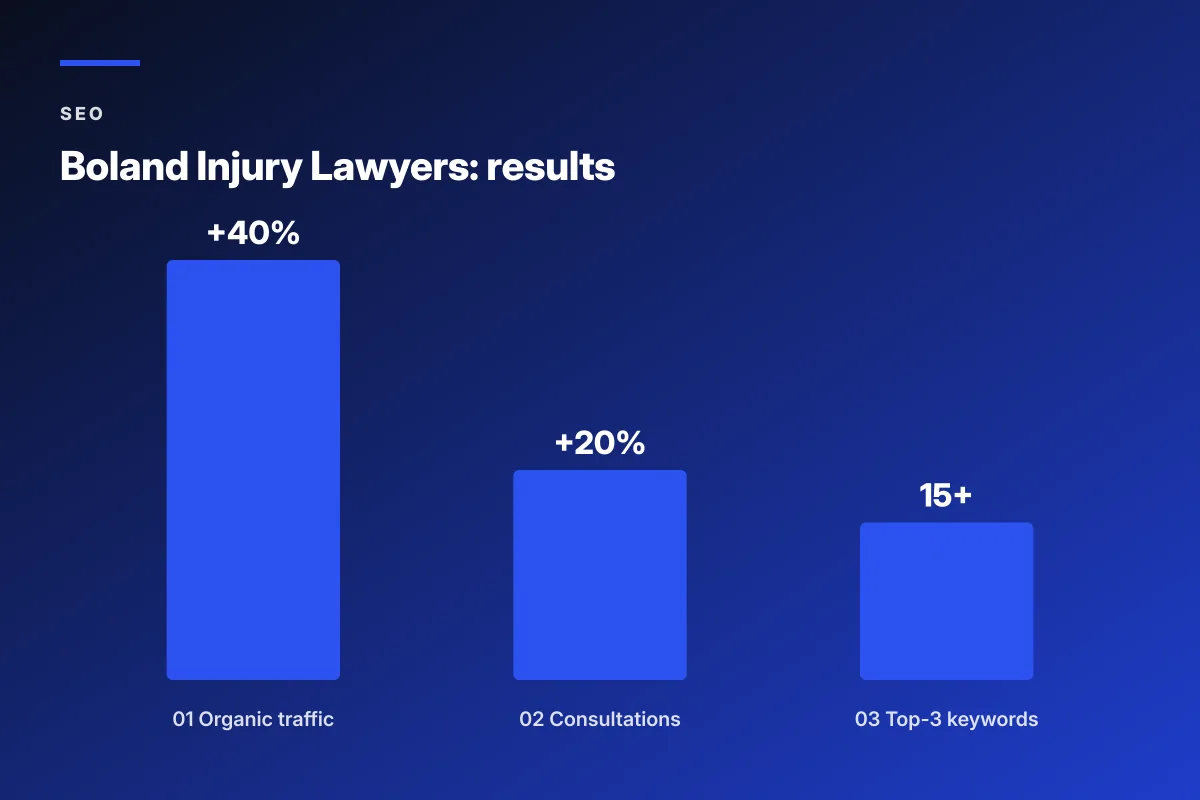
We put the $2,500 into a mix of technical fixes, 3 pieces of long-form content per month, on-page schema work across the practice-area pages, and a focused link campaign on 4 to 6 legal publications per month. Six months in, organic traffic climbed 40 percent, consultations climbed 20 percent, and 15 non-brand keywords reached the top three positions. Cost per consultation from organic worked out under $95, which is a fraction of the paid-search equivalent in personal injury. The 15-page cluster we built continues to compound.
What the budget actually bought
The $2,500 per month broke down to about $900 for content, $650 for link work, $500 for technical and on-page, $300 for reporting and strategy, and $150 for tooling. Every hour tracked to a specific function. Nothing hid behind blended rates. The client got a monthly report that showed exactly which posts were written, which pages moved, and which keywords ranked. When you see a proposal at $2,500, ask for this same breakdown. If the vendor cannot produce it, the number is arbitrary.
The scaling decision at month 6
At month 6, Boland faced a decision. Keep the retainer flat and grow slowly, or step up to $4,500 per month to accelerate content and link volume. They chose to step up because the payback math already justified it. That is the honest way SEO scales. Start at a number that fits your risk tolerance, prove the math, then decide whether to accelerate. Vendors that push you into a bigger retainer on day one without evidence are guessing.
Every year some marketer on LinkedIn posts a screenshot of an agency proposal that quotes $497 per month for search engine optimization services, followed by three fire emojis. The screenshot always leaves out the fine print, which usually reveals the deliverable is one AI-generated blog post and a citation to a directory nobody has visited since 2011. The comments section then argues about SEO being dead for four days, and the cycle repeats every quarter.
The hidden costs of search engine optimization services
Search engine optimization services pricing on the proposal is rarely the total cost. Tooling, hosting upgrades, image work, and content approval time all sit outside the retainer in most contracts. Add 10 to 25 percent on top of the retainer for a fair total-cost estimate.
The most common hidden cost is your own time. A retainer that runs well needs 2 to 5 hours per week of client time for approvals, interviews, and quick decisions. If your team cannot commit that time, the retainer stalls and the vendor cannot do their job. This is a bigger reason for retainer failure than any budget issue. Ask yourself whether you have someone on the team who can own the client-side relationship, and if not, budget for a marketing coordinator to sit between you and the agency.
Tooling costs
Most agencies bundle tooling into the retainer, but ask specifically. If they use Ahrefs, Semrush, Screaming Frog, and Surfer, those tools cost the agency roughly $650 per month per active account. Some agencies pass through the tool cost on top of the retainer. Others eat it. Neither is wrong, but you need to know before the first invoice arrives. Also ask whether you get read-only access to the tools during the engagement. You should, because visibility into rankings and backlinks is not a favor.
Content approval time cost
Content approval eats more time than most clients estimate. A 2,500-word blog post that requires two rounds of stakeholder review adds 3 to 5 hours of internal time per piece. Multiply that by 4 posts a month and you are spending 12 to 20 hours per month reviewing content. Delegate approval to one person if you can. Committee approval kills SEO velocity, and slower velocity means slower rankings, which means the retainer looks worse than it should. Refer to the Search Engine Land SEO coverage for how content velocity affects timelines. Deeper background on quality signals lives on the Moz Beginners Guide to SEO.
Search engine optimization services prices by industry
Search engine optimization services prices vary by industry because the underlying job varies. Legal and finance run higher because keyword competition is fierce. Home services run lower because local intent is cleaner. Ecommerce runs mid-band with a catalog surcharge for large SKU counts. Healthcare runs high because HIPAA-compliant content and schema push scope up.
The table below shows honest 2026 monthly retainer bands by industry for a small-to-mid business. Enterprise pricing runs 2 to 4 times these numbers. Numbers are US and Canada. UK and Australia run 15 to 25 percent higher due to labor costs and content standards.
| Industry | Small business retainer | Mid-market retainer |
|---|---|---|
| Legal | $2,500 to $5,500 | $6,000 to $14,000 |
| Healthcare and dental | $2,000 to $4,500 | $5,000 to $12,000 |
| Home services | $1,200 to $3,500 | $4,000 to $9,000 |
| Ecommerce | $2,000 to $5,000 | $5,500 to $15,000 |
| SaaS and B2B | $3,500 to $7,000 | $8,000 to $18,000 |
| Real estate | $1,500 to $3,500 | $4,000 to $9,000 |
Legal industry pricing detail
Legal SEO runs higher because a single top-three ranking on personal injury or DUI in a metro can be worth $40,000 to $200,000 per year in cases. Firms fight for those rankings with $10,000 to $25,000 monthly retainers, and the content demands are heavier because Google applies stricter YMYL scrutiny. Expect content that reads like a real attorney wrote it, backed by citations, jurisdiction detail, and author schema tied to a real bar-admitted lawyer. Anything less gets demoted.
Healthcare pricing detail
Healthcare SEO carries the same YMYL treatment. Content needs a licensed practitioner to review it, schema needs Physician or Medical Business types, and the site needs HIPAA-compliant forms if any patient data ever touches the browser. Dental and med-spa retainers land at the lower end of this band. Multi-specialty medical groups and hospitals land at the higher end. Our Healthcare SEO Agency for Patient Growth lays out the retainer scope by specialty.
Search engine optimization services pricing red flags
Pricing red flags fall into four buckets. Guaranteed rankings, opaque scope, hourly rates that look too round, and long lock-in contracts. Any one of them alone is not disqualifying. All four in the same proposal is a hard pass.
Guaranteed rankings are the biggest red flag. No SEO agency can guarantee a ranking because search algorithms are outside anyone’s control. What a good agency can guarantee is process, deliverables, and reporting. Anyone promising you position one on your primary keyword in 90 days is either lying or planning to game the search index in ways that will get you deindexed. Neither ends well.
- Guaranteed rankings on specific keywords
- Vague deliverables that use verbs like optimize and improve without quantities
- Hourly rates that are suspiciously round like $75 or $100 across all roles
- Contract lock-ins of 12 or 24 months with punitive exit fees
- No named strategist, only a nameless team behind an account manager
- Backlink packages of 50-plus links per month for under $500 total
- No monthly report, only a quarterly slide deck
Contract lock-in language
SEO retainer contracts of 6 months are reasonable because the work compounds and the first 3 months are largely setup. Contracts of 12 months are pushing it and should come with defined milestones you can trigger an exit on if the vendor misses. Contracts of 24 months with no exit clause are indefensible in a service where the algorithm can change three times a year. Read the termination clause carefully, and negotiate a 90-day performance review with the right to exit if agreed KPIs slip. Any reputable vendor will accept that clause.
Opaque scope language
Watch for words like ongoing, full-service, dedicated, and full-service without any quantities behind them. A proposal that says ongoing content creation means nothing. A proposal that says 3 pieces of 2,000-plus word content per month, drafted by a named writer, edited by a named strategist, and published to the site by the 15th of each month, means something. Push every soft phrase toward a hard number before you sign. If the vendor pushes back, they either cannot commit to the number or they are hiding a smaller scope than the retainer implies.
Negotiating search engine optimization services pricing
SEO pricing has room to negotiate on scope, not on rate. Agencies rarely cut their hourly rate because the rate reflects labor cost. What they will negotiate is the mix of activities inside the retainer, the reporting cadence, and the tooling access.
The best negotiation you can run is a scope trade. If you can commit internal time to writing first drafts or interviewing subject matter experts, ask for a lower content line item and more link work instead. If you already have a strong technical foundation, ask for the technical hours to shift to content. Trade scope, not rate, and you will get a better package for the same retainer. Our internal teams do this trade with about 40 percent of new retainer clients in the first 60 days.
Payment terms negotiation
Ask about net-30 versus net-15 payment terms. Some agencies offer a 3 to 5 percent discount for annual prepay, which can be meaningful on a $60,000 annual retainer. Others prefer monthly ACH and will not discount. Ask, and be direct about the number you are trying to hit. Also ask whether the agency accepts credit card at par or passes through the 3 percent fee. Small line items add up on a two-year engagement, and they are worth clarifying in the first month.
Scope trades that actually work
The scope trades that work best are content-for-links, technical-for-content, and reporting-for-hours. If your team can produce quality first drafts, the agency can spend those hours on link outreach or technical work instead. If your dev team has already handled the technical baseline, those hours shift into content or promotion. If you can accept a monthly report instead of a weekly one, the saved hours go into direct work. Trade thoughtfully and you get more value from the same retainer number.
Wrapping the pricing question
Search engine optimization services pricing is not a mystery once you know the bands, the levers, and the traps. A local practice sits in $500 to $1,500. A small business sits in $1,500 to $4,000. A mid-market operation sits in $4,000 to $10,000. Enterprise sits in $10,000 to $30,000. The number that fits you depends on your market, your site, and the budget you can sustain. Anything cheaper is skimming, and anything wildly more expensive without a clear reason is likely padded.
If you are evaluating a proposal right now, use the six-item checklist. Scope, deliverables, reporting, KPIs, tooling, exit. Push every soft phrase to a hard number. Ask for the last three client engagements at your retainer size. Talk to two of those references. Read the exit clause. If the vendor passes all of that, the price is fair enough to sign. You can find our pricing on our Search Engine Optimization Services, along with the retainer tiers and what each one buys.
Frequently asked questions
What is a fair search engine optimization services pricing range for a small business?
A fair small business SEO retainer runs $1,500 to $4,000 per month in the US and Canada market in 2026. That range buys you 2 to 4 pieces of long-form content per month, real on-page work across the money pages, monthly Google Business Profile posts, a defined link outreach budget, and a rankings dashboard a human strategist actually reviews. Below $1,500 you typically get citation checklists and template blog posts that do not move rankings in competitive markets. Above $4,000 you are usually paying for either faster velocity, deeper content quality, or a larger link budget. The right number depends on how competitive your local or niche market is and how many pages the site needs.
How much does search engine optimization services cost for enterprise clients?
Enterprise SEO retainers run $10,000 to $30,000 per month, and complex platforms with global footprints can push higher. The retainer scale reflects the scope of a typical enterprise engagement: hundreds to thousands of pages requiring technical audits, international hreflang implementations, editorial content strategies across multiple product lines, and dedicated link acquisition campaigns targeting Tier-1 publications. Enterprise engagements also include dedicated lead strategist time, quarterly executive reviews, and integration with in-house content teams. Payback windows sit at 12 to 24 months, which is longer than small business SEO, but the absolute revenue impact is proportionally larger. Enterprise buyers should expect a formal RFP process and detailed statements of work rather than a one-page proposal.
Are search engine optimization service plans priced monthly or as one-time projects?
Most search engine optimization service plans are monthly retainers because SEO is a compounding job that needs continuous attention. Retainer pricing sits at $500 to $30,000 per month depending on scope. One-time project pricing does exist for specific deliverables. Technical audits run $1,500 to $12,000. Site migrations run $4,000 to $25,000. Content strategy engagements run $3,000 to $9,000. Hourly consulting for in-house teams runs $150 to $450 per hour. Performance-based pricing tied to rankings or revenue exists in the market but is uncommon because the incentives are hard to align cleanly. Most buyers should default to a monthly retainer with a clear exit clause after 90 days.
Why does cost of search engine optimization services vary so widely between vendors?
Cost varies because SEO scope varies. Two vendors quoting the same retainer number can deliver very different work. One might spend the retainer on template blog posts and low-value citations. Another might spend the retainer on strategist-written content, real editorial link outreach, and monthly technical audits. The way to compare vendors is to compare scope, not price. Ask each vendor for the exact hour breakdown by role and function. A lead strategist rate should sit at $180 to $300 per hour in the US. A content writer with SEO experience should sit at $80 to $150 per hour. If a vendor cannot show you the breakdown, the price is arbitrary and the comparison is meaningless.
How long before search engine optimization services pricing pays back?
Payback windows vary by market and starting position. Small business SEO retainers typically pay back in 6 to 14 months on a well-run account. Mid-market retainers pay back in 10 to 18 months. Enterprise SEO pays back in 12 to 24 months. Payback depends on domain authority at the start, the current index status, keyword competition, and the size of the retainer. A domain that already ranks for 200 keywords will move faster than a fresh domain with no backlinks. Ask any vendor what payback window they project and what they will do if the numbers slip past that window. Reasonable vendors will accept a 90-day performance review clause tied to specific KPIs.
What hidden costs come with search engine optimization service plans?
The proposal price is rarely the total cost. Common hidden or additional costs include tooling pass-throughs at $200 to $650 per month if not bundled, hosting or CDN upgrades of $50 to $500 per month for larger sites, image sourcing at $30 to $100 per piece of content, translation costs for multilingual sites, and internal time for content approval and stakeholder review. The biggest hidden cost is your own team's time. A retainer that runs well needs 2 to 5 hours per week of client-side time for approvals, subject-matter interviews, and quick decisions. If your team cannot commit that time, the retainer stalls. Budget 10 to 25 percent on top of the quoted retainer for a fair total-cost estimate.
Is cheap search engine optimization services pricing ever worth it?
Cheap SEO under $500 per month rarely produces results in competitive markets. What you can get for that price is a citation checklist, a directory submission service, or an AI-generated blog on autopilot. None of those move rankings in 2026 because Google's spam updates devalue thin content and low-quality directories. Cheap SEO can work in very specific edge cases. A hyperlocal service business in a non-competitive rural market might see gains from cleaned Google Business Profile management and a handful of citations. A brand-new domain in a niche with almost no competition might rank on light effort. Outside those edges, cheap SEO usually costs more in wasted time than in actual retainer dollars, because it delays real progress by 12 to 18 months.
Book your free 30-minute strategy call.
No spam, no sales rep. We use your email to schedule your call with a senior strategist. That is it.
More from the blog
View all articles → SEO
SEO Organic Search Engine Optimization Services That Grow Real Traffic
Read article SEO
SEO SEO for Pet Groomers That Fills the Appointment Book Weekly
Read article SEO
SEO