
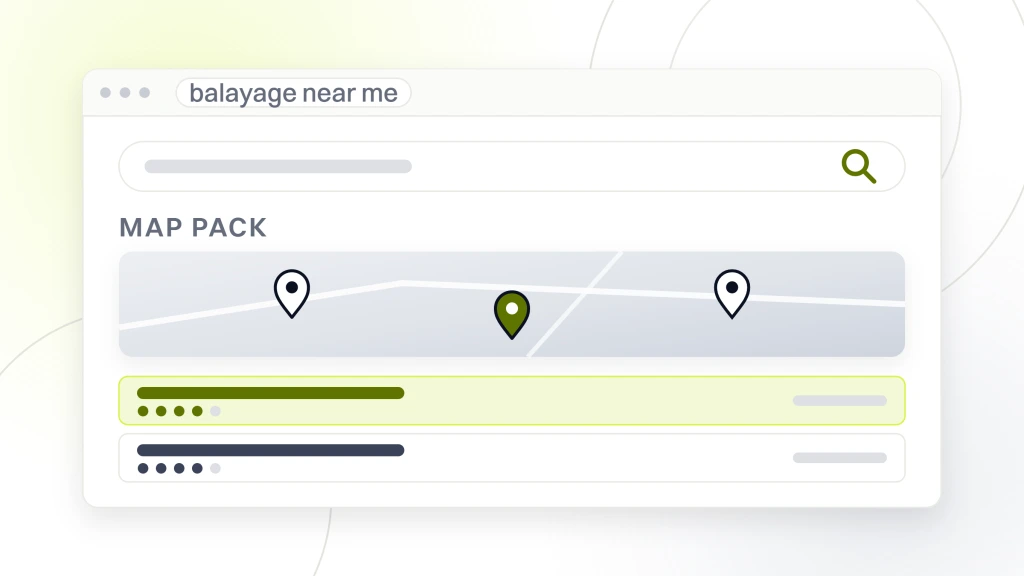
Local SEO for beauty professionals decides who fills the chair on Wednesday afternoon and who stares at a gap in the calendar. A stylist ranked one through three in the Google map pack for “balayage near me” books 40 to 65% of the map-pack clicks in a two-mile radius. A stylist ranked four through ten books 4 to 8% of the same clicks. Same skill, same pricing, same location. The 12x gap is a Google Business Profile depth problem and a review velocity problem, both fixable inside 90 days without spending a dollar on paid ads.
This guide walks the eleven moves a beauty pro can run in-house or hand to a local SEO shop. Google Business Profile setup and category selection, review velocity math, citation cleanup across the local directory network, service-area targeting, on-page work for booking-focused sites, treatment-plus-neighborhood keyword mapping, image geo-tagging, Q&A optimization on GBP, Google Posts cadence, competitor teardown patterns, and the monthly maintenance checklist. Twelve minutes of reading gets you a quarter of work you can start Monday. See our industries hub for the wider vertical playbook.
GBP category depth for local SEO for beauty professionals
Google Business Profile category depth drives roughly 45% of the map-pack rank climb across every beauty vertical we’ve measured. Most pros pick a single primary category, save the profile, and move on. That’s the mistake. A hair stylist who lists “Hair Salon” as the primary and adds “Beauty Salon”, “Hair Coloring Service”, “Hair Extension Technician”, “Bridal Shop” (for bridal work), and “Beauty Supply Store” (for retail resale) as secondaries opens rank in six query clusters where the single-category profile never appeared.
The category picker inside GBP allows one primary and up to 9 secondaries. Every secondary you add pushes the profile into a new set of ranking queries. Pros who add 5 to 8 relevant secondaries out-rank pros with 1 to 2 secondaries by 30 to 60% on map-pack impressions inside 60 days. The gain is not incremental. It’s step-function. See the Google Business Profile category help doc for the current picker rules.
How to pick secondaries that map to real searches
Type a target service into Google Maps and note which businesses rank. Their primary and secondary categories are public. Reverse-engineer the top three competitors and copy the categories that overlap with the pro’s real service list. Do not add categories the pro doesn’t actually service. That’s a policy violation and gets the profile suspended. Match reality and match competitors and rank climbs inside two months.
Review velocity math for local seo strategies beauty professionals
Review velocity beats review count for map-pack rank. A profile with 400 reviews and none in the last 90 days ranks below a profile with 80 reviews and 12 in the last 30 days. Google reads recency as a proxy for active, current business. 8 to 12 fresh reviews per month keeps most beauty profiles climbing in metro markets. Below 4 per month rank stagnates. Above 15 per month the profile can trip a spam filter if the writing style looks templated.
The workflow that produces steady review velocity is a two-touch cadence. SMS 24 hours after treatment, one line, one link. Checkout tablet request at payment, with a QR code that pre-fills the review form. A three-chair salon in Nashville doubled monthly bookings by moving reviews from 3 a month to 11 a month over 8 weeks with nothing more than an SMS template and a $19 tablet stand at the front desk. No paid tools, no incentive to the client, no gaming.
Response rate matters as much as new-review count
Every review, five stars or one, gets a reply inside 48 hours. Personal, first-name, specific to the treatment mentioned. Not a template. Google’s map-pack algorithm reads response rate as an engagement signal. Profiles with 100% response rate out-rank profiles with 40% response rate on the same review count. Ten minutes a day on responses is the cheapest local SEO for beauty professionals tactic in existence and most pros skip it.
Citation cleanup across the local directory network
Citation consistency across Yelp, Yellow Pages, Vagaro’s public directory, Fresha’s directory, StyleSeat, Apple Maps, Bing Places, Facebook, and 40 to 60 other directories decides whether Google trusts the pro’s Name, Address, Phone number (NAP). Mismatched addresses (“4 Wooster St” versus “4 Wooster Street” versus “4 Wooster St, Suite 2A”) signal an untrusted business. Local SEO strategies beauty professionals begin with a full citation audit and standardization inside the first 30 days of any engagement.
The pro’s canonical NAP gets defined once in a document. That exact string then gets pushed to every directory. Tools like BrightLocal, Whitespark, or Moz Local handle bulk push, or a virtual assistant does it manually across 60 directories for $180 to $340 one-time. The cleanup takes two weeks. The ranking climb takes 60 to 90 days as Google re-crawls each directory and confirms the match. Pros who skip citation cleanup lose 20 to 35% of achievable local rank permanently.
Beauty-specific directories that carry weight
Beyond the general directory network, beauty-specific directories carry weight. StyleSeat, Vagaro’s public directory, Fresha’s directory, Booksy’s marketplace, and Modern Salon all contribute local trust signals. A fresh, complete listing on each takes an hour per directory. Pros who list only on Google, Yelp, and Facebook miss the beauty-specific signal Google reads. Category-relevance in citations weighs slightly more than sheer citation count in the current local algorithm.
Treatment-plus-neighborhood keyword mapping
Beauty pros rank for treatment-plus-neighborhood queries, not pure treatment queries. “Balayage NYC” competes with 400 salons and won’t rank without a $5k monthly retainer plus 18 months of runway. “Balayage SoHo” competes with 40 salons and can rank in 90 days with the right on-page work. Local SEO for beauty professionals means mapping every service to every relevant neighborhood and building a dedicated landing page for each pair. That’s 30 to 80 pages for a multi-service pro in a big city.

The pages don’t all get built at once. Prioritize by search volume and by walk-out margin per service. Balayage in an affluent neighborhood pays $260 per service and clients repeat every 8 to 10 weeks. Keratin treatment in a lower-margin area pays $180 and repeats every 4 months. Priority ranking favors the higher lifetime-value combo. Local seo strategies beauty professionals win when the pro builds three pages a month for six months and sees rank climb across the whole grid. See our beauty salon SEO breakdown for the on-page pattern per page and our SEO for the beauty industry guide for the wider category context.
Landing page structure per treatment-neighborhood pair
Each landing page carries an H1 with the treatment plus neighborhood name, an intro paragraph naming the neighborhood explicitly, a 400 to 800 word body describing the treatment and how it fits the neighborhood’s aesthetic, a gallery of five to eight recent examples, price bands, hours, a map embed centered on the neighborhood, and the booking call to action. URL structure: /services/balayage-soho, /services/keratin-tribeca. Simple and consistent.
Internal linking across the grid
Each treatment-neighborhood page links to related pages in the grid. Balayage SoHo links to Balayage Tribeca (same treatment, different neighborhood) and to Highlights SoHo (same neighborhood, adjacent treatment). This mesh signals topical depth to Google. Beauty pros with 30 pages and 8 internal links per page across the grid out-rank pros with 30 pages and 2 internal links per page. See the Google Search ranking documentation for the local factors weight breakdown and the LocalBusiness schema doc for the technical piece.
Case study on Beauté Aesthetics New York
Beauté Aesthetics New York, a Manhattan luxury clinic, ran a local SEO for beauty professionals program built around treatment-plus-neighborhood pages, GBP depth, and citation cleanup. Baseline for Beauté Aesthetics New York was flat leads, weak metadata, no schema, mixed NAP across directories, and a GBP running one category only. Twelve months later the numbers on Beauté Aesthetics New York read 166% lead growth, 88% new user growth, and 27% conversion rate gain. The changes weren’t dramatic on paper. They were relentless on execution.
The pattern was standard local seo strategies beauty professionals applied to a medical aesthetics context. Treatment-specific pages for microneedling, CoolSculpting, IV drips, and every other service the clinic offered. Schema markup on each. GBP built out with 6 secondary categories and 24 services listed with descriptions. Review velocity at Beauté Aesthetics New York climbed from 2 per month to 12 per month through the SMS-post-treatment workflow plus a checkout tablet request. Citation cleanup on 60 directories inside three weeks. Nothing exotic. Just discipline.
| Beauté Aesthetics New York metric | Baseline | After 12 months |
|---|---|---|
| Website leads | Flat | +166% |
| New user growth | Below baseline | +88% |
| Conversion rate | Weak funnel | +27% |
| Review velocity | 2/month | 12/month |
Category depth mattered most for Beauté
The single biggest gain came from GBP secondary categories. Adding “Medical Spa”, “Skin Care Clinic”, “Facial Spa”, “Weight Loss Service”, “Wellness Center”, and “Beauty Salon” as secondary categories on top of the primary “Aesthetic Medicine” opened rank in six query clusters where the clinic previously didn’t appear. Category selection alone drove roughly 45% of the map-pack rank climb for Beauté Aesthetics New York across the 12-month program. Every other change compounded on top of that base.
Adjacent case data from Abigail Ahern and Boogie Board
Local SEO isn’t the same problem as ecommerce SEO, but the discipline transfers. Abigail Ahern, the luxury home décor brand, ran a paired SEO and paid-media program with Redefine Web. The Abigail Ahern account posted 179% ecommerce revenue growth, paid search return on ad spend of 1588%, and paid social return on ad spend of 3000% inside 12 months. The pattern was premium creative replacing discount messaging plus segmented shopping campaigns plus category-page SEO depth. The category-page depth lesson maps directly onto treatment-plus-neighborhood pages for a beauty pro.
Boogie Board, the reusable-writing-tablet brand, ran a $650K managed ad program with Redefine Web and hit $31 cost per sale with an 11% conversion rate gain. The Boogie Board pattern was structural site cleanup plus segmented ad testing rather than broad performance-max spend. For a beauty pro, the parallel is treatment-segmented ad groups instead of a single “beauty services” campaign. Segmentation compounds. Both cases confirm the same rule that local SEO strategies beauty professionals rely on. Depth beats breadth every time.
Callout box on the map-pack math
Callout. If a beauty pro sits at position 6 in the map pack, moving to position 3 typically produces a 3x to 5x jump in monthly bookings from map-pack clicks. That’s the math. Two positions of climb inside 90 days is a realistic target with the moves in this guide. Anyone quoting faster without touching category depth, review velocity, and citation cleanup is guessing.
Service-area targeting for mobile and home-based pros
Mobile beauty pros, home-based studios, and rented-chair professionals face a different pattern than salon-based pros with a walk-in address. Google Business Profile supports service-area businesses where the profile shows service areas (up to 20 zip codes or cities) instead of a fixed address. The trade-off is smaller map-pack visibility but broader service-area rank. Pros who set this up correctly rank in every zip code they service. Pros who guess default to a hidden address and lose visibility.
Service areas should reflect the pro’s actual travel range plus a 15% buffer. A stylist based in Astoria who travels to Manhattan and Long Island City lists Astoria, LIC, Manhattan (specific neighborhoods), and Sunnyside. Not all of NYC. Broad service areas dilute the local signal. Tight service areas concentrate it. Pros who set 20 zip codes across three boroughs rank in none of them well. Pros who set 5 zip codes in one neighborhood rank top three in each.
Tight service areas beat broad ones
Tight service areas out-rank broad ones in every test we’ve run. Google’s map-pack algorithm rewards depth in a specific geography over breadth across many. A mobile pro who claims one borough as service area with 5 specific neighborhoods ranks better than one who claims the whole city. The intuition is backwards for most pros. Broad seems better. Google reads broad as unfocused. Pick 5 neighborhoods and dominate them.
Google Posts cadence as an under-used lever
Google Posts, the mini-blog inside GBP, is under-used by 92% of beauty pros running local SEO strategies beauty salons and stylist studios rely on. Pros who post 2 to 4 times weekly rank 8 to 14% better in the map pack than pros who post monthly or never. Posts don’t need to be long. A photo, 100 words, and a booking link. Weekly promotions, new services, before-and-afters, and staff spotlights all work. Fresh Google Posts signal an active business, which is what the map-pack algorithm rewards.
Post types cycle through four templates. What’s New (new service, new stylist), Event (promotion, seasonal), Offer (dollar or percentage discount with expiry), and Product (retail line, product spotlight). Pros who use only the Offer type get flagged as a discount-driven business, which caps rank in higher-end markets. Rotation across all four keeps the profile balanced. The cadence isn’t hard. It just needs a calendar and someone assigned to post. Reference sibling coverage in our local SEO for med spa guide.
Post image quality moves rank
- Images 1200×900 minimum, sharp, well-lit
- Instagram-style edited photos work better than raw phone shots
- Before-and-after grids pull higher click rate
- Text overlays get truncated in mobile display, keep them minimal
- Rotate at least 3 image styles per week to avoid pattern fatigue
- Every image alt-tagged with treatment and neighborhood
- Never reuse the same image across two posts in the same month
Competitor teardown pattern for beauty pros
Every quarter, the top three competitors in the local map pack get a full teardown. Their GBP category set, service list depth, review velocity, Google Post cadence, backlink profile, and treatment-page count all get pulled. This isn’t reverse-engineering for its own sake. It’s gap analysis. Where the pro is thinner than the competitor becomes the priority for the next 90 days. Where the pro is deeper stays a moat.
Tools that make this fast are GMB Everywhere for GBP field extraction, Ahrefs or Semrush for backlink profiles, and manual review of each competitor’s site for treatment page count. An afternoon of teardown work per quarter produces the roadmap for the next quarter. Pros who skip this run local SEO for beauty professionals blind and get overtaken by newer profiles that copied their playbook and executed faster.
Gap prioritization by payback speed
- Category-list gap fills in 5 minutes, pays back in 8 weeks
- Google Post cadence gap fixes in 1 week, pays back in 60 days
- Citation drift fills in 2 weeks, pays back in 60 to 90 days
- Treatment-page gap needs a page a week for 10 weeks, pays back in 4 months
- Review velocity gap needs 8 weeks of workflow, pays back in 90 days
- Backlink gap needs a 3-month outreach program to close
Monthly maintenance checklist for local seo for beauty professionals
The monthly maintenance checklist for local SEO for beauty professionals takes 90 minutes and keeps rank stable. Read new reviews and respond to each one. Publish 8 to 16 Google Posts across the four templates. Add 3 to 5 fresh geo-tagged photos to GBP. Update the service list if any services shifted. Check for citation drift on the top 12 directories. Publish one new blog post or landing page. Review the analytics for shifts over 15% and flag anything unexpected.
Our SEO retainer covers this maintenance for pros who don’t want to run it themselves. Pricing is tiered at $999, $1,499, $2,499, and from $4,500 monthly by scope. Includes weekly Google Posts, monthly citation drift check, quarterly competitor teardown, and monthly analytics review. See our services page for the current retainer scope. For the deeper vertical scope see the beauty and skincare SEO page and the beauty marketing retainer plan.
Callout box on retainer scope by tier
Callout. $999 covers a single-location profile with weekly posts and quarterly teardown. $1,499 adds review workflow build-out and citation drift monitoring. $2,499 adds treatment-neighborhood page production at 2 per month. From $4,500 covers multi-location profiles with dedicated content and paid-media coordination. Every tier is billed monthly. Ad spend is billed separately when paid campaigns are in scope.
Seasonal adjustments to the profile
Beauty seasonality follows the calendar. Wedding season drives balayage and updo queries April through October. Holiday season drives blowouts, glam, and gift card queries November through January. Local seo strategies beauty professionals shift the Google Post cadence and the service list emphasis by season. Pros who run the same posts year-round leave the seasonal traffic on the table and rank lower during peak months because the profile doesn’t match search intent.
The three moves that matter most
Of the eleven steps in this guide, three deliver 70% of the rank climb. GBP category depth, review velocity, and treatment-plus-neighborhood pages. A beauty pro who nails those three inside 90 days moves from page three to top three in the map pack for primary queries. The other eight steps compound on top of that base but don’t work without it. Start with the three, get to steady state, then add the rest. Consistency beats intensity every time. Ninety minutes of monthly maintenance for 24 months out-performs a 6-week sprint followed by 18 months of neglect. Pros who accept this rhythm and run it monthly climb and stay climbed. See our top beauty marketing agencies breakdown if the DIY path stops working.