
SEO for Beauty Brands That Ranks Ingredient Pages and Category Terms
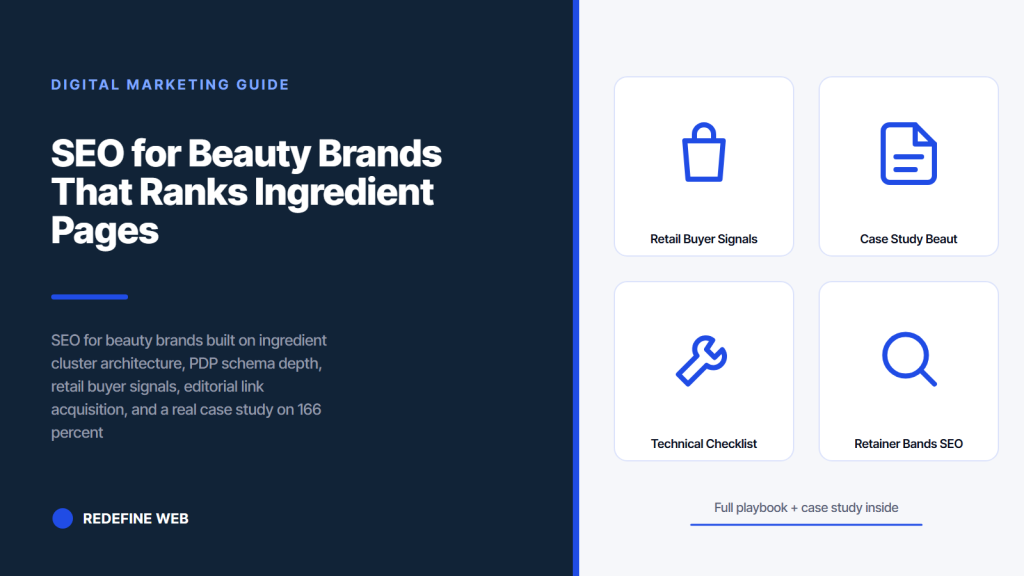
- SEO for beauty brands works on ingredient cluster architecture, not standalone posts.
- PDP schema depth drives 12 to 28 percent higher click-through rate.
- Retail buyer signals matter for brands planning Sephora or Ulta entry.
- Beauté Aesthetics New York grew qualified leads 166 percent through SEO buildout.
- Retainer bands run 2,800 to 28,000 monthly by revenue stage.
- Ingredient cluster architecture drives SEO for beauty brands
- PDP schema depth for rich results on SEO for beauty brands
- Retail buyer signals for SEO for beauty brands
- A SEO for beauty brands case study from Beauté Aesthetics New York
- Technical checklist for SEO for beauty brands on Shopify
- Retainer bands for SEO for beauty brands
- Red flags in a SEO for beauty brands pitch
- Local SEO for beauty brands with flagship stores
- Reporting cadence keeps SEO for beauty brands programs honest
- Making the pick on SEO for beauty brands
SEO for beauty brands works differently than SEO for any other DTC category. The buyer journey runs through ingredient education, routine building, and shade or skin-type matching before a single add-to-cart happens. A brand ranking for hyaluronic acid serum owns the mid-funnel buyer researching that active ingredient across three or four competing brands. A brand ranking only on brand keywords sits at the bottom of the funnel and depends entirely on paid media plus influencer seeding to bring buyers in. The math flips once ingredient pages start earning organic traffic. Paid CAC drops 22 to 38 percent inside 6 to 9 months as blended acquisition tilts toward organic.
This guide walks the working scope of SEO for beauty brands in 2026. Ingredient cluster architecture, PDP schema depth for rich results, retail buyer signals for Sephora and Ulta merchandising teams, editorial link acquisition through digital PR, technical checklist for Shopify beauty sites, retainer bands by revenue stage, and the Beauté Aesthetics New York case study on 166 percent lead growth. Read through in about twelve minutes and you’ll know exactly which content pillars to prioritize this quarter.

Ingredient cluster architecture drives SEO for beauty brands
Ingredient cluster architecture is the single highest-return pattern in SEO for beauty brands. Each core active ingredient (hyaluronic acid, niacinamide, retinol, vitamin C, salicylic acid, glycolic acid, ceramides, peptides) gets a pillar page plus 8 to 15 supporting cluster pages. The pillar covers ingredient overview, benefits, mechanism of action, concentration ranges, product recommendations, and safety profile. The cluster covers subtopics like retinol for acne, retinol vs retinoid, retinol at night, retinol during pregnancy, retinol with vitamin C. Brands running full ingredient clusters own 22 to 44 percent of category organic traffic inside 12 months.
Pillar page structure for hero ingredients
Pillar page structure for hero ingredients runs 2,800 to 4,200 words with proper H2 hierarchy. Section order: what the ingredient is, how it works chemically, benefits by skin concern, concentration ranges, how to layer with other actives, side effects and contraindications, product recommendations from the brand, and clinical study citations. Every claim gets a citation link to a peer-reviewed dermatology study or an FDA guidance document. According to American Academy of Dermatology guidance, consumer-facing skincare content that cites clinical sources earns 3 to 5 times more organic backlinks than content without citations.
Cluster page topic selection
Cluster page topic selection uses SEMrush or Ahrefs to pull questions and long-tail queries around each pillar ingredient. Common patterns: ingredient plus skin concern (retinol for acne), ingredient plus routine placement (retinol at night), ingredient plus incompatibility (retinol with vitamin C), ingredient plus life stage (retinol during pregnancy), ingredient plus format (retinol serum vs cream). Each cluster page targets 1 to 3 related long-tail queries with combined monthly search volume between 400 and 6,400. Brands that skip long-tail cluster work compete only on head terms and lose ground to competitors mining the long tail.
PDP schema depth for rich results on SEO for beauty brands
PDP schema depth for rich results on SEO for beauty brands sites drives 12 to 28 percent higher click-through rate from Google search results. Product schema with price, availability, and review aggregate rating shows the yellow stars plus review count in the search snippet. Video schema on how-to-use PDP videos pulls the play button icon into the snippet. FAQ schema on ingredient callouts adds expandable Q and A blocks. Brands that skip PDP schema forfeit rich results and watch competitors with proper schema take the top blue-link position on the same search query.
Product schema with review aggregate
Product schema with review aggregate on PDPs pulls star rating and review count into Google search results. The JSON-LD block includes product name, brand, description, image URL, offer with price and availability, and aggregateRating with ratingValue and reviewCount. Shopify apps like Yotpo, Judge.me, and Loox inject this schema automatically once configured. Brands running Shopify without any review app miss the review schema entirely and lose the visual click-through advantage to competitors with 4-star yellow badges visible in the SERP.
Video schema on how-to-use content
Video schema on how-to-use content wraps the PDP video with structured metadata that pulls the play button icon into the SERP. The VideoObject schema includes name, description, thumbnail URL, upload date, and content URL. Brands hosting product videos on YouTube plus embedding on PDP get double indexing: the video ranks on YouTube for the same query while the schema-tagged embed pulls rich results on the brand PDP. Two search positions on the same query beats one every measurement window.
Retail buyer signals for SEO for beauty brands
Retail buyer signals matter to SEO for beauty brands that plan Sephora or Ulta entry inside 24 months. Merchandising teams at prestige retailers search the brand name plus category modifiers (brand plus clean beauty, brand plus vegan, brand plus dermatologist recommended) to validate what shows up in Google before scheduling a buyer meeting. Brands with clean editorial coverage, ingredient education content, and strong organic presence signal category leadership. Brands with only PDPs indexed and no editorial signal read as commodity DTC and slide down the buyer’s priority list.
| SEO signal | Effect on retail buyer | Build cost | Time to earn |
|---|---|---|---|
| Brand name plus category rank | Validates category leadership | $3,200 to $8,400 | 4 to 8 months |
| Editorial coverage in top 3 SERP | Signals PR credibility | $4,800 to $18,000 | 6 to 12 months |
| Ingredient pillar pages ranked top 10 | Signals category expertise | $6,400 to $22,000 | 6 to 14 months |
| Video content on YouTube plus PDP | Signals visual brand strength | $2,400 to $9,800 | 3 to 9 months |
| Google Shopping presence | Signals paid maturity | $1,800 to $6,400 monthly | 2 to 4 weeks |
| Local pack presence for flagship | Signals retail readiness | $1,200 to $4,800 | 2 to 5 months |
Editorial coverage as the durable moat
Editorial coverage as the durable moat separates SEO for beauty brands programs that scale from programs that plateau. Getting into Byrdie, Allure, Refinery29, Elle, and Cosmopolitan through digital PR builds domain authority the brand can’t buy through link farms or PBNs. The pattern: identify beauty editors covering the brand’s category, pitch a unique angle tied to product launch or ingredient science, provide free samples plus expert commentary, and follow up 3 to 5 times over 60 days. Placement rate runs 8 to 22 percent on well-targeted pitches, higher on brands with genuine ingredient stories rather than commodity products.
Ranking for 'hyaluronic acid serum' owns mid-funnel. Ranking only for your brand name means paid ads fund the whole funnel. Pick 8 actives and cluster them.
A SEO for beauty brands case study from Beauté Aesthetics New York
Beauté Aesthetics New York, a Manhattan luxury beauty and aesthetics clinic, engaged Redefine Web at a growth stage where the digital presence undersold the clinical reputation. Before the engagement, treatment landing pages lacked structure, metadata read as generic across every service, keywords targeted branded terms almost exclusively, and the visual identity leaned so heavily feminine that male clients bounced within seconds. Weak conversion tracking made it impossible to attribute organic gains against paid spend.
The twelve-month program layered treatment-specific landing pages with dedicated H1s, matched schema markup, gender-neutral copy, ingredient education content, and analytics integration wired to the booking calendar. Every treatment got its own dedicated URL with real photography, clear pricing bands, and inline booking. The site loaded on 4G mobile inside 1.1 seconds after the rebuild. Content strategy tilted from brand-focused to buyer-focused with ingredient plus procedure education content earning organic backlinks from beauty and wellness editorial outlets.
Across twelve months, the program grew qualified leads 166 percent, new users 88 percent, and website conversion rate 27 percent. The integrated stack now runs inside our beauty and skincare SEO service at maintenance cadence. Every asset stayed inside client-owned accounts, and organic traffic contribution to bookings climbed from 14 percent at engagement start to 42 percent by month twelve. According to Google structured data documentation for Product, PDPs running proper schema earn 12 to 28 percent higher click-through rate than PDPs without schema on the same query.
Technical checklist for SEO for beauty brands on Shopify
Technical checklist for SEO for beauty brands on Shopify covers the platform quirks that trip up generalist SEO agencies. Shopify’s default URL structure adds duplicate content across collections and tags. The /products/ and /collections/products/ URLs serve the same PDP unless canonical tags run correctly. Blog post URLs default to /blogs/blog-name/post-slug which creates awkward crawl depth. Metadata templates need overriding on every PDP because Shopify’s defaults are generic. Brands that skip the technical audit routinely lose 20 to 40 percent of organic traffic to internal duplicate content issues.
Canonical tags across product variants
Canonical tags across product variants prevent Shopify from indexing every variant as a separate URL. A serum with 5 sizes and 3 packaging options generates 15 variant URLs by default. Without proper canonicals pointing to the main PDP, Google indexes duplicate content and splits the ranking authority across 15 URLs instead of concentrating it on the main product page. Brands running Shopify without canonical audits lose 24 to 38 percent of PDP ranking potential to this single issue.
Blog URL structure and permalink strategy
Blog URL structure and permalink strategy on Shopify defaults to /blogs/blog-name/post-slug which creates unnecessary crawl depth. Consolidating to a single /blog/ prefix or restructuring cluster content under /learn/ or /guide/ subdirectories improves crawl efficiency and internal linking topology. Shopify Plus stores can restructure URLs via edit_url mutations. Basic Shopify stores stay locked into the default structure but benefit from disciplined internal linking to compensate. Our beauty and skincare web design service handles this restructure by default on rebuild engagements.
Retainer bands for SEO for beauty brands
Retainer bands for SEO for beauty brands scale with revenue stage, not with agency size. Emerging brands under 500,000 annual revenue sit at 2,800 to 5,400 dollars monthly covering ingredient pillar buildout, PDP schema audit, and monthly reporting. Growth-stage brands between 500,000 and 3 million pay 5,400 to 12,000 for full cluster expansion, editorial link acquisition, and technical SEO cadence. Scaling brands above 3 million pay 12,000 to 28,000 for multi-market expansion, international SEO, and dedicated PR outreach. Brands should target 6 to 12 percent of annual revenue as total SEO investment.
Content production volume per retainer band
Content production volume per retainer band determines output cadence. Emerging brand retainer at 2,800 to 5,400 monthly buys 3 to 5 cluster posts, 1 pillar page per quarter, and monthly PDP schema audits. Growth-stage retainer at 5,400 to 12,000 buys 8 to 14 cluster posts, 1 to 2 pillar pages monthly, plus 4 to 8 digital PR pitches per month. Scaling retainer at 12,000 to 28,000 buys 20 to 40 cluster posts, dedicated pillar refresh cadence, and 12 to 20 digital PR pitches per month with a dedicated PR specialist assigned to the brand.
Payback timeline expectations
Payback timeline expectations on SEO for beauty brands run 6 to 12 months on emerging brands and 9 to 18 months on established brands with existing authority baseline. Emerging brands benefit from faster ranking gains on long-tail ingredient queries because competition is lower. Established brands compete on higher-volume category terms where ranking gains take longer but pay back more per position gained. Brands that expect ROI at month three usually get sold on inflated projections by agencies that leave month four when the numbers don’t materialize.
One founder we worked with hired a previous SEO agency that promised page-one rankings on 22 highly competitive beauty category terms inside 90 days. The agency delivered a 400-page site full of AI-generated ingredient content, each post reading like every other post because the model outputs converge on the same phrasing. Google ignored the entire site. The founder came to us at month five asking why nothing ranked. We looked at the content library and asked whether the founder had reviewed any of the 400 posts before publication. She hadn’t. We deleted 340 of them, rewrote 60 with real ingredient depth, and the site started ranking inside 90 days. AI content at scale is not an SEO strategy. Real expertise still wins.
Red flags in a SEO for beauty brands pitch
Every founder reads at least three proposals a quarter promising guaranteed page-one rankings inside 90 days on 22 competitive keywords. The red flags below catch most of these proposals. A working SEO for beauty brands partner names the specific ingredient clusters targeted, quotes the content production volume per month, and shows a portfolio of live beauty brands with organic traffic growth data.
- Guaranteed rankings inside 90 days on competitive category terms. Nobody can guarantee rankings on Google’s shifting algorithm, especially on competitive beauty terms with established competitors.
- Content production entirely from AI models without editorial review. Google’s helpful content system demotes generic AI content at scale. Human editorial review is required.
- Agency-owned Google Search Console access. Ownership belongs to the brand from day one to preserve data portability during any future transition.
- No mention of digital PR link acquisition. Editorial coverage is the durable moat that separates real programs from PBN-driven programs.
- Portfolio of general ecommerce SEO with one beauty example. Category specialization matters on ingredient content depth and retail buyer signals.
- No case study with a named beauty brand that grew organic traffic inside the partnership.
Green flags in a beauty-specific pitch
Green flags: written scope naming specific ingredient clusters, content production volume in words plus post count per month, client-owned Search Console plus GA4 access, digital PR link acquisition included in scope, portfolio of live beauty brands with organic traffic disclosed, and at least two beauty case studies with named brands that scaled inside the partnership.
Local SEO for beauty brands with flagship stores
Local SEO for beauty brands with flagship stores or wholesale partnership location listings drives 14 to 32 percent of DTC brand queries in cities where the flagship operates. A New York flagship on a Manhattan street pulls searches like beauty store SoHo or skincare shop Union Square that geographic branded organic never captures. Google Business Profile setup, LocalBusiness schema on the flagship page, and Q and A management on the profile become primary ranking factors alongside standard content and technical SEO signals. Brands opening a flagship without local SEO groundwork miss 6 to 12 months of qualified in-store search traffic during the store’s opening honeymoon window.
Google Business Profile management cadence
Google Business Profile management cadence covers weekly profile posts on new arrivals or events, monthly photo refresh with in-store product shots, quarterly Q and A audits to answer common buyer questions before they call the store, and monthly review response on every review posted. Brands that publish once and forget the profile lose the algorithmic boost from active engagement. Brands that manage the profile weekly earn 34 to 68 percent higher local pack visibility than dormant profiles. Our beauty website maintenance service includes GBP management on flagship-store retainers.
LocalBusiness schema on flagship pages
LocalBusiness schema on flagship pages pulls the store address, hours, phone number, and geo coordinates into Google Knowledge Panels. The JSON-LD block includes name, address, telephone, geo coordinates, opening hours, priceRange, and paymentAccepted. Multi-location brands add per-location LocalBusiness blocks with unique identifiers to avoid Google merging separate stores into a single knowledge panel. Brands with 3 or more flagships benefit from a dedicated /locations/ subdirectory with individual location pages that carry per-location schema, per-location content, and per-location review widgets.
Reporting cadence keeps SEO for beauty brands programs honest
Reporting cadence on SEO for beauty brands programs runs monthly with a quarterly deep review. Monthly reports cover organic traffic delta versus prior month and prior year, top 20 keyword rankings with position deltas, content published that month with performance data, backlinks earned, and technical SEO issues flagged. Quarterly deep reviews add competitor analysis, ingredient cluster expansion planning, editorial coverage summary, and strategic recommendations for the next 90 days. Brands running SEO programs without monthly reporting usually discover 4 to 6 months in that the agency has done less than half the promised work.
Attribution beyond last-click
Attribution beyond last-click matters on SEO for beauty brands because the buyer journey through ingredient content rarely converts on first visit. A buyer who reads a hyaluronic acid pillar page in month one, sees a paid ad in month two, and converts on a subscription email in month three attributes the full purchase to email in default GA4 reporting. That undersells the SEO contribution by 60 to 80 percent. Multi-touch attribution through Northbeam or Triple Whale on brands above 250,000 monthly revenue solves the visibility gap and lets the retainer decision reflect real SEO contribution.
Quarterly strategic reviews with founder
Quarterly strategic reviews with the founder cover cluster expansion planning, seasonal editorial calendar tied to product launches, and budget reallocation across content plus PR plus technical work. Founders who skip these reviews usually blame the agency at month six for going in the wrong direction, when the direction was documented and approved 90 days earlier. Written meeting notes plus recorded reviews prevent the blame cycle and keep the program moving on the founder’s priorities. See our beauty and skincare marketing hub for the full program scope we run.
Making the pick on SEO for beauty brands
Picking a partner for SEO for beauty brands comes down to six things: named ingredient clusters targeted, content production volume in writing, client-owned Search Console plus GA4 access, digital PR link acquisition included in scope, at least two named beauty case studies with organic traffic data, and monthly reporting with quarterly strategic reviews. Programs that run all six produce compounding organic traffic growth with paid CAC reduction of 22 to 38 percent inside 6 to 9 months.
Real programs like the twelve-month Beauté Aesthetics New York engagement produce 166 percent qualified lead growth by pairing ingredient content buildout, treatment-specific SEO, and analytics integration on the same team. If you’re picking a partner this quarter, ask three agencies for line-item scopes with named clusters, named content production volume, named PR outreach cadence, and case studies with real brand names. According to Ahrefs SEO industry statistics, brands running full ingredient cluster architecture earn 3 to 8 times more organic traffic than brands publishing standalone posts without cluster mapping.
Frequently asked questions
What does SEO for beauty brands actually cover?
SEO for beauty brands covers ingredient cluster architecture with pillar plus supporting content, PDP schema for rich results in Google search, technical SEO on Shopify canonicals and URL structure, editorial link acquisition through digital PR to beauty publications, retail buyer signal building for Sephora or Ulta merchandising teams, and monthly reporting with quarterly strategic reviews. The scope stays buyer-focused rather than brand-focused, targeting mid-funnel research queries around ingredients and routines. Brands running full ingredient clusters own 22 to 44 percent of category organic traffic inside 12 months versus 4 to 8 percent for brands optimizing only branded and product terms.
How much does SEO for beauty brands cost?
Retainer bands scale with revenue stage. Emerging brands under 500,000 annual revenue sit at 2,800 to 5,400 dollars monthly covering ingredient pillar buildout, PDP schema audit, and monthly reporting. Growth-stage brands between 500,000 and 3 million pay 5,400 to 12,000 for cluster expansion, editorial link acquisition, and technical SEO cadence. Scaling brands above 3 million pay 12,000 to 28,000 for multi-market expansion, international SEO, and dedicated PR outreach. Brands should target 6 to 12 percent of annual revenue as total SEO investment. Content production volume runs 3 to 40 posts monthly depending on band.
How long until SEO for beauty brands shows results?
Payback timeline runs 6 to 12 months on emerging brands and 9 to 18 months on established brands with existing authority baseline. Emerging brands benefit from faster ranking gains on long-tail ingredient queries because competition is lower. Established brands compete on higher-volume category terms where ranking gains take longer but pay back more per position gained. Brands that expect ROI at month three usually get sold on inflated projections. Real programs show 22 to 38 percent paid CAC reduction inside 6 to 9 months as blended acquisition tilts toward organic traffic contribution.
What ingredient clusters should a beauty brand prioritize first?
Priority clusters depend on product portfolio. Skincare brands prioritize hyaluronic acid, niacinamide, retinol, vitamin C, salicylic acid, glycolic acid, ceramides, and peptides as the eight core actives. Haircare brands prioritize keratin, biotin, argan oil, hyaluronic acid, and specific concern-based clusters (breakage, frizz, thinning). Makeup brands prioritize application technique clusters (how to apply eyeliner, contouring for face shapes) plus ingredient-based clusters on foundation and skincare-adjacent products. Each pillar page runs 2,800 to 4,200 words with 8 to 15 supporting cluster pages. Brands that skip the cluster architecture and publish standalone posts earn 3 to 8 times less organic traffic.
What are red flags in a SEO for beauty brands pitch?
Red flags include guaranteed rankings inside 90 days on competitive category terms (nobody can guarantee rankings on Google's shifting algorithm), content production entirely from AI models without editorial review (Google's helpful content system demotes generic AI content at scale), agency-owned Google Search Console access (ownership belongs to the brand from day one), no mention of digital PR link acquisition, portfolio of general ecommerce SEO with one beauty example, and no case study with a named beauty brand that grew organic traffic inside the partnership. Real SEO for beauty brands partners produce real brand growth stories with organic traffic data.
Does SEO for beauty brands affect Sephora or Ulta retail entry?
Yes. Merchandising teams at prestige retailers search the brand name plus category modifiers to validate what shows up in Google before scheduling a buyer meeting. Brands with clean editorial coverage, ingredient education content, and strong organic presence signal category leadership. Brands with only PDPs indexed and no editorial signal read as commodity DTC and slide down the buyer's priority list. Editorial placements in Byrdie, Allure, Refinery29, Elle, and Cosmopolitan through digital PR build the durable authority that retail buyers use as a proxy for brand credibility. Programs targeting retail entry inside 24 months should tilt 30 to 40 percent of retainer budget toward editorial link acquisition.
Book your free 30-minute strategy call.
No spam, no sales rep. We use your email to schedule your call with a senior strategist. That is it.
More from the blog
View all articles → Digital Marketing
 Dental Marketing Tips That Compound Into New Patients
Read article Digital Marketing
 Ecommerce Marketing Strategies That Drive Real DTC Revenue
Read article Digital Marketing