
SEO vs PPC for real estate is the first budget question every agent, team, and investor operator asks after the first month of trying to grow inbound lead flow. Answering seo vs ppc for real estate correctly determines whether the first 90 days produces booked showings or burns cash. Both channels work. Both channels fail hard when applied to the wrong operator at the wrong stage. Pick the wrong one first and you burn 90 days plus $8,000 to $15,000 waiting for results that never come. Meanwhile the agent down the street runs the other channel and doubles their booked showings in the same window.
This guide runs the head-to-head. Cost per lead, timeline to first deal, ongoing spend, margin math, lead quality, buyer versus seller mix, metro tier fit, operator profile fit. It closes with a decision framework you use to pick the right first channel for your situation, then a phasing plan for adding the second channel once the first is producing. Every number is drawn from live 2026 accounts we run and audit across single-family agents, luxury teams, investor wholesalers, and property developers across 14 metros.
Budget fit inside seo vs ppc for real estate
Budget size decides which channel starts first as much as timeline pressure does. Operators with $1,500 to $2,500 per month cannot fund both channels. Operators with $4,000 to $8,000 per month should run PPC first and add SEO in month three. Operators with $8,000 to $18,000 per month should run both from month one and phase them together.
Small budget path under $3,000 per month
On seo vs ppc for real estate under $3,000 per month the choice is PPC alone with a light SEO foundation. $1,800 goes to ad spend, $800 to $1,200 goes to PPC management, $200 to $400 goes to landing page hosting plus CallRail. Organic SEO gets one blog post per month and a Google Business Profile weekly pass, no more. This budget produces 15 to 30 booked showings per month by month three with cost per booked showing between $180 and $260.
Mid-budget path $4,000 to $8,000 per month
$4,000 to $8,000 per month funds PPC at scale plus SEO layered in month three onward. Month one and two run PPC only. Month three adds SEO with 2 to 4 blog posts per month plus a technical audit. Month six adds link building at $800 to $1,600 per month. By month twelve the account produces 40 to 80 booked showings per month with 40 to 60 percent from organic and 40 to 60 percent from paid, at a blended cost per booked showing between $95 and $180.
Retainer canon on top of ad spend
Redefine Web’s SEO and PPC retainer tiers run $999, $1,499, $2,499, and from $4,500 per month across every vertical, real estate included. Ad spend gets billed separately on top of the retainer, so a $2,400 ad budget plus the $1,499 management tier is $3,899 in total monthly commit. The tier you pick matches account complexity, not agency headcount. Solo agents rarely need above the $1,499 tier. Luxury teams and investor operations usually sit in the $2,499 or from $4,500 tier for the extra keyword coverage and creative testing volume.
Metro tier fit inside seo vs ppc for real estate
Metro tier changes the seo vs ppc for real estate math on both channels. Tier 1 metros (top 10 US markets) have brutal PPC bid competition and equally brutal SEO domain-authority competition. Tier 2 metros (100K to 500K population) hit the sweet spot on both channels. Tier 3 metros (under 100K population) skew heavily toward SEO. Paid bid competition is minimal, and organic search volume is thin at the same time. A tight proven real estate SEO strategy compounds fast in these markets.
Tier 1 metro strategy
New York, Los Angeles, Chicago, San Francisco, Miami. Tier 1 PPC bid ceilings on cash-urgency phrases run $55 to $95 per click. Cost per booked showing lands at $260 to $480. SEO domain authority requirements sit at 55+ to rank on head terms, which takes 18 to 30 months of focused work. So the play is tight niche PPC on long-tail phrases with a specific neighborhood plus modifier, plus SEO invested in one submarket rather than the whole metro. Winning a submarket beats losing the whole metro every time.
Tier 2 metro strategy
Kansas City, Cleveland, Wichita, Columbus, Milwaukee, Nashville, Raleigh. Tier 2 metros are the sweet spot for both channels. PPC bid ceilings run $22 to $45 per click. Cost per booked showing lands at $95 to $210. SEO domain authority requirements sit at 30 to 45 to rank on head terms, achievable in 8 to 14 months of steady work. So the recommendation is to run both channels from month one if budget supports it, PPC first if budget is under $4,000 per month. Every tier 2 account in our real estate portfolio produces the best margin math we track.
Tier 3 metro strategy
Under 100K population the head search volume is thin, so ranking on organic head terms produces 40 to 90 organic sessions per month, not the 400 to 900 you would see in a tier 2 metro. PPC bid ceilings sit at $8 to $18 per click and the whole metro cost per booked showing lands between $70 and $140. In short, tier 3 metros run PPC-heavy from month one, with SEO scoped to a narrow content library of 12 to 20 evergreen posts that cover buyer and seller intent without expecting monthly refresh cadence.
A side-by-side comparison of seo vs ppc for real estate
The table below runs the head-to-head across nine variables. Use it as the reference chart when running an internal budget-planning meeting.
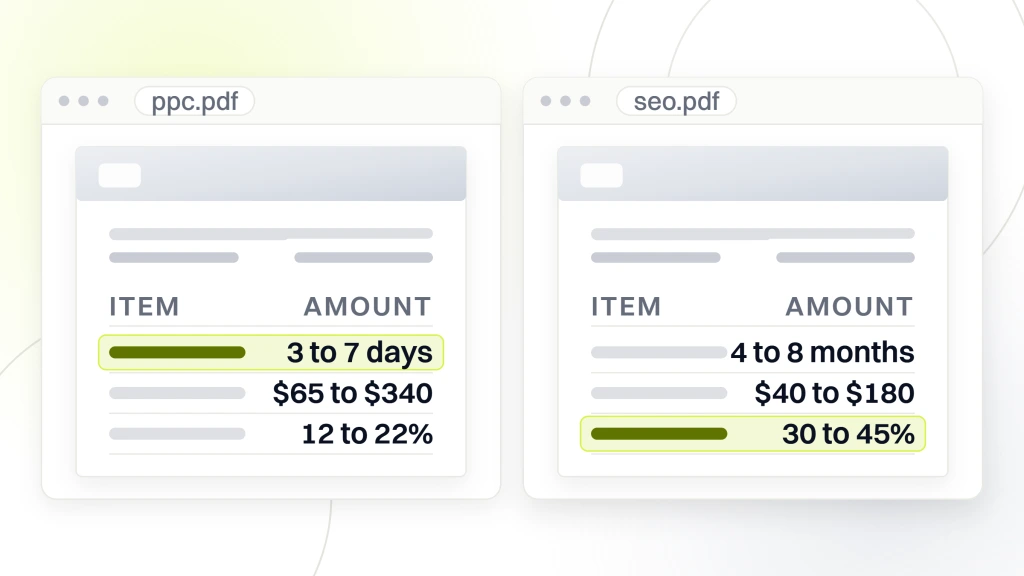
| Variable | Real estate PPC | Real estate SEO |
|---|---|---|
| Time to first lead | 3 to 7 days | 4 to 8 months |
| Time to compound scale | 60 to 90 days | 10 to 18 months |
| Cost per lead range | $65 to $340 | $40 to $180 |
| Close rate on booked showings | 12 to 22% | 30 to 45% |
| Lead urgency | High | Medium to low |
| Lead intent depth | Shallow to medium | Deep |
| Ongoing monthly cost | Full spend continues | Content plus links, spend stays flat |
| Break-even window | 60 to 90 days | 10 to 14 months |
| Asset value at year 3 | Zero (stop paying, stop leads) | 3x to 6x annual investment |
What the table hides about seasonality
Seasonality lives inside both sides of seo vs ppc for real estate. PPC costs rise in peak spring buyer season by 20 to 40 percent as every competitor bids up the same phrases. SEO organic volume rises in the same window as more searchers hit the same queries. The difference. PPC costs bump at the same time the deal flow bumps, so net margin stays flat. SEO stays cost-neutral through the same window and margin scales with volume. Across a full 12 months, SEO delivers 25 to 45 percent higher margin than PPC on the same deal flow in tier 2 metros where competition is manageable.
Buyer versus seller channel skew
Buyer traffic skews toward SEO. Buyers do 30 to 90 minutes of research before contacting an agent. Seller traffic skews toward PPC. Sellers move on urgency after a triggering event (job change, divorce, tax bill, inheritance). Motivated investor traffic skews heavily toward PPC. The trigger event is the whole point. Luxury listing traffic skews slightly toward SEO. The buyer research pattern runs longer. A balanced practice pairs local SEO for real estate agents with paid, running both channels with 60/40 splits that flip depending on the account’s core service line.
A real estate case reference for seo vs ppc for real estate
McCarthy Court, a 7-unit luxury development in Sidcup, sold out 100 percent in 3 months pre-completion through a virtual showcase site plus targeted paid campaigns that produced 60 qualified buyer leads and 10,000 targeted campaign visits. The play was PPC-first. The property needed a 90-day sell-through window and there was no time for organic to compound. Same operator planned an SEO layer post-launch for follow-on developments where the sales cycle would run 12 to 18 months, which flips the channel weighting toward organic.
The lesson from that account translates to every real estate operator picking between channels. Match channel timing to sales cycle length. A quick sell-through leans paid. A long compound listing pipeline leans organic. Most operators sit somewhere in the middle and run both channels phased across 6 to 18 months.
What the PPC-first sequence looked like month 1 to 6
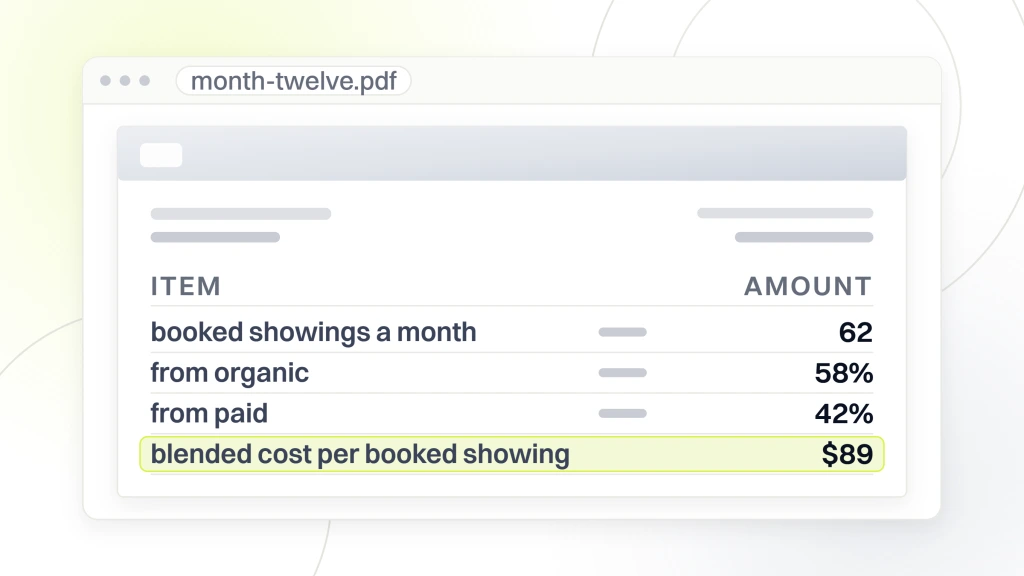
Month 1 to 2 built PPC alone with tight geo-targeting, message-matched landing pages, and CallRail with dynamic number insertion. Cost per booked showing sat at $148 by month 2. Month 3 layered in SEO with 3 blog posts per month plus a technical audit. Month 6 added link building at $1,200 per month. By month 12 the account produced 62 booked showings per month with 58 percent from organic and 42 percent from paid, at a blended cost per booked showing of $89.
What the SEO-first sequence would look like on a longer horizon
An SEO-first sequence starts with a 90-day audit and technical fix pass, then 4 to 6 blog posts per month across months 2 through 8, then link building from month 6 onward at $800 to $1,600 per month. The first meaningful organic lead volume arrives month 6. Break-even lands month 12 to 14. Post-break-even the compound curve accelerates with 20 to 30 percent monthly increases in organic leads across months 15 to 24. This sequence fits operators who can carry 12 months of low lead volume as the compound builds, which is most easily supported by teams with an existing referral book.
A decision framework for seo vs ppc for real estate
Use the framework below to pick your first channel based on your situation. Six questions, six answers, one recommendation at the bottom.
The six-question channel picker
- Do you need revenue this quarter? Yes = PPC first. No = either channel works.
- Is your total monthly marketing budget under $3,000? Yes = PPC only. No = both channels available.
- Are you an investor operator running motivated seller lead flow? Yes = PPC heavy. No = channel choice open.
- Do you plan to run this practice for 5+ years? Yes = SEO must be part of the mix. No = PPC alone works if the exit is under 24 months.
- Do you operate in a tier 1 metro (top 10 US market)? Yes = tight niche PPC plus submarket SEO. No = broader mix works.
- Do you have an existing referral book worth $180K+ annually? Yes = SEO first is safe. No = PPC first for cash flow bridge.
What the framework recommends across common profiles
Solo agent with $2,400 monthly budget and no referral book. PPC alone for months 1 to 6, add light SEO in month 7. Investor wholesaler with $6,000 monthly budget. PPC heavy from month 1, add SEO in month 3, target 70/30 paid/organic split by month 12. Luxury team with $12,000 monthly budget and strong referral book. Both channels from month 1, target 50/50 split by month 18. Property development with 6-month sell-through window. PPC only, no SEO play, redirect SEO budget to on-site content and photography.
Phasing the second channel after the first inside seo vs ppc for real estate
Inside seo vs ppc for real estate the right first channel is the one that fits the budget, timeline, and profile above. The right second channel is the one that fills the specific gap the first channel leaves open. PPC leaves a compound asset gap. SEO leaves a cash-flow gap. Adding the second channel closes the gap the first channel created.
Adding SEO after PPC produces
Once PPC produces steady deal flow at month 2 or 3, redirect 20 to 30 percent of the total marketing budget into SEO content and technical fixes. Month 3 launches the SEO layer with 2 to 4 posts per month. Month 6 adds link building. Month 9 evaluates the organic curve. If organic clicks are climbing 15 to 30 percent month over month, the SEO investment is compounding correctly. If the curve is flat, the SEO scope is too narrow, and the content or link investment needs a review.
Adding PPC after SEO produces
Operators who ran SEO first for 12 to 14 months usually have a referral book and steady organic lead flow, but no way to spike volume for a specific quarterly push. Adding PPC as the second channel gives that spike. Month 15 or 16 launches PPC at $2,400 to $4,800 in ad spend plus $1,499 to $2,499 in management. First deals from PPC arrive week two of the new channel. The combined channel mix by month 18 usually delivers 30 to 50 percent higher total deal flow than the SEO-only baseline held for the prior 12 months.
Common mistakes inside seo vs ppc for real estate decisions
Every real estate operator we onboard walks in with one of five channel mistakes on the table. Fix these and the channel investment produces at the ranges above. Skip the fixes and the account keeps burning budget on the wrong channel for the wrong operator profile.
- Running SEO alone on a 90-day timeline. The compound curve does not activate until month 6, so the operator sees no leads and quits at month 3.
- Running PPC alone for 4 years without ever building the SEO asset. Ad budget compounds annually as the asset stays at zero.
- Splitting a $2,400 budget across both channels. Neither channel gets enough to produce, both underperform, operator concludes both channels are broken.
- Ignoring the metro tier and running a tier 1 PPC play on a tier 1 budget without geo-radius discipline. Cost per lead runs 3x to 5x sustainable. See the real estate PPC cost and ROAS math for tier-fit ranges.
- Running SEO in a tier 1 metro against 60+ domain authority competitors on head terms with a 25 domain authority site. Content ranks nowhere for 24 months.
The channel-picker mistake most agents make
The most common mistake we audit. An agent with $2,400 monthly budget splits it 50/50 between PPC and SEO after a vendor told them you need both. Neither channel gets enough to produce meaningful volume. PPC produces 3 to 5 booked showings per month at cost per booked showing north of $260. SEO produces almost no leads. Content volume is too low to compound. Six months in, the operator concludes both channels do not work. Real problem. The budget could not fund both channels, and picking one at full scale would have doubled the outcome inside the same 6 months.
The vendor red flag
Some agencies pitch a full-service digital marketing package for $999 a month that promises SEO plus PPC plus social plus email plus content. Pull the cover off and the package includes 4 hours of total account work per month, spread across five channels, which produces roughly zero measurable output on any of them. Real work on either channel needs 6 to 14 hours per month from a specialist, which puts real retainer fees between $1,499 and $4,500 depending on scope. That is why our retainer tiers hold at $999, $1,499, $2,499, and from $4,500 per month, with ad spend billed separately on top.
Pick your first channel for seo vs ppc for real estate this quarter
SEO vs PPC for real estate is not a permanent choice. It is a sequencing choice. PPC produces cash flow this quarter. SEO produces a compound asset across 12 to 24 months. The right first channel depends on budget size, timeline pressure, operator profile, and metro tier. The right second channel is always the one the first channel does not produce. Operators who run both together at scale outperform single-channel operators by 30 to 60 percent on total deal flow across a full 24 months, at a blended cost per booked showing 40 to 55 percent lower than either channel alone.
If you are trying to pick between the two, run through the six-question framework above and phase the second channel in as soon as the first is producing. Redefine Web runs both channels inside the Real Estate Marketing Agency for Brokerages program, with SEO handled through the Real Estate SEO Services for Brokerages track and PPC through the Real Estate PPC Agency for Brokerages track. Book a discovery call and we will walk through the specific channel choice for your operator profile, budget, and metro, plus the phasing plan for adding the second channel across the next 6 to 12 months of the practice. See sibling coverage inside our PPC Management Services flat-fee retainer for the platform-specific PPC build.