Real estate SEO that owns the neighborhood search
Real estate SEO services for brokerages, agent teams, and PropTech operators. Neighborhood pages that rank, Google Business Profile work per office, RealEstateAgent schema on every bio, and monthly reports that tie every ranking gain to a booked showing. Retainers start at $499 per month.
Three ways your brokerage is losing showings to search
IDX and MLS listing pages stuck in discovered not indexed
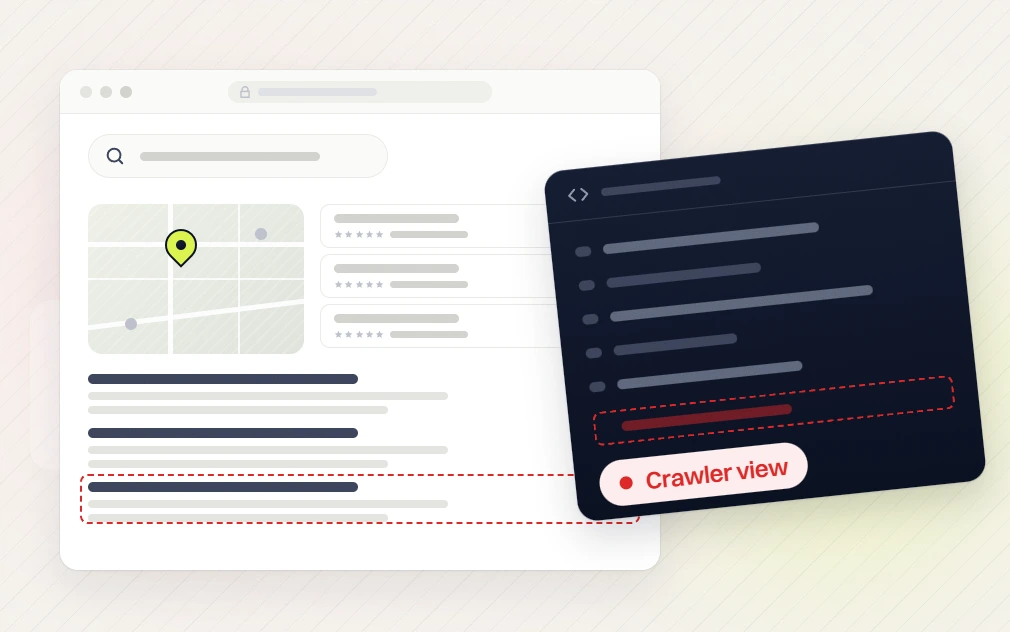
Vendor IDX iframes render client-side. Google skips 38 percent of listing pages and hands the intent to Zillow and Realtor.com. Every listing needs server-rendered HTML, canonicals that resolve to your domain, and Product plus RealEstateListing schema. Otherwise the feed spawns 8,000 URLs Google will not index, and the portals eat every buyer query.
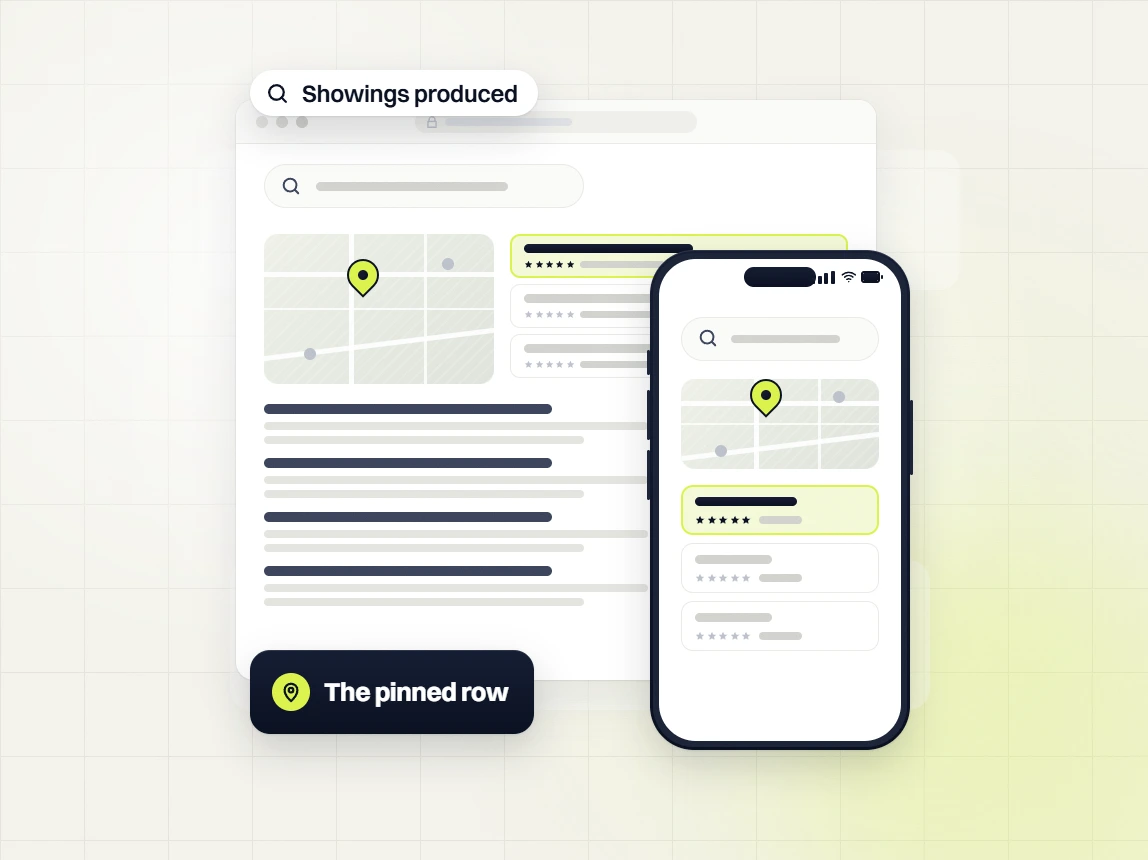
Zillow and Realtor.com outrank you on every city query
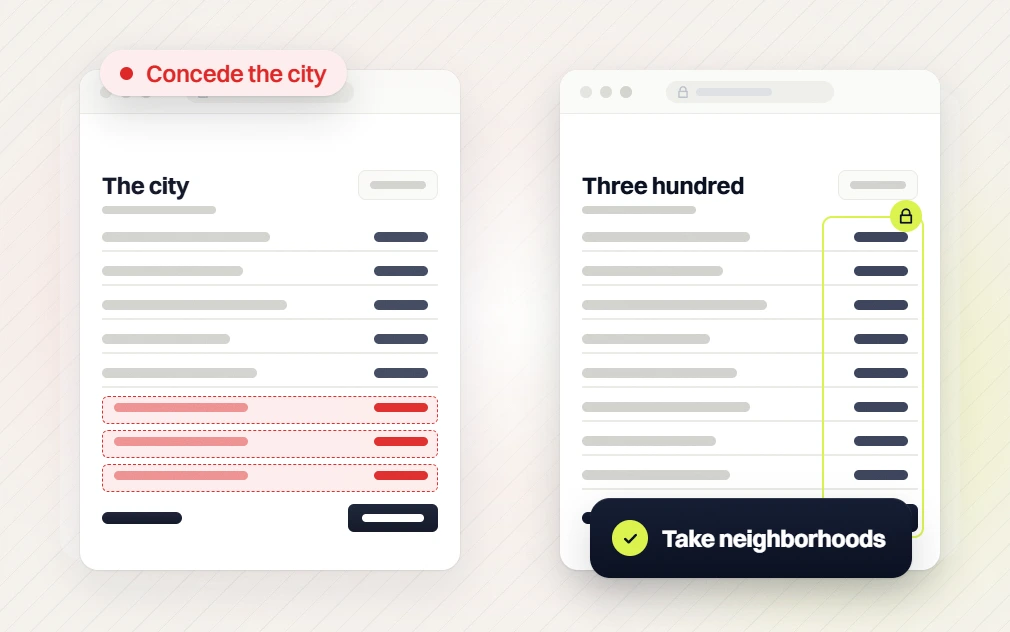
Zillow owns broad city queries with decades of authority. Brokerages win on neighborhood, school-district, and community pages the portals struggle to build with local depth. Fighting for "homes for sale in [city]" burns budget. Publishing 30 to 300 neighborhood pages with agent-authored depth is the only ranking path that works against the portals.
Agent bios and seller AVM pages launch without schema markup
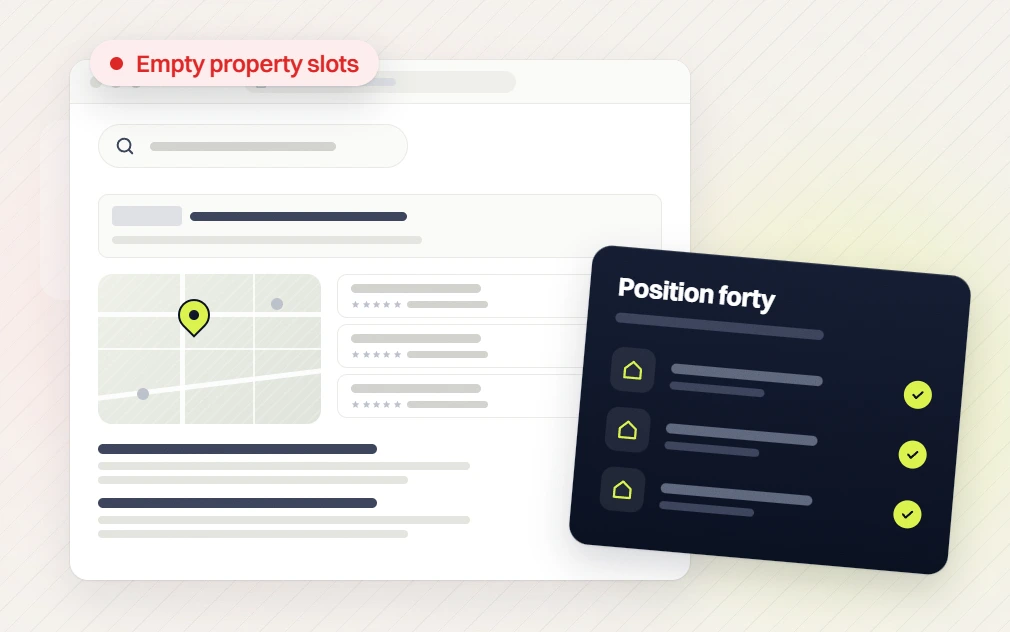
Agent bios need RealEstateAgent schema with license, review count, and area served. Seller AVM landing pages need Product schema so Google can rank them. Most brokerages go live with neither, so bios never rank and AVM pages sit at position 40. Every high-value page needs the right schema on day one.
Three outcomes every real estate SEO retainer earns
Content strategy, technical fixes, and earned links push your neighborhood and community pages in front of buyers and sellers ready to book or list.
One page per neighborhood, school district, and community, launched with RealEstateAgent, Product, and LocalBusiness schema plus clean internal linking.

Weekly ranking dashboards, plus a written monthly review. Every ranking gain traces back to a showing booked in Follow Up Boss, CINC, kvCORE, or BoomTown.
Four stages, every step ends in a sign-off
Fixed scope, written sign-offs, dates on the calendar. Nothing moves to the next stage until your broker-owner approves the gate deliverable. Your launch date does not slip.
Audit that exposes every gap
Technical audit against Core Web Vitals and IDX indexation, content audit against the 15 category clusters we prioritize for real estate, backlink audit with toxic-link disavow, and a local audit covering GBP, NAP consistency, and review posture across real estate directories. Written 30-page report you approve before any content work starts.
Keyword strategy tied to closed transactions
Build the real estate keyword cluster map ("homes for sale near me", neighborhood queries, school-district queries, and 14 more category clusters) and lay every keyword against buyer or seller intent. Each cluster gets a showings booked projection so you see which content pays back first. 12-month calendar plus 90-day priority queue signed off before we publish anything.
On-page and technical fixes weekly
Three neighborhood, community, and school-district pages published weekly with RealEstateAgent, Product, and LocalBusiness schema. IDX rendering fixed, thin content expanded, broken links repaired, Core Web Vitals pushed to green, XML sitemap and robots.txt optimized. Every push live goes into your weekly written report.
Scale, GBP, digital PR, reporting
Google Business Profile work per office, four earned placements a quarter in real estate publications and local news, citation cleanup across Zillow, Realtor.com, Trulia, and Homes.com profiles, and 300-plus keyword rank tracking reconciled monthly against showings booked in Follow Up Boss or CINC. Ongoing, not a one-time push.
What you actually get from our real estate SEO services
Five workstreams, every item listed. Nothing lives in a proposal appendix or a phase-two column.
Diagnose before we prescribe
Every real estate SEO engagement opens with a full audit across four disciplines, scored and prioritized by showings booked impact. You see the fixes that pay back first, the toxic links pulling rankings, and the local footprint gaps Zillow and Realtor.com are exploiting in your metro. Sign-off before any content or link work starts.

crawl, IDX render, indexation, LCP / CLS / INP scored against Zillow, Realtor.com, and the top-3 brokerages in your metro.
neighborhood, school district, community, buyer guide, seller guide, market report, agent bio, and AVM clusters mapped to every existing page.
every referring domain scored, PBN and Fiverr link patterns flagged, disavow file drafted for Google Search Console upload.
GBP, NAP consistency, and citation coverage across Zillow, Realtor.com, Trulia, Homes.com, and 45+ real estate directories checked and mapped.
RealEstateAgent, Product, RealEstateListing, LocalBusiness, FAQPage, and BreadcrumbList markup validated against Google guidelines.
every fix scored by traffic impact and showings booked value, so week-one work pays back first.
One page per neighborhood, per school district
Every high-value neighborhood, community, and school district gets its own dedicated 1,500-word page written in-house around real buyer and seller intent. Agent-interviewed neighborhood pages, school-district pages, market reports, buyer and seller guides, and AVM landing pages. Each page rolls out with RealEstateAgent, Product, or LocalBusiness schema and copy built around the real queries buyers and sellers type before they book a showing or list.
homes for sale + neighborhood, market report + neighborhood, best neighborhoods for + persona. Each page built for a specific ZIP-level buyer or seller.
1,500+ words minimum with market data, timeline, financing options, and what happens on the first showing or listing appointment answered on-page.
RealEstateAgent, Product, RealEstateListing, LocalBusiness, FAQPage, and Review schema validated before publish.
real questions sourced from your Follow Up Boss logs and PAA data, structured for AI extraction and rich snippets.
topical clusters linked back to neighborhood pages so authority flows to the pages that book showings, not vanity blog posts.
30 to 60 minute interviews with top-producing agents so pages read like your brokerage, not a template.
Own the local map pack per office
Around 44 percent of real estate clicks land on the top 3 map results or Google Business Profile, not on the brokerage website. We rebuild every office Google Business Profile from categories to services to Q&A, seed real buyer and seller questions, wire CRM-triggered review requests to Follow Up Boss, CINC, kvCORE, BoomTown, or Sierra Interactive, and clean the citation trail across Zillow, Realtor.com, Trulia, and Homes.com profiles.
Real estate agency primary, 3 secondary categories, services, project photos, and Q&A seeded from real buyer and seller questions.
Zillow, Realtor.com, Trulia, Homes.com, Redfin, and 40+ real estate directories audited, corrected, and monitored monthly.
Follow Up Boss, CINC, kvCORE, BoomTown, and Sierra Interactive wired to automated review requests within 24 hours of closed transactions.
grid-based tracking across your service area so you see rank on every neighborhood, not just downtown.
one map-rich page per office with agents, response times, service lines, and neighborhoods covered in that office.
new listings, open house spotlights, sold notices, and market updates published weekly to keep every office profile active and ranked.
Earned links, not bought links
Ranking above Zillow, Realtor.com, and Trulia takes real authority. We earn placements in local news, real estate publications, and community sites your competitors miss. Every link is manually reviewed, and toxic prior links from Fiverr or PBN placements get disavowed so ranking gains hold instead of vanishing in the next algorithm update.
community-angle pitches to metro news outlets and lifestyle press placed by a real PR lead, not a bot.
guest features and expert commentary in real estate industry outlets your referrers and clients read.
local schools, HOAs, chamber events, and neighborhood associations matched to your brokerage for defensible authority signals.
Fiverr, PBN, and spammy links inherited from prior agencies filed in a disavow file for Google Search Console review inside 30 days.
404 links on real estate and community sites replaced with links to your neighborhood pages through direct outreach.
MLS association, franchise brand affiliate pages, and NAR-affiliated directory listings claimed for defensible brand-anchored backlinks.
Every report ties to showings booked
A live ranking dashboard tracks 300+ real estate keywords in real time, and a written monthly report reconciles organic traffic against showings booked and signed listing agreements in Follow Up Boss, CINC, kvCORE, or Sierra Interactive. You see which query bought which showing, and cost per booked showing by neighborhood. Rank 1 with an empty appointment book does not count.
300+ keywords, refreshed weekly, with movement flags on money terms so you see gains before month-end.
organic sessions tied to showings booked and signed listings pulled from Follow Up Boss, CINC, kvCORE, BoomTown, or Sierra Interactive, not to keyword counts.
every call and form attributed to source, campaign, neighborhood page, and query with cost per booked showing by neighborhood.
map pack impressions, calls from GBP, direction requests, and review velocity trended monthly per office.
monthly delta vs Zillow, Realtor.com, Trulia, and your 3 closest local brokerages on every money term.
GBP, Search Console, GA4, and Tag Manager stay in your brokerage accounts. Walk away from us, the footprint stays.
Four SEO tiers for every stage of growth
Pick the tier that matches your practice today. Move up or down with 30 days notice. Hover any feature name for a plain-English explanation of what it moves in your funnel.
Single-location testing local SEO, or recovering from a bad agency.
Growing brands owning the local pack. Organic tied to bookings.
Two to ten locations, organic across service areas and lines.
Enterprise or 11+ locations. Systematic SEO for new openings.
Every SEO feature, tier by tier
HOVER FOR DETAILPages + content +
SEO + local +
Reporting + analytics +
Support + onboarding +
Compliance + enterprise +
Team + service level +
Other +
Real brokerages, real numbers
See what a $400/mo dental site could book back.
Slide in your practice numbers. Assumes a 32% relative conversion improvement, below the median gain on our dental rebuilds.
Common real estate SEO questions
Straight answers on pricing, timelines, IDX indexation, GBP, neighborhood content, and what actually gets done each month. If your question is not here, book the audit call.
How much should I pay for SEO services?
+
Real estate SEO services at Redefine Web run from $499 to $3,500 per month across 4 tiers. Foundation is $499 per month for solo agents in a single city. Growth is $999 per month for small teams or boutique brokerages building neighborhood content. Authority is $1,999 per month for multi-office brokerages scaling local and content SEO together. Enterprise starts from $3,500 per month for larger brokerages needing per-office content operations and portfolio-level reporting. Every tier includes technical SEO, on-page work, local SEO for offices with physical locations, neighborhood content publishing, link earning, and monthly reporting. Higher tiers add per-office Google Business Profile management, per-neighborhood content clusters, and dedicated content production coordinators. Ad spend for Google Ads or Meta is billed separately and stays optional. Most brokerages get the fastest return by running real estate SEO services and paid ads together in the first 6 months. Cheaper than $499 per month typically buys template content that will not rank against Zillow.
Is SEO dead or evolving in 2026?
+
SEO is evolving fast in 2026, not dead, especially for real estate. Google added AI Overviews and Search Generative Experience to results pages, which cut click-through on informational queries but left commercial queries like “homes for sale in [neighborhood]” and “realtor near me” mostly intact. Buyers and sellers still click through to brokerage sites when they are ready to book a showing or list. What died is thin, template, keyword-stuffed content. What works now is deep, agent-authored neighborhood content with clear structured data, real reviews, and strong Google Business Profile signals. Our real estate SEO services shifted 3 years ago toward EEAT signals (author bios, review counts, closed transactions on-page), Google’s core structured data guidance, and content depth. Brokerages that publish thin AI content lose. Brokerages that publish real, useful content from real agents keep winning organic buyer and seller leads at a lower cost per lead than paid channels can match. That has not changed since 2019.
What is the 80 20 rule of SEO?
+
The 80 20 rule of SEO says 80 percent of your organic traffic comes from 20 percent of your pages. In real estate SEO services work, that 20 percent is almost always your neighborhood pages, school-district pages, and top-producing agent bios. We use the 80 20 rule to prioritize which pages get investment. Instead of publishing 200 thin blog posts, we build 30 to 50 deep neighborhood and community pages that carry the ranking load. Every audit at Redefine Web opens by finding your current top 20 percent, then spending 80 percent of the retainer on making those pages stronger with schema, internal linking, agent-authored depth, and freshness updates. New pages fill gaps in the 20 percent. Blog content supports the neighborhood pages, not the other way around. This is why our brokerage clients see faster ranking gains than agencies that publish weekly blog posts on generic topics. Focus on the pages that move revenue, and the rest of the site follows the same trend inside 6 months of steady work.
Is SEO still worth it in 2026?
+
For real estate, yes. Real estate SEO services are one of the highest-ROI channels available to brokerages in 2026, because organic buyer and seller leads convert at 3 to 5 times the rate of cold portal leads and cost nothing per lead once ranked. Paid ads on Google and Meta keep getting more expensive as Zillow and Realtor.com bid up every commercial query. Organic rankings on neighborhood, school district, and community queries are the only path most brokerages have to a lead cost under $80 per closed showing. AI Overviews cut click-through on some informational searches, but buyer and seller intent queries still send clicks to brokerage sites. The brokerages winning in 2026 are the ones that invested in SEO 12 to 24 months ago. Starting now is late, not too late. Waiting another 12 months is too late, because your local competitors will have compounded another year of authority you cannot buy back with a bigger ad budget.
What are the 4 types of SEO?
+
The 4 types of SEO are technical SEO, on-page SEO, off-page SEO, and local SEO. Every real estate SEO services retainer at Redefine Web covers all 4. Technical SEO fixes IDX and MLS listing indexation, Core Web Vitals, schema markup (RealEstateAgent, Product, LocalBusiness, RealEstateListing), XML sitemaps, and crawl budget on every listing URL. On-page SEO writes neighborhood pages, school-district pages, buyer and seller guides, market reports, and AVM landing pages with keyword-mapped titles, headings, and body content. Off-page SEO earns backlinks through digital PR to real estate publications, local news, and community sites, plus toxic backlink disavow from prior agencies. Local SEO manages Google Business Profile per office, citation cleanup across Zillow, Realtor.com, Trulia, and Homes.com profiles, and CRM-tied review generation. Skipping any of the 4 types leaves ranking gains on the table. Zillow beats brokerages on domain authority. Brokerages beat Zillow on local depth, but only when all 4 types run together every month.
How much does an SEO agency cost?
+
A real estate SEO agency in the United States typically charges between $2,000 and $10,000 per month for brokerage-grade work. Anything under $1,000 per month usually buys template content or overseas link building that will not rank against Zillow. Redefine Web sits at the lower-mid end of the range: $499 to $3,500 per month across 4 tiers, because we run in-house with a small team and no offshore content. Enterprise brokerages with 20 plus offices sometimes need custom quotes above $5,000 per month, especially when franchise brand affiliations require per-office reporting layers. Contract length is typically 6 months, because real estate SEO takes 90 to 180 days to show ranking gains and 6 months to show revenue gains. Month-to-month agencies exist but rarely deliver results on real estate SEO because the ranking timelines do not match a 30-day commitment window. Ad spend for Google Ads or Meta is always billed separately from retainer, and you own every account, listing, and page we build for your brokerage.
How to choose a real estate SEO agency?
+
Ask 6 questions when choosing a real estate SEO agency. One, do you have brokerage case studies with ranking screenshots and CRM-reconciled lead numbers, not vanity traffic charts? Two, who writes the neighborhood content, in-house real estate writers or offshore generalists? Three, how do you handle IDX indexation and RealEstateListing schema? Four, what CRM integrations do you support (Follow Up Boss, CINC, kvCORE, BoomTown, Sierra Interactive) for reporting? Five, what is your link earning approach, digital PR or paid placements? Six, what happens on cancellation, do we keep the accounts, content, and site? Any agency that dodges these answers is not ready to run real estate SEO services at scale. Check NAR resources for real estate marketing standards and Fair Housing compliance before signing. A good agency will match those standards on every deliverable, not push you to relax them, and will hand over every account and asset the day you decide to leave.
Who are the biggest SEO companies?
+
The biggest SEO companies globally include enterprise generalists like WebFX, Seer Interactive, Distilled (now Brainlabs), Victorious, and Ignite Visibility. In real estate on its own, the biggest names include Luxury Presence, Real Estate Webmasters, and BoomTown for full-stack website plus SEO combos. Redefine Web positions differently. We focus on in-house real estate SEO services with a small team, deep vertical knowledge, and per-office reporting. Bigger is not always better in real estate SEO. Enterprise agencies often assign junior account managers to smaller brokerages, and vertical specialists sometimes cost 3 to 5 times more without matching ranking outcomes. When choosing between big and boutique, ask who will actually work on your account day to day, what their real estate portfolio looks like, and whether they can name your top 3 local competitors on the discovery call. If they cannot, they are not doing the research they will charge you for over the first 6 months of the retainer.
How to do SEO for a real estate website?
+
Real estate SEO for a brokerage website breaks into 5 workstreams that all run together. One, fix IDX and MLS listing indexation with server-side rendering, canonical tags that resolve to your domain, and RealEstateListing schema on every listing URL. Two, publish 30 to 300 neighborhood, school district, and community pages with 1,500 words of agent-authored depth, RealEstateAgent schema, and internal links back to the buyer and seller hub. Three, optimize Google Business Profile per office with categories, services, photos, weekly posts, and CRM-tied review requests. Four, earn backlinks from local news, real estate publications, and community sites through digital PR, and disavow toxic prior links. Five, report weekly rankings and monthly organic-to-showings-booked reconciliation from Follow Up Boss, CINC, kvCORE, BoomTown, or Sierra Interactive. Skip any step and rankings plateau. Do all 5 for 6 months and neighborhood queries move to page 1. Broad city queries (like “homes for sale in Denver”) stay owned by Zillow. Fight neighborhoods, not cities.
What does a real estate SEO agency do each month?
+
A real estate SEO agency runs 4 workstreams every month: technical fixes, local SEO, content publishing, and link earning. At Redefine Web, every retainer gets a written scope with owner names and due dates before work begins. Technical work covers Core Web Vitals, RealEstateAgent and Organization schema, canonical hygiene on IDX and MLS-generated listing URLs, XML sitemap health, and rendering audits so Google actually indexes the listings. Local SEO covers Google Business Profile optimization, citation building on Zillow, Realtor.com, Trulia, and Homes.com profiles, and review generation flows tied to Follow Up Boss, CINC, or kvCORE. Content publishing hits neighborhood pages, school-district pages, buyer guides, seller guides, market reports, and seller AVM landing pages, 3 pages per week on Growth and above. Link earning uses digital PR pitches to real estate publications, local news outlets, and neighborhood association sites. Every push live goes into your weekly written report, and the monthly report reconciles organic traffic to booked showings.
How do you handle IDX and MLS pages so Google indexes them?
+
IDX and MLS listing pages are the biggest indexation problem in real estate SEO. Vendor iframes render client-side, canonicals often point back to Zillow or the MLS feed, and pagination spawns thousands of thin duplicate URLs. Google marks 30 to 40 percent of listing pages as discovered not indexed and ignores them. Our real estate SEO services fix this with server-side rendering of listing HTML, canonical tags that resolve to your domain, schema for every listing (Product plus RealEstateListing markup where the MLS agreement allows), noindex on pagination and filter combinations that create thin duplicates, and XML sitemap coverage on active listings. Inside Search Console coverage report, we verify every week that discovered not indexed listing count drops. Most brokerages see indexation climb from 60 percent to 90 plus percent inside 90 days. The gain on organic listing traffic from that alone typically pays back the first 3 months of retainer, before any neighborhood content ranks. It is the highest-return single fix in real estate.
Do you offer real estate SEO for multi-office brokerages and franchise networks?
+
Yes. Multi-office real estate SEO services live on our Authority tier at $1,999 per month for brokerages with 2 to 5 offices, or on Enterprise from $3,500 per month for brokerages with 5 plus offices or franchise networks with multiple brand affiliations. Multi-office work adds per-office landing pages with local SEO signals, per-office Google Business Profile management, per-location review generation, and per-office citation building. Content strategy prevents duplicate content issues while still ranking every office locally, so each location has its own neighborhood clusters. Reporting rolls up to brokerage-level dashboards plus per-office detail so the marketing director sees the roll-up and the office managing broker sees their own numbers. Franchise brokerages get a single account team across all franchise offices with shared engineering, a shared link-earning calendar, and per-office strategy leads. Institutional knowledge builds across the network instead of getting siloed by office, and the monthly review names owner, dates, and next-month plan per office.
How long does real estate SEO take to show ranking results?
+
Most brokerages see first local map-pack gains in 3 to 6 weeks. First organic ranking gains on neighborhood pages typically appear in weeks 6 to 8. Local queries like “realtor near me” or “homes for sale [neighborhood]” usually rank in the map pack by month 4. Compounding organic buyer and seller lead volume shows up by month 6 to 9. Local SEO moves faster than content SEO because Google Business Profile signals, citations, reviews, and proximity are easier to move than deep content authority. Brokerages in less competitive markets or with unique specialties see faster local ranking gains than brokerages in major metros fighting 30 plus established brokerages plus Zillow. New brokerage domains under 12 months old rank slower because Google trusts them less. Established brokerages with prior organic footprint move faster. Recovery from a bad prior real estate SEO agency takes 3 to 6 months of cleanup before growth resumes. Real, ranked page-one revenue growth from neighborhood queries usually lands in month 6 or 7 for a healthy brokerage domain.
Can real estate SEO recover from a previous agency that hurt our rankings?
+
Yes. Post-agency recovery is one of the most common projects new real estate clients start with. First 30 to 45 days go to a full technical audit, backlink audit with disavow file, content audit that identifies thin or off-topic pages, and a written recovery roadmap with dates and owners. Manual penalties get reconsideration requests filed with Google. Algorithmic drops from the Helpful Content update or Product Reviews update get content rewrites, EEAT signals added, and thin AI-generated content either rewritten with real agent expertise or removed. Toxic link profiles from prior agencies that bought Fiverr links or PBN placements get disavowed and slowly replaced with editorial links from real estate publications and local news. Recovery timelines run 3 to 9 months depending on severity. Redefine Web publishes a monthly recovery scorecard so you see disavow progress, indexation change, and ranking recovery in one report. Bad prior agency work rarely destroys a domain, but it always slows growth until fully cleaned.