
Shopify vs woocommerce seo is the question every store owner asks before committing to a platform. The honest answer. Both platforms rank well when built correctly, and both fail when neglected. What really differs is the setup cost, the technical ceiling, the customization freedom, and the total cost of ownership as the catalog grows past 500, 2,000, and 5,000 SKUs. This guide breaks down every one of those inputs against real store scenarios. Founders comparing agency options can vet a good woocommerce web design agency partner before scoping the build.
You’re likely reading this since a friend swore Shopify is easier or a WordPress developer swore WooCommerce ranks better. Both are half right. Below you get the ranking mechanics comparison, the schema and Core Web Vitals breakdown, the URL structure control differences, the cost benchmarks by store size, the migration realities, and the decision framework that tells you which platform fits your team and your catalog. Bring your projected 12-month revenue plan. Every recommendation below reads better with your growth assumptions next to it. Teams reviewing this alongside our ecommerce seo audit checklist land on tighter priority stacks faster.
Core Web Vitals and speed in shopify vs woocommerce seo
Shopify loads faster on average. The platform runs on a global CDN with edge caching by default. A default Shopify store on Dawn theme loads in 1.8 to 2.4 seconds on mobile. A default WooCommerce store on cheap shared hosting loads in 3.5 to 5.5 seconds. The gap closes with proper WooCommerce hosting and caching.
Well-configured WooCommerce on Kinsta, WP Engine, or Rocket.net with WP Rocket and Perfmatters produces load times on par with Shopify. Yet WooCommerce speed demands ongoing attention. Theme updates can slow the store, plugin conflicts can add render-blocking scripts, and image compression can drift. Shopify’s platform manages the speed baseline consistently no matter the theme choice.
Core Web Vitals scores matter for ranking. A product page in the red on Largest Contentful Paint ranks 3 to 8 positions below a competitor’s page in the green on the same query. Shopify’s default green scores give newer stores a 2 to 4 month ranking advantage during the window when the WooCommerce competitor sorts out their caching stack. After that first year, both platforms perform equally when both are configured correctly.
The WooCommerce speed variance is where store owners get burned. A store owner who launches WooCommerce on cheap hosting (Bluehost, HostGator) reads that WooCommerce ranks well and cannot understand why the store is stuck on page 5 for the flagship term. The answer is almost always a 4.5 second LCP that the store owner never measured. Fixing hosting and caching moves rankings 3 to 8 positions within two crawl cycles. Shopify never has this problem. The platform handles the infrastructure for you.
Schema, URL structure, and technical SEO control
WooCommerce hands you full technical control over meta, schema, URL structure, templates, and the performance stack. You can rewrite category slugs, add custom breadcrumbs, output Product schema with your own fields, and stack multiple schema plugins for FAQ, HowTo, or LocalBusiness markup on the same page. Rank Math and Yoast both plug into WooCommerce cleanly. So do custom PHP templates when the plugin option doesn’t fit.
Shopify offers strong SEO foundations with a few structural limits. The platform ships automatic canonical tags, sitemaps, and clean product URLs out of the box. Product pages get Product schema by default on most modern themes. Yet the URL pattern is locked. Every product sits under /products/ and every collection under /collections/. You cannot flatten that to a single /category/ path, and you cannot nest categories into a tiered structure like /living-room/sofas/sectional/ without app workarounds.
For most stores under 500 SKUs, the Shopify URL limit is invisible. The store owner never needed a tiered structure to begin with. For stores at 2,000+ SKUs with genuine category depth, that limit forces awkward workarounds, tag pages, or Shopify Plus custom development. WooCommerce lets you build the URL tree the taxonomy actually needs.
Cost of ownership over 3 years compared
Total cost of ownership decides the right platform for a store’s revenue tier. Shopify Basic runs $39 per month. Shopify Standard runs $105 per month. Shopify Advanced runs $399 per month. Shopify Plus starts at $2,000 per month. WooCommerce is free but demands hosting ($15 to $500 per month), premium themes ($60 to $200 one-time), and premium plugins ($200 to $500 per year). See our related ecommerce digital marketing agency for how paid, SEO, email, and retention fit under one retainer.
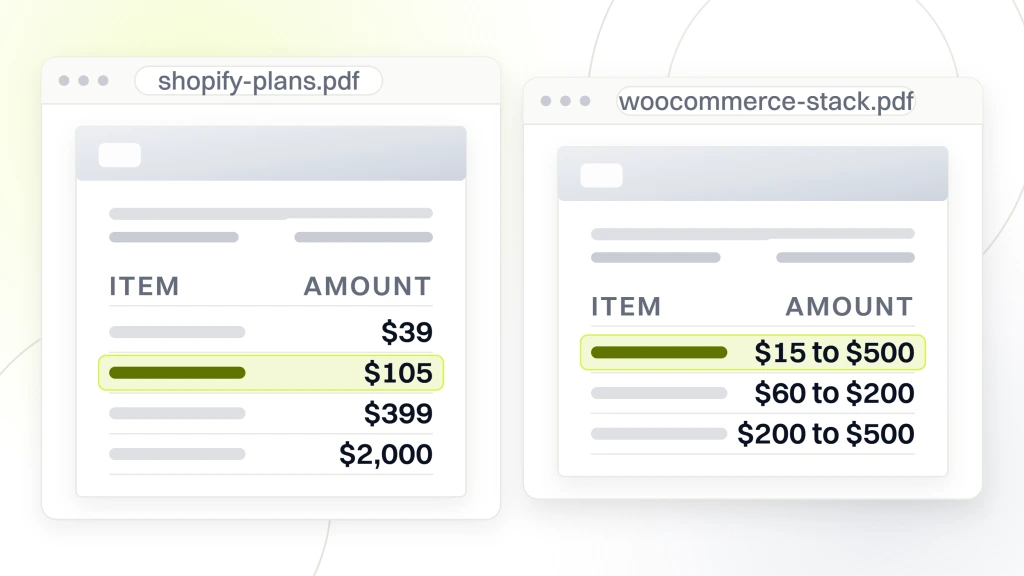
Under $500K annual revenue, Shopify Basic or Standard is usually the cheaper total cost once you count the developer time WooCommerce needs for theme customization, plugin conflicts, and Core Web Vitals maintenance. Above $2M annual revenue, WooCommerce becomes cheaper than Shopify. The platform fees on Shopify Advanced or Plus start to dominate the total cost. Between $500K and $2M, either platform costs roughly the same and the choice comes down to team preference. Once the platform pick is made, brands should pair this comparison with our writeup on the broader ecommerce seo strategies that apply across both stacks.
| Store revenue tier | Shopify total cost | WooCommerce total cost | Winner on cost |
|---|---|---|---|
| Under $500K per year | $470 to $1,400 per year | $800 to $2,200 per year | Shopify |
| $500K to $2M per year | $1,400 to $6,000 per year | $2,200 to $6,500 per year | Roughly equal |
| $2M to $10M per year | $6,000 to $28,000 per year | $4,000 to $14,000 per year | WooCommerce |
| $10M+ per year | $28,000 to $80,000 per year | $10,000 to $30,000 per year | WooCommerce Plus enterprise host |
The cost math shifts once you factor in agency time. Shopify agencies charge premium rates. The developer pool is smaller. A Shopify developer costs $95 to $185 per hour compared to $60 to $120 per hour for a WooCommerce developer. That gap matters for stores running frequent theme customization work every quarter. Stores that never touch the theme after launch see minimal agency cost difference between platforms over the life of the store.
App and plugin ecosystem effects on ranking
Shopify’s app store has 8,000+ apps. WordPress has 60,000+ plugins with 3,000+ built for WooCommerce use. Both ecosystems cover the main SEO use cases (schema, rank tracking, redirects, sitemaps, reviews, image optimization). The quality gap is smaller than platform advocates claim.
Shopify apps are more consistent in quality. Shopify vets every app before listing. WordPress plugins are more numerous but quality varies widely. A store owner can pick a bad WooCommerce plugin from a $19 flea market of options. Shopify’s curation removes the worst options. Yet the curation adds monthly fees on many apps that WordPress equivalents charge one-time.
For SEO work, both ecosystems have proven stacks. Shopify SEO apps. Yoast for Shopify, Booster: Sitemap & SEO, Judge.me for reviews, Loox for photo reviews, plus.this for schema. WooCommerce SEO plugins. Rank Math, Yoast SEO, All in One SEO, Reviews.io integration, Perfmatters. Both stacks produce equivalent SEO outcomes when configured by someone who knows what they are doing.
The one area where Shopify apps pull ahead is review integration. Judge.me and Loox handle product review widgets, schema markup, and email automation better than most WooCommerce equivalents. Stores that depend on review-driven conversion (jewelry, cosmetics, apparel) benefit from Shopify’s review ecosystem. WooCommerce catches up if the store uses Reviews.io or Trustpilot Business integration, both of which run $89 to $299 per month on top of the WooCommerce base.
Content marketing, blogging, and topical authority
WooCommerce runs on WordPress, so blogging and content marketing are native to the stack. You get full Gutenberg block editing, custom post types on click, cornerstone content flags in Rank Math, and topic-cluster structure without third-party apps. That’s the reason big WooCommerce stores rank for hundreds of informational keywords beyond product terms.
Shopify’s blog engine is functional but plain. You can publish posts, add tags, and set meta titles. Yet you cannot easily build silo structures, custom post types, or programmatic landing pages without Shopify Plus or a headless setup. Content-heavy DTC brands often bolt a WordPress instance onto a Shopify store to get the content muscle back. That works but adds hosting and integration cost.
For stores that plan to rank on 500+ informational and commercial queries over 24 months, WooCommerce gives a cleaner content path. For stores focused only on transactional product and collection terms, Shopify’s blog is enough. Match the content ambition to the platform before launch.
International, multi-currency, and multi-language SEO
Shopify Markets ships built-in multi-currency, multi-region pricing, and local domain routing (.co.uk, .de, .fr). The setup is faster and the tax logic is baked in. For a store selling to 3+ countries out of the gate, Shopify Markets on Shopify Advanced or Plus is the fastest path to launch.
WooCommerce handles international through plugins. WPML for translation, WooCommerce Multilingual for product content, Aelia for currency switching, plus a solid hosting stack that serves each region. The setup takes 2 to 4 more weeks than Shopify Markets but produces a more customizable output. Enterprise sites past $10M revenue often run this WooCommerce stack since the URL and hreflang control is worth the setup pain.
Migration considerations before switching platforms for shopify vs woocommerce seo
Migrations produce short-term ranking dips of 15 to 30 percent that take 2 to 4 months to recover, even with a clean redirect map. That dip alone is why most SEO consultants advise against migrating for SEO reasons alone. The stronger cases for migration. Cost of ownership past $2M revenue, need for custom checkout, or need for category page copy freedom.
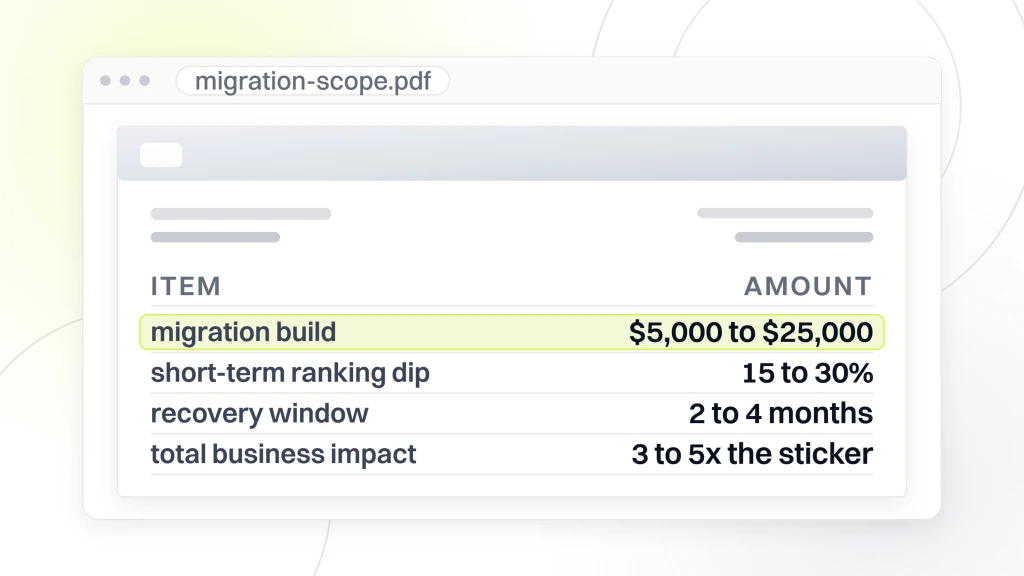
The migration itself costs $5,000 to $25,000 depending on catalog size, integration complexity, and whether the current store uses custom features that need rebuilding on the destination platform. That budget covers data migration, theme rebuild, redirect map, and post-launch cleanup. It does not cover the ranking recovery time or the revenue loss during the transition. Total business impact of a migration usually lands at 3 to 5x the sticker cost.
Redirect maps are where migrations succeed or fail. Every current URL needs a mapped destination URL and a 301 redirect. Missing redirects on high-revenue URLs cost 20 to 60 percent of that URL’s traffic within 30 days. A migration team that skips the URL audit and asks the merchant to “fix redirects after launch” is setting up a 3 to 6 month recovery cycle instead of a 6 to 8 week one.
RAFZ Cirkulära Interiörer, a Swedish sustainable furniture brand, ran a full custom rebuild on WooCommerce and saw conversion rate climb 28 percent, page load drop from 15 seconds to 2 seconds, and server requests fall 82 percent post-launch. Their choice to stay on WooCommerce with a lightweight custom theme let the team keep URL control and add a place2place API integration that Shopify Basic couldn’t have supported natively. See the web.dev ecommerce guidance for the technical baseline every migration team should hit before switching platforms.
Team and skill considerations by store size
Platform choice hinges on the team running the store. A marketing lead with no WordPress experience will run Shopify better than WooCommerce. A merchant with a WordPress developer on staff will run WooCommerce better than Shopify. Neither is objectively easier for every team.
Shopify’s admin UI is friendlier for non-technical merchants. Product creation, order management, discount setup, and shipping rule configuration all sit inside one clean UI. WordPress admin is more powerful yet demands knowing which plugin controls which setting. Merchants who came from Shopify to WooCommerce report the plugin sprawl learning curve is the hardest part of the transition.
For SEO work, Shopify’s constraints hurt smaller teams less than they hurt larger teams. A solo merchant on Shopify never notices the URL structure limitation. They have 30 products and 5 collections. A 5-person e-commerce team on Shopify running a store with 3,000 SKUs hits the limitation daily and works around it with apps, workarounds, and custom Liquid. The same store on WooCommerce lets the same team do the work natively without workarounds.
How to pick between Shopify and WooCommerce for a new store launch
Pick Shopify if the store has under 500 SKUs, the team has no WordPress developer, revenue is under $500K annually, and time to launch matters more than URL structure control. Pick WooCommerce if the store has 2,000+ SKUs, a WordPress developer on staff, revenue above $2M, or category page copy freedom is a business requirement.
Between the two extremes, the decision comes down to team preference and what the merchant is willing to run day to day. A merchant who wants to focus on marketing and product picks Shopify. A merchant who wants full control and can manage a plugin stack picks WooCommerce. Both platforms produce winning stores in the same category. The difference is who runs them.
- Under 500 SKUs, non-technical team, under $500K revenue. Shopify Basic or Standard
- 500 to 2,000 SKUs, mixed team, $500K to $2M revenue. Either platform, tiebreaker is team preference
- 2,000 to 5,000 SKUs, technical team, $2M+ revenue. WooCommerce on managed WordPress hosting
- 5,000+ SKUs, dev team on staff, $5M+ revenue. WooCommerce Plus or Shopify Plus depending on custom needs
- Multi-country, multi-currency, complex tax needs. Shopify Plus for infrastructure, WooCommerce for URL control
- Custom checkout requirement (subscription, quote, B2B). WooCommerce or Shopify Plus (not Basic or Standard)
- Time to launch under 6 weeks. Shopify (WooCommerce launches take 10 to 14 weeks average)
The decision is not permanent. Migrations happen. Around 12 percent of Shopify Plus stores migrate to WooCommerce or headless commerce every 3 to 5 years as they scale past $10M revenue. Around 8 percent of WooCommerce stores migrate to Shopify when they hit a stage where infrastructure management becomes a distraction. Neither direction is a mistake if the reason is right.
Where BigCommerce fits in the shopify vs woocommerce seo debate
BigCommerce sits between Shopify and WooCommerce on the technical control axis. The platform provides solid native SEO features. Editable URLs, native canonicals, faceted search, and Product schema out of the box. Merchants can implement SEO best practices without extensive technical knowledge, and the platform handles hosting and security updates like Shopify does.
The tradeoff. BigCommerce has a smaller app ecosystem (1,300+ apps) and a smaller developer pool than Shopify. Pricing runs $39 to $399 per month on standard plans, with BigCommerce Enterprise for high-volume stores. For merchants who want Shopify-style managed infrastructure with more URL flexibility, BigCommerce is a real option. For merchants who want maximum technical control, WooCommerce still wins. For merchants who want the largest app ecosystem and the fastest launch, Shopify still wins.
What to do this week to lock in a platform decision
Pick three actions from the list below and finish them by Friday. A prepared merchant makes a better platform decision by grounding the choice in their actual constraints rather than the general internet consensus that shifts every quarter with each new agency’s blog post.
Most store owners start the decision without knowing their actual SKU count, category depth, or projected 12-month revenue. Those three numbers alone decide 80 percent of the platform choice. The seven actions below produce the numbers and the honest team assessment needed to pick without regret.
- Count current SKUs and projected SKUs at 12 and 24 months out
- Map current categories and projected category depth (top level, second level, tags)
- Estimate 12-month revenue against the platform cost tiers in the table above
- Audit your team’s WordPress and Liquid experience honestly, not aspirationally
- List the three custom features the store must have (subscription, quote, custom checkout, B2B pricing)
- Test both platforms with a 14-day trial building the same 5 SKUs and 2 categories
- Get two agency quotes for a launch on each platform for direct cost comparison
The Ecommerce SEO Services for DTC Brands page at Redefine Web covers ongoing SEO work on both Shopify and WooCommerce stores under a shared retainer format. For stores wanting design and build support during the platform launch, the Ecommerce Website Design Services team handles both Shopify and WooCommerce builds. Related reading in the Best E-commerce Platforms for SEO in 2025 guide compares against BigCommerce and Magento, and the WooCommerce SEO Services for Growth-Focused Stores guide covers the WooCommerce-specific execution.
Shopify vs woocommerce seo is not a one-answer question. Both platforms rank well when configured correctly, both fail when neglected, and both have team-fit conditions that matter more than any technical benchmark. The Ecommerce Marketing Retainer Plans from $1,499/mo covers ongoing execution on either platform. Stores growing organic revenue steadily are the ones that picked the platform matching their team and then ran the same boring category page work every month for 12 months. That is the entire trick. Next Tuesday is when the plan starts.