
Top Digital Marketing Agencies for CPG Food Brands Shortlist
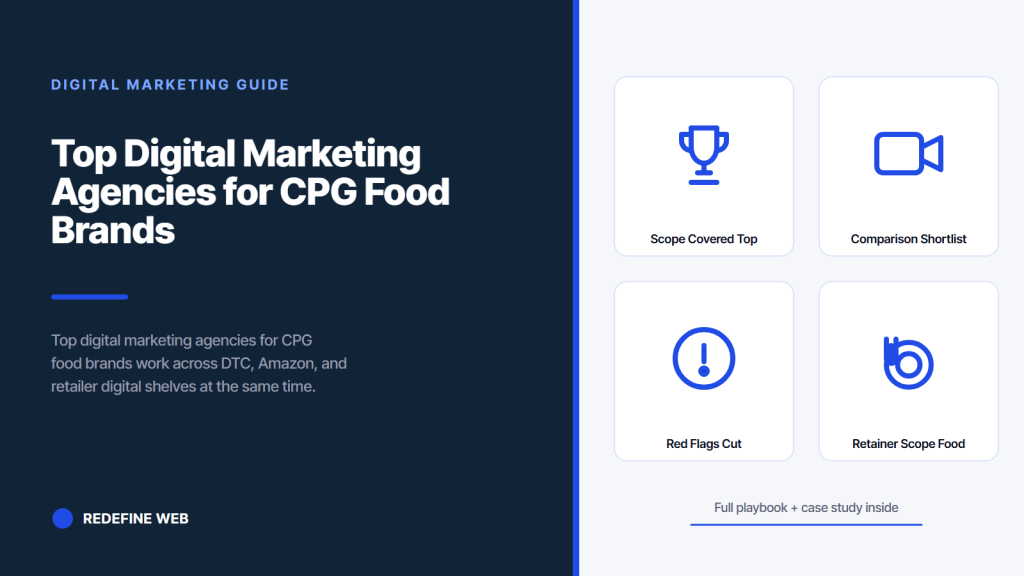
- Cover four workstreams on one retainer with one lead.
- Category depth shows in the last three CPG food brands onboarded.
- Reporting layer blends DTC, Amazon, and retailer networks into one dashboard.
- Creative pipeline ships 30 to 120 concepts per quarter.
- Fees run 5K to 45K per month with six months minimum.
- Scope covered by top digital marketing agencies for CPG food brands
- Filter one for top digital marketing agencies for CPG food brands is category depth
- Filter number two is the reporting layer
- Filter number three is the creative pipeline
- Sansa Interiors maps to the top digital marketing agencies for CPG food brands shortlist
- Comparison of shortlist archetypes by CPG brand stage
- Fee ranges to expect on a CPG food retainer
- Questions to ask on the first agency call
- Red flags that cut agencies from the shortlist
- Retainer scope your food shortlist should demand
- Timeline to close a CPG food agency hire
Top digital marketing agencies for CPG food brands are the partners that walk a snack or drink brand from a DTC Shopify site through Amazon sponsored ads, into Instacart and Kroger Precision Marketing, and finish the year with a paid social library the brand actually owns. The shortlist gets thin fast because most agencies pitch DTC alone or Amazon alone and call the retailer digital shelf a bonus deck at the end of the sales cycle every quarter.
This guide walks the filter a CPG food founder should use on any shortlist, the retainer scope the partner should carry, and the monthly fees to expect at each brand size on the growth curve. It also names how Redefine Web scopes the work when a CPG food brand walks in with a Shopify Plus site, an Amazon storefront, and a retailer relationship in play on the same growth quarter across the four channels the top digital marketing agencies for CPG food brands actually need to run at once.
Scope covered by top digital marketing agencies for CPG food brands
Top digital marketing agencies for CPG food brands cover four workstreams that run on the same account. DTC growth on the Shopify or WooCommerce catalog with paid social and Google Shopping. Amazon Ads and Amazon Marketing Cloud on the retail shelf. Retailer digital networks including Instacart Ads, Kroger Precision Marketing, and Roundel. And the reporting layer that blends all three back into a single cost per new customer number the founder can compare across quarters on one weekly dashboard.
Every workstream has a matching creative pipeline. DTC needs 30 to 60 short-form video concepts per quarter for Meta and TikTok Shop. Amazon needs A-plus content, brand store refresh, and Sponsored Brands video every eight weeks on the storefront. Retailer networks need shopper marketing creative built to the retailer template on Instacart and Kroger. Any agency that pitches Meta creative alone and hands the other three pipelines back to the brand’s internal team is running a single-channel play on a multi-channel category and calling the split a partnership.
Redefine Web scopes the four workstreams into one retainer with one strategy lead and one weekly report. The founder gets one dashboard covering DTC ROAS, Amazon ACoS, retailer network return on ad spend, and blended CPA on new customer count every Monday morning. Read the food and beverage marketing hub for the parent scope on how the four workstreams fit inside a single CPG retainer.
Filter one for top digital marketing agencies for CPG food brands is category depth
Category depth is the first filter on any shortlist. An agency that has run three snack brands, two functional beverage brands, and one specialty food brand knows the SKU velocity curves, the seasonal peak calendar, and the Amazon reviewer sign-off rules that break a launch. An agency with one CPG food logo on a case study page and eight D2C fashion brands elsewhere is a fashion shop willing to take a food account. Founders pay for the difference in the first two quarters of any retainer signed against thin depth, which is the whole point of running the shortlist filter on the top digital marketing agencies for CPG food brands before signing.
Ask on the first call for the last three food brands the agency onboarded, the ACoS ranges they held on Amazon over the last four quarters, and the last time a retailer network onboarding they ran hit the six-week ramp target. If the answers turn vague or point to a case study from three years ago on a different vertical, the category depth is thinner than the pitch deck showed. A CPG food brand that hires shallow depth pays for the agency’s learning curve inside the first two quarters of the retainer commitment.
Category depth also shows up in the questions the agency asks the brand on the first call. A real CPG food shop asks about the trade calendar, the syndicated data source, the current retailer list, the Amazon reviewer velocity, and the FDA compliance window on any new launch. A generic agency asks about the target demographic, the brand voice, and the color palette. The question set on discovery is the fastest tell on real category depth. See the Progressive Grocer coverage for the trade-side signals every serious CPG food agency should be reading weekly to stay current.
Filter number two is the reporting layer
The reporting layer is the second filter on the shortlist. Any agency that hands over three separate dashboards for DTC, Amazon, and retailer networks is running three separate reports and calling the collection a program. Real CPG food work needs a single blended dashboard that ties spend on Meta, Google, TikTok, Amazon, Instacart, and Kroger back to one cost per new customer number every week on the same view the founder opens on Monday morning across the account.
The dashboard has to pull server-side attribution data from the Meta Conversion API, the TikTok Events API, the Amazon Advertising API, and the GA4 measurement protocol on one integration layer. Any dashboard that runs on platform-reported numbers alone is off by 15 to 40 percent on the true attribution. Server-side normalizes the signal and lets the founder compare the channels on a real like-for-like basis. Ask any agency on the shortlist for a screenshot of the dashboard they hand a similar-size CPG food brand every Monday and verify the server-side layer is live already.
The weekly written pulse matters as much as the dashboard. A real CPG food retainer ships a Monday morning email covering the wins, misses, tests running, and asks for the founder inside 300 words. Any retainer that ships a screenshot dump with no narrative is running out the clock on the retainer. The pulse is the fastest way to tell whether the agency is thinking about the account or just clicking through the platforms every week. Read the eMarketer category coverage for the current CPG food channel benchmark data every reporting layer should index against.
CPG shortlists thin out on Instacart Ads and Kroger Precision questions. If the agency pitches Meta and hands retailer work back to you, they're single-channel.
Filter number three is the creative pipeline
The creative pipeline is the third filter on any shortlist. Meta and TikTok Shop run a creative-first buying model, and the account burns out on ad fatigue inside six weeks if the pipeline ships fewer than 30 concepts per quarter for a growth-stage brand. A real CPG food agency runs a UGC-plus-brand creative model with a documented pipeline of 30 to 120 concepts per quarter depending on the brand size and the current trailing revenue on the DTC catalog.
Ask the agency for the concept count they ran in the last quarter on a similar-size CPG food account. Ask for the UGC creator roster, the brand producer, the editor, and the strategist who wrote the briefs on the last quarter. If the answer names a single generalist who wrote briefs, filmed, and edited, the pipeline is not going to hold at scale. A real CPG food creative pipeline runs at least four roles across the team, and every concept goes through a brief, a script, a shot list, a delivery gate, and a launch gate before it hits the account.
Creative volume is one metric. Creative quality is the second on the same measurement. Every concept has to include a hook inside the first 1.5 seconds, a payoff inside 15 seconds, and a CTA that ties to a specific SKU or trial pack landing page on the DTC site. Concepts that miss any of the three ship as filler and drag the account’s average CPA up over the next four weeks on the same paid channel. Redefine Web scopes the creative pipeline as a fixed monthly fee with a documented concept count that hits the volume every month across the account without exception.
Sansa Interiors maps to the top digital marketing agencies for CPG food brands shortlist
Sansa Interiors Inc. is a Toronto interior design firm that specializes in modern residential spaces and hospitality venues including cafes and restaurants across the city, and the engagement maps directly to how top digital marketing agencies for CPG food brands run a full-stack growth program. The engagement transfers to a CPG food shortlist decision because the shape of the growth curve carried the same three-filter test on the account across the twelve month program the shop ran on the account.
Sansa Interiors Inc. hit 641 percent organic traffic growth, moved from 18 annual inquiries to 133, and landed top-3 Google rankings plus press features in DesignMilk, Casa Vogue, Elle, and Chic Haus inside a 12-month program. Every filter that made the growth possible transfers to the CPG food shortlist test. Real category depth on the interior design vertical. A single reporting layer that tied CRM inquiries back to organic traffic and paid ads. A creative pipeline that fed digital PR features and long-form content on a compounding schedule the shop kept every month.
The transfer point for a CPG food brand is the strategy-plus-execution split on one partner. Sansa did not hire a shop that ran ads. Sansa hired a partner that built the KPI framework, redesigned the site, ran the paid channels, and secured the press features on the same 12-month arc across the account. A CPG food brand that hires three separate shops for DTC, Amazon, and retailer networks pays for three separate strategy loads and gets three separate dashboards on Monday morning every week that never reconcile against each other on the blended CPA report.
Comparison of shortlist archetypes by CPG brand stage
The table below compares the common shortlist archetypes a CPG food founder sees on the first pass through the pipeline. The fit column names the brand stage the archetype actually works for. The gap column names the workstream the archetype typically drops out of the retainer scope. Use it as a filter on the first three names on any shortlist to cut the field before running the three-filter test on the top two candidates.
| Shortlist archetype | Best fit brand stage | Typical scope | Common gap | Monthly fee range |
|---|---|---|---|---|
| DTC boutique shop | Pre 3M DTC only | Meta, Google, email | Amazon, retailer networks | 5K to 15K |
| Amazon specialist | Amazon-first brand | Sponsored, DSP, AMC | DTC creative, retailer | 4K to 12K |
| Shopper marketing agency | Scale retail brand | Instacart, Kroger, Roundel | DTC, creative pipeline | 8K to 25K |
| Full-service CPG shop | 3M to 30M brand | All four workstreams | Deep Amazon DSP | 15K to 45K |
| Enterprise holding company | 50M plus scale brand | All workstreams plus TV | Founder access, agility | 50K to 200K |
Two mistakes most CPG food founders make on the shortlist. First, hiring a DTC boutique at 3M in revenue and asking them to add Amazon and retailer networks inside six months on the same team. The DTC shop does not have the muscle in either channel and the founder pays for the ramp inside the quarter. Second, hiring the enterprise holding company at 8M in revenue because the pitch deck looked polished on the sales cycle.
The right archetype for most 3M to 30M CPG food brands is the full-service CPG shop with all four workstreams under one retainer. The scope covers DTC, Amazon, retailer networks, and the blended reporting layer on one Monday morning report. The team stays small enough that the founder can reach the strategy lead on a Monday morning without going through an account manager. See the food and beverage marketing retainer page for the fixed-fee scope Redefine Web runs on CPG food accounts every month across the four workstreams.
Fee ranges to expect on a CPG food retainer
Fee ranges run 5,000 to 45,000 dollars per month depending on the brand stage and the workstream count on the retainer scope. A pre-3M DTC brand starts at 5,000 to 10,000 with a DTC-only scope. A 3M to 10M brand adding Amazon runs 10,000 to 20,000 on the retainer. A 10M to 30M brand adding retailer networks runs 20,000 to 35,000. A 30M-plus brand adding connected TV runs 35,000 to 45,000 on the pure agency retainer.
Media spend sits on top of the retainer and does not flow through the agency invoice unless the retainer explicitly bundles managed media. Most CPG food brands pay the media platforms directly and the agency invoices the fee separately every month. This split protects the brand from a mark-up on the media pass-through and keeps the platform relationships clean on the brand side. Any retainer that insists on running the media through the agency and takes a percentage on the spend is running a legacy holding company model that costs 15 to 25 percent more than the pure retainer arrangement across the same scope.
Contract length runs six months minimum for CPG food work because the retailer network onboarding takes six to twelve weeks, and the Amazon Ads tuning takes eight weeks to steady state on the shelf. Any agency willing to sign a 90-day pilot is not planning to hit the retailer network results inside the pilot window on the timeline. A real CPG food retainer starts at six months, extends to twelve after the first quarter, and rebalances the workstream mix every quarter based on the cohort report on the account across the campaign structure.
Questions to ask on the first agency call
Questions to ask on the first call with any agency on the shortlist come in three groups. Category depth questions on the first pass. Reporting layer questions on the second pass. And creative pipeline questions on the third pass through the discovery script. Every question has a right answer shape the founder can grade against a rubric on the call. Any agency that dodges any of the three groups on the first call gets cut before the second call scheduled on the calendar.
Category depth questions include the last three CPG food brands onboarded, the current ACoS range on Amazon, and the last retailer network onboarding that hit the six-week ramp on the retainer. Reporting layer questions include a screenshot of the weekly dashboard, the server-side attribution stack, and the source of the blended CPA number on the report. Creative pipeline questions include the concept count per quarter, the creator roster, and the delivery gate on every concept before it hits the account structure. The number of founders who skip these questions and sign anyway is roughly half every audit I have sat through.
A fourth group of questions covers the team and the access model. Ask which strategy lead runs the account, how many other accounts the strategy lead carries on the workload, and how the founder reaches the strategy lead outside a monthly review meeting. Ask for the team roster with names and roles, not job titles alone on the deck. A pitch that leaves the team roster off the deck is a pitch planning to swap the team after the contract signs on the retainer. Read the Food Navigator USA coverage for the trade context every serious agency should track on the CPG food category weekly.
Red flags that cut agencies from the shortlist
Red flags on the shortlist cut candidates fast on the first review. Three category-specific flags separate a real CPG food shop from a general DTC agency wearing the label on the pitch deck. Any of the three drops the agency from the second-call list on the same evaluation cycle the founder is running against a fixed timeline that closes in two weeks on the pipeline.
First flag is a pitch that treats Amazon as a bonus channel. Amazon is 40 to 60 percent of the CPG food ecommerce shelf on most category slices. Any agency that pitches DTC as the core and Amazon as a side project is running the wrong mix. Second flag is a case study library that lists CPG food alongside 20 other verticals with no dedicated food case study inside the last 18 months on the account history. Third flag is a retainer scope that ends at Meta creative and hands off Google, Amazon, and retailer networks to internal partners on the brand side.
A fourth flag is a fee structure tied to a percentage of media spend rather than a fixed retainer on the monthly invoice. Percentage-of-spend deals push the agency to grow spend, not to grow orders on the DTC catalog. A real CPG food retainer runs a fixed monthly fee and grows or shrinks based on the workstream scope, not the media budget on the account. Founders who miss this incentive alignment pay for the misalignment in the second year when the media budget grows and the retainer scales with it on the invoice. See the food and beverage web design page for the site build that pairs with the paid channels on a growth retainer.
Retainer scope your food shortlist should demand
The retainer scope your CPG food shortlist should demand covers four workstreams, one strategy lead, one reporting layer, and one creative pipeline that ships to a fixed monthly volume. Any pitch that trims the scope to Meta and Google alone is a pitch scoping half the category. The retainer signed at that scope carries a hidden cost in the second and third channel the founder eventually adds through a second vendor on the same year the DTC channel starts to plateau.
The scope also covers the site work that pairs with the paid channels on the DTC catalog. A retainer that runs Meta and TikTok into a slow Shopify checkout closes half the return the same media would deliver into a fast checkout. Site improvements, page speed tuning, checkout UX passes, and Klaviyo flow rebuilds sit inside the retainer scope, not as a separate quarterly project on the invoice. Any scope that carves site work into a separate line item leaves the founder chasing two vendors on the same growth quarter without a shared owner.
The scope should name the specific KPIs the retainer is graded against on the quarterly review meeting. Blended CPA on new customer count. DTC ROAS on last-30-day cohort. Amazon ACoS on Sponsored Products. Retailer network return on ad spend on Instacart and Kroger. And the total blended MER on the account across all channels. Any retainer that skips the KPI list on the SOW is running a scope that will drift inside the first two quarters on the account timeline and turn into a general marketing service.
Timeline to close a CPG food agency hire
Timeline to close a CPG food agency hire runs six to eight weeks from the first pitch call to the signed retainer on the calendar with any of the top digital marketing agencies for CPG food brands on the shortlist. Weeks one and two run the initial pitch calls with the top five names on the shortlist. Weeks three and four run the three-filter test on the top two candidates with a working session on each account. Weeks five and six run the reference calls with two current clients of each finalist on the retainer scope side.
Weeks seven and eight cover the SOW negotiation, the contract redlines, and the kickoff plan on the calendar with the finalist. The kickoff itself takes another two weeks after signing before the first campaigns run live on the account. Founders who compress the timeline below six weeks on the front end typically miss the reference call step, which is the highest-signal step on the entire process for filtering the top two candidates against real client outcomes on the current book of business.
Reference calls need to run with the client-side operator running the account day to day, not the founder alone on the check. Read the food and beverage SEO page for the organic scope that pairs with paid on any retainer. The operator sees the weekly cadence, the response time on urgent asks, and the quality of the reporting layer up close on the account. Any reference call routed only to the client founder gives a filtered view of the retainer performance. Two operator references plus one founder reference on each finalist gives the fullest picture of how the retainer runs across a normal quarter before the signed contract locks the choice in.
Top digital marketing agencies for CPG food brands run four workstreams on one retainer with a single blended reporting layer and a documented creative pipeline that hits 30 to 120 concepts per quarter every month. Sansa Interiors hit 641 percent organic traffic on the same shape of one-partner strategy plus execution. A CPG food brand that runs the three-filter test on category depth, reporting layer, and creative pipeline lands with a partner that closes the same growth math inside 12 months on the DTC catalog, the Amazon shelf, and the retailer digital network at the same time.

Frequently asked questions
What do top digital marketing agencies for CPG food brands actually cover?
Top digital marketing agencies for CPG food brands cover four workstreams on the same account. DTC growth on the Shopify or WooCommerce catalog with paid social and Google Shopping. Amazon Ads and Amazon Marketing Cloud on the retail shelf. Retailer digital networks including Instacart Ads, Kroger Precision Marketing, and Roundel. And the reporting layer that blends all three back into a single cost per new customer number the founder can compare across quarters. Every workstream has a matching creative pipeline that runs at the same time on the account.
How much do CPG food marketing agencies cost per month?
Fee ranges run 5,000 to 45,000 dollars per month depending on brand stage and workstream count. A pre-3M DTC brand starts at 5,000 to 10,000 with a DTC-only scope. A 3M to 10M brand adding Amazon runs 10,000 to 20,000. A 10M to 30M brand adding retailer networks runs 20,000 to 35,000. A 30M-plus brand adding connected TV runs 35,000 to 45,000 on the pure agency retainer. Media spend sits on top of the retainer and does not flow through the agency invoice on most modern deals.
What are the top red flags when shortlisting a CPG food agency?
Three red flags cut candidates from the shortlist fast. Pitches that treat Amazon as a bonus channel when Amazon is 40 to 60 percent of the CPG food ecommerce shelf. Case study libraries that list CPG food alongside 20 other verticals with no dedicated food case study inside the last 18 months. And retainer scope that ends at Meta creative and hands off Google, Amazon, and retailer networks to internal partners. A fourth flag is a percentage-of-spend fee structure that pushes the agency to grow spend rather than orders on the account.
How long should a CPG food marketing agency contract run?
Contract length runs six months minimum on CPG food work because retailer network onboarding takes six to twelve weeks and Amazon Ads tuning takes eight weeks to steady state. Any agency willing to sign a 90-day pilot is not planning to hit the retailer network results inside the pilot window. A real CPG food retainer starts at six months, extends to twelve after the first quarter, and rebalances the workstream mix every quarter based on the cohort report. The six-month floor also matches the trade calendar cadence most retailers use on the trade planning side.
What questions should I ask on the first call with a CPG food agency?
Ask three groups of questions on the discovery call. Category depth including the last three CPG food brands onboarded, the current ACoS range on Amazon, and the last retailer network onboarding that hit the six-week ramp. Reporting layer including a screenshot of the weekly dashboard, the server-side attribution stack, and the source of the blended CPA number on the account. Creative pipeline including the concept count per quarter, the creator roster, and the delivery gate on every concept before launch. Also ask which strategy lead runs the account.
Which shortlist archetype fits a 5M CPG food brand?
A 5M CPG food brand fits the full-service CPG shop archetype that covers all four workstreams under one retainer. The scope covers DTC, Amazon, retailer networks, and the blended reporting layer at 15,000 to 25,000 dollars per month on a typical scope. The team stays small enough that the founder can reach the strategy lead on a Monday morning without going through an account manager. A DTC boutique shop at this stage cannot handle Amazon or retailer networks. An enterprise holding company assigns a junior team and the founder loses direct access to the strategy lead.
Book your free 30-minute strategy call.
No spam, no sales rep. We use your email to schedule your call with a senior strategist. That is it.
More from the blog
View all articles → Digital Marketing
 Dental Marketing Tips That Compound Into New Patients
Read article Digital Marketing
 Ecommerce Marketing Strategies That Drive Real DTC Revenue
Read article Digital Marketing