
URL rating is a number between 0 and 100 that one company puts on one page of your site, based on the links pointing at it. It is not a Google metric, it is not an industry standard, and the near-identical numbers sold by three other companies are measuring different things on different scales. Almost every argument about this number comes from treating it as though it were a temperature everyone reads off the same thermometer.
The good news is that this is one of the few corners of the field where the vendors publish their method. Three of the four metrics below are documented by the companies that sell them, in enough detail to work out what your score is reacting to. Everything quoted here comes from those pages and from Google’s own documentation, read on the dates recorded, so you can check every line rather than take it on trust.
What URL rating is, and the two other things this search returns
Before the definition, a thirty second detour that will save some readers the whole article, because this phrase returns three unrelated products and only one of them is the subject here.
If you came looking for the category a security vendor has assigned to a web address, the thing that decides whether a corporate firewall lets the site through, that is web filtering and it has nothing to do with search. The term that will find it is URL categorization, together with the name of whichever vendor is doing the blocking, because the category is that vendor’s and not a shared one. And if the question is what a URL is or what makes a good one, that is web address structure, a different subject again and a much shorter one, and the term for it is URL structure. Neither is covered below, and both are a faster search than reading on.
What is covered is the link metric. Ahrefs, which coined it, defines it in one line. “URL Rating (UR) shows the strength of a page’s link profile on a 100-point scale. The bigger the number, the stronger a page’s link profile is.” That is the whole claim, and notice how narrow it is. Link profile strength. Not quality, not relevance, not whether the page is any good, and not how it will rank.
Where a number like this belongs in a wider picture of a site is a question our website audit page sets out, and the short version is that it sits near the edge rather than at the center.
How the vendor says it is calculated
The documentation is unusually specific, and reading it tells you which of your actions could move the number and which cannot.
Four things are stated directly. “Both internal and external links are taken into account”, so your own site structure feeds it and you are not solely at the mercy of other people. The algorithms “spot and cut off” what the documentation calls linking loops, “the exchanging of rating scores again and again in a loop between two websites”, and it “also removes some links which can artificially increase UR”. And “there is no difference between the HTTP and HTTPS version of a URL”, which kills one recurring support question.
Asked whether it resembles Google’s PageRank, the vendor answers plainly. “We use the same basic PageRank principles to calculate URL Rating (UR). We count links between pages; We respect the ‘nofollow’ attribute; We have a ‘damping factor’; We crawl the web far and wide.”
The practical reading is that internal linking is a lever you control. A page you link to from your strongest pages will carry a higher number than an orphan, and that is true regardless of what anyone else does. It is also the part most teams never touch, because the number gets filed under link building and link building gets filed under outreach.
Why the scale is logarithmic, and what that does to a target
This single sentence in the documentation should change any goal anybody has ever set against this metric.
“The scale is logarithmic, which means that it’s a lot easier for a page to go from UR 20 to UR 30 than it is to go from UR 70 to UR 80.”
Ten points is not ten points. The distance between two scores depends entirely on where on the scale they sit, so a target expressed as a number of points is a target whose difficulty nobody has established. Going up ten from a low base might be a month of ordinary internal linking. The same ten points near the top can be a year of work that most sites will never do.
So an objective written as raise UR by fifteen is not a plan, it is a wish with arithmetic attached. If you must set a target on this number, set it relative to specific pages you are competing with rather than as an absolute gain, because at least that anchors it to a real distance on the curve.
UR and DR are not the same scale
The second number on the same screen looks like a bigger version of the first and is not, which is where most of the confusion in this subject actually lives.
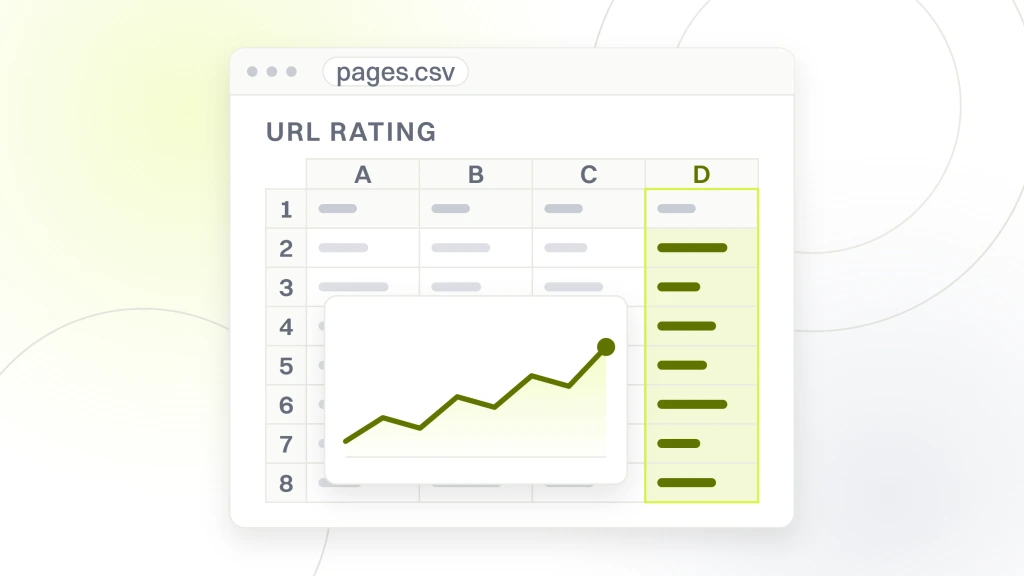
“UR is a page-level metric, whereas DR is a domain-level metric. So if you put a website into Ahrefs Site Explorer and check its UR, the number you get will be for the homepage alone.” That last clause catches people constantly. A site-level UR reading is not a site reading. It is your homepage.
Domain rating is defined separately as showing “the strength of a website’s backlink profile compared to the others in our database on a 100-point scale”, and it is computed differently, with each source domain splitting its rating equally among the domains it links to. The vendor gives the worked example. “A DR-10 domain which links to three other domains can influence your DR more than a DR-80 domain which links to a million other domains.”
The vendor’s own summary of the difference is the cleanest one available. “While they are both backlinks-based metrics, UR compares pages to pages, whereas DR compares domains to domains.” The documentation adds that the two are not measured on the same scale. Two numbers, same screen, same range, not comparable to each other.
Why a strong page can sit on a weak site
Follow that distinction one step further and a common source of panic disappears.
The documentation answers it directly. “Therefore, a page with many high-UR links (therefore creating a high UR page) can exist within a low-DR domain.” One page of yours attracted links. The domain as a whole did not. Both numbers are correct and they are describing different objects.
This is worth knowing because the reverse also happens and is more dangerous. A site with a flattering domain number can be full of pages nobody has ever linked to, and if you are judging a guest post opportunity or a partnership on the domain figure alone, the page your link will actually sit on may carry almost nothing. The domain number told you about the neighborhood, not the house.
Which is the single most useful habit in this whole subject. When the decision is about one page, read the page-level number. When it is about a whole site, read the domain-level one. Most bad calls here are made by reading the wrong one of the two.
What counts as a good score, according to the people who sell it
Every version of this question gets asked constantly and the vendor’s own answer is that the question does not have one.
“It’s important not to judge Domain Rating in absolute terms. That’s because Domain Rating is a relative metric by definition. It’s not possible to say that a Domain Rating of 30 is good, or 50, or 60, or 70. It’s all relative.” The suggested rule is that yours is fine “if it’s higher than or comparable to similar sites”.
That is worth taking seriously rather than treating as a dodge, because the definition contains the reason. The score is strength “compared to the others in our database”, so it is a position in a population, and populations move. A number that holds still while the web grows is not the same achievement two years running.
The consequence for reporting is direct. A slide showing your score alone says almost nothing. The same slide showing your score beside four named competitors says something real, and it is the only form in which this number belongs in front of anybody making a decision.
The other three metrics, and which ones publish a method
Three other companies sell a number that looks like this one. They are not the same measurement, and the difference in what each is even trying to do is larger than most comparisons admit.
| Metric | Scale | What the vendor says it is built from |
|---|---|---|
| UR and DR, from Ahrefs | 0 to 100 | PageRank principles, damping factor, nofollow respected, internal and external links, loops removed |
| Domain Authority and Page Authority | 1 to 100 | A machine learning model over backlink data, predicting likelihood of appearing in results |
| Trust Flow | 0 to 100 | Proximity to a manually reviewed set of trusted seed sites |
| Authority Score | 1 to 100 | A compound metric from eight weighted factors, covering link power, organic traffic and six spam indicators |
Read those four rows against each other. One vendor propagates a score along links. Another trains a model to predict an outcome. A third measures how close you sit to a hand-picked set of trustworthy sites. The fourth mixes link data with estimated organic traffic and a battery of spam checks, so it is not purely a link metric at all. Those are four different theories of what authority even is, which is why the numbers disagree and why arguing about whose is right misses that they are answering different questions.
That fourth one is worth a second look, because it is the one most often filed alongside the others as though it were the same kind of number. Its documentation describes a compound metric grading the overall quality of a website or a webpage, built on three facets, link power, organic traffic and what it calls the natural profile, and calculated from eight weighted factors. Two of those cover link power and organic traffic. The other six are spam indicators, among them no organic rankings in results, an unnaturally high share of dofollow domains, and an imbalance between links and organic traffic. That difference matters in practice. A score built partly on a traffic estimate can move when nothing about your links has changed, and a score carrying spam checks can be pulled down by the company your link profile keeps rather than by anything you did this quarter. Tools that grade sites are compared in our website checker comparison, which covers what each one actually returns.
The admission sitting in one vendor’s own documentation
You do not have to take a competitor’s word for the limits of these numbers, because one of the vendors states the limit on its own definition page.
Moz, describing Domain Authority, writes that it is calculated “using a machine learning algorithm that evaluates multiple factors, primarily focusing on backlink data”, and that the score “assesses the likelihood of a domain appearing in Google search results”. Then, in the same explanation, it says this. “Domain Authority is not a Google ranking factor and has no effect on the SERPs.”
Read what that sentence is doing. The company that invented the metric, on the page selling you on it, tells you it does not influence the thing you are trying to influence. It is a prediction about an outcome, not an input to it, and the distinction is the whole reason these scores can move without your traffic moving and the other way around.
That reframes what a change in any of these numbers means. It is the vendor’s model updating its estimate of you. It is not a report of something Google did.
What Google says about numbers like these
This is the part most worth having in writing, and it comes from Google’s own guidance on third-party tools rather than from anybody’s characterization of it.
Google writes that “some third-party services provide data that some users of those tools misinterpret as somehow being from Google”, and then states the position in eleven words. “Third-party tools don’t have access to our internal ranking data.” The same page adds that “they can’t guarantee performance” and that “any predictions are their own and like predictions generally, may not happen”.
It also addresses the endorsement question that gets attached to these metrics in sales conversations. “Google doesn’t evaluate third-party services, so be wary of such claims and those making them.” And it names its preference, saying it “strongly encourages” using Search Console, “which provides you with key information and data directly from Google Search itself”.
So the hierarchy is settled by the only party who could settle it. Your own search data is first-party and observed. Every rating in this article is third-party and modeled. Both are useful, they are not the same kind of thing, and one of them is not evidence about the other. What belongs in a report and in what order is covered in our guide to what goes in an SEO report.
PageRank, and the gap between a principle and a formula
The PageRank connection is the strongest claim made for these metrics, so it is worth seeing exactly how far the two sides take it, because neither takes it as far as the sales pitch does.
The vendor’s side is careful. Having said it uses the same basic principles, it immediately adds that “nobody knows exactly how PageRank is calculated except Google themselves”. That is a company telling you its metric is modeled on a published idea rather than reproduced from the real thing.
Google’s side narrows it from the other direction. In its own list of common misconceptions it writes that “while PageRank uses links and is one of the fundamental algorithms at Google, there’s much more to Google Search than just links. We have many ranking signals, and PageRank is just one of those.”
Put the two together and the honest description of this metric is a model of the principles behind one signal among many, built by a company that says it cannot see the real formula. That is genuinely useful and it is nothing like a ranking prediction. Most disappointment with this number comes from expecting the second thing.
What these numbers are actually good for
Having taken the number apart, it would be a mistake to conclude it is worthless. It is good at a narrow set of jobs and bad at the one it usually gets used for.
- Comparing candidates. Ranking fifty possible link sources or fifty of your own pages against each other, where you only need an order rather than a truth.
- Finding your own neglected pages. A page that matters commercially and carries almost nothing is an internal linking job you can do this week without asking anybody.
- Sanity-checking a claim. When somebody offers a placement on a strong site, the page-level number tells you whether the specific page is strong.
- Not for reporting progress. It is a vendor’s modeled estimate on a moving population, so it answers to their index rather than to your quarter.
That last line is the one that saves money. A monthly report whose headline is one of these scores is reporting on a third party’s opinion of you, and it will eventually move for reasons nobody in the room caused.
Where this sits next to the other numbers you are shown
Three different kinds of number get put in front of you and treated as interchangeable, and keeping them apart is most of the skill.
A position in Google is an observed event. A checker’s score out of 100 is a summary of a page against a rule list. A vendor authority metric, which is everything in this article, is a model of a link graph. Our explainer on SEO ranking is where those three are separated properly, and this article is the narrow one, taking only the link metrics and only what they measure.
The related question of what any score out of 100 is computed from, and why a check that appears on every page can outweigh something far worse that appears once, belongs to our piece on what an SEO score is made of. That one takes scoring generally. This one takes link ratings specifically.
Delivery metrics are a fourth family again and share none of this machinery, since they are measured on your own pages rather than modeled from the link graph, and our look at website speed testing covers how those are produced.
What we would check first
If this number is on your dashboard and you want it to earn its place, there are two things worth doing and one worth stopping.
List the five pages that actually earn money and read the page-level rating for each, not the homepage figure the tool shows by default. Then look at how many of your own internal links point at those five. On most sites the answer is embarrassing, and since internal links are counted, this is the one input you can change without anybody else’s cooperation.
The thing to stop is setting a numeric target on the score itself. The scale is logarithmic and the population moves underneath you, so the target is meaningless and unfalsifiable at the same time. Compare against named competitors instead, which is what the vendor recommends. If you want the wider sequence of checks a site should get and where this one fits into it, our guide to checking a site properly sets out the order.
And if the honest answer is that nobody knows which of your pages earn, that is the problem to solve before any link metric can tell you anything useful, which is where a free website audit is a more productive place to start than a score.