5.0 · verified April 2026
"They kept the process simple and focused. Understood our goals as a dental practice and stayed focused on improvements that would make the website and ad campaigns more effective."

Custom websites for industrial OEMs, fabricators, and multi-plant operators. Spec catalogs, cut sheets, distributor portals, and RFQ forms wired straight into your ERP. Qualified RFQ volume triples inside 90 days on the average site.
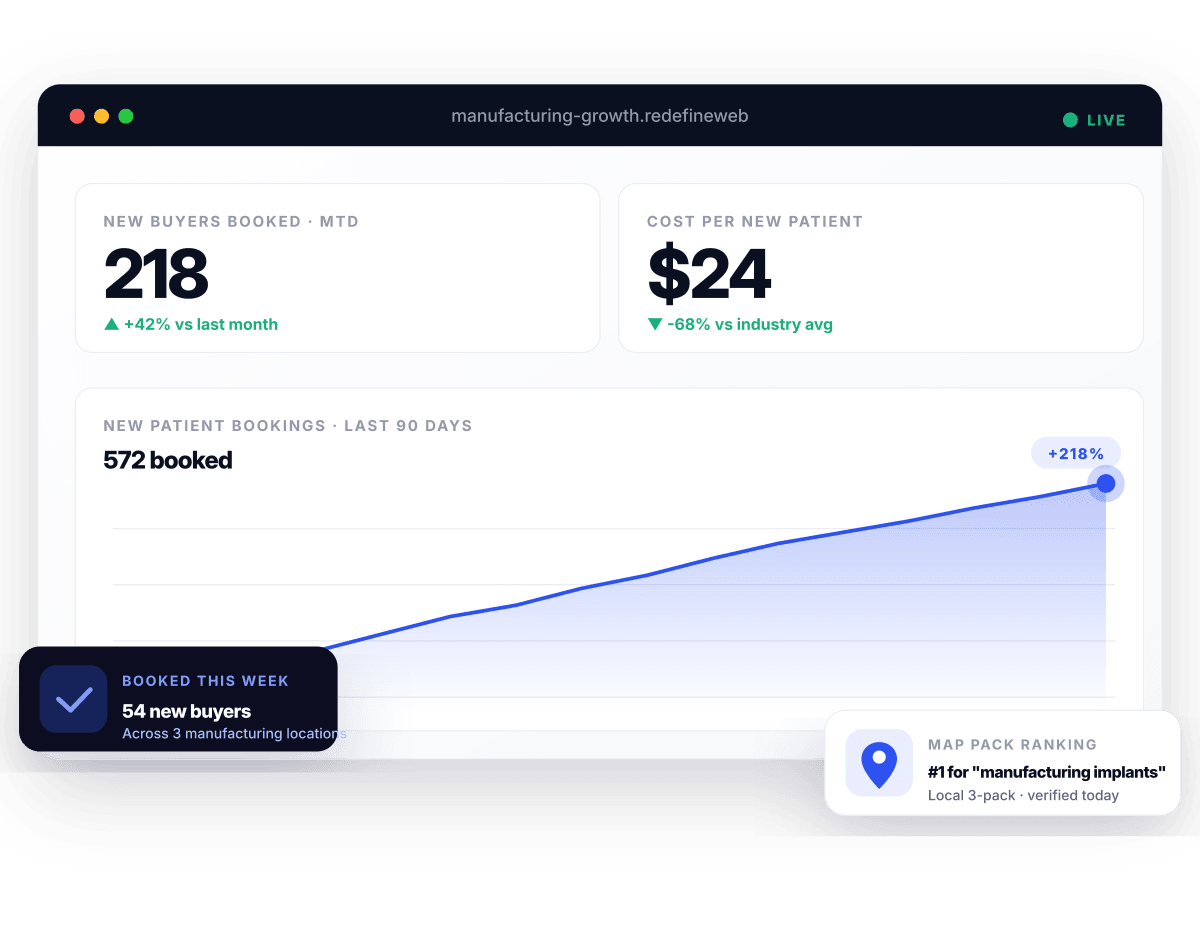


























Nothing here is "reach" or "impressions". Every outcome maps to a revenue event you can point at.
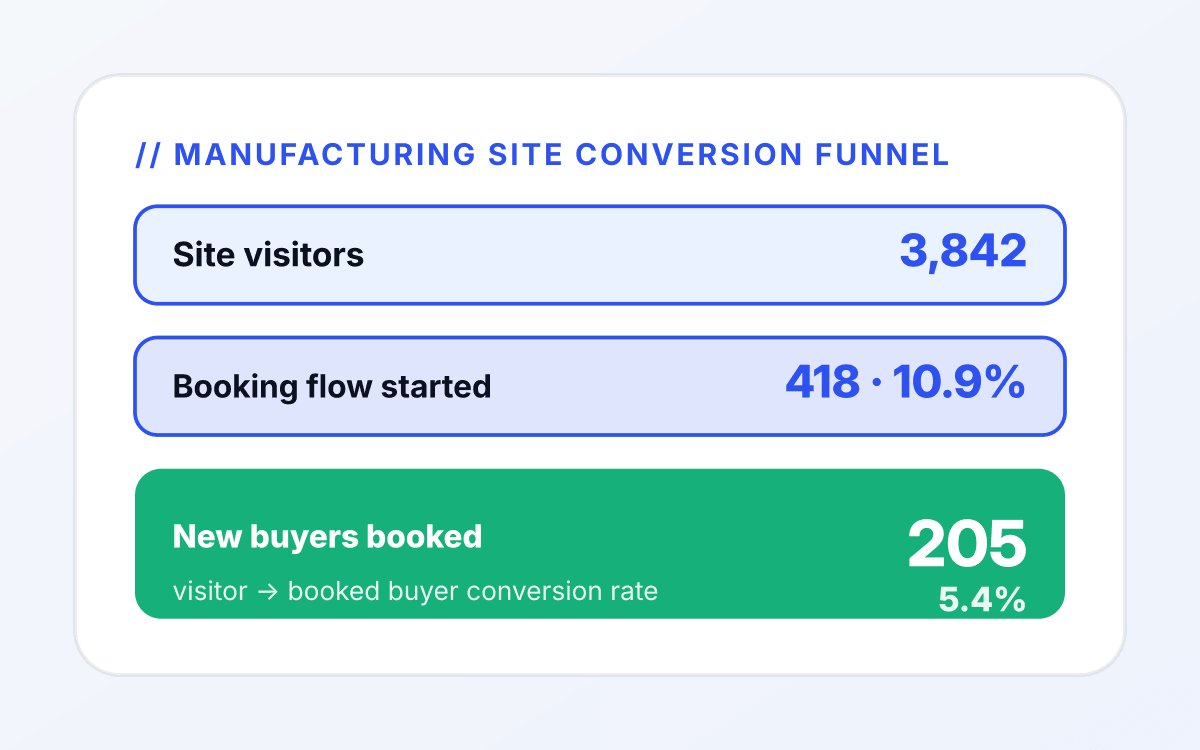
Architecture built to convert, qualifying UX, and a shortened funnel move the number that puts revenue on the board. Website builds that measurably outperform your current baseline in the first 60 days after launch.
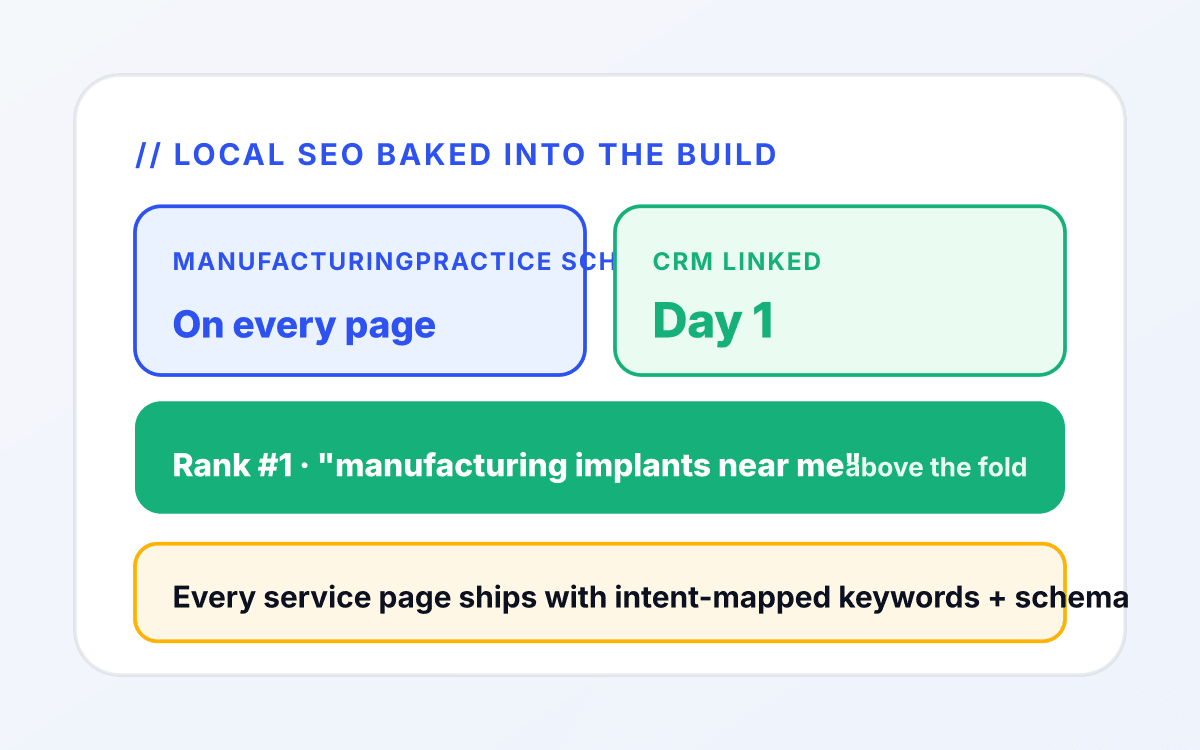
Every page ships with manufacturing-relevant schema, targeted metadata, and search intent baked into URL slugs. No SEO retrofit six months after launch.
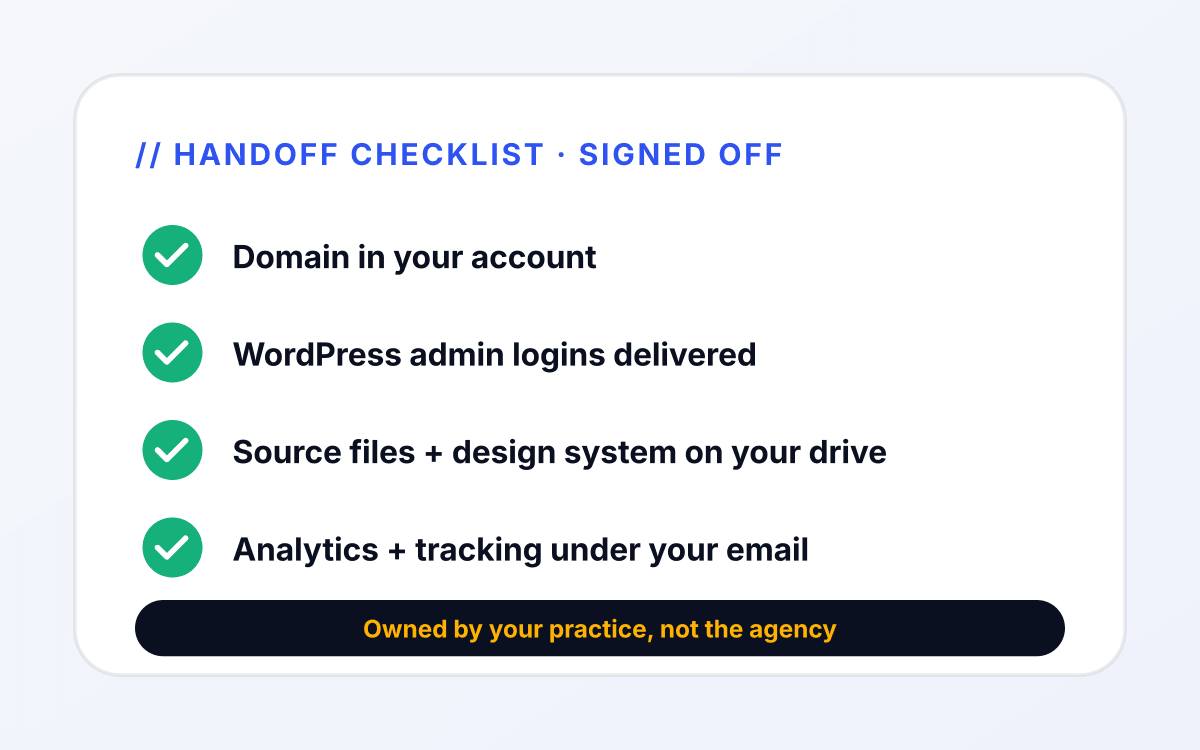
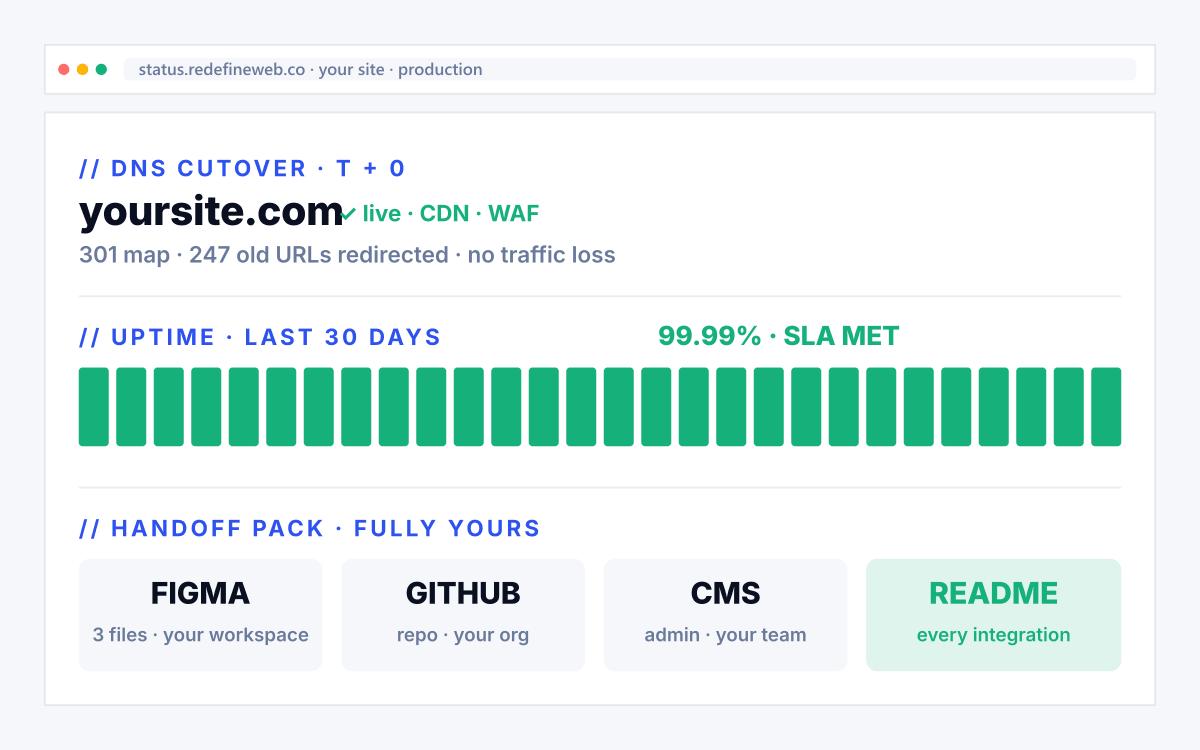
Your name on the domain, your logins on the CMS, your team trained on the platform. Walk away with the site whole if you ever leave.
Pick the tier that fits your catalog scope and integration list. Move up or down with 30 days notice. Setup runs at cost. Hover any feature for a plain-English breakdown.
For small manufacturers establishing distributor and buyer presence.
For mid-size manufacturers building distributor pipelines.
For multi-facility operators with custom catalog + RFQ flows.
For OEMs and industrial enterprises needing global rollout and SSO.
Tap any section to expand or collapse. Hover a feature name for a plain-English explanation.
| Feature | 01 · Launch | 02 · GrowthPopular | 03 · Scale | 04 · Enterprise |
|---|---|---|---|---|
| Up to 5 pages | ✓ | ✓ | ||
| Up to 12 pages | ✓ | ✓ | ||
| Unlimited pages | ✓ | ✓ |
| Feature | 01 · Launch | 02 · GrowthPopular | 03 · Scale | 04 · Enterprise |
|---|---|---|---|---|
| Quarterly CRO reviews | ✓ | ✓ |
| Feature | 01 · Launch | 02 · GrowthPopular | 03 · Scale | 04 · Enterprise |
|---|---|---|---|---|
| SLA-backed uptime | ✓ |
| Feature | 01 · Launch | 02 · GrowthPopular | 03 · Scale | 04 · Enterprise |
|---|---|---|---|---|
| Mobile + speed optimized | ✓ | ✓ |
| Feature | 01 · Launch | 02 · GrowthPopular | 03 · Scale | 04 · Enterprise |
|---|---|---|---|---|
| 30-day post-launch support | ✓ | ✓ | ||
| 2 rounds of revisions | ✓ | ✓ | ||
| Custom CMS training | ✓ | ✓ |
| Feature | 01 · Launch | 02 · GrowthPopular | 03 · Scale | 04 · Enterprise |
|---|---|---|---|---|
| SOC 2 / SSO integration | ✓ | |||
| Custom security review | ✓ | |||
| White-label client portal | ✓ |
| Feature | 01 · Launch | 02 · GrowthPopular | 03 · Scale | 04 · Enterprise |
|---|---|---|---|---|
| Dedicated success team | ✓ | |||
| Quarterly executive reviews | ✓ |
| Feature | 01 · Launch | 02 · GrowthPopular | 03 · Scale | 04 · Enterprise |
|---|---|---|---|---|
| Conversion-tuned design | ✓ | ✓ | ||
| Basic CRM integration | ✓ | ✓ | ||
| GA4 setup | ✓ | ✓ | ||
| Multi-segment landing pages | ✓ | ✓ | ✓ | |
| SOC 2 / SSO | ✓ | ✓ | ||
| Bespoke design system | ✓ | ✓ | ||
| CallRail + lead tracking | ✓ | ✓ | ||
| HubSpot / Salesforce integration | ✓ | ✓ | ||
| GA4 + server-side tracking | ✓ | ✓ | ||
| A/B test framework | ✓ | ✓ | ||
| 60-day post-launch CRO | ✓ | ✓ | ||
| Deep CRM + marketing automation | ✓ | ✓ | ||
| Custom analytics dashboard | ✓ | ✓ | ||
| Webflow / Next.js / Shopify Plus | ✓ | ✓ | ||
| 90-day post-launch CRO sprint | ✓ | ✓ | ||
| 12-month optimization retainer | ✓ |
Every quote below is verified by Clutch through a direct call with the client. No cherry-picking.
Three engagements where website design moved the number that matters. All client-verified.
Slide in your numbers. Assumes a 20% relative conversion improvement, which is what our first audit typically finds on non-optimized sites.
If your question is not here, book the 30-minute call. An industrial designer answers on the call, not through a sales rep.
Manufacturing web design services at Redefine Web run from $1,500 to $25,000+ as fixed-price projects across four tiers. Launch is $1,500 for small shops establishing a first spec-first site. Growth is $3,500 for growing manufacturers with 5 to 20 product categories and multi-material catalogs. Scale is $7,500 for mid-market manufacturers with distributor portals and multi-facility content. Enterprise starts at $25,000 for $20M+ manufacturers with complex product configurators, ERP integration, and per-facility content architecture.
Every tier is a fixed-price project, not a monthly bill. Payment runs 40 percent at kickoff, 40 percent at design approval, 20 percent at launch. Scope, timeline, and price are locked in the statement of work before work starts. Change orders are estimated in writing before the change goes live.
Ongoing manufacturing SEO or PPC retainer is separate and starts at $999/mo if you want the site to compound after launch.
Launch and Growth tier manufacturing websites go live in 6 to 10 weeks. Scale tier goes live in 10 to 14 weeks. Enterprise tier ranges 14 to 24 weeks depending on ERP integration, product configurator complexity, and per-facility content depth. Every project has a written milestone tracker with owner names and dates from week one.
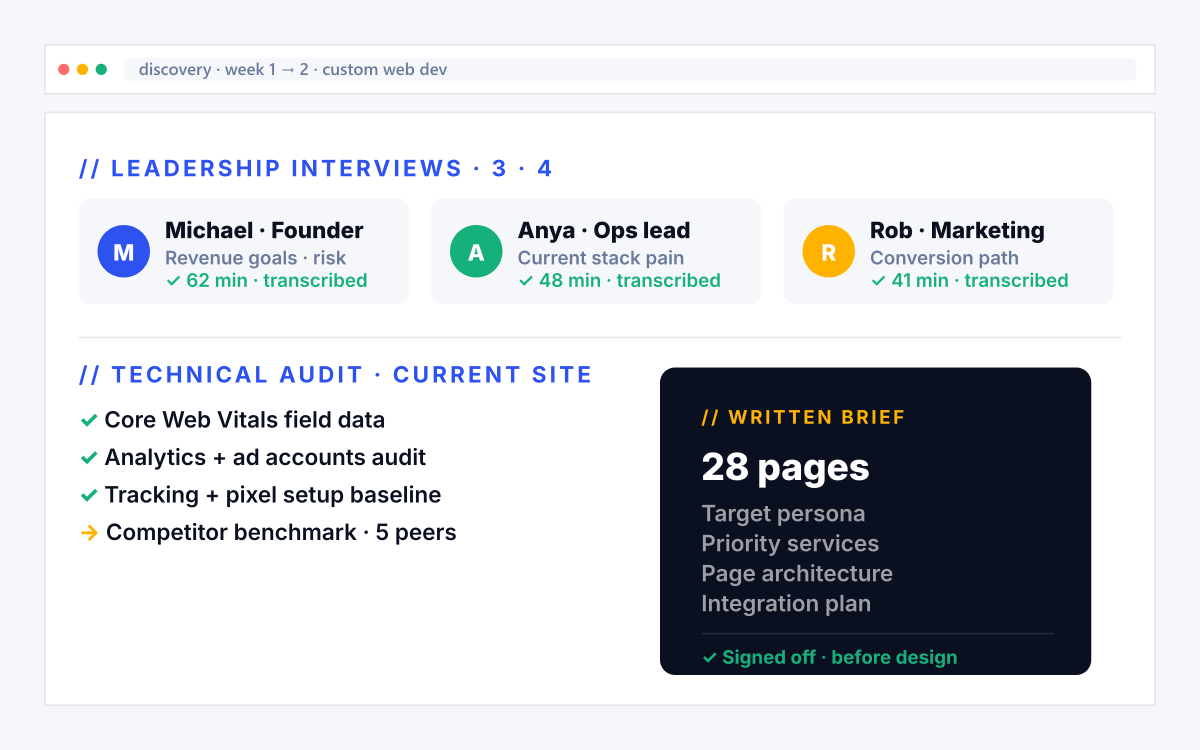
The 6 to 10 week timeline breaks into four phases. Week 1 is discovery, positioning, and information architecture. Weeks 2 and 3 are visual design and content production. Weeks 4 to 6 are development, spec sheet integration, and CMS build. Weeks 7 to 10 are QA, ERP or CRM wiring, and launch.
Delays almost always come from client-side content, not from the build side. Spec sheets, CAD files, product photography, certifications, and application content are the most common bottleneck. If your team wires up content on schedule, we hit the date. If content stalls, we surface the risk on the weekly call and reset expectations.
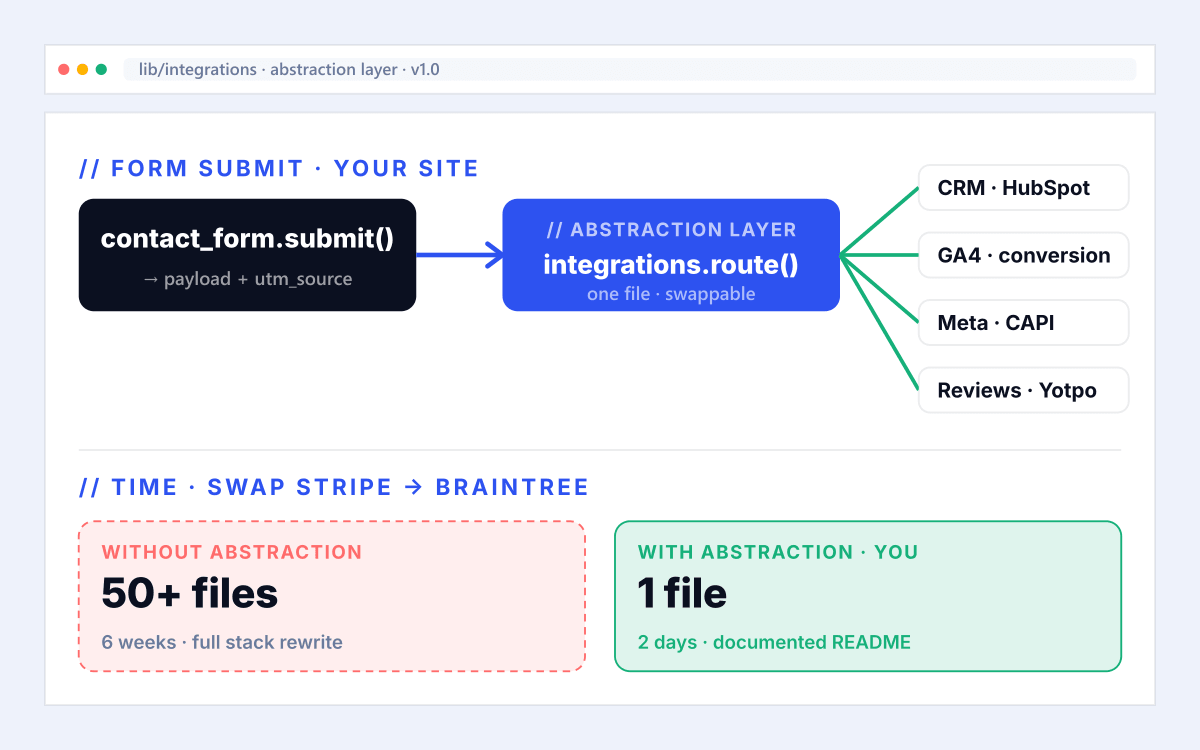
Yes. Every manufacturing website design agency engagement includes ERP and CRM integration. We wire up SAP, NetSuite, Microsoft Dynamics, Epicor, or your ERP-adjacent system on the operations side. HubSpot, Salesforce, or Pipedrive on the sales-and-marketing side. RFQ forms route to CRM with lead scoring based on part number, material, quantity, and target lead time.
Deep integration is included on Growth tier and above. Launch tier includes lightweight integration (webhook or Zapier) to keep the price at $1,500. Scale and Enterprise add server-side tracking with Enhanced Conversions for Google Ads, plus distributor portal integration for manufacturers with dealer or rep channel relationships.
Every integration ships with a written runbook and QA checklist. You get documentation, not just a working demo.
Well-built manufacturing websites convert 3 to 8 percent of qualified traffic on the primary RFQ or contact request CTA. Commodity industrial products convert lower (1 to 3 percent) because comparison shopping is fierce. Custom fabrication, specialty engineered products, and niche capabilities convert higher (5 to 12 percent) because search intent is more specific and the alternatives are fewer.
Real numbers depend on your product complexity, target buyer, and current site's RFQ friction. Cold Google Ads traffic to a generic contact form converts 40 to 60 percent lower than intent-driven Google Search traffic to a spec-specific landing page. Distributor referrals convert 3 to 5x higher than either. We baseline your current numbers before launch so the post-launch conversion improvement is measurable, not guessed.
Every manufacturing website design company engagement includes a written baseline: current conversion rate by primary CTA, current session-to-RFQ path, and current form abandonment rate.
SEO foundations are baked into every manufacturing website design tier: technical SEO audit, information architecture that supports category, application, and part-number pages, Product and Organization schema, canonical hygiene, XML sitemap and robots configuration, Core Web Vitals green on launch, and Google Business Profile audit for manufacturers with physical facility presence.
Ongoing manufacturing SEO retainer (content publishing, link earning, technical documentation SEO, distributor and industry directory building) is a separate monthly engagement starting at $999/mo. That is where compounding organic RFQ growth actually happens.
Redesigns of existing manufacturing sites always include a full redirect map so ranking pages are preserved. Part-number and application pages that already rank get mapped to new equivalents. Losing organic traffic on a manufacturing redesign is a preventable failure, not a normal one.
Yes. Scale and Enterprise tier manufacturing website design projects include compliance workflow support. For manufacturers with ITAR or EAR export-controlled products, we implement access controls and content gating that keep sensitive technical data out of public-index paths. For ISO 9001, AS9100, IATF 16949, or ITAR-certified manufacturers, we surface certifications with proper documentation.
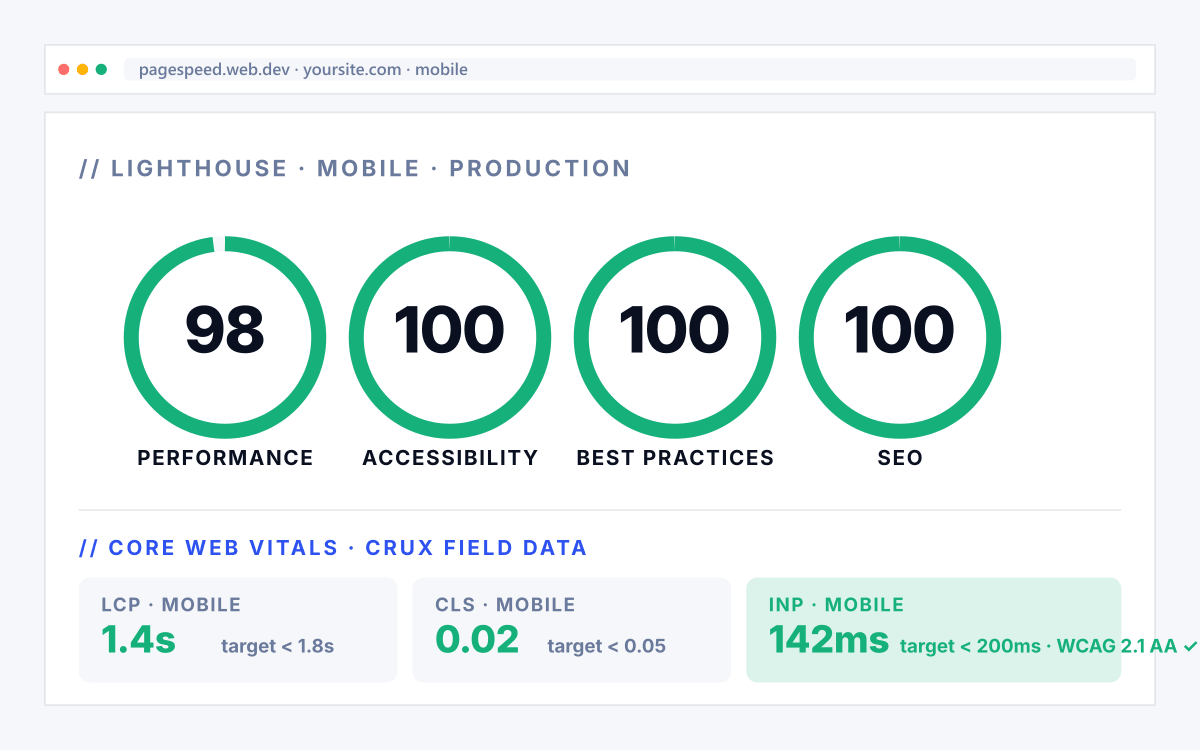
Every manufacturing site we build ships WCAG 2.1 AA accessible for ADA compliance because manufacturing websites face ADA complaints too. GDPR-compliant cookie consent (Cookiebot or OneTrust) and CCPA compliance are baseline for manufacturers with EU or California customer bases.
Compliance work does not replace your firm's compliance program or export control lead. It complements them. If your manufacturing operation is preparing for an ITAR audit or ISO recertification, we coordinate with your compliance lead so the marketing site is not the weak link.
Yes. Manufacturing website redesigns are the majority of our manufacturing web design agency work. Redesign process always starts with a full organic traffic and ranking audit. We identify the top 50 to 300 URLs by organic traffic (usually a mix of part-number pages, application pages, and specification pages), map every one to a new equivalent, and lock in a redirect strategy before content or design work starts.
Post-launch, we monitor rankings and organic traffic weekly for 90 days and catch any drops before they compound. Most redesigns hold within 5 percent of pre-launch organic traffic through the transition, and many gain 15 to 40 percent within 3 months from the new site's improved technical SEO and RFQ conversion architecture.
The biggest ranking loss risk is not the redesign itself. It is technical content that gets rewritten without preserving the depth that earned engineering-audience rankings. We flag pages that need topical preservation before writing starts, not after traffic drops.
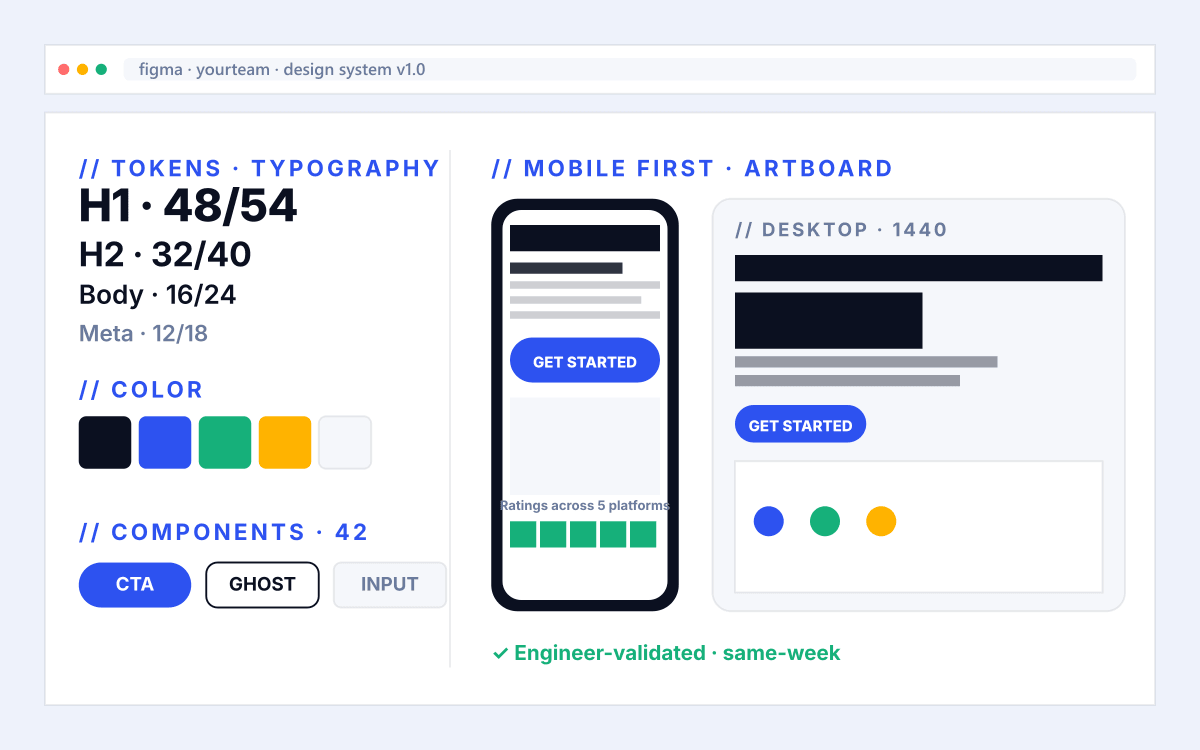
We build manufacturing websites on WordPress with a custom theme (default), Webflow, or Next.js with a headless CMS, depending on your team's editorial preferences, ERP integration needs, and product catalog complexity. All three options ship page-speed optimized, mobile-first, WCAG 2.1 AA accessible for ADA compliance, and Core Web Vitals green on launch.
WordPress is the default because most manufacturing marketing teams can edit content without engineering help and the plugin ecosystem covers common integrations (WooCommerce for parts, Gravity Forms for RFQs, HubSpot for CRM) out of the box. Webflow makes sense for design-heavy manufacturers with simpler catalogs. Next.js headless makes sense for manufacturers with large product catalogs, complex configurators, and existing engineering resources.
Product configurators for engineered-to-order manufacturers usually run on WooCommerce Product Add-Ons, custom PHP configurators, or dedicated CPQ platforms like DealHub or PandaDoc integrated into the site.
Yes. Multi-facility manufacturing website design is our Scale tier ($7,500). Enterprise ($25,000+) covers larger facility counts, multi-brand portfolios (parent brand with acquired subsidiary brands), and complex per-facility content architecture with equipment capability details, certifications by facility, and material specializations.
Multi-facility work includes per-facility landing pages with equipment lists, certifications (ISO 9001, AS9100, IATF 16949), tolerances achievable, and material specialties. That helps procurement teams find the right facility for their spec requirements before submitting the RFQ.
Multi-brand work adds portfolio-level positioning so brands do not confuse buyers on shared landing pages. Shared engineering content and cross-brand internal linking funnels buyers to the right-fit product without cannibalizing rankings between brands.
Yes. Every manufacturing web design services engagement includes 30 to 90 days of post-launch support at no additional charge, depending on tier. Launch tier includes 30 days. Growth includes 45 days. Scale includes 60 days. Enterprise includes 90 days. Post-launch support covers bug fixes, minor content updates, and analytics QA.
After post-launch support ends, ongoing manufacturing website maintenance moves to a monthly plan starting at $199 for the Essential tier. Maintenance covers hosting, security patching, backups, analytics upkeep, spec sheet updates, and included content edit hours. Conversion rate optimization and A/B testing sit on a separate CRO retainer starting at $1,500/mo.
Post-launch support is not a sales trick to extend the project. It is honest transition time. Most sites need small fixes in the first 30 days as real RFQ traffic exposes edge cases the launch QA missed.
Copywriting is included on Growth tier ($3,500) and above. Launch tier ($1,500) assumes your team writes the copy from a positioning brief we provide, because that is what keeps the price low. Scale and Enterprise include senior industrial copywriting for the full site plus positioning and messaging work up-front.
Manufacturing copy is a specialty skill. It has to speak accurately about spec tolerances, material properties, and process capabilities without dumbing down for a marketing audience. Generic marketing copy sinks RFQ conversion because engineers can smell the difference between "high-precision solutions" and "±0.001-inch tolerance on 316L stainless steel with ISO 9001-certified inspection."
Every copywriting engagement starts with engineering interviews (30 to 60 minutes each for 2 to 5 engineers or plant managers), competitor teardowns, and a written messaging framework signed off before writing starts.
A manufacturing web design agency knows the specific patterns that turn engineering and procurement traffic into qualified RFQs. Spec-first product pages that publish tolerances, materials, and certifications openly. Capability pages that map to how procurement teams actually search. Application pages that show the product doing the job across industries. RFQ forms that respect how engineers actually specify parts.
Generalist agencies build good-looking marketing sites. They usually miss the manufacturing-specific conversion architecture: the CAD download that keeps engineers on-site instead of bouncing, the spec sheet library that ranks on part-number queries, the distributor locator that connects buyers to authorized channel partners, and the RFQ form that captures the right technical detail on first submission.
Redefine Web's manufacturing website design company work covers all of that as the default scope. It is what "manufacturing web design" means when the designer has actually built industrial sites that produced RFQs.
Senior manufacturing website design strategist on the call. Three specific site fixes you can push live with or without us. Written summary in your inbox the next business day.
Drop your email. An industrial designer reviews your funnel and books the 30-minute audit within one business day.