
B2B Ecommerce Marketing Strategies for Long Sales Cycles
- Five buying phases need mapped content coverage across a 6 to 18-month cycle.
- Gated content plus progressive profiling captures named contacts at 8 to 20 percent conversion.
- Account-based marketing beats broad targeting on mid-market B2B catalogs.
- Distributor and reseller portals carry 65 percent of B2B ecommerce revenue.
- Quote-to-cash compression pays back faster than any top-of-funnel spend.
- Gated content and lead magnets in b2b ecommerce marketing strategy
- Account-based marketing for b2b ecommerce catalogs
- Distributor and reseller portals that feed b2b ecommerce marketing strategies
- Quote-to-cash workflow inside b2b ecommerce marketing strategies
- B2B ecommerce email marketing and nurture cadence
- Paid search and LinkedIn for b2b ecommerce marketing strategies
- Measurement stack for b2b ecommerce marketing strategies
- A b2b ecommerce marketing strategy in production
- Where b2b ecommerce marketing strategies fit the stack
Most B2B ecommerce stores run marketing playbooks copied from consumer DTC brands, and the numbers never quite work. The paid social ads pull cheap clicks that never turn into procurement conversations. The email flow ends at abandoned cart when the buying committee actually needs a case study and a distributor quote. A real set of b2b ecommerce marketing strategies fixes this by starting from the shape of the buyer. A procurement lead at a mid-market manufacturer takes 6 to 18 months to move from first search to signed purchase order, involves 6 to 10 people on the buying committee, and pulls in a distributor or reseller partner more than half the time.
This guide covers the plays we run on industrial, medical, chemical, and enterprise SaaS accounts every week. Long-cycle mechanics. Gated content for a 12-month nurture. Account-based marketing sized for mid-market catalogs. Distributor and reseller portals. Quote-to-cash workflow compression. Our ecommerce marketing agency hub covers the wider stack these plays plug into.
Gated content and lead magnets in b2b ecommerce marketing strategy
Gated content is the pillar of any b2b ecommerce marketing strategy because the buyer expects to trade an email for a real research asset. Consumer DTC brands almost never gate content because the buying cycle is too short. B2B brands almost always gate at least some content because the cycle demands nurture, and the buyer knows the trade. The rule of thumb is that gated content works when the asset saves the buyer real time or real risk, and it fails when the asset is a rewritten blog post hidden behind a form.
Assets worth gating on a B2B ecommerce catalog
- Category-specific ROI calculators that project savings, throughput, or compliance risk for the buyer’s specific scale.
- Vendor evaluation scorecards the procurement lead can carry into a shortlist meeting without rewriting from scratch.
- Integration architecture diagrams showing the vendor’s product fitting into common ERP, WMS, and CRM stacks.
- Compliance readiness assessments mapped to the buyer’s industry standards (FDA, ISO, SOC 2, HIPAA, REACH).
- Multi-account benchmark reports sourced from the brand’s own installed base with anonymized peer data.
- Peer case study PDFs covering revenue outcomes, integration timelines, and change-management notes.
Running that six-asset gating stack produces roughly 8 to 20 percent of website traffic converting to a named contact, versus 0.4 to 1.2 percent on ungated blog content. The captured contacts flow into a marketing automation nurture that runs 6 to 18 months, matching the buying cycle. Every asset in the list saves the buyer real work, so the form-fill rate stays high across the year. A sibling read on marketing automation ecommerce platforms and flows covers the flow side that catches the captured contacts.
Form fields that keep completion rates high
Gated forms fail when the field count goes past six on a first-touch asset. Ask for email, name, company, role, company size, and one qualifying question about the buyer’s timeline or use case. Skip phone number on the first form because it kills completion rate by 30 to 50 percent. Save the deeper qualifying questions for the second-asset download, when the buyer has already crossed the trust threshold once. Progressive profiling built into HubSpot, Marketo, or Pardot handles this automatically, and it fills the CRM record without asking the buyer for everything on day one. Brands that skip progressive profiling either ask too much on the first form and lose leads, or ask too little across the whole nurture and hand the sales team an empty CRM record.
Account-based marketing for b2b ecommerce catalogs
Account-based marketing (ABM) is the b2b ecommerce marketing strategy that treats named target accounts as the campaign audience instead of anonymous website visitors. Instead of running paid social to a broad interest audience, ABM runs coordinated content, ads, direct mail, and sales outreach at a curated list of 50 to 500 accounts the brand actually wants as customers. Done right, ABM produces 3 to 8 times the pipeline value per dollar of a broad-audience program on mid-market B2B accounts.
Sizing the target account list
The right list size depends on the brand’s sales team capacity and the average deal cycle length. A 4-rep team running 12-month cycles handles roughly 80 to 200 tier-one accounts and another 200 to 400 tier-two accounts, for a total ABM audience of 300 to 600 accounts. A 10-rep team handles 500 to 1,200 total accounts. Building the list starts with the brand’s existing customer profile, expands to look-alike firmographics via ZoomInfo or Cognism, and filters against a minimum revenue threshold that matches the brand’s average order value. Publishing a working ABM list of 500 accounts and then running coordinated content plus ads plus SDR outreach against it for 90 days produces measurable pipeline gains by month three on the accounts we run.
Channels that hit the buying committee
Reaching a 6 to 10-person buying committee at a named account takes multi-channel coordination. LinkedIn ads with company-name targeting to hit the champion and the influencer. Programmatic display via 6sense, Demandbase, or RollWorks to hit the account IP range across the open web. Direct mail to the champion with a $80 to $150 gift item tied to the value proposition. Personalized landing pages (via Mutiny or Personyze) that show the buyer their own company logo and industry-specific messaging. Sales development rep outreach on LinkedIn and email, working from the champion’s inbound engagement signal. Running four of those five channels in parallel against the named account list is what separates an ABM program that produces pipeline from a rebrand of the old lead-gen program with a new name on the deck.
Distributor and reseller portals that feed b2b ecommerce marketing strategies
Roughly 65 percent of B2B ecommerce revenue flows through a distributor, reseller, or channel partner rather than through the direct-to-buyer site. Any set of b2b ecommerce marketing strategies that ignores the partner channel gives up two-thirds of the addressable revenue. A working partner portal turns the distributor network into a sales force the brand does not have to hire, and it stops the partner from selling a competitor by accident because the competitor made their catalog easier to quote from.
What a real distributor portal needs to carry
A working distributor portal carries live catalog data with tier-specific pricing per partner, downloadable spec sheets and CAD files, co-branded marketing assets, quote-request forms that route into the brand’s CRM, order tracking with real-time inventory visibility, sales training modules with certification tracking, and a rebate or spiff dashboard the partner rep can log into and see their earned incentives. Missing any of the seven pieces sends the partner rep to the phone with a sales question, and the friction slows the entire quote-to-cash pipeline. Building the portal on Shopify Plus B2B, BigCommerce B2B Edition, Adobe Commerce, or a custom stack takes 3 to 6 months on average and pays back inside 12 months on accounts with 50 or more active distributors.
Marketing programs that push the portal
The portal only produces revenue if the distributor network uses it every week. Push adoption through monthly partner newsletters, quarterly product-training webinars, an annual partner conference (in-person or virtual), a rebate program that rewards portal-logged quotes over phoned-in quotes, a co-marketing fund partners can draw from for local demand generation, and a partner-of-the-quarter recognition program that puts the top rep on the LinkedIn feed. Programs that stack four to six of those elements keep partner engagement at 70 to 85 percent monthly active use of the portal. Programs that launch the portal and stop marketing it hit 15 to 30 percent monthly active use and blame the portal build.
A procurement committee of 6-10 people doesn't recover from a cart email. Build a distributor quote path and a 12-month nurture instead. Kill the abandon-cart flow this week.
Quote-to-cash workflow inside b2b ecommerce marketing strategies
Quote-to-cash is the operational pipeline that runs from the buyer’s first quote request to the paid invoice, and it is where most B2B ecommerce marketing plans die on the transition from marketing to sales. A working b2b ecommerce marketing strategy treats quote-to-cash as part of the marketing stack, not a separate finance workflow, because the friction inside the quote step is what kills 30 to 50 percent of the pipeline that marketing worked six months to build. Shortening the cycle from quote to signed PO by even one week compounds across every deal in the funnel.
| Quote-to-cash stage | Typical time | Best-in-class time | Owner | Tool |
|---|---|---|---|---|
| Quote request submitted | Same day | Under 2 hours | Marketing form | HubSpot, Marketo, Salesforce |
| Configuration and pricing | 3 to 7 days | Under 24 hours | Sales engineering | Salesforce CPQ, Conga, DealHub |
| Approval workflow | 2 to 10 days | Under 2 days | Sales manager | DocuSign CLM, Ironclad |
| Contract redlines | 7 to 30 days | Under 7 days | Legal | Ironclad, Icertis |
| Signed and PO issued | 3 to 14 days | Under 3 days | Procurement | Coupa, Ariba, Zip |
| Invoice and payment | 30 to 90 days | Under 30 days | Finance AR | NetSuite, Sage Intacct |
Cutting the total quote-to-cash time from an industry-average 55 to 145 days down to 20 to 45 days is worth roughly 15 to 25 percent additional annual revenue on the same marketing spend, because deals close inside the quarter that produced the lead instead of slipping to the next fiscal window. Configure Price Quote (CPQ) software plus a real approval workflow plus pre-approved contract templates covers most of the compression. A sibling read on ecommerce marketing dashboard attribution and reporting cadence covers the measurement side that makes the compression visible.
Marketing owns the quote-request submission stage because the form design, page copy, and confirmation flow decide whether the buyer even completes the quote request. Sales owns configuration onward, but marketing feeds the pre-populated quote defaults from the buyer’s known account data. Every friction point in the workflow gets measured monthly against the best-in-class times in the table above, and the biggest drop-off stage gets priority attention until it moves. That is how the marketing team stops losing 40 percent of built pipeline to workflow friction on the sales side.
B2B ecommerce email marketing and nurture cadence
B2B ecommerce email marketing is the layer that catches captured contacts and nurtures them across the 6 to 18-month cycle. Consumer email flows built around abandoned cart and win-back miss the point on B2B, because the B2B buyer is not one person deciding in an evening. The right nurture cadence assumes the buyer is a committee that reads maybe one email a week from any given vendor, and the emails have to earn the open across a year of dead space between active buying windows.
Twelve-month nurture skeleton
A working 12-month nurture skeleton runs weekly during the first six weeks after lead capture, bi-weekly through months two and three, monthly through months four to nine, and quarterly through months ten to twelve. Email content shifts across the year to match the buying phase: education pieces in the first three months, comparison and vendor-evaluation content in months four to six, ROI and case study proof in months seven to nine, and offer or event invitations in months ten to twelve. The cadence dropoff protects the inbox from vendor fatigue, and the content shift keeps the emails useful even for a buyer who is not ready to act until month 11. Missing the shift keeps sending the same intro-level content and produces the classic unsubscribe wave at month four.
Behavioral triggers that pull leads back into active nurture
Behavioral triggers pull a lead from the passive quarterly cadence back to the weekly active-buying cadence when the buyer signals interest. Pricing page visits, spec-sheet downloads, quote-request page abandonment, and repeat visits from the same account IP inside 14 days all trigger the intent flow. That flow sends a short personal-style email from a sales rep with a calendar link, plus a piece of comparison content mapped to the buyer’s likely question. A sibling read on email marketing for ecommerce flows campaigns and examples covers the wider ecommerce email pattern the B2B nurture adapts. B2B ecommerce email marketing wins by treating the year like a calendar of maybe eight useful email moments, not 52 weekly newsletters the recipient tunes out by week three. The HubSpot B2B email marketing guide covers the wider tactical detail on cadence math and behavioral triggers for teams running the nurture in-house.
Paid search and LinkedIn for b2b ecommerce marketing strategies
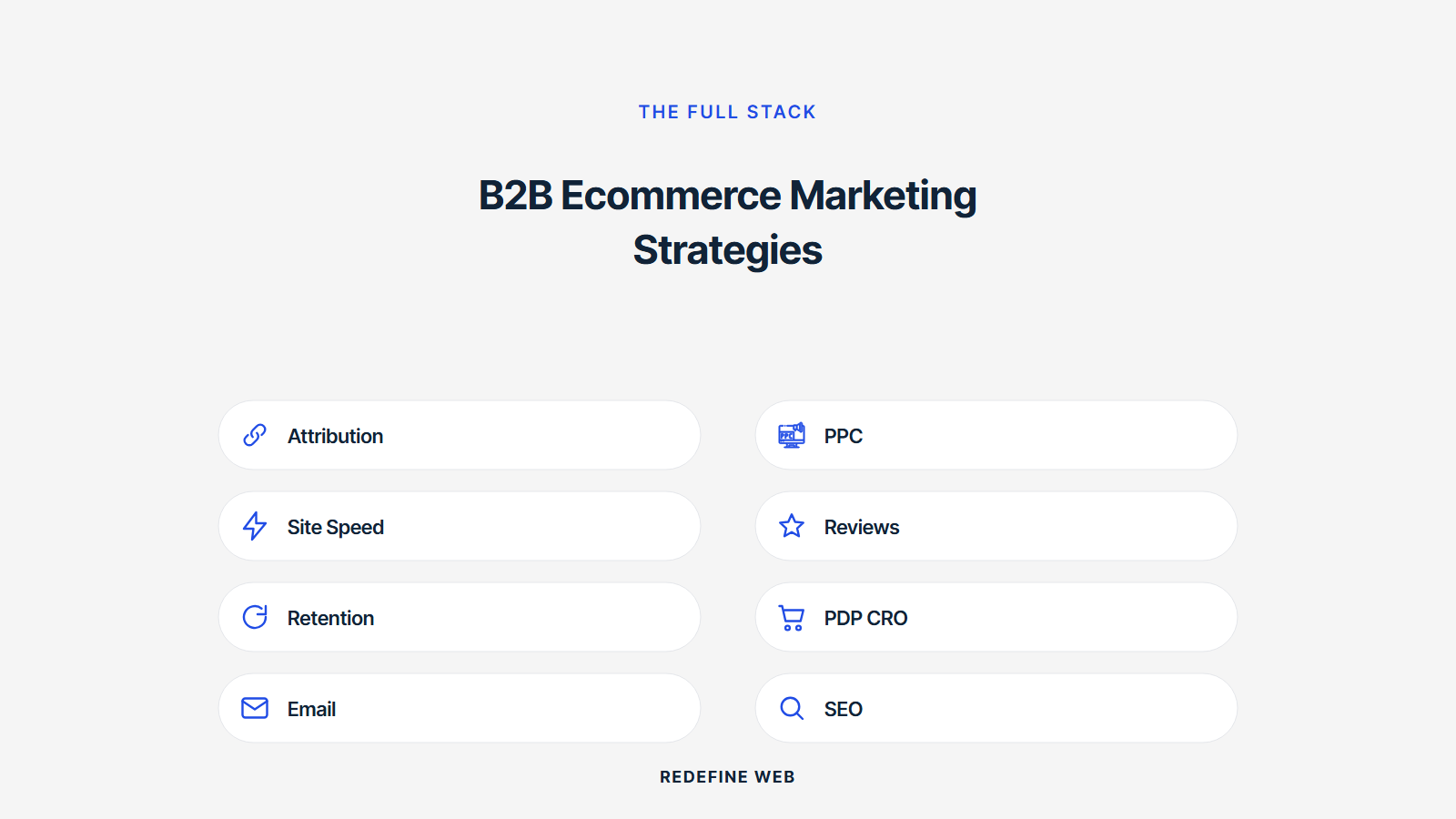
Paid search and LinkedIn are the two channels that carry most of the paid-media weight inside b2b ecommerce marketing strategies. Meta and TikTok work poorly for most B2B categories because the audience-targeting model does not map cleanly to job title, seniority, and firmographic data. Google Ads and LinkedIn map directly to those signals, and they produce the majority of the traffic worth spending money on. Programmatic display via 6sense or Demandbase fills in the account-based layer covered earlier in this guide.
Every B2B ecommerce paid-media review meeting eventually reaches the moment where the CMO points at a TikTok ad from a consumer brand and asks the agency to do exactly that. The video is a dancer holding a candle. The brand sells industrial compressors to petrochemical facilities. The polite recommendation is that the mechanism does not translate. The CMO will insist on trying anyway, and three months later the agency is asked why the dancing-compressor TikTok campaign did not go viral. Somewhere in the reporting archive of every B2B ecommerce brand, a viral-copy attempt from a category that does not fit quietly lives on as evidence that the paid channel choice is a first-order decision, not a creative decision.
Google Ads playbook for B2B ecommerce
Run branded search first to defend the trademark against competitor bidding. Run high-intent non-branded search on category terms plus buying-modifier terms (best, top, review, alternative, comparison). Run bottom-funnel search on integration-specific terms (product name plus integration name, product name plus certification, product name plus platform). Skip broad-match keywords on B2B because the click quality collapses. Bid up on desktop, bid down on mobile because the B2B buyer converts overwhelmingly on desktop. Budget $6,000 to $30,000 monthly on Google Ads at mid-market scale, and expect a $180 to $900 cost per marketing-qualified lead depending on category and competition. The Search Engine Land B2B PPC library covers the deeper tactical detail for teams running paid search in-house.
LinkedIn Ads playbook for the buying committee
Run three LinkedIn Ads campaigns in parallel. A single-image or document-ad campaign targeting the champion job title with a gated content asset. A conversation ad targeting the influencer bench with a two-step response flow. An account-based campaign uploading the named target account list and running sponsored content plus lead gen forms against the buying committee. Budget $8,000 to $40,000 monthly on LinkedIn at mid-market scale. Cost per MQL runs $220 to $1,400 depending on category, seniority, and offer strength. LinkedIn Sales Navigator plus the ad platform combined lets the SDR team follow up on inbound engagement inside 48 hours, which is where LinkedIn actually pays back the CPM.
Measurement stack for b2b ecommerce marketing strategies
Measurement is what decides whether the b2b ecommerce marketing strategies get renewed the following year. A strategy measured only on marketing-qualified leads runs the classic mistake of celebrating the top-of-funnel and ignoring the fact that only 4 to 8 percent of those MQLs close. A strategy measured only on closed revenue runs the opposite mistake of waiting 18 months to know what worked. A working measurement stack tracks every stage of the funnel together and reads the numbers monthly rather than pulling them from four dashboards.
Eight numbers that matter for B2B ecommerce
Website sessions from the target account list, from a reverse-IP tool like Clearbit Reveal or 6sense. Marketing-qualified lead volume by campaign source, from HubSpot or Marketo. Sales-qualified lead conversion rate, from CRM stage progression. Sales pipeline value created by campaign, from Salesforce or HubSpot deal reports. Sales pipeline value influenced by campaign, on a multi-touch attribution model that credits every touchpoint. Closed revenue by campaign, from CRM closed-won reports. Sales cycle length by lead source, tracking whether faster-closing sources deserve more budget. Customer acquisition cost payback period, calculated as CAC divided by monthly gross margin. Reading those eight numbers together every month tells the founder whether the marketing dollar is producing pipeline, and which strategies are pulling their weight over the long cycle. A sibling read on ecommerce marketing dashboard attribution and reporting cadence covers the wider dashboard pattern.
Attribution windows that catch long-cycle influence
Last-click attribution undercounts B2B marketing revenue by 40 to 70 percent on most accounts because the buyer touches 12 to 22 pieces of content across a year before signing a PO. Use a 12 to 18-month attribution window with a data-driven or W-shaped model, and add a marketing mix model layer that reconciles platform-reported and CRM-reported revenue. Run the reconciliation quarterly to catch drift between the platform pixel data and the CRM data of record. Combined attribution plus quarterly reconciliation catches the assisted revenue that long-cycle marketing produces, and it gives the executive team a fair picture of the payback across a fiscal year rather than a 30-day paid-ads window.
A b2b ecommerce marketing strategy in production
Poly Processing came to our team with a chemical-tank manufacturing catalog, an installed base of industrial plants and municipalities across North America, and a marketing stack running entirely on trade shows plus a static brochure site. The website had no technical documentation, no gated content, no SEO, and no inbound funnel. The sales team relied on trade-show booth conversations plus outbound calls to a legacy account list. Cost per qualified lead ran high because reps had to chase every prospect by hand, and digital decision-makers who preferred to self-serve early research never made contact with the brand.
Our team built a full B2B inbound program covering buyer-persona research and journey mapping across five buying phases, a modern mobile-first site build with technical documentation and downloadable spec sheets, an interactive tank configurator that let procurement leads self-qualify the exact tank they needed, a HubSpot marketing automation and CRM implementation with progressive profiling on gated content forms, a category-authority content library covering chemical-storage safety, corrosion resistance, and regulatory compliance, and a quarterly webinar series featuring the brand’s engineering team. Cadence held at 8 to 12 published pieces monthly across the first year, and the sales team started engaging inbound leads instead of chasing outbound cold lists.
Over the following year, cost per lead dropped 90 percent, inbound ROI hit 10 times marketing spend, and the sales team engaged hundreds of qualified monthly leads from inbound automation. The interactive tank configurator turned into the highest-converting page on the site because it let procurement leads self-qualify a $12,000 to $180,000 tank order with real product data before ever speaking to a rep. That is the shape of a b2b ecommerce marketing strategy that actually pays back the retainer inside 12 months on an industrial catalog.
Where b2b ecommerce marketing strategies fit the stack
B2B ecommerce marketing strategies sit inside a wider go-to-market plan that includes sales enablement, channel partner marketing, customer success, and revenue operations. Marketing is not the whole stack. Marketing is the layer that fills the top of the funnel, nurtures the middle, and hands the bottom to sales in a state the rep can close inside a reasonable window. Brands that treat marketing as separate from sales and partner channels produce content that looks nice and moves nothing.
Pick the buying-phase map first, then the gated content library, then the ABM account list, then the quote-to-cash workflow compression, then the measurement. Run gated content plus email nurture plus paid search plus LinkedIn as the baseline for any mid-market B2B ecommerce brand. Add distributor portal work in year two once the direct funnel is producing. Add full ABM in year three once the CRM is populated enough to know which accounts to target. Read the eight KPIs every month and refresh the strategy every quarter. Do those five things for 12 months and B2B marketing grows into a real revenue line the CFO can point at.
Our sibling read on affiliate marketing ecommerce programs and networks covers the channel-partner side where distributor and reseller programs adapt into a B2B affiliate model. The analyst and thought-leader plays that B2B categories use instead of consumer influencer content run on a similar payout structure, sized to the account revenue rather than a follower count.
Our ecommerce marketing retainer starts at $599 per month and runs six months, because a B2B ecommerce program needs a full quarter to build the buying-phase content map and another quarter to prove the pipeline attribution math. Faster than that and the numbers are noise on a 12-month cycle. Slower than that and the sales team loses faith in inbound before the flywheel spins. The ecommerce marketing retainer page covers the scope and pricing in more depth. Teams weighing international launch should read our cross border ecommerce market playbook for the six-decision frame.
For teams building an AI stack on top of the frameworks above, our read on AI marketing for ecommerce tools and applications covers the tools and buildout sequence.
Frequently asked questions
What are the best b2b ecommerce marketing strategies for long sales cycles?
The best b2b ecommerce marketing strategies for long sales cycles are built around the five buying phases: problem identification, solution scoping, vendor comparison, internal approval, and purchase execution. Each phase needs mapped content, a paid channel presence, and a sales-assist handoff. Gated content captures named contacts at 8 to 20 percent conversion, versus 0.4 to 1.2 percent on ungated blog content. Marketing automation nurtures the captured contact across 6 to 18 months at a cadence that steps down from weekly to quarterly. Paid search and LinkedIn produce most of the qualified traffic. Distributor portals cover the 65 percent of B2B revenue that flows through channel partners.
How does a b2b ecommerce marketing strategy differ from a consumer DTC strategy?
A b2b ecommerce marketing strategy differs from consumer DTC in three specific ways. The buyer is a 6 to 10-person committee, not one person, so single-user retargeting misses most of the vote. The average order value runs $2,400 to $180,000 depending on category, which means the funnel needs a sales-assist layer that consumer brands skip. Roughly 65 percent of B2B ecommerce revenue flows through a distributor or reseller partner, which means the marketing has to feed the partner channel as well as the direct site. Consumer DTC playbooks that ignore these three facts fail on B2B accounts almost regardless of budget.
How much should a b2b ecommerce marketing agency budget produce in pipeline?
A b2b ecommerce marketing agency budget of $12,000 to $40,000 monthly at mid-market scale should produce $180,000 to $900,000 in sourced pipeline value quarterly, at a 3 to 6 times pipeline-to-spend ratio on a mature program. Closed revenue trails pipeline by the average sales cycle length, so a program launched in Q1 shows meaningful closed revenue in Q3 to Q4. Cost per marketing-qualified lead runs $180 to $1,400 depending on category, channel mix, and offer strength. Enterprise-scale budgets of $60,000 to $200,000 monthly produce proportionally larger pipeline, and account-based marketing programs raise the pipeline-to-spend ratio to 4 to 8 times on curated named account lists.
What role does b2b ecommerce email marketing play in the long-cycle funnel?
B2B ecommerce email marketing carries the nurture layer that keeps a captured lead in flow across the 6 to 18-month buying cycle. The right cadence steps down from weekly during the first six weeks after capture, to bi-weekly through months two and three, monthly through months four to nine, and quarterly through months ten to twelve. Email content shifts to match the buying phase: education early, comparison and evaluation in the middle, ROI and case study proof late. Behavioral triggers (pricing page visits, spec-sheet downloads, quote-request abandonment) pull leads back to the active-buying cadence. Skipping the shift produces unsubscribe waves at month four.
How do distributor portals fit into b2b ecommerce marketing strategies?
Distributor portals fit into b2b ecommerce marketing strategies as the platform that turns partner channels into a working sales force. A real portal carries tier-specific pricing per partner, downloadable spec sheets and CAD files, co-branded marketing assets, quote-request forms routed into the brand CRM, order tracking with inventory visibility, sales training with certification tracking, and a rebate or spiff dashboard. Marketing programs (monthly newsletters, quarterly webinars, annual partner conferences, rebate incentives, co-marketing funds, partner recognition) push portal adoption. Programs that stack four to six of those elements keep partner monthly active use at 70 to 85 percent. Portals launched without ongoing marketing hit 15 to 30 percent adoption and blame the platform build.
Book your free 30-minute strategy call.
No spam, no sales rep. We use your email to schedule your call with a senior strategist. That is it.
More from the blog
View all articles → Digital Marketing
 Dental Marketing Tips That Compound Into New Patients
Read article Digital Marketing
 Ecommerce Marketing Strategies That Drive Real DTC Revenue
Read article Digital Marketing