
Email Marketing for Ecommerce Flows Campaigns and Examples
- Email carries 25 to 40 percent of DTC monthly revenue.
- Six core flows cover welcome, cart, browse, post-purchase, winback, replenishment.
- Send two to four weekly campaigns against the engaged segment.
- Run DKIM, DMARC, and monthly list hygiene for deliverability.
- Retainers run $599 to $12,000 monthly on 6-month contracts.
- Ecommerce Email Marketing Examples Across Categories
- Best Ecommerce Email Marketing Platforms
- What Do Ecommerce Email Marketing Services Cost
- How Abigail Ahern Scaled With Ecommerce Email Marketing
- Measuring Ecommerce Email Marketing Strategy Outcomes
- Where Email Marketing for Ecommerce Fits Your Stack
A DTC brand running email marketing for ecommerce as an afterthought quietly leaves 25 to 40 percent of monthly revenue on the table before any paid channel gets audited. The retention side of the account is the layer that pays back paid acquisition, and email carries the biggest share of that retention revenue for almost every category we operate. This read walks the full email program the way our team builds it for Klaviyo and Attentive accounts, from the core flow set through the weekly campaign calendar, segmentation logic, deliverability guardrails, list growth mechanics, and real examples across beauty, apparel, supplements, and consumable food brands from $500,000 yearly revenue up through $30M scale accounts. Every rule and number in this read comes off live client dashboards our team reads monthly, not off a Klaviyo blog post. Read straight through and finish with a written priority order for the first 90 days of a real retention rebuild.
Ecommerce Email Marketing Examples Across Categories
Ecommerce email marketing examples get more useful when they are pinned to a real category, a real subject line pattern, and a real revenue outcome rather than abstract creative theory. The examples below come off our own client work across skincare, coffee, apparel, and luxury home decor. Every example ties back to a specific flow or campaign type and a measured revenue share on the account.
Skincare Welcome Series Example
A skincare brand at $3M yearly revenue runs a four-email welcome series across ten days. Email one delivers a 15 percent off code plus a founder note on ingredient philosophy. Email two on day two walks the routine builder tool tied to skin concern segmentation. Email three on day five drops social proof and dermatologist quotes. Email four on day nine reinforces the incentive window and links a bestseller bundle. The flow drove 11 percent of monthly email revenue on its own for the trailing 90 days at rebuild and cut welcome-to-first-order time from 14 days to 6 days on the median new subscriber.
Coffee Replenishment Example
A specialty coffee roaster at $1.8M yearly revenue runs a replenishment flow triggered off first-order shipping notification. The flow lands three emails at day 18, day 25, and day 32 after order, timed against the median reorder point across the buyer base. Subject lines carry the actual roast name and a one-click reorder link tied to the subscribe-and-save offer. The flow drove 22 percent of monthly email revenue at the 90-day post-rebuild mark and pushed second-order rate at day 60 from 24 percent to 38 percent. Replenishment flows are the highest-payback single move consumable categories can run.
Best Ecommerce Email Marketing Platforms
The best ecommerce email marketing platform for a DTC brand depends on stage, catalog complexity, and how tightly the brand runs SMS alongside email. Klaviyo dominates the Shopify segment for stores past $500,000 yearly revenue because the native product-catalog integration, segmentation depth, and predictive lifetime value features clear the bar most competitors miss. Attentive leads the paired SMS conversation at scale. Sendlane and Omnisend land smaller brands well. Mailchimp still runs pre-$500,000 starter stores decently before the segmentation ceiling pushes brands off the platform.
Klaviyo for Shopify Brands
Klaviyo pricing scales with active subscribers and lands most $1M to $10M brands between $600 and $3,200 monthly. The platform includes flows, campaigns, segmentation, predictive analytics, product recommendation blocks, and native Shopify plus WooCommerce integration. The reporting layer inside Klaviyo lines up with the metrics rhythm most retention programs need. The Attentive plus Klaviyo pairing works well past $2M yearly revenue when SMS starts pulling its own share of monthly revenue. Read the wider platform view inside the marketing automation ecommerce deep read.
Omnisend and Sendlane Alternatives
Omnisend runs cleanly for stores under $2M yearly revenue with a lower monthly platform fee and tight Shopify integration. Sendlane serves stores that want deeper journey builder control on smaller lists. Mailchimp still ships fine for pre-launch brands under $250,000 yearly revenue but the segmentation cap starts hurting once the brand needs more than three or four segments running weekly. Every brand outgrows Mailchimp before $1M yearly revenue in nine cases out of ten, and the switch to Klaviyo pays back inside a quarter through recovered flow revenue alone.
What Do Ecommerce Email Marketing Services Cost
Ecommerce email marketing services cost $599 to $12,000 monthly depending on scope, list size, and campaign volume across paired channels. Starter retainers at $599 to $1,500 monthly cover the six core flows plus two weekly broadcast campaigns for DTC brands sitting under $500,000 yearly revenue.
Growth retainers at $2,500 to $5,000 monthly cover a full campaign calendar, monthly flow audits, and quarterly creative refresh. Mid-market retainers at $5,000 to $12,000 monthly cover a paired SMS plus email program with dedicated strategy and creative capacity across a wider send calendar.
Every retainer runs on a six-month contract with a monthly plan review, a shared reporting dashboard, and clear ownership on strategy, creative, and platform execution. Retainer scope reads different depending on whether the brand already runs Klaviyo, needs a full migration from Mailchimp, or wants a paired SMS build alongside the email side. See the full retainer scope inside the ecommerce digital marketing services deep read that walks per-tier deliverables end to end.
Every DTC founder eventually reaches the Monday morning where the Klaviyo revenue report shows email carried 38 percent of the previous week, the founder emails the marketing lead asking why the number is finally holding, and the answer is that nobody sent the promo blast the founder personally drafted last Tuesday because the engaged segment already bought that bundle three weeks ago. The founder learns that a quieter calendar aimed at the right segment beats a louder one aimed at the whole list, usually while reading a Klaviyo dashboard on the couch at 9 pm.
A tired welcome flow leaks 12% of new-subscriber revenue. Open Klaviyo, click Metrics, check welcome flow conversion. If under 4%, rewrite it before next week's send.
How Abigail Ahern Scaled With Ecommerce Email Marketing
Abigail Ahern, a London-based luxury home decor brand on Shopify, engaged Redefine Web in August 2020 with a retention program leaning heavily on discount-anchored broadcast sends. The paid side of the account carried most of the growth conversation while the email side quietly under-delivered.
The retention rebuild started with a full flow audit against the six core flows every DTC brand needs running. Welcome, cart abandonment, browse abandonment, post-purchase, winback at day 90, and category-specific replenishment for the interior refresh cadence buyers actually run against home decor. Segmentation moved off demographic guesswork onto behavioral signal split by engagement window, purchase count, and category preference. Creative direction pulled off constant discount banners onto premium mood-led content that matched the luxury brand voice and the design-conscious buyer segment. Deliverability guardrails caught a suppression backlog that had been silently costing 12 percent of the active list to spam placement.
The results across a 12-month window on the rebuilt email plus paid rhythm. Ecommerce revenue climbed 179 percent year over year. Paid search return on ad spend reached 1,588 percent driven by the non-branded rebuild. Paid social return on ad spend reached 3,000 percent through disciplined retargeting supported by the retention flows catching every buyer signal. Ecommerce conversion rate roughly doubled from baseline. Contribution margin per order recovered as the discount reliance dropped across email and paid together. The retention side of the account went from a compliance line item to a compounding growth channel that pulled the whole account forward.
Measuring Ecommerce Email Marketing Strategy Outcomes
Measurement discipline for ecommerce email marketing strategy work sits on four numbers most retention programs skip and one dashboard the whole team reads weekly. Revenue share of total ecommerce revenue attributable to email. Revenue per subscriber against the active list. Flow revenue split by flow name. Engagement segment health across the last 30, 60, and 90 days. A brand tracking those four numbers together spots deliverability drift, flow degradation, and segment fatigue two to four weeks before revenue actually drops.
Revenue Share and Revenue Per Subscriber
Revenue share pulled from email marketing for ecommerce should land at 25 to 40 percent of total ecommerce revenue on healthy DTC accounts once the flow set matures. Revenue per subscriber against the active list should land at $0.35 to $1.20 monthly depending on category and average order value. Consumable categories run higher because reorder cadence pulls repeat email revenue every month. Apparel and home goods run lower because between-purchase cycles pull further apart. Brands running below the category floor usually have a segmentation problem or a flow rebuild waiting to happen.
Deliverability and Engagement Health
Deliverability and engagement health carry the trailing indicators that predict revenue drift long before the founder notices it in the P and L. Inbox placement rate against Gmail, Yahoo, and Apple Mail. Open rate against the engaged 30-day segment. Click rate against opens. Complaint rate against total sends. Unsubscribe rate per campaign. A brand tracking those numbers monthly beats a brand chasing a single weekly revenue print every quarter because the leading signals move first. The Klaviyo ecommerce benchmarks report is a useful outside read for category benchmarks and the HubSpot email marketing statistics roundup covers the wider industry view.
Where Email Marketing for Ecommerce Fits Your Stack
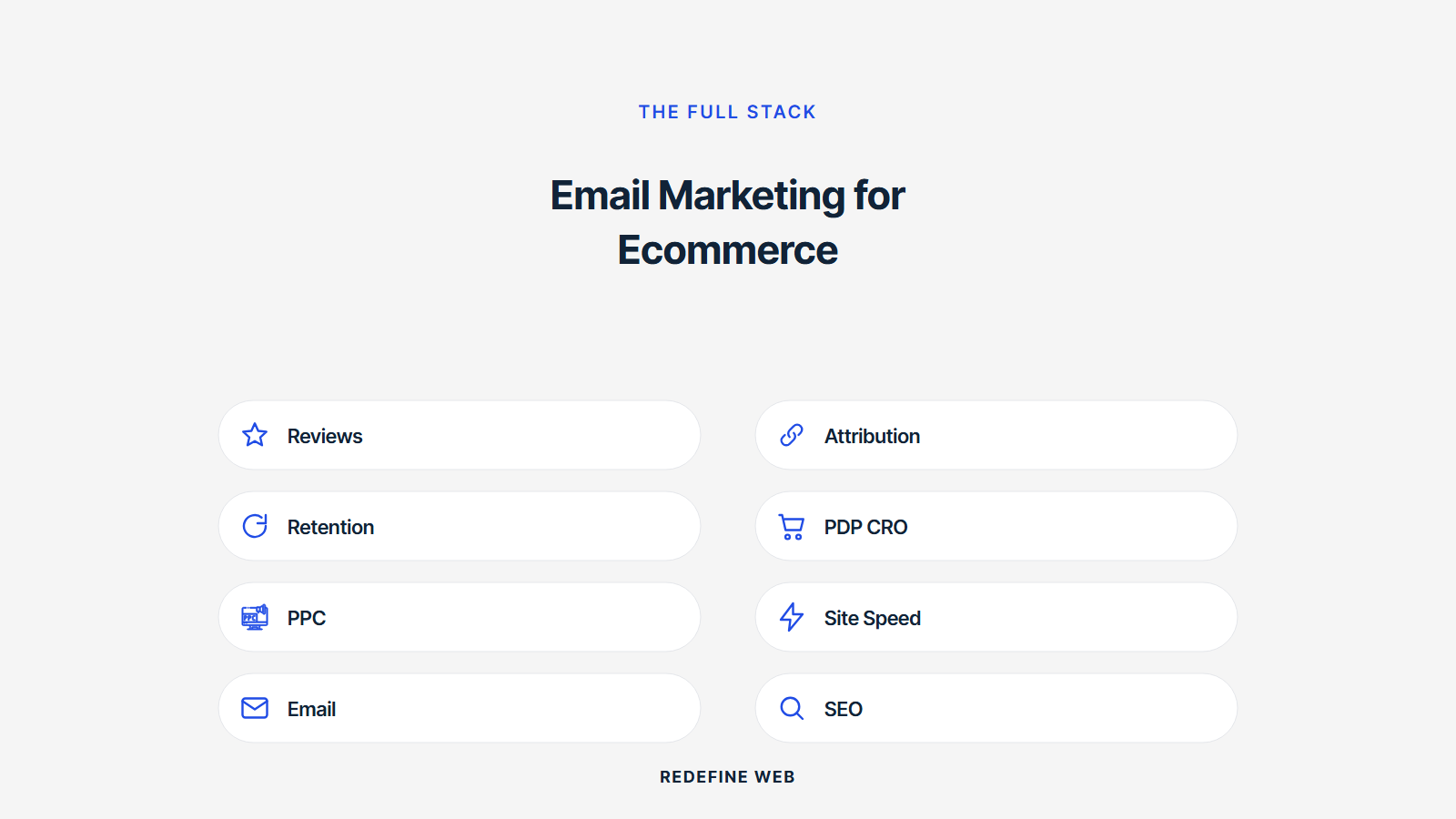
Email marketing for ecommerce sits inside the wider retention layer of the marketing stack as the highest-payback single channel most DTC brands operate. Paid social and paid search sit above it as the acquisition layer. SMS sits alongside it as the paired retention channel that carries urgency-anchored moments email cannot. Organic search and content sit underneath as the demand-generation layer that fills the top of the funnel. The stack works when every layer talks to every other layer through the metrics dashboard and the campaign calendar.
Founders ready to rebuild the retention side against real category benchmarks can start with a free audit of the current flow set, segmentation, deliverability posture, and campaign calendar. That audit produces a written priority order before any retainer conversation opens. Whether the brand runs a starter Shopify store at $300,000 yearly revenue or a scale account past $15M, anchoring on the six core flows plus a category-aware campaign calendar plus disciplined segmentation beats chasing the next Klaviyo template pack every quarter of 2026. Read the wider retention rhythm inside our ecommerce marketing agency hub for the cross-channel view, then book a free audit call for a written priority list before any retainer conversation opens.
See our sibling read on content marketing strategy for ecommerce for the framework version of the same playbook.
Teams selling into procurement committees should read our sibling guide on b2b ecommerce marketing strategies for the long-cycle nurture pattern that fits a 6 to 18-month decision.
Frequently asked questions
What is email marketing for ecommerce and why does it matter for DTC brands?
Email marketing for ecommerce is the retention channel that reads back to every buyer signal inside the store through automated flows plus a broadcast campaign calendar. It carries 25 to 40 percent of monthly revenue on healthy DTC accounts because owned audience beats rented reach on payback math. Paid channels rent attention against auction inflation every fiscal year. Owned email pays a flat platform cost and reaches the whole engaged segment on send day. The compounding math kicks in once list growth outpaces churn and the flow set catches every buyer signal that already lived inside the store.
How does an ecommerce email marketing strategy differ across categories?
An ecommerce email marketing strategy differs across categories on cadence, flow priority, and revenue share. Consumable categories like coffee and supplements run replenishment flows tied to reorder cadence and carry 30 to 40 percent of monthly revenue from email. Skincare and beauty carry 25 to 35 percent with a heavier welcome and category segmentation load. Apparel and home goods carry 15 to 28 percent with longer between-purchase cycles that push more revenue toward broadcast campaigns rather than flows. Every category needs the six core flows in place, but the campaign calendar and cadence shift by category to match buyer behavior.
What do ecommerce email marketing services cost for a DTC brand?
Ecommerce email marketing services cost $599 to $12,000 monthly depending on scope, list size, and campaign volume. Starter retainers at $599 to $1,500 monthly cover the six core flows plus two weekly campaigns for brands under $500,000 yearly revenue. Growth retainers at $2,500 to $5,000 monthly cover a full campaign calendar, monthly flow audits, and quarterly creative refresh. Mid-market retainers at $5,000 to $12,000 cover a paired SMS plus email program with dedicated strategy and creative capacity. Every retainer runs on a six-month contract with a monthly plan review and a shared reporting dashboard.
Which ecommerce email marketing examples pay back the fastest?
Ecommerce email marketing examples that pay back the fastest sit inside the six core flows rather than broadcast campaigns. Welcome series drives 8 to 15 percent of monthly email revenue on healthy brands. Cart abandonment recovers 8 to 14 percent of triggered sessions on cart adds. Post-purchase drives 5 to 12 percent of monthly email revenue and pushes second-order rate up. Replenishment for consumable categories drives 15 to 25 percent of monthly email revenue on its own. A brand rebuilding all four together usually recovers 20 to 35 percent of email revenue inside 90 days without any new list growth work.
What is the best ecommerce email marketing platform for a DTC brand past $1M yearly revenue?
The best ecommerce email marketing platform for a DTC brand past $1M yearly revenue is Klaviyo in nine cases out of ten. Klaviyo pricing scales with active subscribers and lands most $1M to $10M brands between $600 and $3,200 monthly. The platform includes flows, campaigns, segmentation, predictive analytics, product recommendation blocks, and native Shopify plus WooCommerce integration. Attentive pairs with Klaviyo well for the SMS side once brands pass $2M yearly revenue. Omnisend and Sendlane work for smaller stores under $2M. Mailchimp starts hurting past three or four active segments and usually gets replaced before $1M yearly revenue.
Book your free 30-minute strategy call.
No spam, no sales rep. We use your email to schedule your call with a senior strategist. That is it.
More from the blog
View all articles → Digital Marketing
 Dental Marketing Tips That Compound Into New Patients
Read article Digital Marketing
 Ecommerce Marketing Strategies That Drive Real DTC Revenue
Read article Digital Marketing