
Best B2B SaaS Marketing Campaigns and Real Case Study Examples
- Best B2B SaaS marketing campaigns follow six repeatable patterns.
- Pipeline-first paid works backward from a sourced-opportunity target.
- Inbound plus CRM rebuild fixes fragmentation before pipeline can move.
- Fast launch motion coordinates four channels in a two-week window.
- Persona-driven architecture grows qualified leads 30 to 60 percent.
- B2B SaaS marketing examples pattern four: niche Meta plus webinar
- B2B SaaS marketing case study pattern five: 48-day SEO-plus-paid sprint
- B2B SaaS marketing creatives examples that actually convert
- B2B SaaS performance marketing creatives examples in paid social
- B2B SaaS marketing case studies at the persona-driven ad architecture level
- How to compare best B2B SaaS marketing campaigns for your context
- What every b2b saas marketing example above has in common
- Wrapping up the best B2B SaaS marketing campaigns discussion
The best B2B SaaS marketing campaigns of the last two years break down into a small number of repeatable patterns. Not magic. Not brand storytelling. Repeatable patterns you can steal, adapt for your ICP, and run inside a single quarter without a fresh strategy deck. This guide walks through real case studies, the creatives that ran live, the funnel math that closed, and the exact tactics you can steal into your own SaaS. No inflated numbers, no ghost-written slides, just what worked.
You are probably reading this because your own campaigns feel stuck. Every SaaS marketing team hits the wall where paid CAC is climbing, organic is flat, and the CMO wants a new play. The examples below cover the patterns we have seen produce results across fintech, EdTech, environmental SaaS, coaching platforms, and enterprise automation, at company stages from seed through Series D. Each one is a real client account with published outcomes and named tactical moves. Steal freely, adapt for your context, and run it inside a quarter. The playbook is not the moat.
B2B SaaS marketing examples pattern four: niche Meta plus webinar
Niche Meta plus webinar campaigns fit vertical SaaS with narrow buyer segments. Meta targeting for interest-based decision-makers. Webinar as the nurture asset. Data enrichment for sales handoff. Small ICP, big yield when the targeting is right.
The B2B SaaS marketing examples in this shape usually get dismissed by generalist agencies as too small to matter. Wrong call. The small ICP is exactly why the pattern works. A vertical SaaS with 40,000 total addressable buyers cannot run generic Google Ads at scale without wasted spend. It can run Meta with custom interest audiences targeting the exact decision-maker profile. It can pair Meta with webinars that educate the buyer on the SaaS category. It can enrich the leads for a sales team that speaks the vertical’s language. Small audience, high yield per dollar, if the operator knows the vertical.
Scannable environmental SaaS case
Scannable is a SaaS platform for environmental asset management serving municipalities and nonprofits with GIS visualization tools. Custom Meta audience strategy targeted interest-based decision-makers. Webinar promotion nurtured complex prospects. Data enrichment completed prospect details for the sales handoff. Continuous Meta optimization improved CPL and engagement weekly. Result: 450x more webinar leads, 92 percent CPL reduction, and 7 new clients in six months. The niche Meta plus webinar pattern works exactly this well when the vertical is narrow and the buyer is real.
What to steal from niche Meta
Steal the custom interest-audience build. Do not accept Meta’s auto-generated audiences for a niche vertical. Build the audience by interest, behavior, and geography until it looks like your actual ICP. Steal the webinar-as-nurture-asset move. A weekly webinar is a better nurture asset than a whitepaper for complex buyers. Steal the data enrichment step. A raw Meta lead with an email and a name is not a sales-ready lead. Enrich to a firmographic profile before handoff. Steal the weekly optimization cadence. Meta rewards attention.
B2B SaaS marketing case study pattern five: 48-day SEO-plus-paid sprint
The 48-day SEO-plus-paid sprint fits new-domain SaaS platforms that need lead volume before the SEO patience curve pays out. Run both channels in a coordinated 48-day sprint and you compress the ramp from six months to two.
The B2B SaaS marketing case study pattern here fixes a specific problem. A new-domain SaaS with no SEO authority cannot rank on the strong keywords for three to six months. Meanwhile the sales team needs pipeline now. The 48-day sprint runs SEO groundwork on the site architecture, blog gap content, and keyword expansion in parallel with a paid restructure across Google, LinkedIn, and Facebook. Paid delivers the leads in weeks 2 to 6. SEO starts producing in month 3. The compressed timeline works because the two channels support each other during the ramp.
Simply.Coach 48-day sprint case
Simply.Coach is a SaaS platform for executive coaches and coaching businesses. New domain, no authority, thin paid results. We built custom site architecture aligned to user intent, launched keyword-gap content targeting high-volume queries, and restructured paid across Google, LinkedIn, and Facebook with solution-led single-image ads and integrated lead-gen forms. In 48 days: 80 percent organic lead growth, 120 percent paid lead growth, and lower paid spend across the sprint. Compressed timeline, coordinated channels, honest measurement. The 48-day SEO-plus-paid pattern delivers exactly this shape.
What to steal from the SEO-plus-paid sprint
Steal the parallel-track approach. SEO groundwork and paid restructure at the same time, not sequenced. Steal the keyword-gap content strategy. Identify keywords where competitors rank but the SERP is weak, target those first, not the head terms. Steal the solution-led paid creative. Replace generic text ads with single-image conversion ads that speak to a specific problem. Steal the integrated lead-gen forms. Native forms on Meta and LinkedIn convert 2 to 3 times better than a click-through to a landing page for cold traffic.
B2B SaaS marketing creatives examples that actually convert
B2B SaaS marketing creatives examples that convert share four traits. They speak to a specific job title. They lead with a specific outcome number. They avoid product feature language. They pair with landing pages that match the ad copy word for word.
Most SaaS ad creatives fail on the same four points. Generic buyer targeting. Vague value proposition. Product-first messaging. Ad-to-landing page mismatch. When you fix all four, the same audience that ignored the last creative converts on the new one, sometimes at 3x or 4x the rate. The examples below are shapes that we run repeatedly across accounts, not one-time wins. Steal the shape, adapt the copy for your ICP, and test against your control creative.
Job-title targeted creative
Job-title targeted creative names the buyer in the ad. For a payments SaaS, the ad might read: CFO, your finance team is spending 6 hours a week on manual reconciliations. Named audience, quantified pain, implicit product. The ad does not describe the SaaS at all. It describes the buyer’s Wednesday afternoon. Landing page then delivers the SaaS solution. Ad-to-landing continuity closes the loop. When the buyer feels seen, they click. When the page delivers on the pain, they convert.
Outcome-number led creative
Outcome-number led creative leads with the result. Cut lead cost 97 percent, or scale MQLs 100x, or add £1.8 million in pipeline in a year. Named number in the ad, real client story on the landing page, gated case study behind a form. This creative shape converts because SaaS buyers are skeptical of round-number claims. A specific number implies a specific story. When the landing page delivers that story, the buyer trusts the SaaS enough to book a call.
Copying a case study's ad creative rarely works. Copying their pipeline math does. Reverse-engineer their conversion rates onto your ICP and rebuild your daily budget.
B2B SaaS performance marketing creatives examples in paid social
B2B SaaS performance marketing creatives examples in paid social follow a slightly different set of rules than search. Paid social is disruptive, not intent-driven. Creative has to earn the pause before it earns the click.
Paid social buyers scroll fast. Your ad has about 1.7 seconds to earn the pause. That means big text, high contrast, and a first-frame promise that stops the scroll. Once you have the pause, you have 4 to 6 seconds to earn the click. Product feature listings do not survive that window. Named-outcome storytelling does. The examples below are patterns we have seen convert across Meta, LinkedIn, and TikTok for B2B SaaS at various ARR bands.
The pattern-interrupt hook
The pattern-interrupt hook uses a phrase or image the target would not expect from a SaaS brand. A finance SaaS opening with a photo of a coffee-stained legal pad, for example. Or a HR SaaS opening with the text: your hiring manager just Slacked you at 11pm. The interrupt earns the pause. The follow-through delivers the SaaS value proposition. The mismatch between what B2B SaaS looks like normally and what the ad presents is the exact reason the ad works.
The customer-quote testimonial creative
Customer-quote testimonial creative works when the quote is specific and the customer is named. Vague testimonials with first names and job titles fail. Full-name, full-title, specific-outcome testimonials succeed. LinkedIn as the surface amplifies this because the platform surfaces the customer’s own network. When your customer’s peers see the testimonial in their feed, the click-through rate climbs. Ask customers for named testimonials as part of onboarding, then rotate them through the creative pool as evergreen assets.
The single most common SaaS ad we still see in the wild is a picture of a laptop with a fake screenshot of the product, and the caption Boost Your Productivity Today. Every time we run a creative audit for a new client, this ad is somewhere in the account. Sometimes it is running at $47 CPC. Sometimes it has been the account’s control creative for two years. Sometimes both. The laptop is the same stock laptop. The productivity is not measurable. The ad is unkillable because no one has been brave enough to pause it.
B2B SaaS marketing case studies at the persona-driven ad architecture level
Persona-driven ad architecture separates campaigns by buyer role, not by product feature. School principal, IT director, and CFO become three separate campaigns with three separate creative pools. Each speaks the role’s language and offers the role’s outcome.
B2B SaaS marketing case studies at this level of architecture usually come from EdTech, healthtech, and enterprise verticals where the buying committee is real and multi-persona. Running one campaign to a mixed audience wastes budget on the wrong persona in every impression. Splitting into role-specific campaigns lets each persona get the exact creative, landing page, and follow-up sequence that fits their evaluation motion. The gain from splitting is usually 30 to 60 percent higher qualified leads at the same or lower CPA.
Camu Digital Campus EdTech case
Camu Digital Campus is an EdTech SaaS with a cloud-driven LMS and SIS for K-12 and higher education. Buying committees include deans, IT heads, school principals, and district administrators. We restructured Google Ads into branded, competitor, and high-intent campaigns, added Performance Max for reach, and built LinkedIn campaigns with persona-specific audience clusters filtering by job title and role. Creative refreshed to persona-specific stories and demos. Result: 70 percent more qualified leads, 28 percent lower CPA, and LinkedIn engagement climbing from 0.2 percent to 1.2 percent. Persona-driven architecture at work.
What to steal from persona-driven architecture
Steal the campaign-per-persona structure. Even if the audience overlap is 20 or 30 percent, the creative and landing page differences justify separate campaigns. Steal the branded plus competitor plus intent split on Google. Each of the three has different intent, different CPC, and different creative. Do not blend them. Steal the LinkedIn job-title filtering. Precise role and seniority filters cut wasted spend on tangential audiences. Steal the retargeting layer. Persona-specific retargeting closes the loop for the buyers who visited but did not convert.
How to compare best B2B SaaS marketing campaigns for your context
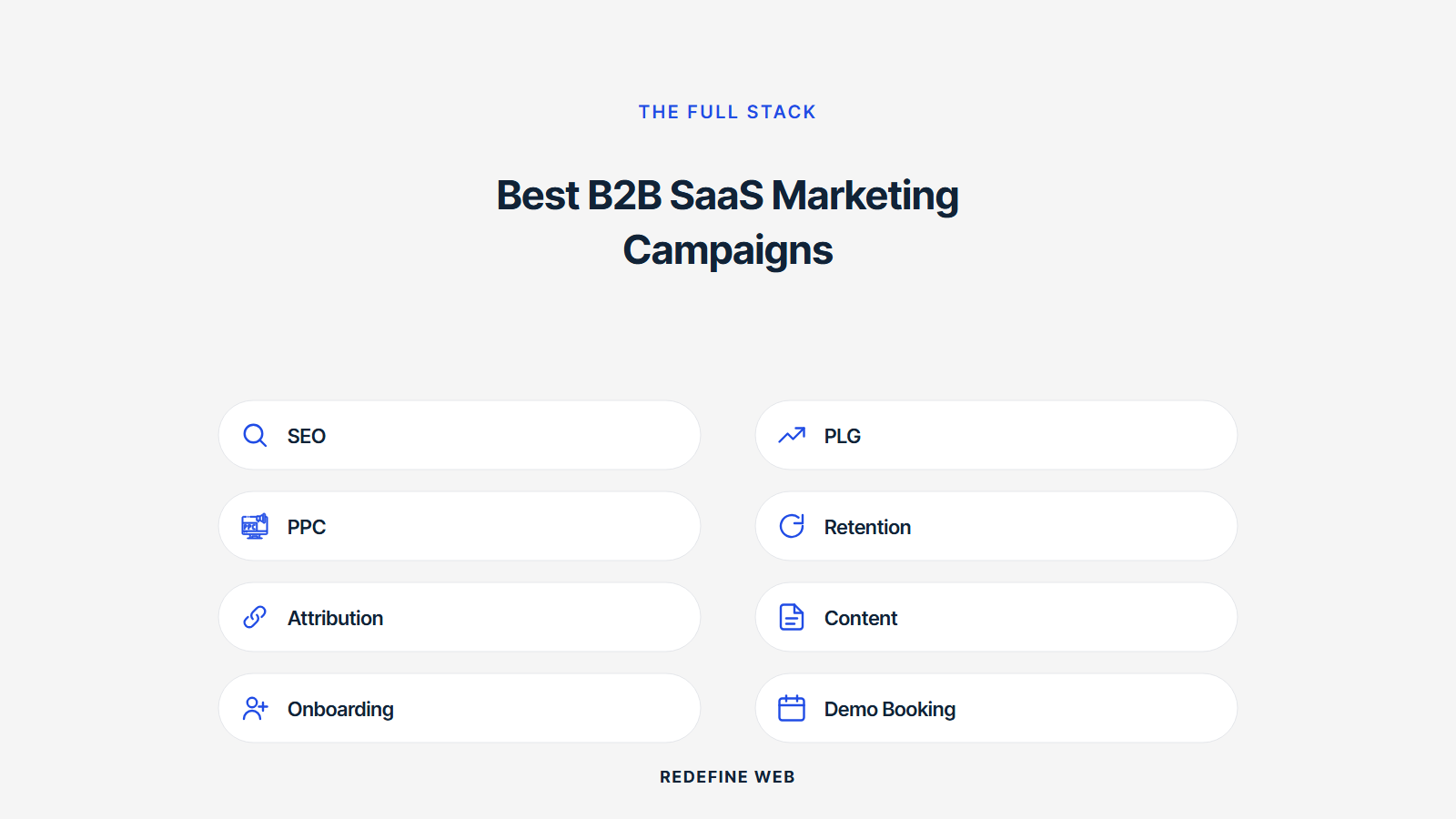
Compare the campaigns against your context on three axes. Company stage. Sales motion. Buyer count and buying committee size. The right pattern to steal depends on where you land across the three axes. Not every pattern maps to every SaaS, and forcing a mismatched pattern usually wastes a quarter of budget.
The table below is a quick way to match your context to the pattern likely to work fastest. If two patterns look plausible for your context, run the smaller-scoped one first. Success on a smaller pattern buys you the budget and the internal permission to run a bigger one next. Fast wins compound into big wins. Slow first-attempts usually get canceled before they produce anything, and the internal appetite for marketing risk drops for the next twelve months.
| Pattern | Best fit stage | Best fit sales motion |
|---|---|---|
| Pipeline-first paid | Series B and up | Sales-led or hybrid |
| Inbound plus CRM rebuild | Series A to C | Sales-led with long cycle |
| Fast launch motion | Seed to Series A | Product-led with self-serve |
| Niche Meta plus webinar | Any stage vertical SaaS | Sales-led with narrow ICP |
| 48-day SEO plus paid sprint | New domain any stage | Any motion needing fast pipeline |
| Persona-driven architecture | Series B and up multi-persona | Committee-based buying |
Stage-first pattern selection
Start with stage. Seed to Series A picks fast launch motion or 48-day sprint. Series A to C picks inbound plus CRM rebuild. Series B and up picks pipeline-first paid or persona-driven architecture. Vertical SaaS at any stage picks niche Meta plus webinar. Getting the stage match right protects you from copying a Series C pattern when you are a seed-stage company, which is the single most common cause of failed B2B SaaS marketing campaigns.
Motion-first pattern selection
Sales motion filters the shortlist further. Product-led with self-serve fits fast launch or persona-driven architecture. Sales-led with long cycle fits inbound plus CRM rebuild or pipeline-first paid. Hybrid motions fit pipeline-first paid best because the reporting infrastructure handles both self-serve and sales-assisted revenue in one dashboard. Motion mismatch is the second most common cause of failed campaigns, because a great pattern in the wrong motion produces leads the sales team cannot close.
What every b2b saas marketing example above has in common
Every b2b saas marketing example above shares five underlying moves. Real ICP defined by role and firmographic filter. Pipeline-tied reporting through the CRM. Named-outcome creative that leads with a specific result. Coordinated channels across paid, organic, and retention. Honest measurement including metrics that did not move. Miss any one and the pattern collapses.
The tactical shapes differ across the six patterns, but the underlying discipline does not. Every campaign above starts with a real ICP defined by job title, firmographic filter, and buying committee. Every campaign ties back to CRM-verified pipeline as the north star KPI. Every campaign uses named-outcome creative rather than generic feature listings. Every campaign coordinates paid, organic, and retention motions rather than running them in silos. And every campaign reports honestly, including on the metrics that did not move. Those five moves separate the best B2B SaaS marketing campaigns from expensive activity.
- Real ICP with job title, firmographic filter, and buying committee mapped
- Pipeline-tied reporting through CRM integration, not just ad platform stats
- Named-outcome creative that leads with a specific result, not a product feature
- Coordinated channels across paid, organic, retention, and sales handoff
- Honest measurement including channels that underperformed the target
The ICP discipline
The ICP discipline is the hardest to hold, because sales and product teams push to widen the ICP whenever a quarter comes up short. Widening the ICP dilutes the campaign quality and lowers the conversion rate for the whole account. Hold the line. If the ICP is wrong, do the work to redefine it, not the shortcut of accepting broader traffic. A tight ICP with 3 percent conversion beats a broad ICP with 0.4 percent conversion, every quarter, every time. The math is not close.
The honest measurement discipline
The honest measurement discipline gets harder as the account matures. Early campaigns are easy to grade because everything is new. Mature campaigns require you to compare against the pattern that was working, and honest measurement often means killing a campaign that was contributing but is now the wrong shape. Killing productive-looking campaigns is politically hard inside a SaaS marketing team. Do it anyway. The compounding cost of running a stale winner past its expiration date is bigger than the short-term hit of killing it.
Wrapping up the best B2B SaaS marketing campaigns discussion
The best B2B SaaS marketing campaigns are not secret plays. They are repeatable patterns, coordinated channels, and disciplined measurement. Steal freely, run the pattern that matches your context, and measure honestly. Everything else compounds from there.
If you take one thing from this guide, take the pattern-to-context matching table above and use it to shortlist the plays that fit your SaaS. If you take two things, add the ICP discipline and the honest measurement discipline as running constraints on any pattern you steal. When you are ready to talk numbers on your specific pattern, our B2B SaaS marketing agency engagement is built around this steal-and-adapt shape. Our SaaS PPC agency work and SaaS SEO agency work cover the two channel-specialist engagement shapes for the pipeline-first and sprint patterns. For steady-state programs, our SaaS marketing retainer plans lay out the monthly cadence at each stage. Broader industry pattern archives from SaaStr and the annual OpenView Partners benchmark reports give you the outside baseline for the numbers above. The Gartner Marketing research library covers the enterprise SaaS pattern context in more depth.
Frequently asked questions
What actually defines the best B2B SaaS marketing campaigns in 2026?
The best B2B SaaS marketing campaigns share five underlying moves regardless of tactical shape. A real ICP defined by job title, firmographic filter, and buying committee. CRM-tied pipeline reporting as the north star KPI, not clicks or MQLs. Named-outcome creative leading with a specific result rather than a product feature. Coordinated channels across paid, organic, retention, and sales handoff. Honest measurement that includes the channels and creative that underperformed. Tactical patterns differ across pipeline-first paid, inbound rebuilds, launch motions, niche Meta, sprint plays, and persona architectures, but the underlying discipline does not.
Which B2B SaaS marketing case study gives the fastest transferable lessons?
The Automation Anywhere case gives the fastest transferable lessons for enterprise SaaS. Pre-restructure, CPL sat at $1,936 with generic global campaigns and unclear KPIs. Post-restructure, the campaigns were split by objective, a free-trial funnel replaced the whitepaper gate, per-region landing pages replaced the global page, and bid strategy shifted from rank to conversion. CPL dropped 97 percent to $63, MQL acquisition scaled 100 times from 150 to 8,000 monthly, and ad impressions grew 300 percent. Enterprise SaaS teams can lift the goal-split architecture, the free-trial funnel, and the regional landing pages directly into their own accounts.
What are the most useful B2B SaaS marketing creatives examples?
Two shapes convert reliably. Job-title targeted creative names the buyer in the ad, quantifies their pain, and implies the product only through the landing page. CFO, your finance team is spending 6 hours on manual reconciliations is a job-title creative shape. Outcome-number led creative leads with a specific result, cites the client story on the landing page, and gates the case study behind a form. Cut CPL 97 percent, or added £1.8 million in pipeline are outcome-led shapes. Both beat generic productivity claims and product feature listings by 2 to 4 times on click-through and 2 to 3 times on downstream conversion.
How do B2B SaaS performance marketing creatives examples differ in paid social versus search?
Search creative earns intent-driven clicks and can lead with product benefits because the buyer already searched for the category. Paid social creative earns the pause first, then the click. Search allows 30 to 60 characters of headline and rewards keyword-matching copy. Paid social rewards big text, high contrast, and first-frame promises within 1.7 seconds. Pattern-interrupt hooks work in paid social because the buyer did not expect a SaaS ad. Named-testimonial creative works especially well on LinkedIn because the platform amplifies the customer's own network. Adapt the underlying story to the surface, but never lift search creative directly into paid social.
Can a small SaaS company steal the pipeline-first paid pattern effectively?
Yes, at a smaller scale. Pipeline-first paid works at any budget because it is a discipline, not a spend level. Start with the target sourced-opportunity number, work backward through conversion rates to the daily budget, and structure campaigns by objective rather than by product. A seed-stage SaaS with a $6,000 monthly budget can run pipeline-first paid on Google alone. Add LinkedIn as budget grows. The Rocket Software launch pattern used a variant of this at seed stage and produced 3,000 customers in week one and 400 daily subscribers after launch. The pattern scales down as cleanly as it scales up.
Which B2B SaaS marketing campaign fits new-domain SaaS with no SEO authority?
The 48-day SEO-plus-paid sprint is the pattern for new-domain SaaS. Site architecture rebuild, keyword-gap content, and paid restructure run in parallel in a compressed 48-day window. Paid delivers leads in weeks 2 to 6 while the SEO groundwork accumulates authority. SEO starts producing in month 3, extending the ramp naturally. Simply.Coach ran this pattern with an 80 percent organic lead lift and 120 percent paid lead lift in 48 days, at lower total paid spend. New-domain SaaS with a working ICP and reasonable content budget can follow the same sprint shape and see comparable ramps.
How do the best B2B SaaS marketing campaigns handle attribution across long buying cycles?
Long buying cycles require multi-touch attribution or at least a working assist model. Single-touch attribution punishes top-of-funnel and rewards bottom-of-funnel, which distorts the budget allocation over time. Best-in-class SaaS marketing operators run CRM-based sourced pipeline as the primary KPI, add multi-touch attribution as a secondary lens, and use influence-tied revenue as a tertiary lens for expansion revenue. The three lenses together give a fair picture. Any agency that promises attribution on day one without describing the CRM and warehouse infrastructure required is over-promising, and the first 60 to 90 days of any real engagement include reporting stack setup.
Book your free 30-minute strategy call.
No spam, no sales rep. We use your email to schedule your call with a senior strategist. That is it.
More from the blog
View all articles → Marketing Strategy
 Professional Services Marketing Strategy That Books Real Consults
Read article Marketing Strategy
 Food and Beverage Marketing That Actually Books Revenue
Read article Marketing Strategy