
B2B SaaS Marketing Team Structure That Scales With ARR
- Hire demand gen generalist first. Not a CMO. Not a content lead.
- Series A team is 3 to 5. Series B is 7 to 12.
- Below $8M ARR, head of marketing. Above $25M ARR, CMO.
- Marketing reports to CEO. Never to sales. Never to ops.
- Weekly scorecard beats quarterly OKR review for real accountability.
- B2B enterprise saas marketing organization at Series C between $25M and $80M ARR
- How to structure b2b saas marketing team hiring order
- Reporting lines inside a working b2b saas marketing team
- Specialists versus generalists on a b2b saas marketing team
- A real B2B SaaS marketing team rebuild we ran and what moved
- Salary bands for a b2b saas marketing team in 2026
- Structural mistakes that kill a b2b saas marketing org
- Getting started with your b2b saas marketing team structure
You want a b2b saas marketing team structure that fits your current ARR, not one copied from a Series D playbook that would cost you $2M a year to staff. This guide is the honest version of the org chart at each stage from $2M to $80M ARR, the hiring order, salary bands in 2026, reporting lines, and the four mistakes that stall marketing teams below their potential. Read straight through in about ten minutes.
Written for founders, VPs of marketing, and CMOs at B2B SaaS companies planning the next hire. By the end you know which role to hire next, who they report to, what they cost, and how to structure the team without creating org chart problems that take two years to unwind. Also covered: the b2b saas chief marketing officer scope by stage, when to bring one in, and when a VP of marketing is the smarter hire.
B2B enterprise saas marketing organization at Series C between $25M and $80M ARR
The Series C b2b saas marketing team structure runs 18 to 35 people. A CMO runs the function with two or three VPs reporting in. Demand gen splits into paid and organic acquisition. Product marketing grows to 3 to 5 people. Brand marketing arrives. Field marketing arrives if you have sales reps in multiple regions. ABM becomes a dedicated function. Total headcount cost $3.5M to $6.5M fully loaded.
At Series C the b2b enterprise saas marketing organization takes on the shape most operators recognise. Multiple layers, multiple specialisations, real brand investment. The right structure at this stage is a hub-and-spoke with functional VPs owning strategy and IC teams executing. Any structure that keeps the CMO doing IC work at Series C is a signal the CMO was promoted too fast or the VPs were hired too weak. Both are fixable, but the fix takes a quarter and costs pipeline in the interim.
| Stage | ARR | Team size | Headcount cost | Top marketing role |
|---|---|---|---|---|
| Seed to Series Seed | Under $2M | 1 | $95k to $140k | Demand gen generalist |
| Series A | $2M to $8M | 3 to 5 | $520k to $780k | Head of marketing |
| Series B | $8M to $25M | 7 to 12 | $1.4M to $2.1M | VP of marketing |
| Series C | $25M to $80M | 18 to 35 | $3.5M to $6.5M | Chief marketing officer |
| Growth / late-stage | $80M plus | 40 plus | $8M plus | CMO plus SVP structure |
Roles that arrive at Series C
Brand marketing lead at $200k to $260k, owns brand system, PR, and creative. Head of field marketing at $190k to $250k if you have regional sales teams. ABM lead at $170k to $220k running account-based programs. Head of community or customer marketing at $160k to $210k if community drives expansion revenue. Each of these arrives at Series C because there is now enough revenue to fund them and enough sales headcount to feed them. Below Series C most of these roles are premature.
VP of marketing versus b2b saas chief marketing officer
The VP of marketing runs the function operationally. Owns quarterly plan, hires, budget allocation, and cross-functional projects with product and sales. The b2b saas chief marketing officer sits at the exec table and owns marketing strategy, brand narrative, board reporting, and executive relationships with sales, product, and finance leadership. You need a VP first. You need a CMO when the VP role has scaled beyond one person and you have $30M plus ARR. Hire a CMO earlier and they will either build a bigger team than the revenue can sustain or step into IC work and stall.
How to structure b2b saas marketing team hiring order
Hire in this order. Demand gen generalist first. Content lead second. Marketing ops third. Then head of marketing to sit above them. Then designer, product marketer, and SEO specialist as the team grows past six. Any order other than this creates gaps that cost you pipeline and slow the team.
The two most common mistakes in hiring order. First, hiring a content lead before a demand gen generalist. Content compounds slowly. Without demand gen running paid experiments and lifecycle, the first 6 months of content ships to nobody. Second, hiring a designer before marketing ops. Design without ops means beautiful landing pages that do not convert because tracking is broken. Fix the plumbing first, then the aesthetics. Redefine Web covers the ops setup in SaaS Marketing Retainer Plans from $599/mo.
The first six hires in order
- Demand gen generalist, first hire, runs solo to $3M ARR
- Content lead, second hire around $3M ARR, adds SEO and long-form
- Marketing ops manager, third hire around $5M ARR, fixes tracking and reporting
- Head of marketing, fourth hire around $7M ARR, promotes internal or hires external
- Designer, fifth hire around $8M ARR, brings brand consistency
- Product marketer, sixth hire around $10M ARR, owns launches and battlecards
Promoting internally versus hiring external for head of marketing
Promote the demand gen generalist to head of marketing if they have shown strategic range and want the role. Hire external if the generalist wants to stay hands-on or lacks leadership experience. The internal promote wins on institutional knowledge. The external hire wins on outside pattern recognition. Both work when the fit is right. What does not work is promoting a strong IC into a head role they never wanted. That loses your best IC and creates a mediocre head. Ask before you offer. Related reading in Content Marketing Institute archives.
Reporting lines inside a working b2b saas marketing team
The marketing lead reports to the CEO or founder, not to the head of sales, not to the COO. Marketing reporting into sales makes marketing serve sales quotas at the cost of long-term brand and pipeline compounding. Marketing reporting into ops means marketing gets treated as a service function rather than a growth function. Both distortions cost you pipeline inside a year.
Below the marketing lead, functional leads report up cleanly. Demand gen, content, product marketing, brand, and ops each have one lead. Any structure where a demand gen manager reports to both marketing and sales is broken. Pick one line and defend it. Dotted lines to sales for demand gen are fine. Solid lines are not. The specific rules around this in your operating cadence save you six months of political drift.
Cross-functional working with sales and product
Marketing and sales run weekly pipeline reviews and monthly funnel reviews. Marketing and product run monthly launch planning and quarterly roadmap reviews. Marketing and success run monthly expansion revenue reviews and quarterly customer marketing planning. These cadences replace ad-hoc requests and reduce the number of Slack pings by roughly 40 percent. Any team without these cadences is losing 3 to 5 hours per person per week to context switching. Related: SaaS Website Design Agency for B2B SaaS.
OKRs and scorecard that keep the team focused
Marketing OKRs align to pipeline sourced, MQL to SQL conversion, and expansion revenue if customer marketing is in scope. The scorecard runs weekly, not quarterly. Weekly scorecards catch drift 8 weeks before quarterly reviews would. Quarterly OKRs set direction. Weekly scorecards catch execution problems. Both are needed, but the weekly scorecard is the one that keeps a team accountable in real time. Any b2b saas marketing team without a weekly scorecard is drifting on execution regardless of how good the OKRs read.
Founders under ARR often hire a CMO who won't touch HTML. Ask any candidate to walk you through a landing page they built last quarter. If they can't, wrong hire.
Specialists versus generalists on a b2b saas marketing team
Below $10M ARR hire generalists who can move across functions. Between $10M and $25M ARR hire a mix of both. Above $25M ARR hire specialists with generalist team leads. That progression fits most B2B SaaS org charts and matches the point where specialist skill becomes cheaper than generalist context switching.
The math is straightforward. A generalist who runs paid, writes copy, and manages the CMS at $130k is worth more than three specialists at $110k each until you have enough volume in each function to keep specialists productive. Once volume climbs, specialists produce 2 to 3x the output of a generalist in their specific function. The crossover point is around $10M ARR for most SaaS. Watch for it and hire ahead of it by 6 months.
Where a generalist wins on your team
A generalist moves the whole funnel when priorities shift. When your paid channel spikes CPCs, the generalist rewrites the landing page, reworks the lifecycle sequence, and updates the sales enablement material inside a week. A specialist can only fix the paid channel piece. At Series A and early Series B, priorities shift every 60 days, so generalists win. At Series B and later, priorities stabilise and specialists start winning on depth.
Where a specialist wins on your team
Specialists win on depth and speed inside their function. A dedicated SEO specialist at Series B knows Google algorithm updates the day they land, has a network of link builders on standby, and can spot a keyword cannibalisation issue in your architecture inside 30 minutes. A generalist would take a week to get to the same insight. Once your organic strategy is compounding and needs weekly optimisation, the specialist pays for themselves inside a quarter. Related: SaaS SEO Agency Tied to Pipeline & ARR.
The most common request we get on the first call from a founder about b2b saas marketing team structure is to help them hire a rockstar CMO who will also personally write the landing page copy, run the paid channel, and code the tracking pixels. The honest answer is that rockstar CMOs charge $400k plus equity and do not code tracking pixels at midnight, and if they do you are either paying way too much or hiring someone who was never really a CMO. Founders always laugh. Then we help them hire a demand gen generalist and shelve the CMO conversation for 3 years.
A real B2B SaaS marketing team rebuild we ran and what moved
Rapyd Financial Network came in with fragmented marketing, roughly 5 inbound leads per month, no unified CRM, and a headcount that looked like a team but operated like solo contractors. The rebuild combined structure, tooling, and a unified inbound program across six channels. Inbound leads tripled. Pipeline grew by £1.8m. Organic website traffic grew 5x.
Month one was structural. We defined a head of demand gen role, brought content and paid under one owner, moved marketing ops into a dedicated seat, and unified the CRM into HubSpot with clean lead routing. Month two rebuilt the paid acquisition funnel, standardised lifecycle sequences, and launched an SEO program targeting decision-maker searches. Months three through six ran the unified program across paid, organic, ABM, and lifecycle with weekly scorecards and monthly funnel reviews. Full write-up in Redefine Web case studies.
The numbers the engagement moved
Monthly inbound leads went from roughly 5 to 15 plus, a 3x gain. Pipeline generated crossed £1.8 million inside the engagement window. Organic website traffic grew 5x driven by the SEO plus content plus redesign combination. The team went from 6 fragmented contributors to 6 well-structured seats plus 2 new hires. Reporting cadence moved from ad-hoc to weekly scorecards plus monthly funnel reviews. Those numbers came from structural discipline, not from more headcount.
What almost broke the rebuild
The COO wanted marketing to report into ops so budget could flow through a single approver. That would have turned marketing into a service function chasing quarterly requests rather than a growth function running long-term programs. We pushed back with the CEO. Marketing stayed reporting to the CEO with a dotted line to the COO for budget approvals. The reporting line held. If your marketing rebuild will not defend the reporting line, the whole team ends up serving whichever function has the loudest voice that quarter.
Salary bands for a b2b saas marketing team in 2026
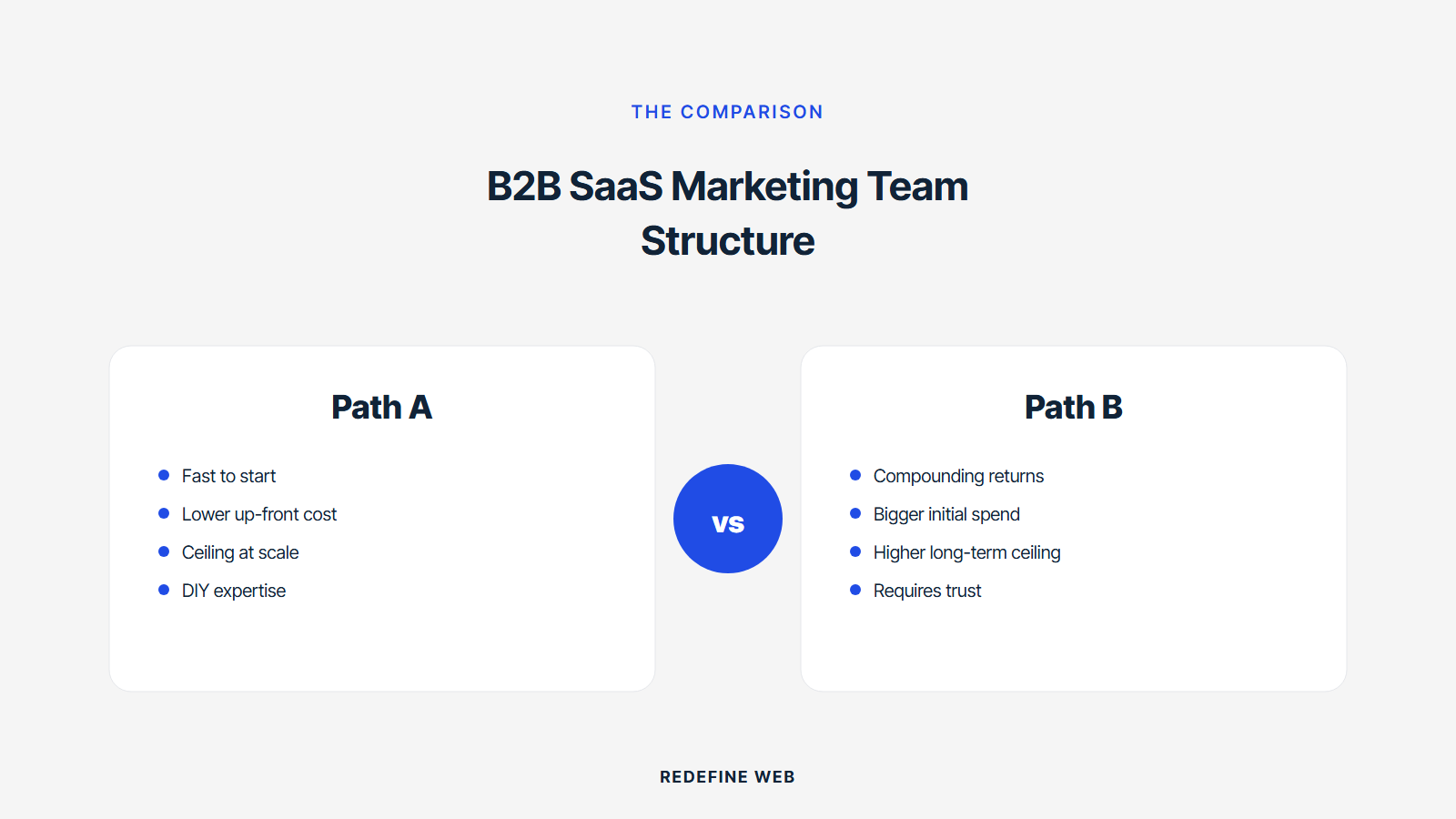
Salary bands scale with ARR stage and geography. US-based teams sit at the top of each band, EU-based teams at the middle, and remote-first global teams anywhere in the range depending on candidate location. Equity is 0.1 to 0.5 percent for IC roles at Series A, 0.05 to 0.2 percent at Series B, and negligible for most roles at Series C.
The bands below are US base salary in 2026 for a 12-month tenure. Add 30 percent for benefits, taxes, and equipment to get fully-loaded cost. Roles hired at the top of the band typically have 10 plus years experience and prior success at a similar-stage SaaS. Roles hired at the middle of the band typically have 5 to 8 years experience and need a strong manager. Roles hired below the band typically have under 5 years experience and need a lot of ramp time.
IC role salary bands
- Demand gen manager: $130k to $170k plus equity
- Content marketing manager: $110k to $150k plus equity
- SEO manager: $115k to $155k plus equity
- Product marketing manager: $150k to $195k plus equity
- Marketing ops manager: $130k to $170k plus equity
- Brand or creative director: $170k to $220k plus equity
Leadership role salary bands
Head of marketing at Series A: $180k to $240k plus 0.3 to 0.6 percent equity. VP marketing at Series B: $250k to $340k plus 0.15 to 0.4 percent equity. B2B saas chief marketing officer at Series C: $340k to $480k plus 0.1 to 0.3 percent equity. SVP or CMO at growth stage: $450k to $650k plus performance bonus and refresh grants. These bands assume US-based, sales-led B2B SaaS. Product-led motions add 10 to 15 percent to leadership bands because the role owns more cross-functional surface area.
Structural mistakes that kill a b2b saas marketing org
Four structural mistakes account for most stalled b2b saas marketing team structure setups. Marketing reporting to sales instead of CEO. Hiring a CMO before Series C. Splitting paid and organic before $15M ARR. Skipping marketing ops until Series B. Any one of these adds 6 months of drag. Two together stall the team for a year.
The order in which you fix these matters. Fix reporting line first. That is the highest-impact change and takes one week to implement. Fix hiring order second. That takes a quarter. Fix org structure third. That takes 2 quarters and involves headcount changes. Fix ops last. That takes 6 months if you have not yet invested in a proper marketing ops function. Any team trying to fix all four at once will drift on execution during the transition. Sequence the changes.
Fixing broken reporting lines
If marketing currently reports to sales or ops, move it to CEO within one week. Tell the sales or ops leader the change is about giving marketing the strategic seat it needs, not about downgrading their scope. Most sales and ops leaders welcome the change because it removes the awkward middle-manager role for a peer function. If your CEO refuses to take on marketing as a direct report, the marketing lead role is probably underscoped and needs upgrading. Fix that before you fix the reporting line.
Fixing premature CMO hires
If you hired a CMO before Series C and the team has stalled, you have three options. First, downgrade the role to VP and let the CMO decide whether to accept or leave. Second, layer a strong VP under the CMO to run operations while the CMO focuses on strategy. Third, wait until you reach Series C and let the role scale into itself. Option two is the highest-percentage move. Option three works if you can afford another 12 months of drift. Option one is the honest reset but often loses the CMO. Google’s guidance on SEO fundamentals is a good frame for what the VP scope should include.
Getting started with your b2b saas marketing team structure
Start by writing down the current org chart. Not the aspirational one. The real one, with actual titles, actual reporting lines, and actual weekly time allocation per person. That single exercise reveals more than any consulting engagement will. Most B2B SaaS marketing teams look worse on paper than in practice, and better in practice than they think. The chart is the honest first step.
Next map the chart against the stage-appropriate structure in this guide. Note gaps, note overlaps, note reporting line issues. Then plan the next three hires in the order specified above. Do not skip roles because a specific person on the team is covering multiple functions. That coverage will not scale, and the roles need dedicated seats once you cross the next ARR band. The chart is your operating manual for the next 18 months. Related: Search Engine Optimization Services.
The 90 day org-chart cleanup plan
Days 1 to 30 document the current chart and identify the top three gaps. Days 30 to 60 fix reporting line issues and clarify scope for existing roles. Days 60 to 90 write JDs for the next two hires and start recruiting. Anything faster and you skip the diagnosis. Anything slower and the team drifts. 90 days is the honest window for a clean b2b saas marketing team structure reset without disrupting the current pipeline.
Next steps if you are planning a rebuild
Book a 30 minute call with a b2b saas marketing operator who has scaled a team through your next ARR band. Not a general management consultant. Not a fractional CMO on a 12 month retainer pitch. An operator who has been through the specific transition you are planning. That single call clarifies your next three hires and saves you a quarter of hiring mistakes. Redefine Web has done this transition on 11 of the last 18 B2B SaaS marketing rebuilds we ran.
Frequently asked questions
What is the right b2b saas marketing team structure at Series A?
A Series A B2B SaaS marketing team is three to five people. A head of marketing running the function reports directly to the CEO. A demand gen manager owns paid channels and lifecycle. A content lead owns SEO and long-form. A designer works part-time or on contract, and marketing ops runs half-time or on contract. Total headcount cost is $520k to $780k fully loaded. Anything larger at Series A wastes budget on specialisation before the data justifies it. Anything smaller and the head of marketing spends 60 percent of their week doing IC work instead of running the function. The three to five person team is the honest sweet spot between $2M and $8M ARR.
Who should the b2b saas marketing team report to?
The marketing lead reports to the CEO or founder. Not to the head of sales. Not to the COO. Marketing reporting into sales makes marketing serve short-term sales quotas at the cost of long-term brand and compounding pipeline. Marketing reporting into ops treats marketing as a service function processing quarterly requests rather than a growth function running long-term programs. Both distortions cost you pipeline inside a year. The one exception is a very early-stage founder who is functionally the head of sales. In that case marketing reports to the founder and the reporting line is clean because the founder wears both hats. Once a dedicated head of sales is hired, marketing stays reporting to the founder.
When should a B2B SaaS company hire a chief marketing officer?
Hire a b2b saas chief marketing officer at Series C, typically between $25M and $80M ARR, when the marketing team has grown to 15 plus people, has multiple functional VPs, and needs an exec-level owner at the leadership table. Below Series C, hire a VP of marketing. A CMO hired too early either builds a bigger team than the revenue can support or steps into IC work and stalls. Both outcomes cost you a year of pipeline. The VP role is more common than founders realise. Most successful B2B SaaS marketing leaders through $25M ARR never carry a CMO title, and their teams run better for it. Save the CMO hire for when the org chart actually justifies the exec seat.
How do you structure a b2b saas marketing team at Series B?
The Series B B2B SaaS marketing team is 7 to 12 people with a VP of marketing at the top. Four functional heads report to the VP. Head of demand gen owns paid and lifecycle. Head of content owns SEO, long-form, and video. Head of product marketing owns positioning, launches, and sales enablement. Marketing ops manager owns the tech stack and reporting. Each head has one or two ICs beneath them. Total headcount cost is $1.4M to $2.1M fully loaded. The trap at Series B is over-specialising. Keep at least three generalists on the team so priorities can shift without redesigning the org chart every quarter. Below $15M ARR keep paid and organic under one head of demand gen. Split them at Series C.
What is the best hiring order for a b2b saas marketing team?
Hire in this order. Demand gen generalist first at seed to Series A. Content lead second around $3M ARR. Marketing ops manager third around $5M ARR. Head of marketing fourth around $7M ARR, promoted internally or hired external. Designer fifth around $8M ARR. Product marketer sixth around $10M ARR. The two most common hiring mistakes are hiring content before demand gen, which means the first 6 months of content ships to nobody, and hiring a designer before marketing ops, which means beautiful landing pages fail to convert because tracking is broken. Fix the plumbing before the aesthetics. Follow the order and you avoid both problems while building a team that scales cleanly through Series B.
How much does a b2b saas marketing team cost by stage?
Total fully-loaded headcount cost scales with ARR. Under $2M ARR the team is one person costing $95k to $140k plus benefits. At Series A between $2M and $8M ARR the team is 3 to 5 people costing $520k to $780k. At Series B between $8M and $25M ARR the team is 7 to 12 people costing $1.4M to $2.1M. At Series C between $25M and $80M ARR the team is 18 to 35 people costing $3.5M to $6.5M. Above $80M ARR the team crosses 40 people with an $8M plus annual cost. These numbers assume US-based salaries in 2026. EU-based teams sit 20 to 30 percent lower. Remote-first global teams sit somewhere in between depending on where the specific hires live.
How do specialists versus generalists fit into a b2b saas marketing team?
Below $10M ARR, hire generalists who move across functions when priorities shift. A generalist at $130k salary who runs paid, writes copy, and updates the CMS is worth more than three specialists at $110k each because the volume in each function does not yet justify specialisation. Between $10M and $25M ARR, hire a mix of generalists and specialists. Above $25M ARR, hire specialists with generalist team leads to run each function. The crossover happens because specialists produce 2 to 3x the output of a generalist in their specific function once volume climbs, but they need enough volume to stay productive. Watch for the transition around $10M ARR and hire ahead of it by 6 months so specialists ramp before the volume arrives.
Book your free 30-minute strategy call.
No spam, no sales rep. We use your email to schedule your call with a senior strategist. That is it.
More from the blog
View all articles → Digital Marketing
 Dental Marketing Tips That Compound Into New Patients
Read article Digital Marketing
 Ecommerce Marketing Strategies That Drive Real DTC Revenue
Read article Digital Marketing