
Commercial Real Estate PPC Management for Brokers and Investors
- Commercial ppc CPCs run 3 to 6x residential rates.
- Cost per lead sits at $180 to $520 on Google Search.
- Cost per booked tour lands at $400 to $1,200 on mature accounts.
- Split tenant and investor campaigns from day one.
- LinkedIn plus Google Search plus retargeting is the full paid stack.
- How much does commercial real estate ppc cost per lead
- Landing pages that make commercial real estate ppc pay back
- A real client case for what commercial real estate ppc can move
- What separates commercial real estate ppc companies from generalists
- Retainer benchmarks for commercial real estate ppc management in 2026
- LinkedIn Ads paired with ppc commercial real estate campaigns
- The five mistakes that sink commercial real estate ppc accounts
- How long commercial real estate ppc takes to produce signed deals
- What to do this week on your commercial real estate ppc account
Commercial real estate ppc looks like residential real estate ppc on the surface. Same Google Ads interface. Same keyword auction. Same landing pages, same tracking pixels, same Google Business Profile in the corner of every serious account. Look one layer deeper and the two channels operate on opposite economics. Commercial CPCs run 3 to 6 times residential rates because a single tenant lease can sit at $180,000 in first-year rent. The sales cycle stretches 90 to 270 days versus 30 to 60 for residential. And the search volume is 20 to 50 times thinner because you’re chasing 4,000 monthly queries per metro instead of 200,000.
This guide walks you through what a working commercial real estate ppc scope looks like across broker, investor, and property-owner accounts. You’ll get the CPL benchmarks Google publishes for the vertical, the campaign structure that separates working accounts from budget theatre, and a real Redefine Web client case whose paid-search restructure delivered a 99 percent conversion increase on 12 percent less monthly spend. Bring your last 90 days of Google Ads data and read straight through in about ten minutes.
How much does commercial real estate ppc cost per lead
Commercial real estate ppc runs $180 to $520 per lead on Google Search in most US metros. Tenant leases sit at the lower end. Investment sales run higher. Tier-one metros push CPL 30 to 60 percent above the national median.
Cost per qualified tour is the number that matters more than raw CPL on a commercial account. On mature accounts, cost per booked property tour sits at $400 to $1,200 depending on property type and submarket. Cost per signed lease or closed sale runs 6 to 12x cost per qualified tour, landing at $2,800 to $12,000. Against $22,000 to $180,000 in commission per deal, the payback math clears easily. Against $6,000 tenant-referral commissions, the math needs a lean campaign structure or a higher close rate to work.
Search volume is the other constraint on commercial real estate ppc math. “Office space for lease Chicago” runs 2,400 monthly searches according to Google’s Keyword Planner. “Office space for lease Milwaukee” runs 320. Below 500 monthly searches per keyword, the account will hit budget caps every day and impression share stays low. The fix on small metros is expanding to phrase-match variants (“Milwaukee office space,” “office for lease Milwaukee”) plus a Display retargeting layer that keeps the brand visible after the first click. Reference material on commercial market search patterns lives at the WordStream online advertising costs guide.
Bid strategies work differently at commercial scale. Target CPA (target cost per acquisition) with a $600 target works when the account has 30+ conversions per month. Below that volume, Manual CPC or Enhanced CPC produces cleaner data because Google’s automated bidding needs a minimum data volume to model against. Investor-facing commercial accounts often run at 4 to 12 conversions per month and stay on Manual CPC through the first year. Tenant-facing accounts hit 20 to 40 conversions per month faster and can move to Target CPA by month four.
Landing pages that make commercial real estate ppc pay back
Landing pages on commercial accounts carry heavier data density than residential landing pages. Tenant-side pages need square footage filters, price-per-square-foot ranges, floor plans, and building amenities. Investor-side pages need cap rate, NOI, occupancy rate, and price-per-unit metrics. Every filter above the fold shortens qualification time and pushes real prospects to the tour or download action faster.
Buyer-side tenant landing pages open with a submarket hero image, a headline naming the neighborhood plus building type, and a filter widget for square footage and price. Below the widget, three to five active property cards with square footage, asking rent, key amenities, and a scheduled-tour button on each card. Below that, a broker bio with real deal-count and testimonial. Every button on the page pushes toward booking a property tour, nothing else.
Investor-side landing pages open with a portfolio summary. Total portfolio size, average cap rate, average NOI, average occupancy. Below that, active investment opportunity cards with the same metrics broken out per property plus a rent-roll download form as the primary action. Investors want to open the PDF and read the T-12 (trailing twelve-month operating statement) before they book a call. Skip the T-12 download and the qualified investor never opens a conversation. Reference material on commercial investment site design patterns lives at the Nielsen Norman Group B2B usability library.
Call tracking works even harder on commercial than on residential. Every tour booked over the phone gets logged with source, ad group, and keyword before ringing the broker. CallRail runs $145 to $325 monthly on a full commercial account with 8 to 20 tracked numbers routing to different brokers across the team. The recordings feed the following week’s negative keyword additions because the callers self-identify with search intent language in the first 60 seconds of every conversation.
A real client case for what commercial real estate ppc can move
Berks Plumbing is a Redefine Web client whose paid-search restructure demonstrates the same pattern a commercial real estate ppc engagement follows on tenant-side accounts. Google Ads conversions rose 99 percent after we rebuilt the campaigns around service-focused landing pages. Cost per acquisition dropped 67 percent over the same window. Organic users rose 75 percent from paired technical SEO work on the site.
The Berks Plumbing engagement started with a single-page website and inefficient ad campaigns running broad match across every plumbing term. We built five dedicated landing pages tied to top ad groups (emergency, water heater, drain, sewer, commercial), rewrote every ad with the same service-specific angle, added a 400-line negative keyword list, and wired CallRail to every ad and landing page. Local Services Ads got restructured with correct job categorization. The result: 99 percent more conversions on 12 percent less monthly spend because wasted broad-match traffic disappeared.
The same pattern moves cleanly to commercial real estate. Replace “emergency plumbing” with “warehouse for lease [submarket].” Replace “water heater repair” with “class A office space [submarket].” Every property type gets its own dedicated landing page, every ad reads with the same property-specific angle, and the negative keyword list keeps investor traffic out of tenant campaigns and vice versa. Cost per qualified property tour drops 40 to 70 percent on accounts where we’ve applied this pattern versus the previous vendor’s flat single-landing-page structure.
CPC math doesn't work at CPCs. If your agency runs commercial with residential ad copy templates, they'll burn ,800/mo and blame low volume.
What separates commercial real estate ppc companies from generalists
Commercial real estate ppc companies with real vertical depth ask three questions on the intro call. Which submarkets are you covering. What property types dominate your pipeline. And what’s your average commission per closed deal. Generalists ask about brand colors, portfolio inspiration, and social media strategy. The specialist is scoping the work. The generalist is scoping a portfolio piece.
Vertical experience shows up in the negative keyword list on day one. A commercial specialist drops in a 500-line negative list with “apartment,” “residential,” “single family,” “section 8,” “HOA,” “tenant screening,” “job posting,” and every other residential-adjacent phrase blocked from the first click. A generalist starts with a 40-line list from a Google template and adds terms reactively over the first month while budget burns on wasted traffic.
Ask the vendor to name a submarket their last commercial real estate client ranked highest converting for last month. If they can’t answer inside 30 seconds, they don’t look at the account weekly. If they name a submarket and quote cost per booked tour against it, the account gets watched. That single question separates working commercial real estate ppc companies from portfolio-only shops in the first sales call. Also request a look at the Search Terms report from a live client (redact the client name if needed) to confirm the account runs tight phrase-match traffic without wasted broad queries.
Retainer past onboarding is where accounts live or die. A vendor that runs onboarding for six weeks, launches campaigns, then disappears with a monthly PDF is billing for setup. A vendor that runs a 45-minute working session every month, adds 20 to 40 negative keywords weekly, and refreshes ad copy quarterly is billing for management. Cost per booked tour between the two styles runs 40 to 90 percent apart by month six. Cheaper isn’t cheaper when CPL doubles. Related generalist ppc work runs through our PPC Management Services practice.
Retainer benchmarks for commercial real estate ppc management in 2026
Commercial real estate ppc management prices the retainer between $1,200 and $8,000 monthly depending on scope and spend. Rule of thumb: management fee runs 15 to 25 percent of ad spend at the low end and drops to 10 to 14 percent as monthly spend clears $18,000. Flat-fee retainers work up to $10,000 monthly ad spend. Percentage-of-spend deals kick in above that and can renegotiate back to flat once the account stabilizes.
| Scope | Monthly ad spend | Management fee | Booked tours target |
|---|---|---|---|
| Solo tenant broker, one metro | $2,000 to $4,500 | $1,200 to $1,800 | 3 to 7 < per month |
| Small tenant team | $4,500 to $10,000 | $1,800 to $3,200 | 7 to 18 < per month |
| Boutique investment firm | $6,000 to $14,000 | $2,500 to $4,000 | 4 to 12 < per month |
| Full brokerage house | $14,000 to $35,000 | $3,500 to $6,500 | 18 to 45 < per month |
| Multi-market portfolio | $35,000 to $85,000 | $6,500 to $12,000 | 45 to 120 > per month |
A fair commercial real estate ppc retainer covers the following every month, and the deliverables sit in a shared client folder your team can open at any time:
- Weekly Search Terms review with 20 to 40 negative keywords added
- Monthly ad copy refresh across every active ad group by property type
- Quarterly landing page conversion audit with named A/B tests queued for the next quarter
- Call tracking review with keyword-level attribution tied to booked tours and signed leases
- Investor asset delivery (T-12 downloads, rent rolls, cap rate charts) refreshed monthly
- Monthly 45-minute working session with the account lead, not an account manager reading a PDF
- Owned account access with MCC linking from your own root account
LinkedIn Ads paired with ppc commercial real estate campaigns
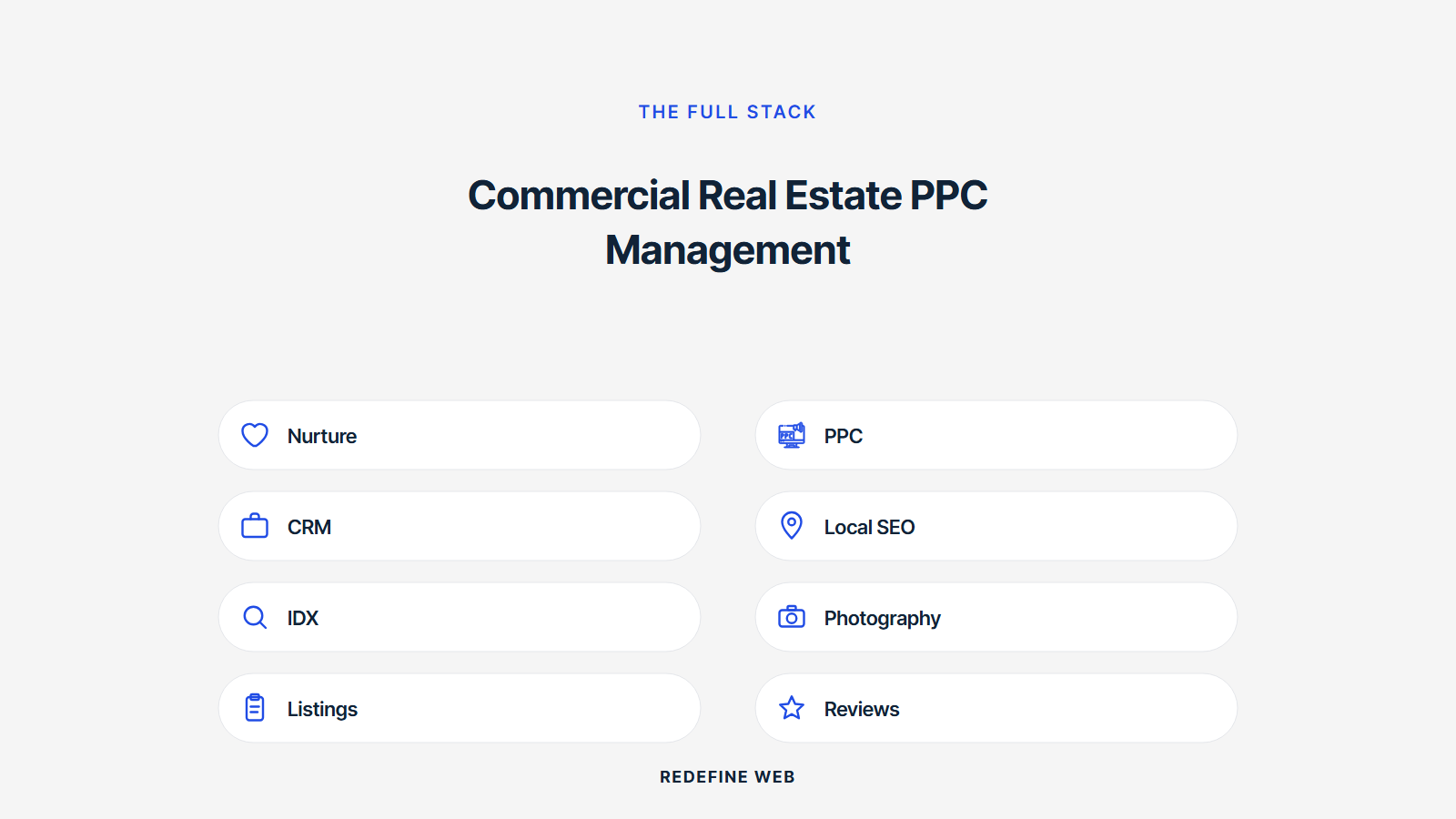
LinkedIn Ads pair strongly with commercial real estate ppc because the decision-makers on the tenant side (facilities managers, office managers, founders) sit inside LinkedIn’s professional targeting more cleanly than any Google Search intent set. A $3,000 monthly LinkedIn scope layered on top of a $6,000 Google Ads scope produces a compound funnel where cold prospects meet the brand three or four times before the tour request lands.
LinkedIn’s targeting on commercial accounts filters by company size (250-1,000 employees), industry (tech, finance, professional services), job title (facilities manager, office manager, CFO), and geography (specific metros). CPCs on LinkedIn run $5 to $12 with CPMs at $25 to $45. Cost per qualified lead lands at $80 to $180, which sits at 40 to 60 percent below Google Search CPL for the same audience. The tradeoff is that LinkedIn leads sit further from decision than Google Search leads because the searcher isn’t actively looking for office space at that moment.
Run LinkedIn as the awareness and nurture layer, Google Search as the intent layer, and retargeting Display or Meta as the mid-funnel bridge between them. Every account with $8,000+ monthly total paid spend should run all three. Below that scope the ROI concentrates in Google Search alone and the added complexity of LinkedIn doesn’t earn back the management overhead. Above that scope, the three-channel structure produces 30 to 50 percent more booked tours than Google Search alone at the same total spend.
LinkedIn Conversation Ads work particularly on the investor side. A structured chat flow that asks about accredited investor status, target deal size, and target geography qualifies the investor in 4 to 6 clicks before the broker gets involved. Cost per qualified investor call runs $220 to $480 on LinkedIn Conversation Ads across accounts we’ve measured in the past 12 months.
The five mistakes that sink commercial real estate ppc accounts
First mistake: mixing tenant and investor campaigns in the same account. “Office space for lease” and “office building for sale” are opposite audiences with opposite landing page needs. Running them under one campaign structure produces mediocre conversion rates on both. Split by property type and by intent from day one.
Second mistake: too-broad geography. Setting the campaign to “United States” or “State of California” when your practice covers three submarkets in Los Angeles burns 60 to 80 percent of budget on clicks from Bakersfield, San Diego, and San Francisco that never turn into tours. Every campaign gets a submarket-specific radius targeting or ZIP code list on day one.
Third mistake: no negative keywords for residential noise. “Apartments for rent,” “single family home,” “HOA fees,” “tenant rights” all pull traffic that never converts on a commercial account. A 500-line residential-adjacent negative keyword list on day one saves 40 to 60 percent of budget in month one alone.
Fourth mistake: same landing page for every property type. Tenant looking for warehouse space and investor looking for multifamily portfolio need entirely different data on the page. Sending both to the same page cuts conversion 40 to 60 percent. Every property type warrants its own landing page with type-specific data density.
Fifth mistake: paying a $4,000 monthly management fee for a spreadsheet emailed once a month with impression counts, click counts, and zero decisions on next month’s negative keywords. The right response the second time around is asking the vendor to name a specific submarket their last client booked the most tours from, the current cost per booked tour on that account, and the negatives they added last week. Real answers separate real management from theatre.
How long commercial real estate ppc takes to produce signed deals
Commercial real estate ppc produces first tour requests inside 14 to 30 days from launch. Signed leases from those tours land 90 to 180 days out because the commercial sales cycle stretches across multiple decision-makers, due diligence periods, and financing contingencies that add weeks between tour and signature.
Every phase moves at Google’s data-collection pace, not the vendor’s promise pace. Weeks one to four handle campaign build, landing page launch, negative keyword list, and first data collection. Weeks five to twelve run optimization on real conversion data, ad copy refresh, and landing page A/B test one. Month four to six delivers mature economics where cost per booked tour drops 30 to 60 percent below launch levels. Signed leases from tours booked in month one commonly close in month four or five, and that lag matters for reporting: the deal-close report always trails the tour-booked report by a full quarter.
Investor-side accounts move even slower on the deal-close side. A qualified investor tour in month one might close in month six or seven after due diligence, financing, and closing coordination. Every honest commercial real estate ppc company caveats the deal-close timeline on the initial sales call so no one at your team expects month-two signed deals from a month-one campaign launch. Set the expectation once at kickoff, revisit it in month three, and the retainer conversation stays anchored to the right timeframe across the full year.
What to do this week on your commercial real estate ppc account
Finish three actions by Friday. Pull the last 30 days of Search Terms and add every residential-adjacent query to the negative keyword list. Confirm call tracking runs on every ad and landing page. Load a competitor’s top ad and compare their landing page against yours side by side.
Those three alone usually move next month’s cost per booked tour 10 to 25 percent lower without touching bids, budget caps, or the ad copy across the campaigns you’re already running. Every week of delay pushes the compounding curve another week down the road, and a competitor with tight negatives and a fast landing page pockets the tour requests you paid for and lost to a slow page.
For teams that want the whole account run off your plate, our Real Estate PPC Agency for Brokerages team handles the build, the tracking, and monthly optimization across tenant and investor campaigns. For teams that need paid coverage alongside SEO on the same account, our Real Estate SEO Services for Brokerages team runs both channels under one working session so the reporting stays clean. A 30-minute audit call reads your last 60 days of Google Ads data, your Search Terms report, and your landing pages, then hands back a specific 90-day plan sized to your current spend.
Frequently asked questions
How much does commercial real estate ppc cost per month for a broker?
Commercial real estate ppc for a solo tenant broker runs $3,200 to $6,300 all in per month. That covers $2,000 to $4,500 in Google Ads spend plus $1,200 to $1,800 in management fee. The lower end funds one tenant Search campaign in one metro. The upper end adds a second campaign for a second submarket, dedicated landing pages per property type, and CallRail attribution wired to a CRM. Below $3,200 monthly, the scope skips landing pages or call tracking, and the account stops paying back inside the first 90 days without those pieces wired properly. Investment-focused broker scopes run higher, starting at $4,500 all in per month.
What is the average cost per lead for commercial real estate ppc?
Average cost per lead for commercial real estate ppc runs $180 to $520 on Google Search in most US metros. Tenant lease queries like "office space for lease [city]" sit at the low end. Investor-facing queries like "multifamily properties for sale" run higher because search volume is thinner and every click competes with private equity buyers. Tier-one metros push CPL 30 to 60 percent above the national median. Mature accounts drop cost per lead 30 to 60 percent below launch levels by month six as the negative keyword list, landing pages, and ad copy compound over consistent monthly optimization.
Should commercial real estate brokers run Google Ads or LinkedIn Ads?
Google Ads for commercial real estate captures decision-maker intent at the moment someone searches for space. LinkedIn Ads reaches the same decision-makers before that intent forms, sitting at the awareness and nurture layer. Most brokerage accounts doing $8,000+ monthly total paid spend run both, with 60 to 70 percent on Google Search and 30 to 40 percent on LinkedIn plus retargeting. Google delivers higher-intent traffic at higher CPL. LinkedIn delivers cheaper qualified impressions that require more nurture. The right mix depends on average deal size and how long a decision cycle your target tenant profile carries.
How is commercial real estate ppc different from residential real estate ppc?
Commercial real estate ppc runs at 3 to 6x the CPC of residential, 20 to 50x thinner search volume, and 3 to 9x longer sales cycles. A residential ppc account measures cost per booked showing weekly and cost per closed deal quarterly. A commercial ppc account measures cost per qualified tour monthly and cost per signed lease across 90-day windows. Commercial landing pages carry heavier data density (cap rate, NOI, square footage filters). Residential landing pages carry lighter data (neighborhood, price band, agent bio). The two channels operate on opposite economics even though the ad platform interface looks identical.
What negative keywords are essential for commercial real estate ppc?
Essential negative keywords on a commercial real estate ppc account include "apartments," "residential," "single family," "HOA," "section 8," "tenant screening," "lease template," "tenant rights," "housing," "schools," "salary," "jobs," "license," and "free." A 500-line residential-adjacent negative list on day one saves 40 to 60 percent of budget in month one alone. Weekly Search Terms review adds 20 to 40 more negatives per week for the first three months. WordStream's own data shows accounts running proper negative keyword hygiene convert at 3x the rate of accounts without.
How long does commercial real estate ppc take to produce signed leases?
Commercial real estate ppc produces first tour requests inside 14 to 30 days from launch. Signed leases from those tours land 90 to 180 days out because the commercial sales cycle stretches across multiple decision-makers (facilities manager, CFO, sometimes legal). Investment-side deals move even slower because due diligence and financing coordination add 60 to 90 days on top of the tenant timeline. Every honest agency caveats the deal-close timeline on the sales call so no one expects month-two signed deals from a month-one campaign launch. Six months of consistent execution is the honest window for mature account economics.
Book your free 30-minute strategy call.
No spam, no sales rep. We use your email to schedule your call with a senior strategist. That is it.
More from the blog
View all articles → PPC
PPC Healthcare PPC Advertising Channels Compliance and Targeting
Read article PPC
PPC Dental Facebook Ads Guide for Practices That Book Patients
Read article PPC
PPC