
Healthcare PPC Advertising Channels Compliance and Targeting
- Google Search anchors every healthcare mix.
- Meta paid social wins on elective services.
- Microsoft Ads is the most underused channel.
- HIPAA-safe tracking is a security decision.
- Build the mix in phases, not all at once.
- Meta Paid Social for Elective Healthcare PPC Advertising
- Microsoft Ads and Overlooked Healthcare PPC Advertising Channels
- YouTube and Programmatic Video in Healthcare PPC Advertising
- HIPAA and Healthcare PPC Advertising Compliance
- Targeting Rules in Healthcare PPC Advertising
- Building a Multi-Channel Healthcare PPC Advertising Mix
- Common Healthcare PPC Advertising Mistakes
- Case Study Multi-Channel Healthcare PPC Advertising Rebuild
- Where Healthcare PPC Advertising Goes Next
Healthcare PPC advertising sits at the intersection of high-intent search behavior and sensitive-vertical policy rules that most digital marketing playbooks never touch. The channels that work in retail paid search behave differently in healthcare because Google, Meta, and Microsoft each treat medical services as a special category with compliance guardrails, disclosure requirements, and creative restrictions that separate the professionals from the pretenders. This guide walks you through every viable healthcare PPC advertising channel, what it costs, what it converts, and where the compliance landmines sit that most vendors ignore until an OCR letter arrives at the practice. You’ll learn how healthcare PPC advertising targeting differs from consumer targeting, which channels to prioritize by specialty and patient LTV, and how to build a channel mix that grows with your practice instead of plateauing at month three. According to HubSpot’s healthcare marketing research, roughly 77% of patients research providers online before booking, and healthcare PPC advertising is how you show up in that research window with the right message at the right moment for the right audience.
Meta Paid Social for Elective Healthcare PPC Advertising
Meta paid social (Facebook and Instagram) shines in healthcare PPC advertising when the service is elective, cash-pay, or visual: cosmetic dentistry, med spa treatments, cataract surgery, hair restoration, plastic surgery, orthodontics. Meta’s targeting no longer allows health-condition segmentation, but interest-based and lookalike targeting still work for these categories because the purchase decision is emotional and visual rather than clinical.
Creative for Meta healthcare PPC advertising has to feel authentic, not stock. Real patient photos (with signed releases), practice team introductions, and short-form video walkthroughs of procedures convert far better than polished stock imagery. Before-and-after photos are restricted for some categories, so build creative around transformation stories, provider expertise, and outcome quality rather than direct clinical imagery when the platform rules limit that.
| Meta Format | Best For | Typical CPA | Target CVR |
|---|---|---|---|
| Feed static image | Awareness for elective services | $40-$120 | 2-4% |
| Reels + Stories video | Provider intro + transformation stories | $25-$80 | 3-6% |
| Lead form ads | Consultation booking | $30-$90 | 5-10% |
| Retargeting carousel | Warm audiences from website | $15-$45 | 6-12% |
Budget allocation inside Meta healthcare PPC advertising typically runs 60-70% cold prospecting, 20-25% retargeting, and 10-15% brand awareness for larger practices with a growth mandate. Practices that push too hard into retargeting without prospecting see their retargeting pool shrink and CPAs climb as the same audience sees the same ads too many times. Frequency capping matters more on Meta than on any other healthcare PPC advertising channel, and it’s the single biggest lever for keeping CPA healthy over the long term.
Microsoft Ads and Overlooked Healthcare PPC Advertising Channels
Microsoft Ads is the most underused channel in healthcare PPC advertising. Bing’s audience skews older (55+), higher-income, and more concentrated in Medicare-age specialties like orthopedics, cardiology, ophthalmology, and gerontology. CPCs run 15-30% lower than Google Search on the same keywords, and CVRs are often comparable or better because competition is thinner.
The catch is Microsoft Ads’ smaller reach. Bing holds roughly 8-10% of US search market share, so it’s a supplement to Google Search rather than a replacement. Practices treating Microsoft Ads as an afterthought (an import-from-Google-Ads once and forget) miss the tuning that makes the channel actually work. Bing users search differently, respond to different ad copy, and click through to landing pages with slightly different conversion patterns than Google users do.
Beyond Microsoft, the other overlooked healthcare PPC advertising channels are Nextdoor Ads for hyperlocal community-based practices, LinkedIn Ads for B2B healthcare tech companies selling to hospital systems, and native ad networks like Taboola for content-driven brand awareness. Each has narrow use cases but can produce cost-per-booked-patient figures that beat Meta or Google in specific niches. Test small, measure honestly, and kill fast if the channel doesn’t clear your minimum ROI threshold within 60 days. Most healthcare PPC advertising accounts never touch these channels because the primary Google and Meta stack absorbs all the available attention, but that’s usually a mistake for practices with budget headroom.
YouTube and Programmatic Video in Healthcare PPC Advertising
YouTube pre-roll works surprisingly well in healthcare PPC advertising when the goal is patient education and brand recall rather than direct response. Practice-produced video content (2-4 minute walkthroughs of procedures, provider Q&A, patient story features) served as pre-roll to condition-related content builds brand recall that shows up as branded Google searches 30-60 days later.
The direct-response case for YouTube healthcare PPC advertising is weaker than the brand-building case. Conversion rates on YouTube ads for healthcare typically sit at 0.5-2%, which is low even by video standards. The right way to measure YouTube in a healthcare mix is by branded search growth and assisted conversions from remarketing pools, not by direct conversions from the view itself. Attribution has to be set up to catch that longer path, or the channel looks unprofitable when it’s actually driving revenue.
Programmatic video and Connected TV (CTV) work for larger practices and hospital systems building regional brand awareness. Costs are higher, targeting is broader, and attribution is harder, but the top-of-funnel effect is real when the budget is significant enough to reach a full market. Skip programmatic entirely if your monthly ad budget is under $15,000, because the channel needs scale to work. For a full walkthrough of channel-specific tactics, see our PPC Tips for Healthcare. Practices running YouTube pre-roll consistently for 90+ days see 10-15% growth in branded search volume, which is the leading indicator worth tracking to justify continued investment in the channel.
Google-only strategies leave older, higher-income patients on Bing. Spin up a Microsoft Ads import from your Google account this week. CPC often lands 30 percent lower.
HIPAA and Healthcare PPC Advertising Compliance
HIPAA compliance in healthcare PPC advertising is not optional and it is not something to figure out after launch. Every channel that sends conversion data back to an ad platform is potentially transmitting PHI unless the setup explicitly prevents it. Google Ads, Meta Ads, Microsoft Ads, and TikTok Ads all use conversion tracking mechanisms that were designed for consumer commerce, not clinical services.
The compliant setup uses server-side conversion tracking that scrubs PHI (patient names, conditions, appointment types) before data reaches the ad platform. Signed Business Associate Agreements sit with every downstream vendor touching the data. Landing page URLs and form fields exclude any patient-identifiable content. Google will not sign a BAA for standard Google Ads under any circumstances, so the compliance work happens on your infrastructure and the tracking-vendor layer, not the platform layer.
Practices that skip this work face real audit risk from the Office for Civil Rights. Fines for a single documented violation run well into six figures, and multi-violation cases hit seven or eight figures with breach notifications required to every affected patient. The healthcare PPC advertising accounts we run treat compliance as a security decision that happens before any bid strategy, not a marketing decision that happens after the ads are already live. That order matters, and it’s the difference between an account that grows sustainably and one that becomes a headline for the wrong reasons.
Targeting Rules in Healthcare PPC Advertising
Targeting in healthcare PPC advertising has more restrictions than most industries because Google and Meta both treat medical services as a sensitive category. You cannot target based on health conditions, medical history, or prescription usage. You cannot build remarketing lists from users who visited condition-specific landing pages if those visits are treated as PHI. Interest categories tied to specific medical conditions are also off-limits on Meta.
What you can target: geography, age range, income (via household income proxies where allowed), device type, time of day, and behaviors tied to non-medical categories (fitness enthusiasts, wellness content readers, luxury goods purchasers for elective cash-pay services). Lookalike audiences built from converted patients are also compliant when the seed audience data was collected under proper HIPAA controls and hashed before transmission to the ad platform.
The safest targeting model for healthcare PPC advertising is geo-radius plus intent-based keyword targeting on Search, and geo-radius plus interest-adjacent behavior targeting on Meta. Anyone selling you condition-specific targeting on major ad platforms is either violating platform policy or violating HIPAA (or both), and the audit risk falls on the practice, not the vendor, in most cases. For a deeper walk-through of channel compliance, our Healthcare PPC Management guide covers the ongoing cadence. The safe rule is always: if the targeting parameter references anything about the patient’s health status, avoid it and rely on intent-and-geography signals instead.
Building a Multi-Channel Healthcare PPC Advertising Mix
Most healthcare practices should build their healthcare PPC advertising mix in phases, not all at once. Phase one: Google Search only, focused on bottom-funnel exact-match keywords with a HIPAA-compliant tracking setup. Get to 30-50 conversions per month here before expanding, because Smart Bidding needs the data to work well and the account needs the baseline to measure against.
Phase two adds Meta paid social if the practice has elective or cash-pay services, or Google LSAs if the practice category qualifies. Phase three adds Microsoft Ads and YouTube pre-roll once the primary channels are stable and the practice has capacity to review three ad accounts weekly instead of one. Phase four (for larger practices) adds programmatic video, native ads, and any specialty publisher networks worth testing.
The joke, and it’s on everyone in the industry: the practice that pitches five channels at month one usually has zero channels working by month six, because attention got spread too thin. Practices that focus hard on one channel for 90 days and expand carefully from there outperform practices that launched everything at once by 40-60% on cost per booked patient. Fewer channels, executed well, beats more channels executed badly every single time. For the pillar-level view, see our PPC for Healthcare. Data from HubSpot’s channel benchmark reports supports the phased approach: focused single-channel accounts outperform multi-channel accounts of the same total spend by 20-30% in year one.
Common Healthcare PPC Advertising Mistakes
Every healthcare PPC advertising engagement we’ve cleaned up after a competitor had the same repeat mistakes. First: no HIPAA-compliant conversion tracking. The account tracked conversions the way any e-commerce account would, sending PHI to Google or Meta with every event. Second: broad-match keywords running without weekly negative keyword additions, bleeding budget on irrelevant searches that had nothing to do with the practice’s specialty or geography.
- Missing HIPAA-safe tracking that transmits PHI to ad platforms with every conversion event.
- Broad-match keywords running without weekly negative keyword discipline.
- One landing page for every ad instead of service-specific pages matched to intent.
- Form fills tracked as the only conversion when 60% of conversions are phone calls.
- Meta ads running at scale with health-condition targeting that violates platform policy.
- Programmatic video for accounts under $15,000/month that don’t have the budget for the channel to work.
- No cost-per-booked-patient reporting so the account looks profitable until the front desk data surfaces the truth.
Fix these seven and the average healthcare PPC advertising account gets 30-50% healthier inside 60 days. None require more budget. All require attention and specific technical work that most agencies skip because it’s boring and unglamorous compared to launching new ad copy or new formats. That gap between what agencies pitch and what accounts actually need is why healthcare PPC advertising has a reputation for expensive underperformance in the industry.
Case Study Multi-Channel Healthcare PPC Advertising Rebuild
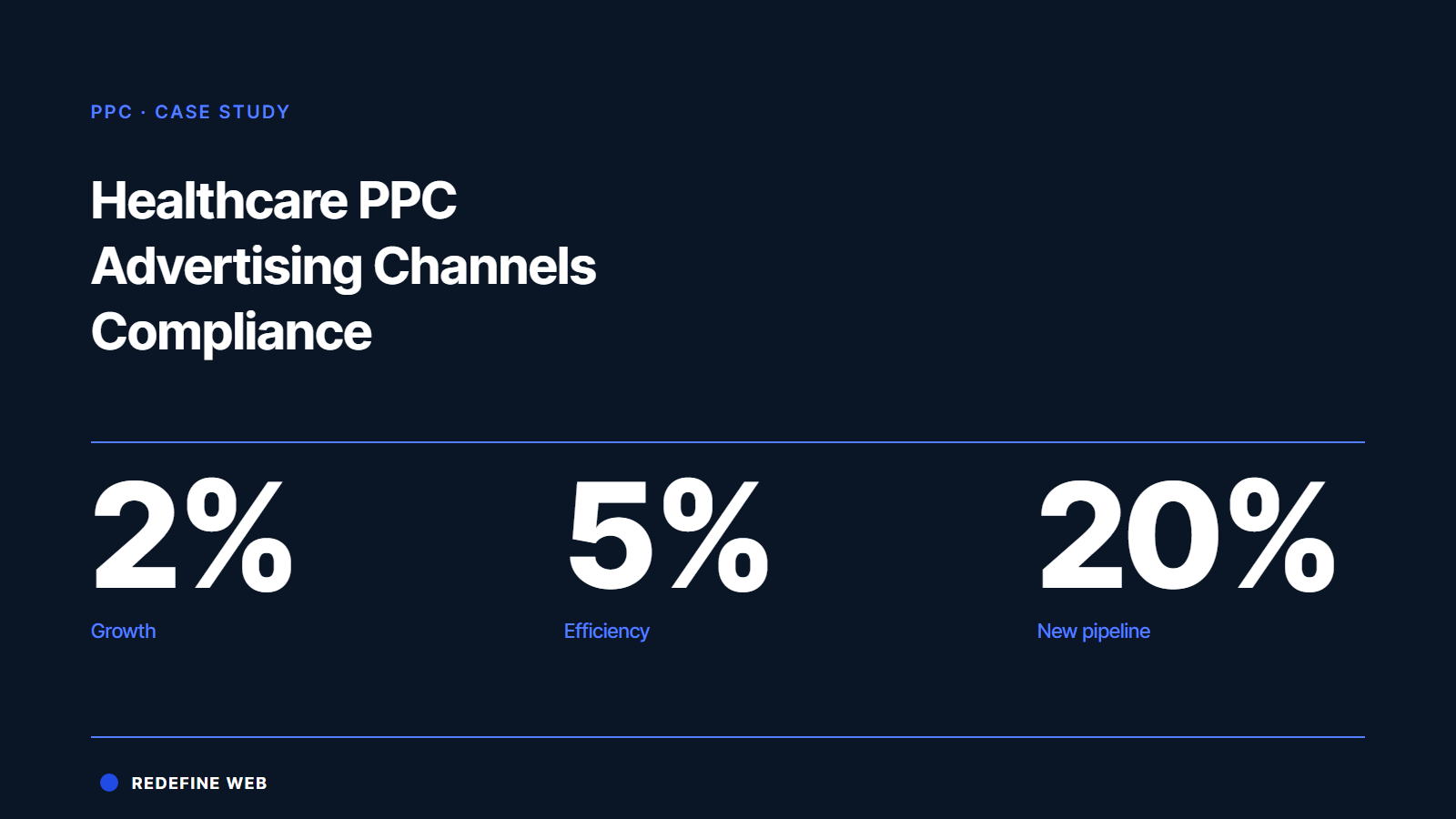
Smile Design Dentistry, a 50+ location DSO, came to us running healthcare PPC advertising across Google Search, Meta paid social, and programmatic display with a previous agency. The results were mixed because attribution was tangled, budget was spread evenly across channels regardless of ROI, and cost per booked patient was invisible in the reporting stack the prior vendor delivered every month.
We rebuilt the channel mix over 90 days. Google Search got restructured by service line and geography with per-location bid adjustments and HIPAA-compliant server-side tracking. Meta paid social got focused on elective services (invisalign, veneers, cosmetic) instead of general practice, which grew CVR from 2% to 5%. Programmatic display got paused entirely because the account wasn’t at the scale where it would work, and the budget shifted into Google Search where it converted better. CallRail integrated end-to-end with the scheduling system, and cost per booked patient became the top-line metric across every channel.
Ninety days in: PPC conversion rate grew 20%, cost per call dropped 30%, and the DSO could finally see which channels drove real patients versus which drove impressions. That reporting transparency, more than any bid tweak or creative test, is what turned the engagement into the kind of scaling relationship healthcare PPC advertising is supposed to produce. For a related view on choosing the right partner to deliver this, see our Choosing a Healthcare PPC Agency.
Where Healthcare PPC Advertising Goes Next
Healthcare PPC advertising in 2026 is trending toward tighter compliance, more automation, and better first-party data infrastructure. Google’s rollout of Enhanced Conversions for Leads and Meta’s Conversions API both push accounts toward server-side data flow, which happens to be the same infrastructure HIPAA compliance requires. Practices that build server-side properly now are positioned for the next 3-5 years of platform changes without rebuilds.
AI-generated creative is showing up across every platform. Google’s Performance Max and Meta’s Advantage+ campaigns rely heavily on machine-generated variants of your provided assets. For healthcare PPC advertising, this creates both opportunity (faster creative testing) and risk (compliance review has to happen on every AI-generated variant before it goes live). Practices that trust automation without a compliance review layer are one bad AI variant away from a platform ban or worse.
The winning healthcare PPC advertising strategy over the next few years mixes disciplined channel selection, HIPAA-compliant server-side tracking, tight first-party data collection, and a creative pipeline that pairs human review with AI assistance rather than handing everything to the machines. For the audit method that supports all of this, see our PPC Audit for Healthcare. According to WordStream’s benchmark data, healthcare accounts that adopt server-side tracking early consistently outperform those that delay, and the gap is widening.
Frequently asked questions
Which channel matters most in healthcare PPC advertising?
Google Search is the anchor channel for almost every healthcare PPC advertising mix because search intent is the strongest buying signal available on the internet. Someone typing 'urgent care near me' or 'dentist accepting Delta Dental' is not window shopping. Most practices should spend 60-70% of their paid budget on Google Search before adding any other channel, because the intent capture drives the highest cost per booked patient efficiency. Meta and Microsoft come next once Google Search has been optimized past a baseline of 30-50 conversions per month.
Is Meta paid social worth it for healthcare PPC advertising?
For elective and cash-pay services like cosmetic dentistry, med spa, plastic surgery, and hair restoration, Meta is often the second-best channel after Google Search. For insurance-based general practice, Meta usually runs at a higher cost per booked patient than Google Search does. The right test is a 90-day pilot with a defined budget cap and a defined success threshold, killing the channel if it fails to hit the threshold or scaling if it clears. Meta rewards visual storytelling and clear before-and-after transformation content within platform rules.
Are Google Local Service Ads good for healthcare PPC advertising?
For qualifying categories like chiropractic, physical therapy, massage therapy, and some medical specialties, LSAs are a strong complement to Google Search because you pay per lead instead of per click. The verification process takes 2-4 weeks and requires background checks and license documentation, which creates a barrier competitors have to clear. Practices that pair LSAs with Search Ads typically see 15-25% lower blended cost per booked patient. LSAs also reward operational responsiveness, so front desk answer rates matter more here than on any other channel.
How does HIPAA affect healthcare PPC advertising?
HIPAA affects every conversion tracking decision in healthcare PPC advertising. Default conversion tracking on Google Ads, Meta, and Microsoft transmits data that can include PHI (patient conditions, appointment types, identifiers) back to the ad platform. The compliant setup uses server-side tracking that scrubs PHI before transmission, plus signed BAAs with any downstream vendor. Google will not sign a BAA for standard Google Ads, so the compliance work happens on your infrastructure and the tracking-vendor layer. Skipping this exposes the practice to real OCR audit risk with six-figure minimum fines.
What's the minimum monthly budget for healthcare PPC advertising?
For a single-location practice running Google Search only, $2,500-$5,000 per month in ad spend is the minimum viable range. Below that, the account can't generate enough conversion data to optimize and Smart Bidding stays stuck in learning mode. Multi-channel healthcare PPC advertising engagements (Google Search + Meta + Microsoft) need at least $8,000-$15,000 per month across channels to run each one at productive scale. Programmatic display and YouTube video only make sense above $15,000 per month total, or the channels don't have the reach they need to convert.
How long should a healthcare PPC advertising channel run before I judge it?
Give any healthcare PPC advertising channel 60-90 days before making a keep-or-kill decision. The first 30 days are usually setup, tracking verification, and initial creative testing. Days 30-60 are landing page refinement and negative keyword build-out. Days 60-90 are when Smart Bidding stabilizes and the account produces reliable cost-per-booked-patient numbers you can trust. Killing a channel at day 30 usually means killing it before the data was clean enough to judge, and killing it at day 120 without improvement is fair grounds for a channel pivot to something better suited.
Book your free 30-minute strategy call.
No spam, no sales rep. We use your email to schedule your call with a senior strategist. That is it.
More from the blog
View all articles → PPC
PPC Dental Facebook Ads Guide for Practices That Book Patients
Read article PPC
PPC Legal PPC Management for Lawyers and Law Firms That Books Signed Cases
Read article PPC
PPC