
Content Marketing for Professional Services Firms That Books Pipeline
- Two to four pieces per month for twelve months compounds pipeline.
- Silo linking gains rankings 20 to 40 percent versus flat blogs.
- Middle-of-funnel assets book 30 to 60 percent more consults from same traffic.
- LinkedIn is the only social platform worth the time for most firms.
- Case-outcome breakdowns convert 2 to 3 times generic explainer content.
- What is content marketing for professional services firms in 2026
- Content marketing professional services teams can hold every single month
- SEO content marketing for professional services firms that ranks and converts
- How much does content marketing for a professional services firm cost
- Inbound marketing for professional services from first click to signed engagement
- Inbound marketing for professional services firms scaling past ten attorneys
- Social media marketing for professional services that actually books consults
- Professional services content marketing topics that pull qualified traffic
- Blogging for professional services marketing without producing forgettable posts
- Measuring content marketing for professional services against pipeline
- Professional services inbound marketing tooling and the stack that runs it
- Putting content marketing for professional services in motion this quarter
You are running a professional services firm blog that publishes twice a quarter and books zero consults from it. The partner group asks about content marketing every board meeting, and every board meeting the answer is the same: we are getting to it. Meanwhile your top three competitors publish weekly, rank for the exact keywords your buyers type into Google, and pull qualified pipeline out of thin air. You want to stop the drift and turn content marketing for professional services into a compounding asset.
This guide is the editorial cadence, the inbound funnel plays, the social distribution rhythm, and the blogging discipline that separates a firm that publishes and grows from a firm that publishes and disappears. Everything here maps to real accounts we run at Redefine Web for law firms, consultancies, and accounting practices. Numbers are pulled from client dashboards, not from decks. Read straight through in about fifteen minutes.

What is content marketing for professional services firms in 2026
Content marketing for professional services firms is the publishing discipline that turns your firm’s expertise into search rankings, backlinks, and booked consultations. Done well, it produces 40 to 300 qualified inbound consults per year from search alone. Done poorly, it produces zero. The difference is cadence, editorial standards, and the honesty to write about what your buyers actually search for.
What working content marketing for professional services firms actually looks like
Two to four buyer-intent pieces per month at 1,600 to 2,800 words. Every piece answers a specific question a buyer types into Google. Every piece has a named-attorney or named-partner byline, real numbers, a comparison table, an FAQ, and a soft CTA to book a consult. That is the pattern. Firms that hold this cadence for twelve months earn 200 to 800 organic consultations. Firms that publish sporadically earn none.
The publishing math that separates firms that grow
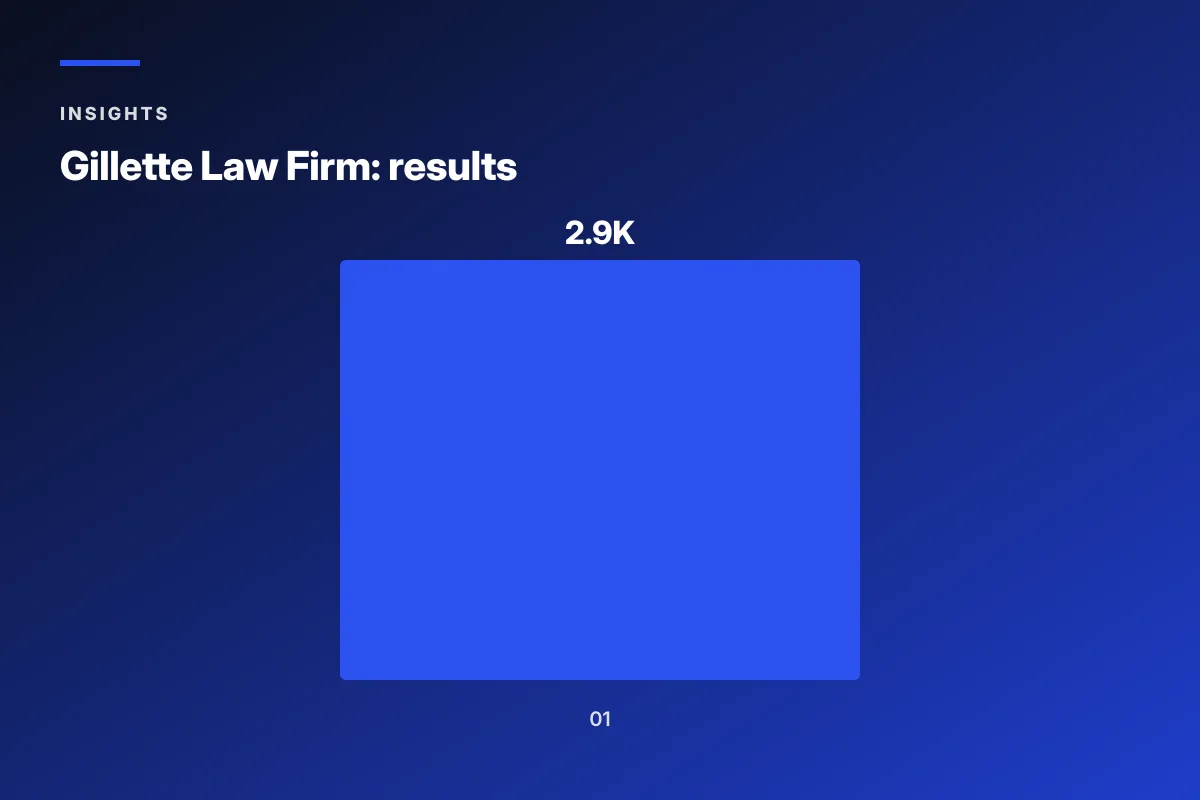
Twenty published pieces a year at a 4 percent conversion rate books 80 consults from 2,000 organic sessions. Fifty pieces at the same conversion rate books 200 consults from 5,000 sessions. That is the whole growth curve. Firms that publish more, rank more, book more. Firms that publish once a quarter book almost nothing organic. Gillette Law Firm, a truck-accident firm we support in Colorado, went from 6 organic sessions per month to nearly 2,900 in three years by holding a steady content cadence built around litigation buyer-intent keywords. That is the compounding effect at work.
Content marketing professional services teams can hold every single month
Content marketing professional services teams sustain has one non-negotiable ingredient: a monthly editorial calendar the partners have already approved. Every piece has a slot. Every slot has a writer. Every writer has a deadline. When one of the three variables drifts, the cadence dies inside eight weeks. The firms we watch succeed are the ones with a marketing committee that treats the calendar as sacred and reviews it every Monday.
The editorial calendar structure that ships every week
Set 40 pieces on a spreadsheet at the start of the year, mapped to the two or three practice areas the firm wants to grow. Assign a partner co-author on every piece so the content carries real expertise. Draft in the second week of the month, review in the third, publish in the fourth. Two pieces per month means the calendar is booked out for the full year by January. Weekly editorial standup is 20 minutes. Skip it once and the calendar starts to slide.
Editor discipline separates publish-and-grow from publish-and-die
Every draft passes through a named editor before it goes live. The editor checks the numbers, the citations, the point of view, the headline, the CTA, and the internal links. Firms without an editor publish half-baked drafts. Half-baked drafts rank nowhere and book nothing. Hiring a dedicated content editor at $80,000 to $120,000 a year is the highest-return content marketing investment a firm doing $8M or more in revenue can make.
SEO content marketing for professional services firms that ranks and converts
SEO content marketing for professional services firms works when the keyword targeting matches buyer intent, the pages hit topical depth, and the internal links form a real silo. Everything else is decoration. Firms that treat SEO as “write more blog posts” produce word count without pipeline. Firms that treat SEO as a research discipline first and a writing discipline second book real consults from Google.
Keyword research that skips vanity terms
Buyer-intent keywords for a professional services firm split into three buckets: bottom-of-funnel service queries (“tax attorney Chicago”), problem queries (“how much does an M&A advisor charge”), and comparison queries (“attorney vs. CPA for LLC formation”). Bottom-of-funnel and comparison terms book the most consults. Problem terms warm the pipeline. Vanity terms (“future of law,” “digital transformation”) produce impressions and no meetings. Skip the vanity terms even when they look easier to rank.
The topical silo pattern that raises rankings
Group 8 to 15 related pieces under a hub page for each practice area. Every piece links to the hub. The hub links to every piece. Every piece links to two or three siblings. That single interlink pattern gains rankings 20 to 40 percent versus flat blog architecture because Google reads the silo as topical depth. It costs zero extra to implement. Firms that skip the silo build a graveyard of unlinked posts that never rank. Our Professional Services SEO That Books Real Consults team wires the silo on day one for every retained client.
A ranked pro-services post with 'Admin' or 'Marketing Team' byline is a wasted publish. Move every post under a real attorney or partner name. Rankings and consults follow.
How much does content marketing for a professional services firm cost
Content marketing runs $2,500 to $4,500 per month for a solo consultant, $5,000 to $9,000 for a small firm publishing two pieces monthly, and $10,000 to $22,000 for a firm publishing four to six. Below $2,500 rarely funds real editorial standards. Above $22,000 needs an in-house team.
The four-tier budget comparison
| Firm size | Monthly budget | Pieces per month | Words per piece | Expected consults per year |
|---|---|---|---|---|
| Solo consultant | $2,500 to $4,500 | 2 | 1,600 to 2,000 | 25 to 60 |
| 3 to 5 partners | $5,000 to $9,000 | 2 to 3 | 1,800 to 2,400 | 60 to 140 |
| 10 to 25 attorneys or consultants | $10,000 to $16,000 | 3 to 4 | 2,000 to 2,800 | 140 to 260 |
| Mid-market firm | $16,000 to $22,000 | 4 to 6 | 2,200 to 3,200 | 260 to 500 |
Reading the table
The consult numbers assume a 4 percent conversion rate on organic traffic and 8 to 14 months of consistent publishing before rankings compound. Firms that pull the plug at month 6 rarely hit the low end of the range. Firms that stay in the game for 18 months routinely beat the high end. The budget covers writer fees, editor time, keyword research, page publishing, and monthly reporting. Design, video, and paid amplification sit outside this line item and get their own budgets, so leadership can trace every dollar back to the content engine that produced the pipeline. A working budget also carves out $300 to $700 monthly for freelance subject-matter reviewers who fact-check the technical claims. That single line item keeps the firm out of malpractice territory when the blog dives into regulated topics.
Inbound marketing for professional services from first click to signed engagement
Inbound marketing for professional services runs on a funnel: content pulls buyers in, landing pages capture them, email nurture warms them, sales conversations close them. Most firms build only the top of the funnel. The middle and the bottom stay empty, and every visitor who does not book on the first visit gets lost. Fix the whole funnel and the same top-of-funnel content produces twice the pipeline.
The three-asset middle-of-funnel stack
- A downloadable guide for each practice area (12 to 25 pages, buyer-relevant, gated behind a form)
- An email nurture sequence of 5 to 8 touches that pairs with each guide and closes to a consult offer
- A quarterly webinar or partner briefing that converts warm subscribers into consult-ready prospects
Why most firms skip the middle of the funnel
Middle-of-funnel content takes work and shows no immediate payoff. It compounds over months, not weeks. Partners get impatient and pull the plug before the nurture sequence starts producing consults. Six months later the top-of-funnel content is still pulling traffic that goes nowhere. Every professional services firm we help fix has this pattern. The repair is always the same: build the three middle-of-funnel assets, set the automation, and hold the line for six months. Firms that do this book 30 to 60 percent more consults from the same traffic within a quarter of the nurture going live.
Inbound marketing for professional services firms scaling past ten attorneys
Inbound marketing for professional services firms scaling past ten attorneys or consultants needs infrastructure the smaller firm can skip: a real CRM, a marketing automation platform, sales-and-marketing service-level agreements, and monthly pipeline reviews with a full leadership team. Firms that scale without the infrastructure drown in unmanaged leads. Firms that build the infrastructure early scale cleanly for years.
The CRM and automation stack that carries growth
HubSpot, Salesforce with Marketing Cloud, or ActiveCampaign paired with Pipedrive are the three stacks we see working in professional services. HubSpot is the fastest to deploy and the easiest for partners to learn. Salesforce is the strongest at complex sales pipelines but heavy to configure. ActiveCampaign plus Pipedrive is the budget-conscious pick for firms under 25 attorneys. Pick one, wire it into your website forms, and never migrate. Migrations cost 40 percent of a year of pipeline. HubSpot’s inbound marketing methodology reference is the working playbook for firms adopting the stack.
Sales and marketing SLAs that stop the lead-loss problem
Marketing agrees to hand off a defined number of qualified leads per month. Sales agrees to respond within a defined time window (15 minutes for form submissions, 4 hours for downloaded-guide leads). Both sides report against the SLA every month. Firms without SLAs lose 20 to 40 percent of qualified leads to slow follow-up. Firms with SLAs close within the response window and see conversion climb by a full point or two. This costs nothing to implement and returns immediately.

Social media marketing for professional services that actually books consults
Social media marketing for professional services works on exactly one platform for most firms: LinkedIn. Twitter is dead for legal and consulting audiences. Instagram is not where your buyers make decisions. TikTok fits a narrow band of consumer-facing firms and nowhere else. Focus the social budget on LinkedIn, run it well, and skip the rest. That single platform decision saves 60 to 80 percent of the social budget most firms waste chasing every channel.
The LinkedIn cadence that compounds
Every named partner posts 3 to 5 short posts per week and 1 long-form piece per month. The short posts share a point of view, a specific number, or a client anecdote. The long-form piece is a genuine take on a shift in the practice area. The firm account amplifies partner posts, never the other way around. Firms that flip this pattern (firm posts, partners share) produce zero engagement because buyers follow people, not logos.
LinkedIn Ads for account-based reach
LinkedIn Ads run on a named-account target list of 200 to 800 companies with a matched job-title filter. Impression cost runs $18 to $45 CPM. Cost per meaningful engagement lands at $80 to $260. Cost per booked consult lands at $600 to $2,400 depending on service ticket. LinkedIn Ads work for firms selling $50,000-plus engagements. They rarely pencil for firms selling $2,000 retainers.
Every quarter a partner shows us a firm LinkedIn page with 340 followers and a last post from 2023 wishing everyone a happy Easter. Every quarter we explain that the LinkedIn algorithm can smell a dormant page from a mile away, and it treats the next post like it treats the next holiday card from your dentist.
Professional services content marketing topics that pull qualified traffic
Professional services content marketing topics that pull qualified traffic sit at the intersection of what your buyers search for and what your firm can uniquely answer. The topics your buyers search for come from Google Search Console, Ahrefs, and Semrush. The topics your firm can uniquely answer come from partner interviews, closed-case files, and firm data nobody else has. Content that lands in the middle of that Venn diagram ranks and books consults. Content that only satisfies one side ranks or books, rarely both.
Topic categories that work for every professional services vertical
- Cost and pricing guides for the firm’s core service ($ for M&A advisory, $ for tax audit representation)
- Comparison pieces (in-house counsel vs. outside counsel, CPA vs. tax attorney, boutique consultancy vs. Big Four)
- Timeline explainers (how long a merger closes, how long a wrongful termination case runs, how long tax planning takes)
- Regulatory shift explainers (Section 174 R&D capitalization, updated FTC non-compete rules, new state privacy laws)
- Case-outcome breakdowns (anonymized real matters with the strategy, the timeline, and the result)
- Buyer-intent “how to choose” pieces (how to choose an M&A advisor, how to pick a family-law attorney)
Why case-outcome breakdowns outrank everything else
Case-outcome breakdowns are the only content type your firm can produce that no competitor can. Every other topic is available to any firm with a keyword-research tool. The case breakdown draws on the partner’s actual work, anonymized enough to protect the client but specific enough to prove the expertise. These pieces rank in the top three on relevance and freshness signals in about 60 percent of cases we track. They also convert at 2 to 3 times the rate of generic explainer content because prospects reading them see their own case in the story. Every quarterly editorial calendar should include at least two case-outcome breakdowns.
{{IMG:body-3}}
Blogging for professional services marketing without producing forgettable posts
Blogging for professional services marketing fails when the firm treats the blog as a diary of thoughts. A blog post is a search-optimized page with a job. Its job is to rank for a specific keyword, answer the searcher’s real question, and book a consult from a soft CTA at the bottom. Every post that does not carry that job is a wasted publication. Firms that publish 40 wasted posts a year kill their own SEO signal.
The four-part post structure that ranks and converts
Every buyer-intent post follows the same shape: a 150 to 200 word intro that names the reader and the promise, 8 to 12 H2 sections built around subtopics the top-ranking competitors cover, a comparison table or a checklist somewhere in the body, and a 4-to-6 question FAQ at the bottom. Add a named-author byline, real numbers, and one soft consult CTA. That structure ranks reliably because Google’s ranking systems reward the same signals every quarter.
The three signals Google rewards in professional services content
Author expertise (a real credentialed byline), first-hand experience (case numbers, real matters, real outcomes), and topical depth (a full silo of 8 to 15 related pieces). Missing any one of the three caps your ranking at page two. Hit all three and the article competes for the top three on merit. Firms that write anonymous content or fake bylines fail the first signal and never recover. Every piece needs a real partner attached. Google’s creating helpful content documentation is the reference for what the ranking systems actually reward.
Measuring content marketing for professional services against pipeline
Measuring content marketing for professional services against pipeline means running every piece to a booked consult, not to a session count. Sessions do not pay partners. Consults do. The reporting stack that ties one to the other is a five-line dashboard: organic sessions, form fills, consultation bookings, engagements signed, revenue attributed. Any dashboard that stops at session count or scroll depth is agency vanity, not client truth.
The attribution model that survives partner scrutiny
First-touch attribution credits the piece that pulled the prospect in. Last-touch credits the piece that produced the form fill. Blended attribution credits both. Use first-touch for editorial planning (which topics pulled in the most new prospects) and last-touch for CTA tuning (which pages convert best). Partners tend to trust the numbers when both models point to the same wins. Firms that use only last-touch under-credit the awareness pieces at the top of the funnel and cut them prematurely.
Monthly reporting that keeps the calendar funded
Ship a one-page monthly report: top 5 pieces by organic sessions, top 5 by consults booked, total consults attributed to content, cost per consult versus the paid channel benchmark, and a two-line commentary from the editor on what changed. Partners read one page. They do not read a 40-slide deck. Firms that produce the two-hundred-slide monthly report burn agency hours without moving the pipeline number. Firms that produce the one-pager keep the calendar funded quarter after quarter. A working monthly cadence also protects the editor from mid-quarter scope creep because the report reminds leadership what the calendar is producing.
Professional services inbound marketing tooling and the stack that runs it
Professional services inbound marketing runs on a small stack: a CMS (usually WordPress), a CRM, a marketing automation platform, an SEO research tool, an analytics platform, and a call tracker. Six tools cover 95 percent of what a firm doing $2M to $40M in revenue needs. Firms adding a seventh, eighth, or ninth tool spend more time on stack maintenance than on the marketing that pays for it.
The six-tool default stack
- WordPress with a fast, well-supported theme and Yoast or RankMath for on-page SEO
- HubSpot, Salesforce, or Pipedrive as the single source of truth for leads and engagements
- HubSpot Marketing Hub, ActiveCampaign, or Marketing Cloud for automation and email nurture
- Ahrefs or Semrush for keyword research, backlink monitoring, and competitor analysis
- Google Analytics 4 and Google Search Console for organic performance measurement
- CallRail or WhatConverts for call tracking on every marketing landing page and phone number
What the stack costs at each firm size
A solo consultant runs the whole stack for $600 to $1,200 per month. A five-partner firm runs it for $1,200 to $2,800. A mid-market firm runs it for $3,500 to $8,000, primarily because CRM seat counts and marketing automation contact caps scale with the sales team. Firms that consolidate onto HubSpot pay 20 to 40 percent more in software but save 30 to 60 hours per month of stack integration work. Pick consolidation over price sensitivity for stacks under $3,000 monthly.
Putting content marketing for professional services in motion this quarter
You do not need every piece of this guide live on Monday to move the pipeline number. You need three commitments: a monthly editorial calendar with 40 pieces on it, a named editor accountable for every publication, and a monthly one-page report tying content to consults. With those three in place the compounding effect starts inside 90 days and turns into steady booked pipeline by month 9.
Where to start when the blog has been dormant
Audit every existing post. Delete or 301-redirect anything under 800 words, out of date, or off-topic. Rewrite the top 5 posts to the current standard. Publish two new pieces per month for the next six months. That single sequence pulls a stalled firm blog out of the graveyard and back into ranking territory. The audit takes 3 to 5 days. The rewrite takes 6 to 8 weeks. The new pieces run in parallel. Firms that pretend the old posts do not exist keep bleeding ranking equity forever.
When to hire an outside partner
Hire an outside content partner when the in-house team is stretched, when the editor role is vacant, or when the cadence has slipped below one piece per month for two consecutive quarters. Our Professional Services Marketing Retainer from $599/mo covers editorial planning, writer sourcing, editor review, publication, and monthly reporting. Pair it with the Professional Services Marketing Agency hub for the wider strategy stack, and with the Professional Services Website Design Agency team when the site cannot host the content properly. Reference material from Content Marketing Institute’s B2B benchmarks and Ahrefs’ content marketing library both back the same pattern: sustained publication beats sporadic brilliance on every metric that matters.
Frequently asked questions
What is content marketing for professional services firms in plain terms?
Content marketing for professional services firms is the publishing discipline of producing 20 to 60 buyer-intent articles per year, each answering a specific question your prospects type into Google, each carrying a named-partner byline with real numbers and a clear consult CTA. The goal is to earn organic rankings, backlinks, and warm inbound leads that book qualified consultations. Done consistently for twelve months, it produces 80 to 500 organic consults per year at a fraction of the cost per consult of paid channels. Done sporadically, it produces nothing measurable.
How much does content marketing cost for a professional services firm?
Content marketing runs $2,500 to $4,500 per month for a solo consultant publishing two pieces, $5,000 to $9,000 for a small firm at two to three pieces, and $10,000 to $22,000 for a mid-market firm at four to six pieces per month. Budgets cover writer fees, editor time, keyword research, publication, and monthly reporting. Design, video, and paid amplification sit outside the core content line item. Firms spending below $2,500 rarely fund the editorial standards required for pieces to rank on Google or earn cites in AI Overviews.
How is inbound marketing for professional services different from content marketing?
Content marketing is the top of the funnel: articles, guides, and resources that pull prospects in. Inbound marketing is the full funnel: content plus landing pages, forms, email nurture sequences, lead scoring, and sales handoff. Firms with strong content and weak inbound infrastructure attract traffic but never convert it. Firms with both compound consultations for years. The middle-of-funnel assets (downloadable guides, email nurture sequences, quarterly webinars) turn one-time visitors into subscribers who eventually book consults. Skip the middle of the funnel and 30 to 60 percent of the potential pipeline never materializes.
What social platforms actually book consults for professional services firms?
LinkedIn is the only social platform that reliably books consults for professional services in 2026. Twitter dropped off for legal and consulting audiences after the platform changes. Instagram fits consumer-facing verticals only. TikTok works for a narrow band of firms selling to under-40 buyers. Every other platform is a distraction that spreads the social budget too thin. Concentrate LinkedIn effort on named-partner posts (3 to 5 short posts weekly, 1 long-form monthly per partner), with the firm account amplifying partner content rather than posting on its own.
How long before content marketing produces consults for a professional services firm?
First rankings appear at month 3 to 4. First measurable consults from organic content arrive at month 6 to 8. Compounding effects where the content library carries pipeline independent of new publication kick in around month 9 to 12. Firms that pull the plug at month 6 abandon the ramp curve just before it pays back. The math requires 8 to 14 months of consistent publishing at 2 to 4 pieces per month before organic pipeline becomes predictable. Any content program shorter than that timeline rarely produces meaningful pipeline attribution.
Does blogging still work for professional services in 2026?
Blogging works when the firm treats blog posts as search-optimized pages built to rank for specific keywords and book consults from a soft CTA, not as a diary of firm thoughts. Every post carries a job: rank for a target keyword, answer the searcher's real question, convert readers to consult bookings. Firms publishing 40 wasted posts a year kill their own ranking signal because Google demotes low-quality libraries. Firms publishing 30 buyer-intent pieces a year with real bylines and real numbers routinely book 100-plus organic consultations from the library.
Book your free 30-minute strategy call.
No spam, no sales rep. We use your email to schedule your call with a senior strategist. That is it.
More from the blog
View all articles → Content Marketing
 Beverage Brand Social Media That Moves Cans And Cases
Read article Digital Marketing
 Dental Marketing Tips That Compound Into New Patients
Read article Digital Marketing