Dental website development is the end-to-end process of scoping, designing, coding, and launching a HIPAA-aware website that turns local search traffic into booked patients, with online scheduling, secure forms, and structured service pages built on a stack you can maintain for years. It sits at the crossroads of clinical trust, SEO, and conversion engineering.
The average dental practice loses 25% to 40% of new-patient inquiries to competitors within 24 hours of a phone or form miss, per industry benchmarks reported by Nielsen Norman Group UX research on how users decide within seconds. The website is the front door. If the front door is slow, ugly, or broken on mobile, the phone stays quiet.
We have built and rebuilt dental websites for solo offices, group practices, and 50-plus location DSOs. This guide is the map we use. You will get a realistic timeline, the must-have features, the WordPress vs custom trade-off, HIPAA rules that actually apply to a website, and the pricing bands we quote every week.
What dental website development actually includes
Dental website development covers strategy, information architecture, UX design, front-end code, back-end integrations, HIPAA-aware forms, on-page SEO, analytics, and post-launch iteration. A real build is not a template swap. It is a project that touches marketing, front-desk workflow, and clinical policy.
Every scope we run has the same 7 layers:
- Discovery and strategy. 2 to 3 weeks. Competitor teardown, keyword map, service inventory, and a wireframe of the top 12 pages.
- Brand and UX design. 2 to 4 weeks. Colors, type, hero systems, and mobile-first mockups for home, service, doctor, location, and contact templates.
- Content production. 2 to 3 weeks. Service pages, doctor bios, and FAQ blocks written for real patient queries, not vendor filler.
- Development. 3 to 5 weeks. WordPress theme or custom framework, template build, form and booking wiring, schema markup, and staging QA.
- Integrations. 1 to 2 weeks. Scheduling tools, phone tracking, review widgets, insurance-verification embeds, and a payment link.
- SEO and analytics. 1 to 2 weeks. On-page tuning, GA4, GTM, call tracking, and Search Console setup with baseline rank capture.
- Launch and 30-day tune. 1 week live, plus 4 weeks of speed, conversion, and content follow-ups.
Total realistic timeline. 10 to 16 weeks for a solo or 2 to 3 doctor practice. 4 to 6 months for a multi-location group. Faster promises are marketing, not schedule.
WordPress vs custom in dental website services
WordPress powers roughly 40.2% of the public web and is the default we pick for 8 out of 10 dental practices. It gives your front desk a familiar editor, a mature plugin market for booking and reviews, and page-speed patterns we know how to hit. Custom stacks (Next.js, headless CMS) earn their keep only when you run a DSO with 20-plus locations, native app integrations, or a design system that has to sync to a mobile product.
Here is how the two options compare on the calls we take every week.
| Decision factor | WordPress | Custom (headless / Next.js) |
|---|---|---|
| Typical build cost | $1,500 to $15,000 | $25,000 to $120,000 |
| Timeline | 10 to 16 weeks | 18 to 30 weeks |
| Front-desk editability | High | Medium, needs training |
| Ongoing dev support | Any WP shop | Small talent pool |
| PageSpeed ceiling | 90 to 98 mobile | 95 to 100 mobile |
| Best fit | 1 to 15 locations | 15-plus locations, patient portals, apps |
In short. WordPress wins on cost, editability, and hiring pool. Custom wins when you need a native patient portal, a booking flow shared with an app, or a design system that scales across product lines. If a vendor pushes custom for a 2-doctor office, ask what problem that stack solves that WordPress cannot.
Must-have features every dental website ships with
A dental website that books patients has 9 non-optional features. Skip any of them and the site becomes an expensive brochure. These are the same 9 blocks we spec in every project, from a responsive web design refresh to a full custom rebuild.
- Online scheduling. A booking widget from LocalMed, NexHealth, Zocdoc, or a native SCF form. Patients booking outside office hours is where 30% to 45% of appointments now come from.
- Click-to-call phone. Sticky mobile CTA with tel: link and CallRail dynamic number swap. Every rung phone is a tracked line, not a guess.
- HIPAA-aware contact forms. No PHI in the email body, TLS 1.2-plus in transit, and a BAA with the form vendor.
- Service pages, one per procedure. Cleanings, Invisalign, implants, veneers, emergency, sedation, pediatric, TMJ, and periodontics get their own indexable page.
- Doctor bios with real photos. Named credentials, years in practice, school, and one human paragraph. Stock photos halve trust.
- Location and hours schema. LocalBusiness plus Dentist JSON-LD with NAP and hours. Google Maps ranks favor structured data.
- Reviews and social proof. Live Google review widget or embedded testimonial video near the booking CTA.
- Insurance and payment info. Accepted plans, financing options (CareCredit, Sunbit), and an in-office savings plan page.
- Blog and FAQ hub. Answer real patient queries. This is where dental SEO compounds month over month.
The bottom line. A dental site without these 9 features leaves booked patients on the table, no matter how pretty the hero image is.
HIPAA compliance in dental website development
HIPAA applies to any dental website element that collects, transmits, or displays protected health information (PHI). Marketing pages that describe services are safe. Any form, chat, portal, or scheduler that touches a name plus a symptom or diagnosis is regulated. Get the categorization wrong and you are looking at fines that start at $137 per violation and reach $2.13 million per year, per HHS 2024 penalty tiers.
The 5 rules we enforce on every dental build:
- Business Associate Agreement (BAA) with every vendor that touches PHI. That includes your form host, scheduler, chat tool, and hosting company. No BAA, no data.
- TLS 1.2 or higher across the whole domain. Not just the checkout page. HSTS on. Mixed-content warnings fixed.
- PHI never in email subject lines or bodies. Forms send a notification only. The actual submission lives in an encrypted vault the front desk logs into.
- Access logs on the CMS. Who logged in, when, and what they touched. WordPress logs via Wordfence or Sucuri, custom via app-level middleware.
- Backup and breach procedure. Nightly offsite backups plus a documented 60-day breach-notification plan per HIPAA Breach Notification Rule.
Cheap builders skip these. That saves you $200 upfront and costs you $50,000 on the first patient complaint.
Appointment booking and patient-portal integrations
Appointment booking is the single highest-ROI integration on a dental website. Live-availability widgets convert 2 to 4 times better than a static contact form. Patients pick a slot in 20 seconds without a phone call. The catch is that not every booking tool plays clean with every practice-management system (PMS). Sync mismatch is the number-one silent bug in dental website services.
The 4 integration models we deploy, and when each one fits:
- PMS-native (Dentrix, Eaglesoft, Open Dental). Deep sync, real chair availability, cost $99 to $299 per month per location. Best for solo and small-group practices already on those systems.
- Third-party live scheduler (LocalMed, NexHealth, Modento). Middleware that pipes to PMS via API. $199 to $499 per month. Best for practices that want a modern patient UX without switching PMS.
- Headless dental patient portal. Custom React or Next.js app that reads and writes to PMS + billing + intake forms. $30,000 to $120,000 build. Best for DSOs with 15-plus locations.
- Zocdoc marketplace. Rented visibility on Zocdoc for $30 to $110 per booked appointment. Best as a supplement, not a replacement for your own site.
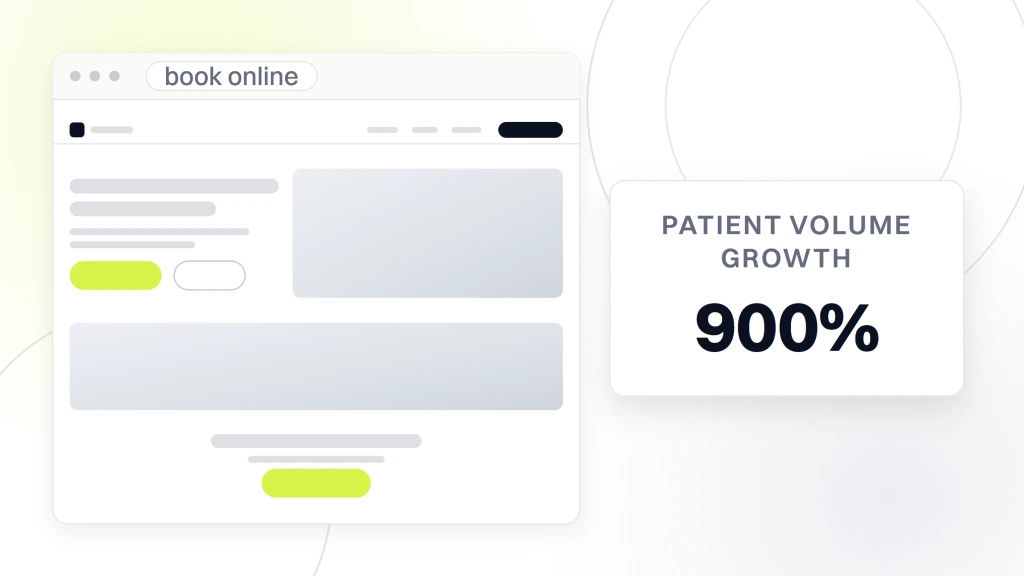
Real example. iSmile Dental Spa in Carmichael, CA went from 1 to 2 new patients per month to 12 to 14 per month after we replaced an outdated brochure site with a secure HTTPS rebuild, ranked 75 keywords on page one within 6 months, and grew patient volume 900% over the multi-year program. The rebuild plus scheduling flow was the reason, not luck.
Custom dental website design vs template kits
Custom dental website design costs 4 to 20 times more than a template kit and, at 2 to 3 doctors, rarely pays back the difference. Templates from Elementor, Divi, or dental-specific vendors come with 10 to 15 pre-built layouts for $299 to $1,200. Custom builds start at $8,000 and stretch to $120,000 for headless patient portals. The right pick depends on brand, budget, and how much you need the site to differentiate.
Templates win when your practice is standard general dentistry in a competitive market where speed to launch matters more than differentiation. Custom wins when you offer sedation, cosmetic, or implant services at price points that require a premium first impression, or when you operate more than 5 locations and need a design system.
For a wider walk-through of template starting points, see dental website templates and our follow-up on the best dental website builder options. Both let you screen shortlist candidates before you commit to a build path.
Real dental website development case study
VP Dental, a 20-plus year practice led by Dr. Valerie Preston, ran on a fragmented vendor stack with web and SEO owned by different agencies. The old site was slow, had no online scheduling, and Google Maps visibility dropped sharply just a few miles outside the office. Cosmetic patient inquiries were low, and revenue growth stalled.
The build. We unified web and SEO under one team. WordPress rebuild with authentic photography and patient-friendly navigation. Online scheduling, virtual consult booking, digital intake forms, and payment gateways were wired into a single flow. Google Maps SEO expanded visibility past the immediate practice radius.
The results after 12 months:
- +100% new monthly patients. Bookings doubled since launch.
- +$8,100 per month in recurring revenue. Added, not shifted, from the redesigned site.
- +776% search impressions. Google Maps SEO expanded reach far past the office block.
The pattern repeats across our dental portfolio. North County Dental Care in Vista, CA drove 1,000% patient growth, 385% more organic traffic, and 500% ROI on a full digital rebuild. Smile Design Dentistry, a 50-plus location DSO, cut cost per call 30% and grew PPC conversion rate 20% across the network. The pattern is always the same. Modern site, structured content, and honest measurement.
Dental website services pricing
Dental website services fall into 4 pricing bands, and picking the wrong one is a $10,000 mistake. Cheap builders (Wix, DIY templates) cost $20 to $50 per month plus 40 to 60 hours of your time, and they cap your SEO ceiling. Dental-specific platforms like ProSites, PBHS, and Great Dental Websites charge $299 to $599 per month with $500 to $1,500 setup, but CRM and advanced SEO usually cost extra. Freelance and boutique agencies run $3,500 to $15,000 for the site, plus $500 to $2,500 monthly retainer.
Our published pricing for practices that want a full-service build:
| Tier | Price | Best for |
|---|---|---|
| SMB Starter | $2,500 one-time | Solo practice, 8 to 10 core pages |
| SMB Growth | $4,500 one-time | 2 to 3 doctors, 15 to 20 pages, integrations |
| SMB Pro | $7,500 one-time | Multi-service practices, custom template system |
| Maintenance Basic | $199 per month | Uptime, backups, security patches |
| Maintenance Growth | $299 per month | Basic plus content updates and analytics review |
| Maintenance Pro | $499 per month | All above plus CRO tests and monthly reporting |
Hosting is bundled into every maintenance tier. That saves practices $30 to $150 per month vs paying WP Engine, Kinsta, or Cloudways separately, and it puts one team on the hook if anything breaks.
When dental website development goes wrong
Most failed dental websites fail for the same 6 reasons, and every one of them is preventable. If a rebuild proposal does not address these upfront, the site will underperform.
- No booking widget on mobile. 68% of dental traffic is mobile. A phone-only CTA loses the 43% of patients who prefer to book without calling.
- Page speed above 3 seconds. Every extra second of load time costs conversions. Slow theme + heavy hero video is the usual culprit.
- Generic content pulled from a template library. Google can spot near-duplicate service copy and demote it. Real doctor bios and location-specific pages beat template filler every time.
- No local schema. Dentist and LocalBusiness JSON-LD is a 5-minute add that separates practices that appear in the Map Pack from ones that do not.
- Vendor lock-in on the CMS. Proprietary builders (ProSites, PBHS) hold your content hostage. If you leave, you re-write everything. WordPress and open-source stacks let you move.
- No analytics baseline. Launching without GA4 + call tracking + Search Console means you cannot prove the rebuild worked. Set the baseline in week 1, not week 12.
Ready to plan your dental website development project
Dental website development is not a template swap. It is a scoped project that touches marketing, front-desk workflow, HIPAA policy, and revenue. Get the 9 must-have features in, pick WordPress or custom based on scale not vanity, and hold every vendor to the pricing bands published here. The result is a site that books patients 24 hours a day.
If you want a partner that runs the whole build under one roof, that is what Redefine Web’s dental marketing team does every day. We have shipped rebuilds for solo offices, group practices, and 50-plus location DSOs, and the case studies above are ours. Start a project scope with our team and we will send back a 12-page plan inside 5 business days, no obligation to commit.