
Ecommerce Website Maintenance Services That Protect DTC Store Revenue
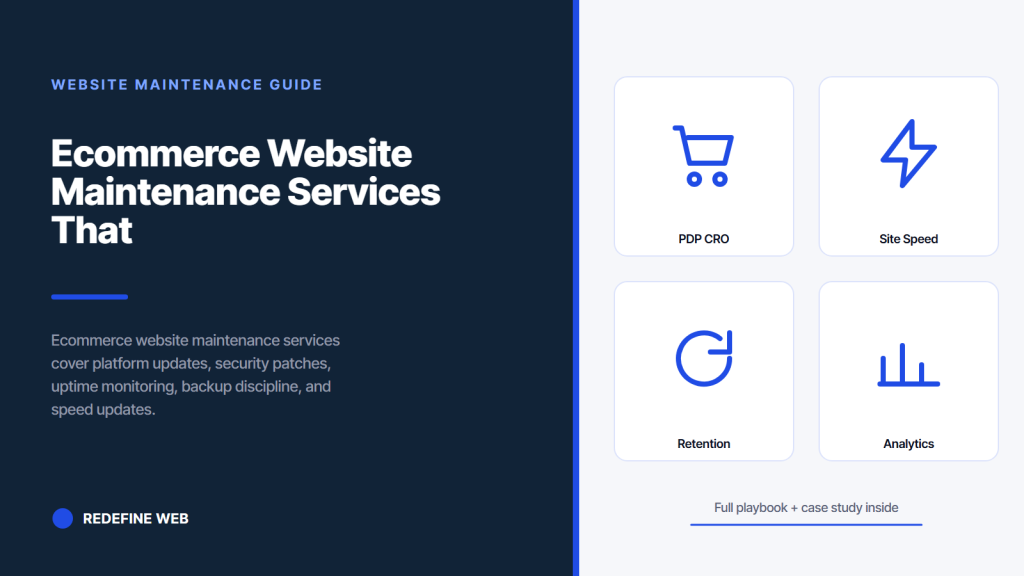
- Six buckets. Updates, security, uptime, backups, speed, and bugs.
- A broken pixel takes down checkout faster than a broken theme.
- Restore drills catch backups that were technically running but corrupt.
- Growth-tier DTC stores need 12 to 20 hours of maintenance monthly.
- Retainers start at $599 per month for standard Shopify stores.
26 Shopify apps generate 20 update notices a month. Skip one and Friday finds the hole. Assign a Monday changelog review to a real human, not automation.
Frequently asked questions
What do ecommerce website maintenance services typically include?
Ecommerce website maintenance services typically include platform and plugin updates on a weekly deploy cadence, security patching against known vulnerability databases, uptime and error monitoring on homepage plus checkout plus payment gateway endpoints, backup discipline with quarterly restore drills, performance regression watch on Core Web Vitals, and a live bug queue for checkout and cart breaks. Retainers below this scope usually cover only monthly plugin updates, which rarely catches the pixel updates and payment gateway credential expirations that actually take down DTC stores. A real retainer takes ownership of the six buckets rather than treating maintenance as a monthly checkbox report.
How much do ecommerce maintenance packages cost per month?
Ecommerce maintenance packages run $599 to $14,000 per month depending on catalog size, platform, and app count. Starter tier standard Shopify stores under 200 SKUs sit at $599 to $1,200 for 6 to 10 monthly hours. Growth tier Shopify or WooCommerce stores with 200 to 1,500 SKUs sit at $1,500 to $3,200 for 12 to 20 hours. Scale tier Shopify Plus or headless stores with 1,500 to 8,000 SKUs run $3,500 to $6,800 for 24 to 40 hours. Enterprise multi-region stores past 8,000 SKUs land at $7,500 to $14,000 for 50 to 90 hours. Retainers below $599 usually cover only surface uptime monitoring, which misses most real ecommerce failure modes on live stores.
How often should ecommerce sites be updated and patched?
Live ecommerce stores need updates on a weekly cadence. Every Monday morning the maintenance team reviews pending platform, plugin, theme, and app updates. Every Tuesday or Wednesday morning between 9am and 11am store-local time the team deploys the batch after staging QA on the top 20 shopper flows. Security patches with active exploits ship inside 24 hours of vendor release, regardless of the standard window. Deploys never happen on Friday, before a payroll run, or during a scheduled email campaign. That rhythm catches breaking changes early in the week when the full team is available to roll back, and keeps weekend revenue safe.
What is the difference between a Shopify and WooCommerce maintenance plan?
Shopify maintenance plans focus on app sprawl reduction, theme code cleanup, checkout customization, Merchant Center feed health, and third-party pixel management. Shopify handles hosting, core security, PCI compliance, and platform updates at the platform level. WooCommerce maintenance plans add plugin update discipline across 34 to 52 active plugins, full PCI compliance work, host-level security hardening, database optimization, and WordPress core updates on top of everything a Shopify plan covers. WooCommerce retainers run 30 to 45 percent higher than equivalent Shopify plans because the update surface stacks. Founders picking between the two should factor maintenance cost into the platform decision rather than treating platform choice and maintenance as separate line items.
Can I do ecommerce website maintenance myself or do I need an agency?
Standard Shopify stores under 200 SKUs with 8 to 12 installed apps can technically run maintenance in-house if the founder or a marketing coordinator owns 6 to 10 hours per month for updates, monitoring reviews, and bug triage. Stores past 500 SKUs, 20 apps, or $80,000 monthly revenue almost always need a specialist partner because the update surface and incident response burden exceed what a solo owner can carry alongside other responsibilities. The break-even math favors an agency retainer once revenue clears $1 million annually, since a single 4-hour Black Friday outage costs more than a full year of retainer fees at the Growth tier. Most DTC brands cross that threshold within the first three years of operation.
Book your free 30-minute strategy call.
No spam, no sales rep. We use your email to schedule your call with a senior strategist. That is it.
More from the blog
View all articles → Website Maintenance
 WordPress Website Maintenance Packages That Keep the Site Safe and Fast
Read article Website Maintenance
 Pet Website Maintenance Checklist for Ecommerce Pet Brands
Read article Website Maintenance