
Food Content Marketing Agency That Grows Real DTC Revenue
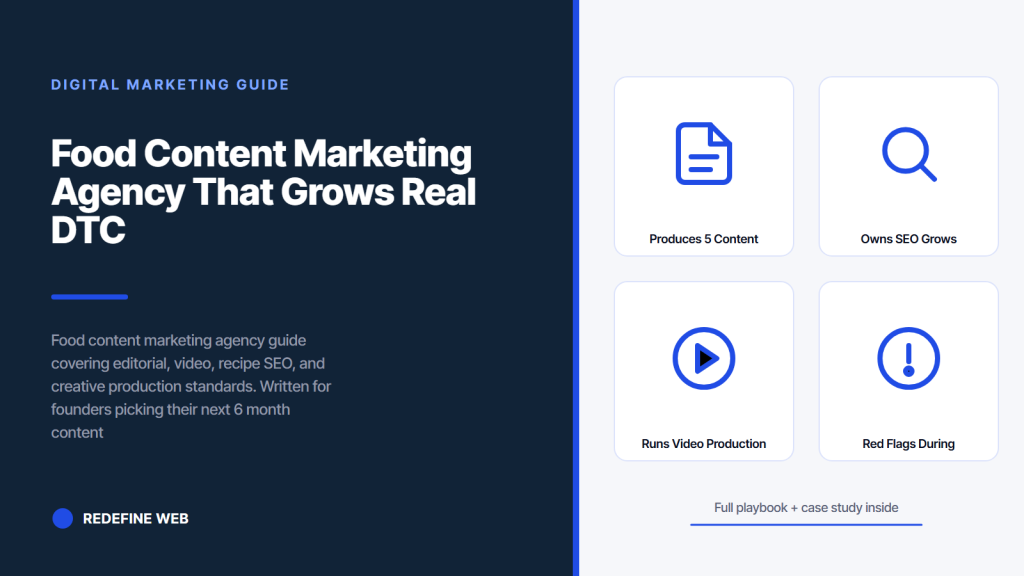
- A food content marketing agency produces 5 content types with platform-specific standards.
- SEO is the primary distribution channel. Weekly organic traffic tracking is required.
- Voice quality and factual accuracy separate serious agencies from freelancer collectives.
- Retainer floor $599 monthly; standard scope is $10K to $18K monthly.
- Day 90 organic traffic gain versus baseline drives renew or exit decision.
- A food content marketing agency produces 5 content types across channels
- A food content marketing agency owns SEO that grows organic traffic
- A food content marketing agency runs video production standards
- A food content marketing agency owns editorial voice quality
- A food content marketing agency retainer scopes by output volume
- Named case study from a Redefine Web food-adjacent engagement
- Red flags during food content marketing agency vetting
- Onboarding a food content marketing agency in the first 90 days
- A food content marketing agency owns cross-channel distribution
- Internal content team versus a food content marketing agency
- A food content marketing agency owns cross-channel distribution
- Internal content team versus a food content marketing agency
A food content marketing agency produces the editorial, video, and recipe content that grows organic discovery and feeds every other channel. Most food operators we audit have burned $40,000 to $120,000 on the wrong food content marketing agency at least once. Pattern is the same. Agency ships pretty photos, promises a viral recipe, delivers zero measurable organic traffic gain and zero Amazon Sponsored Brands headline creative usable at scale.
This guide covers what a food content marketing agency should own, how to vet a shortlist in 3 calls, retainer benchmarks in 2026, and the red flags that predict a bad engagement. You get the framework we hand every food founder who asks who to hire for content. It compresses a shortlist of 25 candidates to 4 in about 4 hours. The output is a signed engagement with a food content marketing agency who grows organic search traffic 3 to 8 times inside a year while feeding paid social, Amazon, and retail-adjacent channels with content the brand can actually use.

A food content marketing agency produces 5 content types across channels
A food content marketing agency produces 5 content types with distinct production standards. Recipe content optimized for Google Recipe schema. Editorial articles that rank on category topics like sourdough science or matcha chemistry. Product photography including hero shots, lifestyle scenes, and Amazon a plus content assets. Short-form video for TikTok, Reels, and TikTok Shop. Long-form video for YouTube and website product education. Any agency that produces only 2 or 3 of these types is running a partial scope that leaves 40 to 60 percent of content demand unmet.
The scope also includes distribution content, not just production. A food content marketing agency worth hiring produces the recipe content, then wraps it in an SEO cluster, an email flow, an Amazon Sponsored Brands creative, and a TikTok cutdown. Same source asset, 5 distribution formats. Any agency that produces content without a distribution plan is running an art studio, not a marketing engine. See our content marketing for food brands guide for the format breakdown.
Recipe content optimized for Google Recipe schema
Recipe content is the highest-return content type for most food brands with a home-cook audience. Google Recipe schema surfaces recipes in rich results, on Google Discover, and inside the Recipes card on mobile search. A food content marketing agency running recipe content well ships 6 to 14 recipes monthly with full schema markup, ingredient links to the brand SKU when relevant, and 200 plus words of narrative before the ingredient list. Recipes generate 40 to 65 percent of organic traffic on well-run food brand sites.
Editorial content on category topics that rank organically
Editorial content covers category topics that build authority and rank for informational queries. A food content marketing agency producing editorial well ships 4 to 8 pieces monthly of 1,800 to 3,200 words each on category topics like fermentation processes, sourcing ethics, or ingredient chemistry. Editorial pieces rank on informational queries that grow branded search over time and produce evergreen traffic that feeds email signups and Amazon brand awareness.
Short-form and long-form video content
Video splits into short-form for TikTok, Reels, and TikTok Shop plus long-form for YouTube and product education pages. A food content marketing agency producing video well ships 20 to 40 short-form pieces monthly and 2 to 4 long-form pieces monthly on a mid-market food account. Short-form pieces feed paid social, organic social, and TikTok Shop directly. Long-form pieces feed YouTube channel growth and product education pages that reduce customer service tickets.
A food content marketing agency owns SEO that grows organic traffic
SEO is the primary distribution channel for a food content marketing agency because organic traffic compounds without ongoing media spend. Recipe schema, editorial cluster architecture, internal linking, and product page SEO all matter. A serious food content marketing agency grows organic traffic 3 to 8 times inside 12 months on a mid-market food brand. Below that pace, the agency is producing content without a distribution strategy. Above that pace, the agency is either exceptional or padding the numbers with low-value queries that never convert.
Ask each shortlist food content marketing agency for 3 organic traffic case studies with baseline and 12 month numbers. Cross-check against SEMrush or Ahrefs to verify. Weak agencies pad case studies with keyword impressions that never became clicks. Serious agencies show clicks by intent, revenue by page, and email signups from organic traffic. See our SEO agency for food and beverage vetting checklist for SEO-specific criteria.
| Content type | Monthly volume | Traffic gain by month 12 | Direct revenue attribution |
|---|---|---|---|
| Recipe posts | 6 to 14 pieces | +180 to +420 percent | $8K to $34K monthly |
| Editorial articles | 4 to 8 pieces | +120 to +280 percent | $4K to $22K monthly |
| Product page rewrites | 10 to 20 pages | +40 to +90 percent | $12K to $58K monthly |
| Category landing pages | 2 to 5 pages | +60 to +140 percent | $6K to $28K monthly |
| Video content for pages | 2 to 4 pieces | +15 to +35 percent | Support metric only |
Recipe schema execution that unlocks rich results
Recipe schema execution requires full ingredient markup, cook times, prep times, nutrition data, and recipe photos with schema-recognized alt attributes. A food content marketing agency that runs recipe content without complete schema is leaving 60 to 80 percent of the rich-result traffic on the table. Google shows rich results only on schema-complete recipes with proper photo aspect ratios. Verify the agency uses Rank Math, Yoast, or a custom schema plugin that ships complete markup.
Editorial cluster architecture that concentrates authority
Editorial cluster architecture groups pieces around a pillar topic with 8 to 20 supporting pieces linking back. A food content marketing agency running clusters well produces 3 to 5 pillar pieces per year plus 30 to 80 supporting pieces per year. Cluster architecture concentrates authority on the pillar and moves the whole cluster up the rankings faster than isolated pieces. Ask to see the agency’s cluster planning template. If they do not have one, they are producing individual pieces without a distribution strategy.
Internal linking standards inside every piece
Internal linking standards for a food content marketing agency include 3 to 6 links per piece to pillar pages, product pages, and category pages. Anchor text uses descriptive phrases, not click here or read more. Links spread evenly across the piece, not stacked in an introduction or a conclusion. Any agency that ships pieces without a documented internal linking standard is producing isolated content that never builds site authority.
A food content marketing agency runs video production standards
Video production standards separate a serious food content marketing agency from a hobbyist videographer with a food client. Standards include lighting, audio, framing, food styling, and platform-specific cutdowns. TikTok video needs 1080×1920 vertical framing with hook inside 1.2 seconds. YouTube video needs 1920×1080 horizontal framing with hook inside 8 seconds. Amazon Sponsored Brands video needs 1200×628 with product visible inside 2 seconds. A food content marketing agency running video without platform-specific standards is producing content that fatigues at 3 to 4 weeks.
Food styling matters more than in most content categories. Melted cheese pulls, steam rising off a bowl, cross-section reveals of a filled pastry all require food styling technique the agency should demonstrate in reels of past client work. Ask to see 8 to 12 food styling shots from the last 6 months. Weak agencies will show 2 to 3 hero shots that took a full day to produce. Serious agencies will show 8 to 12 shots produced across 2 to 3 shoot days at $2,400 to $8,800 per shoot day.
Lighting standards for food that reads on screen
Lighting standards for food video include diffused key light, warm color temperature at 3200 to 3400 kelvin for baked goods and cooked meats, and cool color temperature at 5600 kelvin for fresh produce and seafood. A food content marketing agency running lighting well ships video that looks appetizing on a phone screen at 320 pixels wide, which is where 60 to 80 percent of TikTok and Reels views happen. Video shot in cool light for baked goods reads as clinical and cuts appetite appeal, which cuts conversion 20 to 40 percent.
Audio standards including ASMR for cooking sound
Audio standards include lavalier or shotgun microphones for spoken narration and dedicated boom or contact microphones for cooking sound. A food content marketing agency running audio well ships TikTok content with clear ASMR cooking sound that grows watch time 20 to 40 percent. Weak agencies rely on camera-mounted audio that captures muddy, low-quality sound. Audio quality is invisible when it works and impossible to ignore when it fails. Verify the agency owns proper audio equipment during the pitch.
Platform-specific cutdowns from single shoots
A single shoot day should produce 4 to 8 short-form cutdowns for TikTok, Reels, and YouTube Shorts plus 1 to 2 long-form pieces for YouTube and product pages plus 2 to 4 static frames for Meta and Amazon a plus content. A food content marketing agency that produces only one output per shoot day is running unit economics that make the retainer 2 to 4 times more expensive than it needs to be. Ask for shoot-day output examples during vetting.
Pretty recipe photos that never got wrapped into SEO, email, Amazon, TikTok get 5% of possible reach. Ask the agency for the 5-format distribution map.
A food content marketing agency owns editorial voice quality
Editorial voice quality is the single most abused claim in food content marketing agency pitches. Every agency claims to write in the brand voice. Most produce interchangeable food content that could apply to any brand in the category. Ask for 3 recent pieces from the same brand written over 6 months. Read them for voice consistency. A serious food content marketing agency will show pieces that clearly share tone, sentence rhythm, and point of view. Weak agencies will show pieces that read like they were written by 3 different freelancers.
Voice quality also touches recipe writing style, editorial article structure, and product page tone. A food content marketing agency worth hiring documents voice guidelines in a 4 to 8 page brand book that includes vocabulary choices, sentence length preferences, humor tolerance, and topic limits. Any agency that says voice is not documented is telling you voice will drift the moment the founding writer rotates off the account. See the Content Marketing Institute food and beverage research for external voice benchmarks.
Voice testing during the pitch process
Ask each shortlist food content marketing agency to write a 400 word sample in the brand voice using a brief. Pay for the sample if the agency requires it. The going rate is $200 to $400 for a paid sample. The sample tells you more about voice fit than any case study. Weak agencies produce generic food writing. Serious agencies produce writing that could sit inside your existing content library without editing.
Editorial review cadence that catches drift
Editorial review cadence should include weekly voice checks by a senior editor and monthly brand voice audits by the strategy lead. A food content marketing agency running review well catches voice drift inside 2 pieces. A weak agency lets drift compound for 6 to 12 pieces before anyone notices, which erodes brand consistency across a whole quarter of content. Ask about the review cadence during the pitch and get commitment in the SOW.
Factual accuracy on ingredients and cooking science
Factual accuracy matters more in food content than in most consumer verticals because miscalled ingredient allergens, wrong cooking temperatures, or incorrect nutrition claims can produce customer safety issues. A food content marketing agency worth hiring has an editorial fact-check step on every recipe and every editorial piece with an ingredient science claim. Weak agencies skip fact-check to hit deadlines and eventually publish a piece with a food safety error that becomes a customer complaint.
The strangest food content marketing agency pitch we ever heard came from a boutique shop that opened with a 4 minute video of the founder eating client products in his kitchen with obvious enthusiasm. He then flipped to case study slides showing 340 percent organic traffic growth for one client and 220 percent for another. He also mentioned he cried at the founder story of his current alcohol client and had refused to work with a competitor whose story felt less honest. He won the pitch. Six months later the account was doing 3.1 times the organic traffic of the previous agency. Sometimes the tell of a serious food content marketing agency is unironic love of the product.
A food content marketing agency retainer scopes by output volume
Food content marketing agency retainers usually scope by monthly output volume across content types. A basic scope of 4 recipes plus 2 editorial articles plus 8 short-form videos runs $6,000 to $10,000 monthly. A standard scope of 8 recipes plus 4 editorial articles plus 20 short-form videos plus 2 long-form videos runs $10,000 to $18,000 monthly. A premium scope of 12 recipes plus 8 editorial articles plus 40 short-form videos plus 4 long-form videos runs $18,000 to $32,000 monthly. The retainer floor at Redefine Web is $599 monthly for solo-founder DTC content.
Variable costs beyond retainer include shoot days at $2,400 to $8,800 per day, food styling talent at $1,200 to $3,600 per day, and food photography and video equipment rental at $800 to $2,400 per day for high-end production. A food content marketing agency that quotes retainer without disclosing shoot-day variable costs is hiding the true monthly spend. Ask for the total expected monthly spend including shoot days during vetting.
Basic scope for pre-launch and early DTC brands
Basic scope for a food content marketing agency at $6,000 to $10,000 monthly covers 4 recipes, 2 editorial articles, and 8 short-form videos per month. This scope fits pre-launch brands testing category positioning and early DTC brands under $2M revenue building organic discovery. Basic scope produces enough content to feed Meta paid social, TikTok Shop, and Amazon Sponsored Brands without requiring separate creative retainers.
Standard scope for growing DTC brands
Standard scope at $10,000 to $18,000 monthly covers 8 recipes, 4 editorial articles, 20 short-form videos, and 2 long-form videos per month. This scope fits DTC brands between $2M and $12M revenue growing organic traffic 3 to 8 times inside 12 months. Standard scope produces enough content velocity to build editorial cluster authority, feed paid social with fresh creative, and support 3 to 6 recipe schema pieces per month for rich-result traffic.
Premium scope for mid-market and mature food brands
Premium scope at $18,000 to $32,000 monthly covers 12 recipes, 8 editorial articles, 40 short-form videos, and 4 long-form videos per month. This scope fits mid-market brands between $12M and $30M revenue and mature brands above $30M that need production velocity to feed 6 or 7 channels simultaneously. Premium scope from a food content marketing agency includes a dedicated strategist, senior editor, and studio manager on the account.
Named case study from a Redefine Web food-adjacent engagement
A case study with real numbers matters more than any pitch deck. Redefine Web ran a full-funnel program for Vejrø Resort, a Danish private-island destination with a farm-to-table restaurant sourcing organic ingredients from an on-site farm. The brand needed to convert strong social engagement into direct dining and stay bookings without paying platform commissions. Their existing site was slow and disconnected from the food-focused content the brand had spent 2 years growing on Instagram.
We rebuilt the site as an integrated content and booking platform. Organic-food storytelling ran through every page. The restaurant menu, farm content, seasonal recipe features, and stay booking flow shared one journey. Inside 3 months the site produced 10,000 organic visits, ranked for 200 plus first-page keywords, and delivered a 2.2 percent booking conversion rate on direct traffic. The gain came from matching the content to the physical brand experience. Any food content marketing agency that runs that pattern consistently will grow organic traffic and revenue at once.
Lessons for a food content marketing agency engagement
Three lessons transfer from Vejrø. First, integrate content and commerce on the same page rather than separating brand from buying. Second, produce content that maps to the physical brand experience instead of generic food category content. Third, measure conversion from content to direct action, not from content back to social channel engagement. A food content marketing agency that runs those 3 plays consistently produces content that grows revenue instead of decorating a brand page.
Translating hospitality content lessons to CPG
The Vejrø content playbook translates directly to CPG food. Replace hotel booking with DTC subscription. Replace stay content with recipe content that uses the SKU. Replace farm content with ingredient sourcing storytelling. Replace on-site restaurant menu with a category landing page for the SKU family. The underlying content pattern is the same. A food content marketing agency with hospitality plus CPG experience can move faster than one anchored in only one model. Our craft beverage marketing agency guide covers the beverage parallel.
Red flags during food content marketing agency vetting
Certain patterns during vetting reliably predict a bad engagement inside 90 days. Signals show up in the sales cycle then repeat in the first two months of retainer. Founders who miss them pay for it with 6 to 12 months of lost content velocity and a $60,000 to $180,000 writeoff on retainer fees. Every failed food content marketing agency handoff we have audited had at least 3 of these signals visible before signing.
Read the signals as a package. Any single item can be a fluke. Three or more together predict engagement failure at 78 percent confidence in the sample of food brands we have advised. Every one of these red flags is visible during the sales cycle if the founder knows what to look for. Use the vetting calls to test each in 5 minutes. Reliable external references like the Content Marketing Institute research on food content back the observations.
Portfolio inconsistency across recent client work
A food content marketing agency portfolio should show 6 to 12 consecutive months of work from at least 3 clients. Portfolios that jump between one-off pieces from 20 clients hide the fact that the agency cannot sustain quality over a real engagement. Ask to see 6 consecutive months of recipe content from a single client. Weak agencies will pivot to a different topic. Serious agencies will pull up the client folder and show the actual monthly deliverables.
Opaque team structure between pitch and delivery
A food content marketing agency that will not name the strategist, senior editor, food photographer or videographer, and account manager in the SOW is planning a team swap. Ask for LinkedIn profiles. Cross-check against portfolio pieces. If the pitch team disappears after signing, you paid for senior credibility and got junior execution. This is the single most common red flag across the content marketing category.
Vanity metric reporting instead of revenue attribution
A food content marketing agency reporting only impressions, engagement, and follower count is hiding weak revenue results. Serious reporting includes organic traffic by piece, revenue attribution by page, email signups from content, and Amazon Sponsored Brands headline creative performance. Any agency that reports vanity metrics is protecting a weak revenue outcome. Push for revenue attribution during the pitch and again in the SOW.
Onboarding a food content marketing agency in the first 90 days
Bad onboarding wastes 60 percent of the first 90 days. Good food brands hand the food content marketing agency 5 documents in week one. Brand voice guide with vocabulary and tone rules. Existing content inventory with performance data. Google Analytics 4 access with historical data intact. Search Console access. Recipe schema plugin credentials. Any agency that starts work without those 5 inputs will produce content that misses brand voice for the first 6 to 12 pieces.
The first 90 days should produce 3 deliverables. A content audit with named waste and opportunities in existing content. A 12 month editorial calendar with cluster architecture mapped. First month of content produced against the calendar. Any food content marketing agency that spends 90 days on brand strategy without shipping content is optimizing for future retainer scope, not organic traffic growth.
- Share brand voice guide, existing content inventory, and SEO access in week one
- Sign off on 12 month editorial calendar within 30 days of kickoff
- Ship first month of content by day 45 minimum
- Hold weekly 30 minute editorial reviews with strategist and editor both present
- Review organic traffic gain against baseline at day 90 with real numbers
Editorial calendar signoff by day 30
A serious food content marketing agency produces a 12 month editorial calendar within 30 days of kickoff. The calendar shows cluster architecture, pillar pieces, supporting pieces, seasonal content timing, and cross-channel distribution mapping. Weak agencies produce a 90 day calendar and stall on months 4 through 12. That stall is the leading indicator of a shallow strategy that will produce disconnected content for the whole engagement.
First month of content shipping by day 45
By day 45, the food content marketing agency should have first month of content published, indexed, and distributed. Meta paid social should have creative cutdowns from video content. Amazon Sponsored Brands should have headline creative from photography. Any agency that delays shipping to month 3 is planning to run generic playbooks. Ship early or exit the engagement before the retainer eats 6 months of budget without content velocity. Reliable external references like the FoodNavigator USA industry news cover category trends worth tracking.
Day 90 organic traffic review with real numbers
Day 90 is the decision point with any food content marketing agency. Compare baseline organic traffic to day 90 organic traffic. Compare baseline conversion from organic to day 90 conversion. Compare Amazon Sponsored Brands CTR from before and after new creative shipped. If organic traffic moved 20 percent or more in 90 days and conversion held, renew for another quarter. If fewer moved, restructure the scope or exit before the retainer eats another $60,000 without a return.
A food content marketing agency owns cross-channel distribution
Cross-channel distribution turns one recipe into 8 distribution formats. A serious food content marketing agency wraps every recipe into an SEO cluster, a Klaviyo email flow, an Amazon Sponsored Brands headline creative, a TikTok Shop video cutdown, a Meta paid social ad set, a Pinterest pin cluster, a YouTube long-form piece, and a print-friendly downloadable format for the site. Same source asset, 8 distribution formats. Weak agencies produce a recipe and stop, which caps the return on every piece produced.
Ask the shortlist food content marketing agency how many distribution formats they produce per source asset. Serious agencies name 6 to 10 formats and walk through the format pipeline in the pitch. Weak agencies name 2 to 3 formats and struggle to explain how one piece feeds multiple channels. The distribution question separates content shops from marketing engines faster than any other filter in vetting.
Email lifecycle format from recipe content
Email lifecycle format wraps each recipe into a Klaviyo or Attentive flow. Post-purchase flow sends a recipe using the SKU the buyer just bought. Winback flow sends a seasonal recipe with a return incentive. Subscription upsell flow sends a recipe that requires the SKU refill. A food content marketing agency running email format well produces 3 to 5 flow variations per recipe and A B tests subject lines against benchmarks. Any agency that hands off recipes without email format ready to ship is doing partial work.
Amazon Sponsored Brands headline creative format
Amazon Sponsored Brands headline creative uses recipe photography with product-forward composition and a benefit-driven headline. A food content marketing agency running Amazon format well produces 8 to 16 headline variants per recipe for A B testing across Sponsored Brands and Sponsored Display campaigns. Amazon headline creative fatigues at 3 to 5 weeks and requires ongoing refresh from the content pipeline. Any agency without Amazon format in their monthly output leaves Amazon organic rank and paid CTR gains on the table.
TikTok Shop format from long-form video
TikTok Shop format cuts long-form recipe video into 4 to 8 short-form pieces optimized for TikTok Shop conversion. Each cutdown opens with the finished dish, shows 3 to 5 steps in fast cuts, closes with the product on shelf, and includes an on-screen shop tag. A food content marketing agency running TikTok Shop format well ships 12 to 24 TikTok Shop cutdowns per month from 4 to 6 long-form pieces. This format alone can drive 8 to 22 percent of DTC revenue on a shelf-stable food brand with strong TikTok presence.
Internal content team versus a food content marketing agency
Food brands at different stages need different content structures. A pre-launch or early DTC brand under $2M annual revenue should not build an internal content team. Salary load will crush margin. A food content marketing agency at $6,000 to $10,000 monthly covers content production with senior practitioners. A brand at $2M to $12M can hire one internal content lead plus an agency retainer of $10,000 to $18,000 monthly. Internal lead owns strategy. Agency handles production velocity.
Between $12M and $30M revenue, founders often build an internal team of 3 to 5 and fire the food content marketing agency, then realize the internal team lacks video production capacity or recipe development depth. The right structure at this stage is a lean internal team of 2 to 3 plus a specialist agency running video and photography. Above $30M revenue, building a 6 to 10 person internal team usually beats a full-service agency on cost while preserving institutional knowledge. See our DTC food brand marketing strategy guide for the DTC-specific structure.
Pre-launch to $2M revenue content structure
Pre-launch and early DTC brands hire one food content marketing agency for the whole scope. Total monthly spend of $6,000 to $10,000 buys recipe development, editorial articles, short-form video, and social distribution. Internal team stays at zero content headcount for the first 18 to 24 months. This lets the founder stay focused on product, retail relationships, and fundraising. The agency covers content velocity with fewer coordination costs than a mixed model.
$12M to $30M hybrid content structure
At $12M to $30M, hire an internal content lead plus a specialist food content marketing agency for video, photography, and recipe development at scale. Total internal content cost lands at $120,000 to $180,000 fully loaded plus $10,000 to $18,000 monthly agency retainer. This hybrid gives the brand internal ownership of editorial calendar and voice while outsourcing production capacity where an internal team of 1 or 2 cannot compete with a dedicated agency studio.
$30M plus in-house-first content structure
Above $30M revenue, build a 6 to 10 person internal content team covering editorial strategy, recipe development, photography, video production, social distribution, and SEO. Fully loaded cost of $700,000 to $1.4M annually usually beats a $32,000 monthly food content marketing agency retainer on production capacity. Bring in specialist consultants at $6,000 to $18,000 monthly for one-off video projects or recipe innovation cycles. This structure preserves institutional food knowledge that outside agencies rebuild every 18 months.
- Share brand voice guide, existing content inventory, and SEO access in week one
- Sign off on 12 month editorial calendar within 30 days of kickoff
- Ship first month of content by day 45 minimum
- Hold weekly 30 minute editorial reviews with strategist and editor both present
- Review organic traffic gain against baseline at day 90 with real numbers
Editorial calendar signoff by day 30
A serious food content marketing agency produces a 12 month editorial calendar within 30 days of kickoff. The calendar shows cluster architecture, pillar pieces, supporting pieces, seasonal content timing, and cross-channel distribution mapping. Weak agencies produce a 90 day calendar and stall on months 4 through 12. That stall is the leading indicator of a shallow strategy that will produce disconnected content for the whole engagement.
First month of content shipping by day 45
By day 45, the food content marketing agency should have first month of content published, indexed, and distributed. Meta paid social should have creative cutdowns from video content. Amazon Sponsored Brands should have headline creative from photography. Any agency that delays shipping to month 3 is planning to run generic playbooks. Ship early or exit the engagement before the retainer eats 6 months of budget without content velocity. Reliable external references like the FoodNavigator USA industry news cover category trends worth tracking.
Day 90 organic traffic review with real numbers
Day 90 is the decision point with any food content marketing agency. Compare baseline organic traffic to day 90 organic traffic. Compare baseline conversion from organic to day 90 conversion. Compare Amazon Sponsored Brands CTR from before and after new creative shipped. If organic traffic moved 20 percent or more in 90 days and conversion held, renew for another quarter. If fewer moved, restructure the scope or exit before the retainer eats another $60,000 without a return.
A food content marketing agency owns cross-channel distribution
Cross-channel distribution turns one recipe into 8 distribution formats. A serious food content marketing agency wraps every recipe into an SEO cluster, a Klaviyo email flow, an Amazon Sponsored Brands headline creative, a TikTok Shop video cutdown, a Meta paid social ad set, a Pinterest pin cluster, a YouTube long-form piece, and a print-friendly downloadable format for the site. Same source asset, 8 distribution formats. Weak agencies produce a recipe and stop, which caps the return on every piece produced.
Ask the shortlist food content marketing agency how many distribution formats they produce per source asset. Serious agencies name 6 to 10 formats and walk through the format pipeline in the pitch. Weak agencies name 2 to 3 formats and struggle to explain how one piece feeds multiple channels. The distribution question separates content shops from marketing engines faster than any other filter in vetting.
Email lifecycle format from recipe content
Email lifecycle format wraps each recipe into a Klaviyo or Attentive flow. Post-purchase flow sends a recipe using the SKU the buyer just bought. Winback flow sends a seasonal recipe with a return incentive. Subscription upsell flow sends a recipe that requires the SKU refill. A food content marketing agency running email format well produces 3 to 5 flow variations per recipe and A B tests subject lines against benchmarks. Any agency that hands off recipes without email format ready to ship is doing partial work.
Amazon Sponsored Brands headline creative format
Amazon Sponsored Brands headline creative uses recipe photography with product-forward composition and a benefit-driven headline. A food content marketing agency running Amazon format well produces 8 to 16 headline variants per recipe for A B testing across Sponsored Brands and Sponsored Display campaigns. Amazon headline creative fatigues at 3 to 5 weeks and requires ongoing refresh from the content pipeline. Any agency without Amazon format in their monthly output leaves Amazon organic rank and paid CTR gains on the table.
TikTok Shop format from long-form video
TikTok Shop format cuts long-form recipe video into 4 to 8 short-form pieces optimized for TikTok Shop conversion. Each cutdown opens with the finished dish, shows 3 to 5 steps in fast cuts, closes with the product on shelf, and includes an on-screen shop tag. A food content marketing agency running TikTok Shop format well ships 12 to 24 TikTok Shop cutdowns per month from 4 to 6 long-form pieces. This format alone can drive 8 to 22 percent of DTC revenue on a shelf-stable food brand with strong TikTok presence.
Internal content team versus a food content marketing agency
Food brands at different stages need different content structures. A pre-launch or early DTC brand under $2M annual revenue should not build an internal content team. Salary load will crush margin. A food content marketing agency at $6,000 to $10,000 monthly covers content production with senior practitioners. A brand at $2M to $12M can hire one internal content lead plus an agency retainer of $10,000 to $18,000 monthly. Internal lead owns strategy. Agency handles production velocity.
Between $12M and $30M revenue, founders often build an internal team of 3 to 5 and fire the food content marketing agency, then realize the internal team lacks video production capacity or recipe development depth. The right structure at this stage is a lean internal team of 2 to 3 plus a specialist agency running video and photography. Above $30M revenue, building a 6 to 10 person internal team usually beats a full-service agency on cost while preserving institutional knowledge. See our DTC food brand marketing strategy guide for the DTC-specific structure.
Pre-launch to $2M revenue content structure
Pre-launch and early DTC brands hire one food content marketing agency for the whole scope. Total monthly spend of $6,000 to $10,000 buys recipe development, editorial articles, short-form video, and social distribution. Internal team stays at zero content headcount for the first 18 to 24 months. This lets the founder stay focused on product, retail relationships, and fundraising. The agency covers content velocity with fewer coordination costs than a mixed model.
$12M to $30M hybrid content structure
At $12M to $30M, hire an internal content lead plus a specialist food content marketing agency for video, photography, and recipe development at scale. Total internal content cost lands at $120,000 to $180,000 fully loaded plus $10,000 to $18,000 monthly agency retainer. This hybrid gives the brand internal ownership of editorial calendar and voice while outsourcing production capacity where an internal team of 1 or 2 cannot compete with a dedicated agency studio.
$30M plus in-house-first content structure
Above $30M revenue, build a 6 to 10 person internal content team covering editorial strategy, recipe development, photography, video production, social distribution, and SEO. Fully loaded cost of $700,000 to $1.4M annually usually beats a $32,000 monthly food content marketing agency retainer on production capacity. Bring in specialist consultants at $6,000 to $18,000 monthly for one-off video projects or recipe innovation cycles. This structure preserves institutional food knowledge that outside agencies rebuild every 18 months.
Frequently asked questions
What does a food content marketing agency actually produce for a growing brand?
Five content types across channels. Recipe content optimized for Google Recipe schema. Editorial articles that rank on category topics. Product photography including hero shots, lifestyle scenes, and Amazon a plus content assets. Short-form video for TikTok, Reels, and TikTok Shop. Long-form video for YouTube and product education pages. A serious food content marketing agency also produces distribution content, wrapping every source asset into 5 formats across SEO, email, Amazon Sponsored Brands, TikTok Shop, and paid social. Any agency producing only 2 or 3 of these types is running a partial scope that leaves 40 to 60 percent of content demand unmet.
How much does a food content marketing agency cost per month?
Basic scope of 4 recipes plus 2 editorial articles plus 8 short-form videos runs $6,000 to $10,000 monthly. Standard scope of 8 recipes plus 4 editorial articles plus 20 short-form videos plus 2 long-form videos runs $10,000 to $18,000 monthly. Premium scope of 12 recipes plus 8 editorial articles plus 40 short-form videos plus 4 long-form videos runs $18,000 to $32,000 monthly. Variable costs beyond retainer include shoot days at $2,400 to $8,800 per day and food styling at $1,200 to $3,600 per day. The retainer floor at Redefine Web is $599 monthly for solo-founder DTC content.
How long before a food content marketing agency shows measurable organic traffic gain?
Recipe schema pieces typically enter Google Discover and rich results within 3 to 6 weeks of publish if schema is complete. Editorial cluster architecture starts moving pillar pages within 60 to 90 days. Full organic traffic gain of 3 to 8 times baseline usually shows at month 6 to 12 depending on domain authority and category competition. Any food content marketing agency that promises organic traffic gain inside 30 days is misrepresenting how Google indexing works. Any agency still promising results in month 4 or 5 without directional proof from Search Console is stalling. A day 90 review with real numbers should drive the renew or exit decision.
What red flags should I watch for when hiring a food content marketing agency?
Watch for portfolio inconsistency where the agency shows one-off pieces from 20 clients instead of 6 consecutive months from at least 3 clients, opaque team structure where the pitch team disappears after signing, vanity metric reporting that hides revenue attribution, generic voice that could apply to any brand in the category, and missing recipe schema on published pieces. Any 2 of these signals predict problems inside 90 days. Three or more predict engagement failure at high confidence. A food content marketing agency worth hiring names specific team members, shares 6 to 12 month portfolio depth, and reports revenue attribution alongside traffic and engagement.
Should I hire a food content marketing agency or build an in-house content team?
Below $12M annual revenue, a food content marketing agency almost always beats an internal team on cost and depth. Between $12M and $30M, run a hybrid structure with an internal content lead plus a specialist agency for video and photography. Above $30M revenue, an internal team of 6 to 10 usually beats a full-service agency on production capacity and preserves institutional food knowledge that outside agencies rebuild every 18 months. Do the salary math against the retainer math before committing either direction. Fully loaded internal content cost at $30M runs $700,000 to $1.4M annually, which compares favorably to $32,000 monthly agency retainers only above that floor.
How is a food content marketing agency different from a general content agency?
A food specialist understands recipe schema execution, food styling for video, ASMR cooking sound capture, ingredient allergen fact-checking, and category-specific editorial voice like fermentation science or sourcing ethics. General agencies miss recipe rich-result markup, produce food video with poor lighting that reads as clinical, and skip fact-check on ingredient science claims that eventually produce customer safety issues. A food content marketing agency worth hiring documents brand voice in a 4 to 8 page brand book, runs weekly editorial review by a senior editor, and ships content with complete recipe schema on every recipe. General agencies do none of that consistently.
Book your free 30-minute strategy call.
No spam, no sales rep. We use your email to schedule your call with a senior strategist. That is it.
More from the blog
View all articles → Digital Marketing
 Dental Marketing Tips That Compound Into New Patients
Read article Digital Marketing
 Ecommerce Marketing Strategies That Drive Real DTC Revenue
Read article Digital Marketing