
Healthcare PPC Management (What It Includes, KPIs, and Pitfalls)
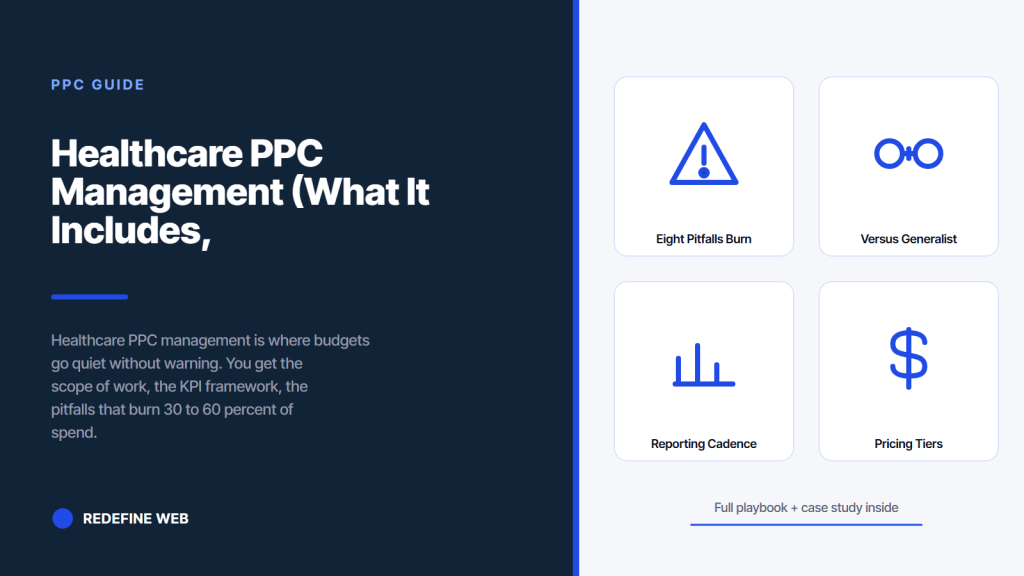
- Eleven workstreams need weekly attention or the account drifts.
- Location targeting default trap wastes 10 to 25 percent of spend.
- Negative keyword discipline saves 20 to 40 percent over 90 days.
- Report on booked appointments and revenue per patient.
- Weekly reports plus quarterly strategy reviews win renewals.
- Eight pitfalls that burn healthcare ppc management budgets
- Pelvic Rehabilitation Medicine case study on healthcare ppc management
- Healthcare ppc experts versus generalist agencies
- Reporting cadence for healthcare ppc advertising management
- Healthcare ppc management services pricing tiers
- Conversion tracking setup that healthcare ppc management depends on
- Bid strategy selection inside healthcare ppc management
- Where to start on healthcare ppc management this Monday
Healthcare PPC management sits somewhere between traffic control and financial audit. Every dollar you spend on Google Ads or Microsoft Ads either books a new patient or quietly disappears into a broken search term. The gap between well-managed and poorly-managed healthcare PPC campaigns runs about 3 to 5x on cost per booked appointment. Same practice. Same market. Same budget. Different management discipline.
This guide is the practical view of healthcare PPC management from the buyer side. What sits inside the scope of work. Which KPIs matter and which get gamed by lazy agencies during monthly reporting. The 8 pitfalls that burn 30 to 60 percent of spend on most healthcare accounts today. The reporting cadence that keeps cost per acquisition visible week over week. Where healthcare PPC experts differ from generalist agencies on compliance and CRO. Read straight through in ten minutes. Then pull your last 90 days of Google Ads spend, run it against the checklist, and see how many of the pitfalls you are currently paying for out of your own pocket.
Eight pitfalls that burn healthcare ppc management budgets
Poorly-managed healthcare PPC accounts share eight common pitfalls. Each one burns 5 to 15 percent of monthly spend on average. Combined, they usually burn 30 to 60 percent of the total budget on wasted clicks and unqualified traffic. Fix all eight and the account performance often doubles without any bid strategy or ad copy changes.
- Missing negative keyword lists on symptom queries
- Broad match keywords with no controls
- Location targeting set to “presence or interest” instead of “presence”
- Landing pages with 15-plus form fields on mobile
- No call tracking for phone conversions
- Quality Score below 5 on top keywords
- Ad copy without dynamic keyword insertion
- No conversion tracking validation for 60-plus days
Missing negative keyword coverage
Every healthcare campaign needs a negative keyword list of 200 to 500 terms after 90 days of running. Common negatives include “free,” “jobs,” “school,” “training,” “how to become,” and every symptom query irrelevant to the specialty. A cardiology practice targeting “heart pain” gets clicks from people searching “heart pain in dogs” or “heart pain teenager anxiety.” Both need to be excluded through negatives. Weekly search term report review adds 5 to 20 negatives per campaign. Six months of that discipline builds a real coverage list.
Broad match without controls
Google pushes broad match aggressively in the current interface. Broad match without careful controls burns 20 to 40 percent of budget on irrelevant queries. Use broad match only inside Performance Max campaigns or with tight negative keyword lists and daily search term review. Never use broad match in standard Search campaigns without daily monitoring. Phrase match and exact match cost more per click but usually pay back better because the query intent matches the ad copy.
Location targeting default trap
Google’s default location targeting setting is “presence or interest.” That setting shows ads to anyone anywhere in the world who mentions your target city in a search. A Denver practice pays for clicks from users in Miami searching “Denver dentist” for other reasons. Change every campaign to “presence” only. That single setting change typically cuts wasted spend 10 to 25 percent in the first 30 days. It is one of the fastest wins available in a poorly-managed account.
Pelvic Rehabilitation Medicine case study on healthcare ppc management
Pelvic Rehabilitation Medicine came to us with 14 locations and a Google Ads account running at $18K per month. Cost per acquisition sat at $340 per booked appointment across the network. Impression share on branded keywords dropped to 42 percent because of a poorly-set bid strategy. Quality Score averaged 3 out of 10 on the top 20 keywords. Search term report had not been reviewed in 5 months. Negative keyword list contained 12 terms total across the account.
We ran a full account rebuild. Campaign restructure by service line. Ad group segmentation by intent. Negative keyword build-out to 340 terms across the account. Landing page rebuild for the top 6 service pages with 4-field forms and call tracking. Weekly search term audits. Six months of tightened management produced booked appointments up 62 percent, cost per acquisition down to $128, Quality Score average of 7.4, and impression share on branded terms up to 91 percent. Every gain came from disciplined management, not from budget increases.
What drove the biggest gains
The location targeting fix cut wasted spend 18 percent in the first 30 days. Negative keyword build-out cut wasted spend another 22 percent inside 90 days. Landing page rebuild pushed conversion rate from 4 percent to 14 percent, which cut effective cost per acquisition by more than half. Ad copy testing with dynamic keyword insertion pushed Quality Score up on 18 of the top 20 keywords. Every one of those gains stacked. No single change produced 62 percent booked appointment growth on its own. The combination did.
Transferable lessons for any healthcare account
Every lesson transfers. Location targeting fix works for any healthcare specialty. Negative keyword discipline works identically. Landing page rebuild math holds across dental, chiropractic, med spa, mental health, and physical therapy accounts. Ad copy testing with dynamic keyword insertion works identically. Weekly search term audit works identically. Apply the same discipline to any healthcare PPC account and the same result curve follows inside 4 to 6 months.
Every practice owner has the same relationship with their Google Ads account. They set it up during an evening in 2022 with a promo credit. They tell the account manager to “make it work.” They log in twice, get confused by the Recommendations tab, click “apply all,” and forget the password again. Six months later, they wonder why cost per lead climbed from $40 to $180. They call the agency. The agency says growth requires more budget. They double the budget. Cost per lead climbs to $240. Somewhere in the account, a Performance Max campaign is quietly buying clicks for “chiropractor jobs Philadelphia” at $8 each. Nobody has looked at the search term report in nine months.
Healthcare ppc experts versus generalist agencies
Healthcare ppc experts differ from generalist PPC agencies in three specific areas. Compliance knowledge for medical claims. Landing page CRO for patient booking flows. Call tracking with HIPAA-compatible providers. Generalist agencies often skip all three because they never handled a healthcare account under audit scrutiny.
Compliance matters because Google Ads restricts ad copy for medical claims. Words like “cure,” “guaranteed,” and disease names in prescription contexts trigger disapprovals. A generalist agency runs ad copy that gets disapproved in review, then wonders why impressions dropped 40 percent overnight. A healthcare PPC expert knows the copy guardrails before writing the ad and stays inside them. That single competency saves weeks of disapproval cycles.
HIPAA-compatible call tracking
Standard call tracking providers like CallRail offer a HIPAA-compatible tier. Generalist agencies often set up the standard tier by default, which records call transcripts and stores them alongside patient PHI in a non-compliant manner. Healthcare PPC experts request the HIPAA tier during setup, sign the BAA, and configure recording rules to exclude PHI. That configuration costs $50 to $200 more per month than the standard tier but keeps the practice out of HIPAA violation territory. See CallRail’s HIPAA documentation for the configuration checklist.
Patient booking flow CRO
Healthcare patient booking flows differ from B2B lead capture. Patients want immediate reassurance about insurance acceptance, provider credentials, and appointment availability before they submit a form. A generic B2B landing page with a “schedule a demo” CTA usually converts at 2 to 4 percent on healthcare traffic. A healthcare-tuned landing page with insurance callouts, provider photos, and same-day booking prompts often converts at 12 to 20 percent. That gap alone justifies hiring healthcare PPC experts over generalists on any account over $5K per month.
Any junk term over 5 clicks in 30 days is money you already lost. Add 20 negatives this afternoon. That single fix cuts most healthcare accounts by 25 percent.
Reporting cadence for healthcare ppc advertising management
Healthcare ppc advertising management gets bought and sold on reporting cadence. Weekly reports show tactical progress. Monthly reports show strategic direction. Quarterly reports show budget defensibility. Any agency that delivers only monthly reports is behind on tactical work. Any agency that delivers only weekly reports has no strategic view.
Weekly reports cover spend pacing, cost per acquisition versus target, negative keyword additions, ad copy tests, and Quality Score changes. Monthly reports add search term audits, competitor benchmarking, and forward-looking budget allocation. Quarterly reports add year-over-year comparison, seasonality analysis, and strategic recommendations for the next quarter. Every one of those layers protects the account and the client relationship. Vague reporting that stops at clicks and CPC loses budget the moment a CFO scrutinizes the spend.
Weekly report format
The weekly report runs on one page. Spend to date versus target. Cost per acquisition versus target. Top 3 wins from the week. Top 3 focus areas for the next week. Any anomalies flagged. Delivered every Monday morning by 10 am. Read by the practice owner in 5 minutes. That format keeps the client informed without the noise of a 40-slide deck that nobody reads. Reference the Google Ads reporting documentation for the underlying metric definitions.
Quarterly strategy review
Every quarter the account manager sits with the practice owner or marketing lead for 60 minutes. Review year-over-year performance. Note seasonality patterns. Discuss upcoming service expansions or location additions. Adjust budget allocation for the next quarter. Set 3 or 4 strategic priorities. That quarterly rhythm turns healthcare PPC management from a transactional service into a strategic partnership. Practice owners who get the quarterly review renew retainers at 85 to 95 percent versus 40 to 60 percent for owners who get only monthly reports.
Healthcare ppc management services pricing tiers
Healthcare ppc management services usually price into three tiers. Under $5K per month ad spend, management fees run $500 to $1,500 per month flat or 15 to 20 percent of spend. $5K to $25K per month ad spend, management fees run $1,500 to $4,000 per month or 10 to 15 percent of spend. Above $25K per month ad spend, management fees run $4,000 to $10,000 per month or 8 to 12 percent of spend.
Percentage-of-spend pricing incentivizes the agency to grow the account. Flat-fee pricing incentivizes efficiency. Both are defensible. Ask which model your prospective agency uses and why. A hybrid model with a floor plus percentage above a threshold works well for growing accounts. Avoid pure percentage-of-spend deals on accounts under $10K per month because the agency incentive tilts toward burning budget rather than driving booked appointments.
What sits inside the management fee
The management fee covers the eleven workstreams listed earlier. Reference the Google Ads Quality Score documentation for the underlying metric that drives most of the tactical work. Weekly hands-on work. Weekly reporting. Monthly strategy review. Quarterly deep-dive. Conversion tracking setup and maintenance. Landing page recommendations (build costs separate). Ad copy writing (limited to Google Ads copy, not landing page copy). Any work outside those items should sit in a separate SOW at a defined hourly rate. Practices that let the agency roll new work into the retainer without repricing usually end up funding scope creep that dilutes account attention.
Contract length norms
Standard healthcare PPC management contracts run 6 months minimum. Anything shorter does not give the agency enough runway to rebuild the account, harvest negatives, refine ad copy, and drive Quality Score up. Anything longer than 12 months without a mid-term review clause locks the practice into a relationship that may not fit performance targets. A 6-month initial term with quarterly reviews and 30-day termination after month 6 works well for most practices.
Conversion tracking setup that healthcare ppc management depends on
Conversion tracking is the foundation every other layer of healthcare ppc management sits on. Wrong conversion tracking produces wrong data. Wrong data drives wrong decisions. Wrong decisions burn budget. Get the tracking right on day one or none of the other workstreams pay back.
Set up conversion tracking for four events on every healthcare account. Form submissions on every service page. Phone calls from the landing page (via call extensions and dedicated tracking numbers). Chat conversations opened from the site. Booking flow completions if you use a scheduling widget. Every event needs a defined conversion value based on average patient lifetime value. That value ties Google’s Smart Bidding to real business outcomes rather than raw conversion volume.
Offline conversion imports
Not every booked appointment closes on the website. Some patients call, book, and no-show. Some patients call, book, and complete the first visit weeks later. Offline conversion imports feed booked-and-attended data back into Google Ads so bidding optimizes toward booked-attended patients, not just form fills. Set up the offline conversion import from your practice management system into Google Ads via CSV upload weekly or API integration daily. That single connection often improves cost per booked-attended patient by 25 to 40 percent inside 90 days.
Google Consent Mode v2 setup
Google Consent Mode v2 became mandatory for EU-facing accounts in 2024. US healthcare accounts should still implement it because it improves conversion modeling accuracy across all users regardless of geography. Consent Mode v2 pairs with your cookie consent banner and passes signal state to Google Analytics and Google Ads. Without it, conversion data undercounts by 15 to 30 percent on modern browsers with tracking prevention enabled. That undercount hides real performance and misdirects bid strategy adjustments.
Bid strategy selection inside healthcare ppc management
Bid strategy selection is where healthcare ppc management gets tactical. Wrong bid strategy for the account size produces wasted budget or capped growth. The correct strategy depends on account maturity, conversion volume, and cost per acquisition target.
New accounts under 30 conversions per month usually run Manual CPC or Enhanced CPC while data accumulates. Accounts between 30 and 100 conversions per month run Maximize Conversions with a target CPA cap. Accounts over 100 conversions per month run Target CPA with a defined target based on business economics. Accounts over 500 conversions per month can layer Target ROAS on top when average patient lifetime value data is reliable. Every stage transition needs a 14-day learning window with limited manual intervention.
Setting the Target CPA number
The Target CPA number should sit at 110 to 130 percent of your current 30-day average CPA. Set it lower and Smart Bidding restricts eligible impressions too aggressively, capping conversion volume. Set it higher and the bidding wastes budget on lower-quality auctions. Review the target every 30 days and adjust based on business capacity. Practices with unused appointment slots can raise the target to grow volume. Practices booked out three weeks can lower the target to improve efficiency.
Seasonality adjustments for healthcare
Healthcare demand shifts seasonally. Dental cleanings spike January and September. Chiropractic demand rises after holiday travel. Med spa treatments peak May and December. Adjust bid targets, budget caps, and ad copy for known seasonal windows. Google Ads seasonality adjustments feature allows temporary bid modifications without training a new bidding model. Use it for known 3 to 14 day windows like Black Friday promotions or back-to-school physicals. Never use it for gradual seasonal shifts. Those need actual budget and Target CPA adjustments.
Where to start on healthcare ppc management this Monday
Start Monday morning with the location targeting audit. Log into Google Ads. Open every active campaign. Check the location settings. Confirm every one is set to “presence” only, not “presence or interest.” Change any that are incorrect. That single 15-minute fix usually cuts wasted spend 10 to 25 percent inside 30 days.
Then run the search term report for the last 60 days. Sort by cost descending. Add every irrelevant query as a negative. Expect 30 to 100 additions on a healthcare account that has been ignored for 6-plus months. Then check every campaign’s Quality Score distribution and note the top 10 keywords with Quality Score below 5. Those become your ad copy and landing page rework backlog. When you’re ready to run the full ppc campaign management for healthcare businesses with a team that runs the eleven workstreams together, our PPC for healthcare pillar covers the strategic side. For the underlying services scope, our Healthcare PPC services guide walks through the deliverables. For the agency setup layer, our Healthcare PPC agency services guide covers the setup work. For the CRO layer that pairs with paid traffic, our Healthcare website CRO guide walks through landing page tests. For the fully integrated program, our Healthcare marketing hub shows the full stack.
Frequently asked questions
What does healthcare ppc management include
Healthcare ppc management covers eleven workstreams that all need weekly attention. Account audit and structural rebuild. Keyword research with intent segmentation. Negative keyword build-out. Ad copy testing with dynamic keyword insertion. Landing page conversion tracking. Bid strategy selection and adjustment. Weekly search term report audits. Quality Score monitoring. Daily budget pacing. Monthly conversion event validation. Compliance review for medical claims. Skip any one of the eleven and the account underperforms compared to disciplined management. The gap between well-managed and poorly-managed healthcare PPC accounts runs about 3 to 5x on cost per booked appointment for the same practice, same market, and same budget.
How much do healthcare ppc management services cost in 2026
Healthcare ppc management services price into three tiers by ad spend. Under $5K per month ad spend, management fees run $500 to $1,500 per month flat or 15 to 20 percent of spend. $5K to $25K per month ad spend, management fees run $1,500 to $4,000 per month or 10 to 15 percent of spend. Above $25K per month ad spend, management fees run $4,000 to $10,000 per month or 8 to 12 percent of spend. Percentage-of-spend pricing incentivizes account growth. Flat-fee pricing incentivizes efficiency. A hybrid model with a floor plus percentage above a threshold works well for growing accounts. Avoid pure percentage-of-spend deals under $10K per month.
What KPIs should healthcare ppc management report on
Track two or three KPIs per bucket across four buckets. Efficiency metrics include cost per click and cost per acquisition. Volume metrics include impression share and total conversions. Quality metrics include Quality Score and landing page conversion rate. Business outcome metrics include booked appointments and revenue per patient. Any agency that reports on clicks and CPC without booked appointments and revenue per patient is hiding a bad account behind vanity numbers. Cost per booked appointment matters more than cost per lead because it accounts for lead quality. Revenue per patient over the first 60 to 90 days closes the loop on actual return on ad spend.
What pitfalls burn healthcare ppc management budgets
Eight common pitfalls burn 30 to 60 percent of healthcare PPC budgets combined. Missing negative keyword lists on symptom queries. Broad match keywords with no controls. Location targeting set to presence or interest instead of presence only. Landing pages with 15-plus form fields on mobile. No call tracking for phone conversions. Quality Score below 5 on top keywords. Ad copy without dynamic keyword insertion. No conversion tracking validation for 60-plus days. Each pitfall burns 5 to 15 percent of monthly spend on average. Fix all eight and account performance often doubles without any bid strategy or ad copy changes. Start with location targeting and negative keyword coverage for the fastest wins.
How do healthcare ppc experts differ from generalist agencies
Healthcare ppc experts differ in three specific areas. Compliance knowledge for medical claims prevents ad disapprovals from words like cure, guaranteed, or disease names in prescription contexts. HIPAA-compatible call tracking with signed BAAs and PHI-safe recording rules keeps the practice out of violation territory. Patient booking flow CRO with insurance callouts, provider photos, and same-day booking prompts converts at 12 to 20 percent versus 2 to 4 percent on generic B2B landing pages. Generalist agencies often skip all three because they never handled a healthcare account under audit scrutiny. The gap in results on any account over $5K per month justifies the specialty premium.
What reporting cadence should healthcare ppc advertising management deliver
Weekly reports show tactical progress. Monthly reports show strategic direction. Quarterly reports show budget defensibility. Weekly reports cover spend pacing, cost per acquisition versus target, negative keyword additions, ad copy tests, and Quality Score changes. Monthly reports add search term audits, competitor benchmarking, and forward-looking budget allocation. Quarterly reports add year-over-year comparison, seasonality analysis, and strategic recommendations for the next quarter. Any agency that delivers only monthly reports is behind on tactical work. Any agency that delivers only weekly reports has no strategic view. The one-page weekly report format delivered every Monday morning by 10 am keeps the client informed without a 40-slide deck nobody reads.
Book your free 30-minute strategy call.
No spam, no sales rep. We use your email to schedule your call with a senior strategist. That is it.
More from the blog
View all articles → PPC
PPC Healthcare PPC Advertising Channels Compliance and Targeting
Read article PPC
PPC Dental Facebook Ads Guide for Practices That Book Patients
Read article PPC
PPC