Healthcare web marketing turns a practice site from a digital brochure into a patient acquisition engine that runs around the clock. Most practice sites still work like glorified business cards. A phone number, hours, a bio page, a contact form no one checks. That was fine in 2015 when patients found practices through insurance directories. In 2026 patients research three practices, compare reviews, book online, and pick the site that answered their questions fastest. The gap between a brochure site and an acquisition engine is roughly 3x on booked patients at the same monthly spend.
Related read: our guide on healthcare website classification criteria covers how to sort practice sites into tiers before scoping any of the work below.
Strong medical practice web marketing blends healthcare website marketing with paid discovery, so healthcare digital marketing feeds the site, and healthcare online marketing closes the loop through follow-up and reviews. This guide walks the full stack for healthcare web marketing in 2026: how SEO and PPC work together, which paid campaigns bring in high-intent traffic, how CRO on the appointment funnel raises bookings, how email and SMS follow-up close patients who research but do not book on the first visit, and how HIPAA rules layer across every play. Every play here comes from real client accounts, not vendor sales sheets.
PPC campaigns that feed healthcare marketing websites
PPC pays back this month while SEO earns rankings for next year. Practice sites that run PPC well hit cost per lead numbers under $30 on commodity procedures and $80 to $150 on high-value elective procedures. Practices that skip PPC either accept a slower growth curve or lean on referral fees that run 4 to 8x the paid cost per lead.
Which campaigns to run first
Google Ads on high-intent commercial queries with local modifiers is the entry point. Brand campaigns bid on the practice name to block competitor conquest. Search campaigns run on emergency-intent queries where booking happens same-day. Performance Max campaigns for retargeting and audience expansion after the pixel pool hits 1,000 users. Local Services Ads for practices where LSAs run: dentists, chiropractors, some medical specialties. Meta Ads on cosmetic and elective procedures where the visual hook helps.
Landing page discipline for healthcare PPC
Every ad group needs a dedicated landing page. Homepage traffic on paid ads runs 3 to 5x higher cost per lead than dedicated landing page traffic. The landing page needs an intent-matched H1, a single-purpose CTA, a form under the fold with at most 4 fields, trust signals (BBB, insurance accepted, provider credentials), and page speed under 2.5 seconds LCP on mobile. Skip any one of those and paid cost per lead doubles. Practices that build one landing page per ad group typically cut their paid cost per lead in half within 60 days.
| Channel | Monthly spend range | Typical CPL | Payback horizon |
|---|---|---|---|
| Healthcare SEO | $2,500 to $10,000 | $0 after payback | 9 to 12 months |
| Google Ads (search) | $5,000 to $30,000 | $25 to $150 | Same month |
| Local Services Ads | $1,500 to $8,000 | $18 to $60 | Same month |
| Meta Ads (elective) | $3,000 to $12,000 | $40 to $200 | 60 days |
| Email plus SMS follow-up | $200 to $600 platform | Under $10 recovery | 30 days |
| Review request automation | $100 to $300 platform | Under $5 | 30 days |
CRO plays that raise website marketing for healthcare conversion
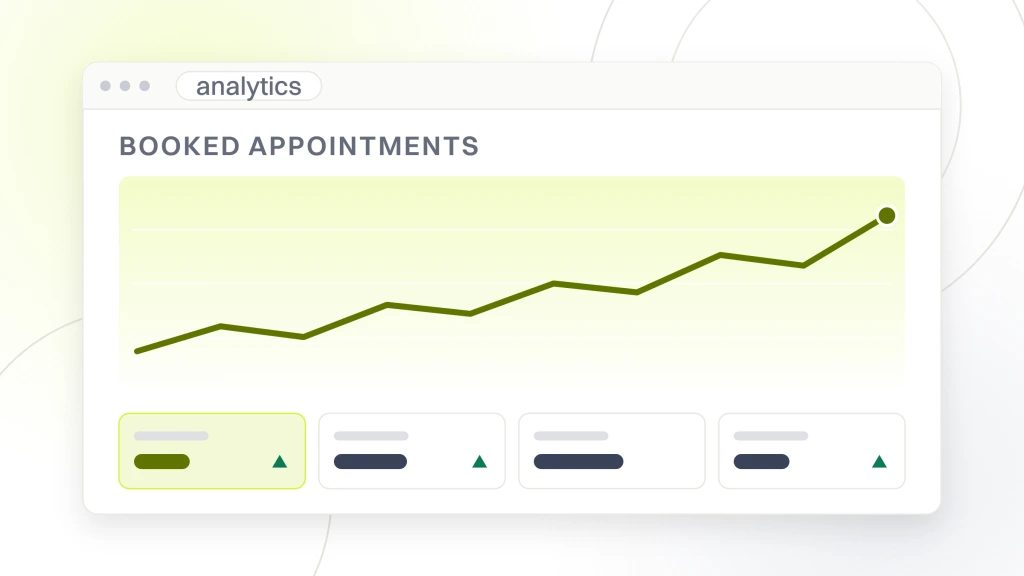
Conversion rate optimization on a healthcare site typically doubles the booking rate inside two quarters without adding traffic. CRO pays back faster than new content or new campaigns because every point of conversion rate multiplies across the traffic already coming in. A 2 percent to 4 percent booking rate gain on a 30,000-visit-monthly site is 600 additional booked patients yearly.
- Above-the-fold appointment CTA on every service page. Not a scroll-past hero, an actual booking widget.
- Chat widget with SMS fallback. Patients on mobile hate calling. Chat and SMS raise night-and-weekend booking rate 40 percent.
- Insurance verification widget. Every patient asks “do you take my insurance.” Answering that on the page cuts drop-off 20 percent.
- Provider bio with headshot on every service page. Trust signal that raises time-on-page and closing rate.
- Star ratings pulled from Google reviews. Not stock testimonials. Real Google review pulls with the actual patient photos.
- Sub-3-second mobile page load. A Google and Deloitte study found a 0.1 second mobile speed improvement lifted the share of lead generation visitors reaching the form submission page by 21.6 percent.
These CRO changes cost less than a single month of PPC and pay back across every month for the life of the site. Practices that skip CRO waste 40 to 70 percent of the traffic they buy on paid and earn organically. That waste widens the gap between the site’s traffic and its actual bookings every month.
Email and SMS follow-up that closes healthcare marketing websites
Roughly 60 percent of patients researching a practice on the site do not book on first visit. They compare, read reviews, ask a spouse, wait until Monday. Without follow-up, most of those patients never come back. Healthcare marketing websites that run email and SMS follow-up recover 15 to 30 percent of the drop-off traffic as booked appointments. That recovered volume stacks on top of every other channel already running.
The three follow-up sequences that work
The insurance-question sequence starts when a patient submits a form asking about coverage. An auto-reply answers the top 5 insurance questions. Two days later, send a message offering to check their specific plan. Five days later, invite them to book without checking. Recovery rate lands between 20 and 30 percent. The consultation-cart-abandon sequence kicks in when a patient starts booking then drops off. A reminder text goes out 30 minutes later, a reminder email the next morning, and a second reminder 3 days later with a light incentive. Recovery rate sits at 15 to 25 percent. The reviews-driven nurture sequence works for cosmetic and elective procedures. A 5-email arc over 3 weeks features patient stories and outcome photos. Recovery rate runs 8 to 15 percent.
HIPAA-safe follow-up platforms
Not every marketing automation platform will sign a BAA. HubSpot signs BAAs on Enterprise. Klaviyo does not sign BAAs. ActiveCampaign does not. Mailchimp does not. Practices sending PHI-adjacent content must use a HIPAA-compliant platform. HubSpot Enterprise, Salesforce Marketing Cloud with the HIPAA add-on, or a specialty healthcare marketing platform like Solutionreach, Weave, or Doctible. The wrong platform choice creates HIPAA exposure inside the first month.
Reviews and reputation management
Reviews are the trust signal that closes patients on the fence between two comparable practices. A practice with 200 Google reviews at 4.7 stars closes 40 to 60 percent more of its site traffic than an equivalent practice with 40 reviews at 4.5 stars. The gap is not linear. It is exponential. Reviews compound as social proof.
A review request workflow that works
Automate a text and email to every patient 2 hours after their appointment ended. Ask a single satisfaction question first. If the answer is positive, redirect to the Google review link with a pre-filled prompt. If the answer is negative, redirect to a private feedback form so the practice can address the issue before it becomes a public review. That two-branch workflow grows the volume of 4-star and 5-star reviews by 5 to 10x versus asking nothing.
Responding to reviews
Every review needs a response. Positive reviews get a 1-2 sentence thank you within 48 hours. Negative reviews get a response within 24 hours that acknowledges the concern, offers to take the conversation offline, and never confirms or denies whether the reviewer is a patient (HIPAA disclosure rules). Every response is public and future patients read them. A thoughtful reply to a 3-star review often wins more trust from the next patient than the original complaint ever cost.
How a multi-location practice ran healthcare web marketing
LifeStance Health Inc. ran healthcare web marketing across 10+ Georgia clinics in the Atlanta market under one integrated team. The site was rebuilt for CRO. SEO and PPC ran under one keyword strategy. Email follow-up was automated. Reviews were requested from every patient. Every channel shared one weekly reporting cadence so the team could react to shifts inside a week, not a quarter.
The result: $19 cost per lead against a $25 target, 3x patient volume, and 100 percent impression share on niche services like TMS therapy where competition was thin. The paid team fed the SEO team the highest-converting patient intents. The SEO team fed the paid team long-tail keyword coverage. The CRO changes on the appointment funnel raised booking rate across both paid and organic traffic. Email follow-up recovered another 15 to 20 percent of the drop-off traffic.
Zero HIPAA compliance incidents ran across the 12-month engagement. Consent Mode was wired correctly across every tag manager container. The team validated analytics weekly to confirm no PHI landed in the pixel pool. One compliance workflow served all six channels instead of six separate reviews. That shared discipline dropped the effective cost per booked patient below anything a single-channel setup could hit.
Pelvic Rehabilitation Medicine ran a parallel program across 14 locations in 10 states for pelvic pain and endometriosis care. Keyword growth reached 174 percent year over year, organic traffic grew 166 percent, and the site launched a dedicated patient community platform. The community platform doubled the email list in 90 days, which fed both the follow-up sequences and the review request workflow. Every channel picked up traffic from the community engine.
Analytics and attribution under HIPAA
HIPAA changes what healthcare analytics can send to Google, Meta, or any third-party tag. Patient names, symptoms, appointment types tied to diagnosis codes, and any URL parameters that carry those signals must be redacted before analytics fires. Getting this wrong triggers a HIPAA incident, not a marketing one, with fines up to $50,000 per violation.
Server-side tagging as the working pattern
Server-side Google Tag Manager is the working pattern for HIPAA-safe healthcare analytics in 2026. Instead of client-side pixels firing directly to Google or Meta, the site sends events to a server-side container the practice controls. That container scrubs any PHI-adjacent fields, applies consent decisions, and forwards a clean payload to the analytics endpoints. Client-side tags run 3 to 5x cheaper but expose PHI silently. Server-side runs $50 to $300 monthly in cloud costs and shuts the exposure down.
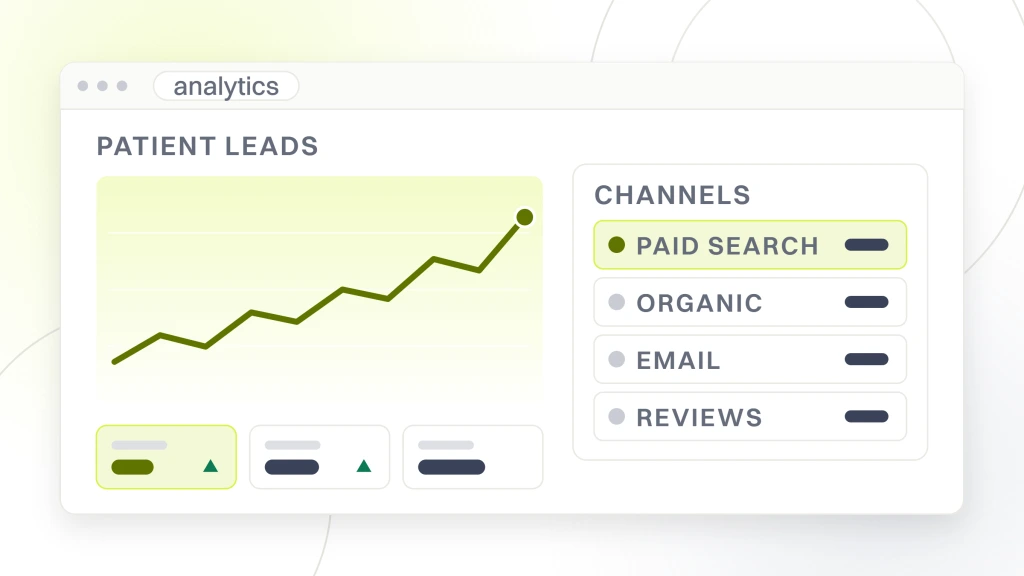
What the weekly analytics report shows
Booked patients by source blended across paid and organic. Cost per booked patient by channel. Conversion rate by landing page. Assist-conversion patterns showing which touches led to booking. Organic ranking movement on the top 30 commercial keywords. Email and SMS follow-up recovery rates. Review request response rates. Every number in the report gets scrubbed of PHI before it hits the dashboard. The Google Consent Mode documentation is the reference for how the consent-driven analytics flow works under HIPAA.
Common healthcare web marketing mistakes
The failures we see on audits repeat across independent practices. None of them are dramatic. All of them cost bookings, rankings, or compliance posture. Fixing three of the six below moves the numbers within a quarter.
- Homepage traffic on paid ads. Homepage runs 3 to 5x higher cost per lead than a dedicated landing page. Build one landing page per ad group.
- Contact form as the only conversion path. Chat, SMS, and click-to-call cover the 60 percent of patients who never fill forms.
- SEO content written for search engines, not patients. Google’s E-E-A-T ranks patient-first content above keyword-stuffed pages every time.
- Reviews requested only from happy patients randomly. Automate the ask 2 hours after every appointment. Volume matters.
- No follow-up email or SMS after a form fill. 60 percent of researchers do not book on first visit. Follow up or lose them.
- Client-side pixels sending PHI to Google Analytics. Move to server-side GTM or accept HIPAA exposure that grows every month.
Where healthcare web marketing is heading
Google AI Overviews and Search Generative Experience change what “discovery” means for healthcare. Patients see AI-generated summaries above the ten blue links on 40 to 60 percent of health queries. Content that gets cited inside those summaries wins outsized visibility. Practices that structure content for AI citation with clear question-answer patterns, structured data, and E-E-A-T signals capture the citation slot. Practices that skip that structural work stay stuck on page 2.
HHS OCR guidance on web tracking technology has tightened repeatedly since 2023. The HHS guidance on HIPAA online tracking is required reading for every practice manager. State privacy laws (California, Virginia, Colorado, Connecticut, Utah plus 15 more through 2027) make geo-based consent rules the new baseline. Compliance work now runs across every marketing channel instead of a one-off legal review.
The practical next step for most practices is a two-week audit against the six channels above. Map current coverage, identify the two biggest gaps, and pick a 90-day sprint to close them. Six months from the first audit to a full-stack healthcare web marketing setup is a realistic timeline for most practice sites. The Google Search Central documentation covers the SEO fundamentals for medical content.