
Healthcare website maintenance services are the monthly discipline that keeps a medical site secure, fast, compliant, and clinically accurate across every provider change, plugin patch, and algorithm shift. Miss that rhythm and the site drifts from launch condition into a rebuild candidate inside two years. Run it well and the same site produces booked patients for five or more.
Search algorithms shift. HIPAA rules tighten. WordPress pushes security patches every few weeks. Providers join and leave. Insurance carriers change what they cover. Without a monthly cadence, tiny drifts compound into broken forms, dead provider bios, and a Core Web Vitals score that quietly bleeds organic clicks. Google’s own Web Vitals reference confirms the thresholds that decide how fast pages need to load to hold ranking.
This guide walks through the monthly healthcare website maintenance checklist we run at Redefine Web across dental groups, mental health providers, and multi-location health systems. You’ll get the 7-part security stack every practice needs at launch and every quarter after. The 3 automated compliance tools worth adopting. The Core Web Vitals cadence that keeps organic traffic climbing. Honest maintenance pricing from $199 to $499 per month tied to what actually gets delivered. And a 14-location Pelvic Rehabilitation Medicine case study on what steady maintenance looks like after 12 months of runway. Pick the sections that match your practice stage.
The healthcare website security stack every practice needs
Healthcare website security is a defense-in-depth problem. No single tool covers every threat, so you stack 7 layers and audit each one every quarter. Miss any layer and one vulnerability turns into the breach that puts protected health information in the wrong hands. The stack below runs on every healthcare site we launch and gets re-verified inside every monthly maintenance pass.
- Web application firewall through Cloudflare or Sucuri, blocking common attacks before they reach WordPress
- Malware scanner through Wordfence or MalCare with real-time alerts on suspicious file changes
- Two-factor authentication on every admin account, with hardware key support for the highest-value logins
- Limited login attempts with IP-based lockout after 5 failed tries
- SSL certificate through the host or Let’s Encrypt with auto-renewal so it never quietly expires
- Database prefix change from default wp_ to a random string that automated scanners can’t guess
- File integrity monitoring that alerts the second an unauthorized core file change lands
Choosing a web application firewall
The web application firewall sits in front of the site and blocks the top attack patterns before they touch your WordPress install. Cloudflare’s free tier covers most bot and SQL-injection traffic, and the $20 per month Pro plan adds bot management for high-traffic groups. Sucuri’s healthcare plan runs $199 per month and includes malware cleanup guarantees. Pick one at launch and stick with it. Switching providers every year loses every rule you’ve tuned on the current stack.
Two-factor on every admin account
Two-factor authentication on every WordPress admin account is non-negotiable for a medical practice. Weak passwords with no 2FA is the most common breach path we see in forensic reviews. Use an authenticator app like Google Authenticator or Authy, not SMS, since SMS is vulnerable to SIM-swap attacks. Hardware keys through YubiKey add a physical layer for owner and clinical-director accounts. That $50 hardware key pays back the first time it blocks a credential-stuffing hit. The WordPress security hardening guide lists the rest of the admin-level checks you should mirror inside the site’s monthly audit.
Automated compliance solutions for healthcare websites
Automated compliance solutions for healthcare websites cut manual work out of accessibility monitoring, HIPAA form validation, and content review. The tools worth adopting run every day instead of every month, so a regression gets caught the same day it lands rather than the day of the next scheduled review. Continuous is the whole point.
3 categories of automated tools carry the load. Accessibility monitoring through axe DevTools for Web, Deque WorldSpace, or accessiBe with continuous scanning. HIPAA form validation through Formstack Healthcare, Paubox, or Formidable Forms with signed BAA coverage. Content review through Grammarly Business with healthcare glossaries or ProWritingAid tuned to a medical style guide. Running all 3 in parallel cuts monthly manual audit time by 40 to 60 percent and catches issues a human reviewer would miss.
Continuous accessibility monitoring
Continuous accessibility monitoring scans every page on every deploy and every new content publish. axe DevTools for Web runs $1,200 to $2,800 per year for a small practice. Deque WorldSpace covers larger accounts at $6,000 to $18,000 annually. accessiBe uses an AI overlay approach that some ADA plaintiff lawyers challenge in court, so we point clients toward axe or Deque instead. Continuous scanning catches an issue inside 24 hours of it going live, instead of on the 30-day audit cycle after 100 patients have already hit the broken page.
HIPAA form validation
HIPAA form validation confirms every patient intake form posts to a BAA-covered endpoint. Formstack Healthcare runs $79 per month per user with signed BAA. Paubox handles email delivery for form notifications at $29 per user monthly. Formidable Forms Pro with the HIPAA add-on runs $499 per year. Pick a stack at launch and audit it monthly for new forms that slipped in without HIPAA-safe routing. The HHS HIPAA security rules reference is the framework your form vendor must map to.
Core Web Vitals healthcare websites need for search performance
Core Web Vitals matter for 2 reasons. Google uses them as a mobile ranking signal. Patients bounce off slow pages before they reach the booking form. The 3 metrics are LCP under 2.5 seconds, INP under 200 milliseconds, and CLS under 0.1. Core Web Vitals healthcare websites hold in the green gain 12 to 25 percent mobile organic click-through inside 60 days on the same rankings.
Performance drifts from 3 sources. Plugin bloat added over months of small changes. Uncompressed staff image uploads pushed straight into location pages. Third-party scripts added for tracking or chat widgets without a page-weight review. Every monthly maintenance pass includes a Lighthouse audit on the top 10 traffic pages, a plugin audit for anything unused, an image compression pass on new uploads, and a script audit for third-party additions. Practices that skip this drift 10 to 25 percent per year on Core Web Vitals until they need a full performance rebuild.
Lighthouse audit cadence
The Lighthouse cadence runs monthly for spot checks and quarterly for deep audits. Monthly checks scan the 10 highest-traffic pages and flag any page that dropped more than 5 points since last month. Quarterly deep audits scan every top-tier page and produce a ranked backlog of performance fixes. Between passes, the automated stack watches for the sudden drops that plugin updates cause. Nothing about this cadence is exciting, and that’s the point.
Image compression as a monthly discipline
Staff-uploaded images are the number one cause of Core Web Vitals drift on healthcare sites. A single 4MB provider headshot on a location page pushes LCP from 1.8 seconds to 4.2 seconds on a phone. The monthly maintenance pass runs every new image through a WebP conversion and compression pipeline that caps file size at 200KB for hero images and 100KB for content images. That single discipline holds LCP inside the green zone across a full year of content updates.
Case study on healthcare website maintenance at Pelvic Rehabilitation Medicine
Pelvic Rehabilitation Medicine runs across 14 locations covering pelvic-pain and endometriosis care. After the initial rebuild grew organic keyword rankings 174 percent and organic traffic 166 percent inside 12 months, the maintenance retainer took over to protect that growth and keep the site compounding. The threats worth protecting against on a group that size are algorithm shifts, security vulnerabilities, provider changes across 14 locations, and Core Web Vitals drift from staff content updates.
The maintenance stack runs monthly across all 14 location pages, weekly on security patches, and quarterly on deep Lighthouse audits. Provider changes get published inside 48 hours of the HR notification. Insurance carrier updates land on the affected location pages the same week they change. Core Web Vitals have stayed in the green across all 14 locations for 6 consecutive quarters. Zero security incidents. Zero PHI exposures. That steady-state discipline is what keeps the 174 percent keyword growth from decaying back to baseline.
| Maintenance metric | Target | Result across 14 locations |
|---|---|---|
| Uptime | 99.95 percent | 99.98 percent achieved |
| Core Web Vitals green | All top pages | 6 consecutive quarters |
| Security incidents | Zero | Zero incidents |
| Provider updates | Under 48 hours | Average 22 hours |
Steady-state discipline
Steady-state is the discipline of running the boring monthly work every month, forever. Applying patches. Scanning for accessibility regressions. Verifying backups actually restore. Checking uptime. Every month the same. That discipline is what lets the Pelvic Rehab site keep producing patients, whereas other practices need a rebuild every 24 months. The retainer has produced zero incidents across 6 quarters, since the boring work happens on schedule, not when someone remembers.
Provider update speed
Provider updates hitting the site inside 48 hours matters, since a stale bio causes real patient confusion. A patient books with Dr. Smith. Dr. Smith left 3 months ago. The patient shows up, the front desk apologizes, and the patient rebooks or walks. The maintenance retainer catches HR notifications inside 24 hours and pushes bio updates inside 48. Groups that let bios sit stale for months quietly hurt their own conversion rate every week.
Healthcare website maintenance services pricing bands
Healthcare website maintenance services at Redefine Web run 3 fixed tiers, $199, $299, and $499 per month, tied to how much site there is to run and how fast issues need to move. Practices paying under the floor tier are usually buying a hosting-only bundle that skips accessibility, HIPAA, and content updates. Practices paying above the ceiling for their size are paying for enterprise overhead their site does not need.
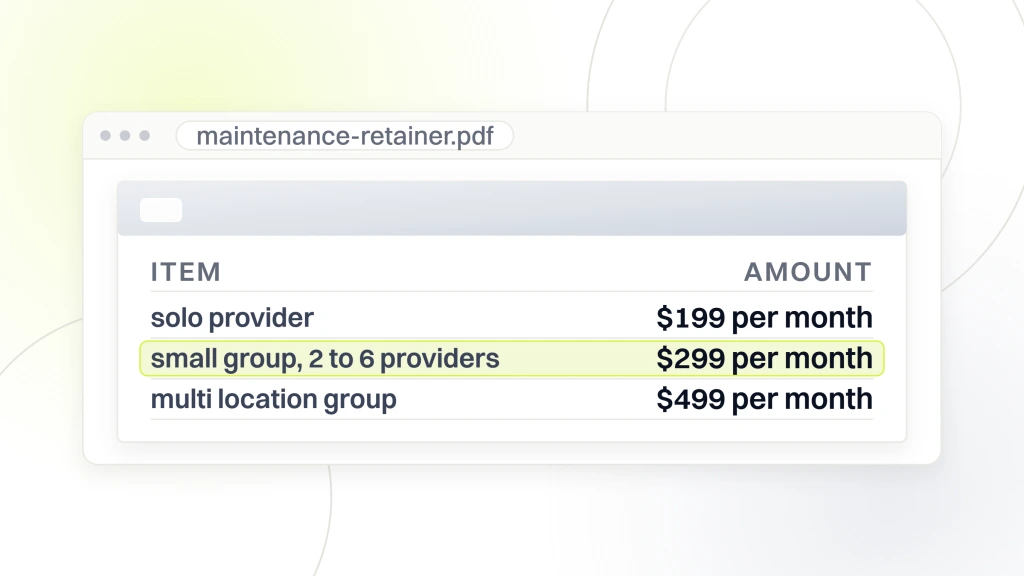
| Practice size | Monthly retainer | Included work |
|---|---|---|
| Solo provider | $199 per month | Monthly checklist, security patches, basic content updates, hosting bundled in |
| Small group of 2 to 6 providers | $299 per month | Full checklist, provider bio updates, accessibility monitoring, HIPAA form audits |
| Multi-location group | $499 per month | All of the above plus location-page updates, review response, and named maintenance lead |
What you’re buying at each band
At the $199 band you get the monthly checklist plus 2 to 3 hours of content updates and bundled hosting. At the $299 band you add continuous accessibility monitoring, full provider bio updates, and monthly HIPAA form audits. At the $499 band you add location-page maintenance across every site, Google Business Profile posting per location, and a named maintenance lead with a 48-hour response SLA on urgent requests. Every tier ships a written monthly summary so you can see exactly what got done.
Contract terms
Every Redefine Web maintenance retainer runs on a 6-month initial term to align incentives on the operational rhythm. After 6 months, the retainer renews on a quarterly cadence with 30-day notice. Any vendor demanding a 12-month commitment without a written performance benchmark is asking for blind trust. The right contract has a 6-month initial term, a documented scope, monthly written summaries, and a written escalation path if the practice needs to exit the retainer.
The strangest maintenance pitch we ever heard came from a shop offering “all-you-can-eat maintenance” for a flat $99 per month. On the intake call the vendor clarified that meant one 15-minute ticket per month, plus $95 for any additional ticket, plus $450 for anything requiring code, plus $199 setup for anything they considered custom. The prospect asked for a written scope. The vendor sent a brochure with the word “all-you-can-eat” in bold 7 times. Nobody runs an open-ended retainer under $200. It’s a scope document that hides the meter.
In-house versus agency healthcare website maintenance
Practices with in-house IT sometimes run maintenance internally. That works when the IT team has WordPress expertise, an accessibility background, and HIPAA form knowledge. It fails when the team is a generalist IT crew running the EMR and practice management system, with the website as an afterthought. The common failure pattern is patches applied but no accessibility scans, backups running but never tested, and content updates sitting in a queue for weeks.
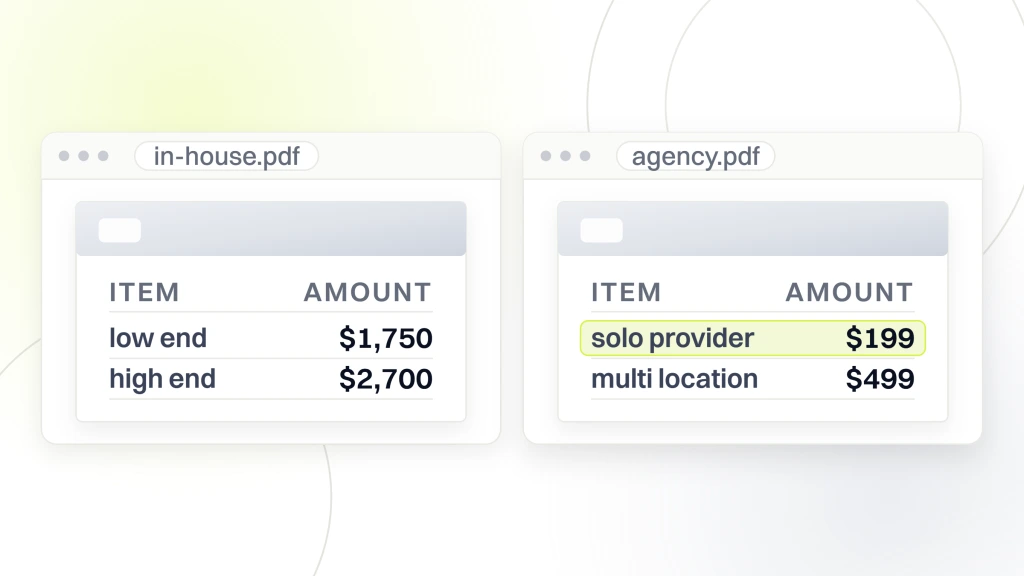
The in-house versus agency math runs like this. In-house cost is roughly 25 percent of a full-time WordPress developer at $85,000 to $130,000 fully loaded. That lands at $21,000 to $32,500 per year, or $1,750 to $2,700 per month. Agency retainer for the same scope runs $199 to $499 per month at Redefine Web. Agency wins on cost most of the time. Agency wins on specialization too, since the same maintenance team runs the same checklist across dozens of healthcare sites and catches patterns an in-house team never sees.
When in-house fits
In-house maintenance fits when the practice has a dedicated web developer whose full workload is the website. That’s rare below the enterprise health-system tier. Most groups that try in-house end up with a marketing coordinator running WordPress updates as one line item in a 15-item job description, which produces the failure patterns above. If the practice can’t dedicate a full 25 percent FTE to the site, an agency retainer wins on both cost and quality.
When agency fits
Agency maintenance fits when the practice wants predictable monthly delivery without hiring or managing a developer. The agency runs the same checklist every month, produces the written summary, and stays accountable to the contract scope. Practices from solo providers through multi-location groups almost always come out ahead with an agency retainer. Only enterprise health systems with dedicated web teams should default to in-house, and even then most of them contract specialty audits out.
Switching healthcare website maintenance services vendors safely
Switching maintenance vendors happens more often than the marketing suggests. Practices outgrow their initial provider. Vendors churn account leads. Retainers drift into hourly billing disputes. The transition itself is where risk concentrates, since credentials change hands, backup ownership shifts, and knowledge of the site’s quirks sits in the head of the outgoing account lead.
The safe transition runs 3 phases. First, discovery of every credential, third-party service, backup location, and open maintenance ticket at the outgoing vendor. Second, formal handoff with new admin accounts created before old ones deactivate. Third, a parallel maintenance month where both vendors run the same checklist so the new team catches anything the outgoing one was doing quietly. Practices that transition without this discipline routinely discover missing plugin licenses, expired SSLs, and orphan tickets weeks after the switch.
Credential and access audit
The credential audit lists every admin account, hosting login, DNS provider access, CDN account, form vendor login, backup storage credential, and third-party service account tied to the site. Every credential gets rotated to a new password owned by the practice. Old vendor accounts get deactivated only after the new team confirms it can access every system. Skipping this leaves the outgoing vendor with credentials they can use accidentally or intentionally months after the retainer ended.
Parallel maintenance month
The parallel month costs the practice one extra retainer payment and catches every discrepancy between what the outgoing vendor was doing and what the incoming vendor now covers. Comparing the written monthly summaries from each vendor side by side often surfaces a scan the old team ran that the new team missed, a plugin license expiring in 60 days, or a backup destination the new team didn’t know existed. That one month of overlap pays back the first time it catches a gap that would otherwise become a real incident.
Working with Redefine Web on healthcare website maintenance services
Redefine Web runs healthcare website maintenance services against the checklist above with a written monthly deliverable, an assigned maintenance lead, and a 48-hour response SLA on urgent requests. Every retainer includes the 7-part security stack, continuous accessibility monitoring, HIPAA form audit, and Core Web Vitals cadence. Onboarding runs 2 weeks. Month one produces the baseline audit and first monthly summary. From month 2 forward, the steady-state rhythm takes over and the site gets quieter every quarter.
Our maintenance retainer starts at $199 per month for a solo provider and scales to $499 for a multi-location group, hosting bundled in at every tier. Our Healthcare Marketing Hub covers the wider stack that maintenance protects, and our Website Maintenance Pillar post walks through the framework end to end. For the sibling read on governance and PHI risk, see our Healthcare Website Security Governance guide.