
How SEO helps real estate agents generate leads comes down to the math of a working brokerage, not marketing theory. Agents want more buyer and seller consults. Organic search produces those consults through traffic that lands on the right pages, converts on the right forms, and gets tracked back to the right dollar. This guide walks the exact mechanics. How search intent maps to agent lead generation. Which page types produce buyer versus seller consults. How long it takes to see measurable lead flow. And the retainer math behind organic paying back inside year one.
You’ll see the mechanics behind residential agent growth, the mechanics behind commercial broker lead generation, and the role of organic search across every segment. We cover buyer intent, seller intent, brand authority, GBP work, and the measurement stack that turns organic traffic into attributable booked consults. Read against your Google Analytics before you brief the next content sprint or hire the next agency.
SEO produces qualified real estate leads that pay back for years
Organic search produces qualified leads at a cost per lead that trends toward zero over time. A new ranking neighborhood page costs 4 to 8 hours of writer time plus a small share of the retainer. That page then produces buyer and seller inquiries for 3 to 7 years with no additional cost, unless Google’s crawl or a competitor pushes it down. Compare that to paid search where every click costs $6 to $18 forever, and the compounding math is obvious. On a 24-month curve, an agent running organic plus paid together sees paid CAC drop 15 to 30% as branded search demand grows.
The second reason organic pulls its weight is that search intent already qualifies the visitor. Someone typing Boulder condos under 700k is a real buyer with a real price range and a real neighborhood preference. That is a much warmer lead than a Facebook cold-audience impression. The visitor arrives with pre-existing intent that took Zillow, Realtor, or Redfin 3 months of retargeting to build. Your ranked page catches them at the moment of that intent, not weeks later after they’ve clicked five listings, saved three homes, and half-committed to another agent.
Third reason. SEO builds durable brand authority alongside the direct leads. Every ranked page mentions your brokerage, links to your team profile, and shows up in the SERP snippet for months or years. That brand exposure compounds. Buyers and sellers who eventually search your brokerage name directly (because they saw you six times in organic results across a quarter of casual research) convert at 3 to 5 times the rate of cold organic entries. Reference our full methodology inside Search Engine Optimization Services.
The fourth reason is retention. A ranked page that produces 8 buyer inquiries a month in year one usually still produces 5 to 6 in year three if the page gets a light quarterly refresh. Paid search leads stop the day the account pauses. SEO leads persist through budget freezes, agency transitions, and market slowdowns. That resilience is what makes organic the base layer under every working brokerage marketing stack, with paid layered on top for immediate lead flow and top-of-funnel testing.
How SEO helps residential real estate agents grow their business on buyer intent
Residential buyer intent is the largest single traffic pool in organic search. A buyer searches a neighborhood plus property type plus a price band. They land on your page and convert on a booking form or an IDX save-search that captures their email and phone. Every metro shares this pattern, and every working residential agent SEO account rides it. The page architecture is simple, repeatable, and produces measurable inquiries on any city with 200,000-plus population.
The page architecture that carries buyer intent starts with neighborhood hub pages (Boulder homes for sale) with an IDX search block and neighborhood-specific market data. Price-band variants (Boulder homes under 700k) for the top 3 to 5 price bands in each neighborhood. Feature-specific variants (Boulder homes with pool, Boulder homes with view) for the top 3 to 5 features buyers filter for on the MLS. School-district pages (homes in Fairview High District) for the top 3 to 5 rated districts in the metro. Twenty to forty pages across a working metro covers 80% of the addressable long-tail volume.
Every buyer-intent page needs three conversion elements to book consults. An IDX search or save-search block that captures buyer email. A booking button (schedule a private showing) tied to your calendar tool. A one-form download offer (buyer guide, neighborhood market report) that captures name plus email for the top-of-funnel visitor who isn’t ready to book yet. Skip any of the three and the page ranks but doesn’t generate leads. That gap is the number-one reason ranked pages produce zero attributable inquiries in month 6 audits.
Timeline for buyer lead generation via SEO
First buyer leads from newly built neighborhood pages arrive in weeks 4 to 12 depending on domain age and competition. A healthy domain (3+ years old, 20+ backlinks, no penalty history) sees first-page rankings for long-tail neighborhood-plus-price-band terms in weeks 4 to 6. New domains take 12 to 20 weeks to reach the same page-one rankings. Once ranking, a typical neighborhood-plus-price-band page produces 2 to 8 buyer inquiries per month, depending on search volume and conversion rate. Multiply across 20 to 40 neighborhood pages and the account is producing 40 to 200-plus buyer inquiries per month by month 12.
Seller intent and how SEO helps real estate agents generate leads
Seller intent traffic is lower volume than buyer intent but converts at 3 to 5 times the rate. A homeowner searching how much is my Boulder house worth is 30 to 90 days from listing, and a valuation form is the natural next step. Seller intent SEO is where most agents dramatically underbuild. Agents put 80% of their content budget on buyer content and 20% on seller content, then wonder why their listing-side commissions plateau. Flip that ratio for the highest ROI.
The page architecture for seller intent. Neighborhood valuation pages (how much is my Boulder home worth) with a home-valuation form as the primary CTA. Neighborhood market-report pages with real MLS-pulled sales data over the past 90 days. Best-time-to-sell-in-neighborhood pages with seasonal price trend data. Sell-my-home-in-metro pages walking the process from valuation through closing. Testimonials from real sellers in the neighborhood with named projects and named sale prices where publishable. Ten to fifteen seller pages across a working metro cover the bulk of seller-side searches.
Every seller-intent page needs a valuation form as the primary conversion action. Three fields (address, phone, condition) sit above the fold. A secondary CTA offers a downloadable market report or a phone consult with the agent. Skip the valuation form and the page ranks but doesn’t generate leads. Seller intent traffic almost always wants the valuation number, and if you don’t give it to them, they’ll click back to Zillow’s Zestimate page and never come back to your site.
Seller intent SEO produces the highest-LTV inquiries on any agent’s account. A closed listing side transaction is often 2 to 3x the commission of the equivalent buyer side. And listing-side deals often open up buyer-side deals (sellers who list often need to buy their next home too). Every dollar of retainer allocated to seller intent SEO tends to compound faster than the equivalent buyer-side allocation. That’s why the callout above pins the 55/30/15 split as a starting point, then shifts more toward seller once the first valuation pages are ranking.
GBP and the map pack lever for real estate lead flow
Google Business Profile is the fastest-moving SEO signal in an agent’s toolkit. A cleaned-up profile with 30 real photos, weekly Google Posts, verified categories, and a review flow that produces 6 to 12 reviews per month typically moves an agent from map pack position 12 to positions 2 to 4 inside 60 days. That single move often produces 30 to 50% of the total organic lead flow in the account’s first six months. No content sprint, no backlink outreach, no schema deployment produces that speed of return.
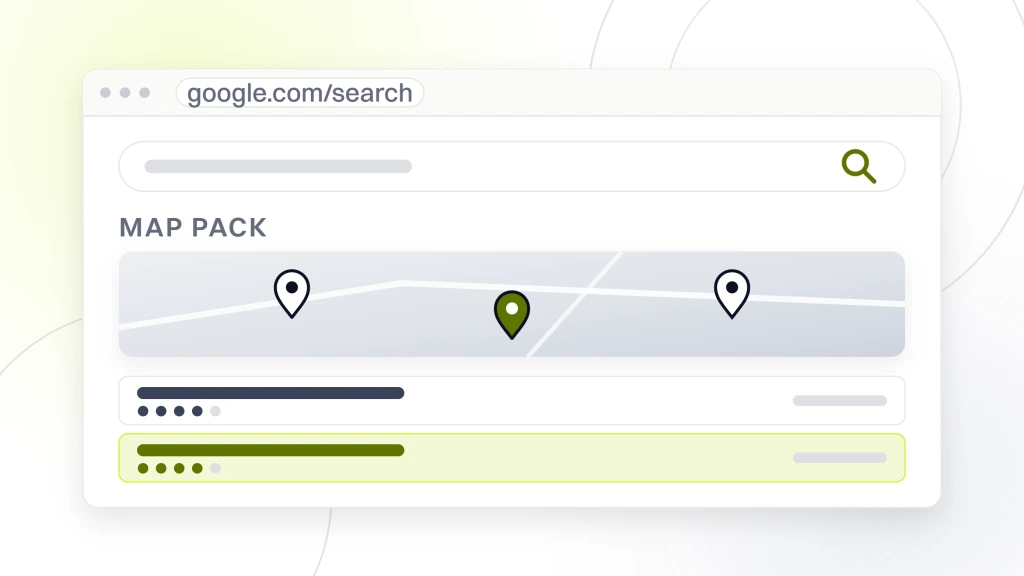
The map pack pulls its own share of qualified searches. Every real estate agent near me or neighborhood realtor search triggers a map pack answer first. A profile in map pack position 2 receives 15 to 25% of clicks on those searches. A profile in position 8 or below receives under 3%. Moving from position 8 to position 2 is a 5 to 8x traffic increase on the map pack alone, before you count the organic-search-result move that usually happens in parallel.
Review flow is the underestimated GBP lever. Agents pulling 6 to 12 new Google reviews per month outrank agents pulling 0 to 2 reviews per month, even when everything else is equal. Install a review-request SMS 4 hours after every closing with a direct link to the Google review URL. Add a monthly audit of category selection, service area accuracy, and question-and-answer moderation on the profile.
Google Posts on the profile keep the ranking signal fresh. Weekly posts (new listing, sold listing, market update, buyer tip) show the map pack ranker that the profile is active and updated. Skip weekly posts and the profile decays inside 90 days. The 20 minutes per week to publish a Google Post is one of the highest-ROI actions on any brokerage account. Batch four posts on the first of each month and schedule them out.
How SEO helps commercial real estate brokers generate qualified leads
Commercial brokers generate leads on a different intent map than residential agents. Search volume is lower per keyword but deal sizes are higher. Sales cycles are longer but retention on tenant relationships is higher. Commercial organic lead generation runs on specialty verticals, tenant representation content, and inventory-driven URL expansion. A commercial broker with 20 tenant-rep pages ranking often outproduces a residential agent with 60 neighborhood pages on booked-consult revenue, given the higher commission per closed deal.
The page architecture for commercial. Property-type-plus-metro pages (office space for lease [metro], industrial space [metro], medical office space [metro], life sciences lab space [metro]). Neighborhood-plus-property-type variants for each submarket the broker covers. Size-range variants (office space under 5,000 sq ft [neighborhood], office space 15,000 to 40,000 sq ft [neighborhood]) for each tenant profile. Tenant representation services and landlord representation services pages for the direct-inquiry conversion. Fifteen to thirty pages covers most single-metro brokerages.
Commercial brokers also generate leads through the property inventory itself. Every available property is an indexable page with unique content, unique keywords, and RealEstateListing schema data. Brokerages that iframe the inventory feed keep those pages invisible to Google. Migrating to inline rendering surfaces 100 to 400 pages inside 60 days and pulls a step-change in organic inquiries. See our Real Estate SEO Services for Brokerages for the migration playbook.
Commercial specialty verticals convert at 3 to 5 times the rate of general office space pages. Medical office space, life sciences lab space, government-lease specialties, and industrial subcategories all pull tighter search intent. Build specialty pages in the first content wave, not the third. The specialty search intent is already sitting in the SERP waiting for a page that answers it, and the first broker to publish a deep specialty page in a metro often holds position 1 for years.
Attribution stack that proves organic search is working
Every retainer conversation past month 4 needs attribution to survive scrutiny. SEO is working is not a defensible statement. Our /boulder-homes-for-sale/ page produced 12 buyer inquiries and 3 booked private showings in the last 30 days is defensible. The attribution stack that produces the second statement runs on four tools, and every working brokerage marketing stack we run installs them before the first content sprint starts.
Google Search Console tracks impressions, clicks, and average position per URL per query. Google Analytics 4 tracks sessions, engagement, and conversion events per landing page. A call tracker (CallRail or equivalent) with dynamic-number insertion tracks phone calls per traffic source and landing page. A form-fill tracker on every conversion form logs the landing page URL, source, and timestamp per submission. Cross-referencing all four gets you page-level ROI in one spreadsheet.
Together the four tools produce a weekly report the agent understands. Which pages are ranking on which queries. Which pages are producing which conversions. Which specific inquiries came from which specific pages. That report turns SEO is working into a spreadsheet with dollar values per URL. From that point the retainer conversation runs on evidence instead of feelings, and the client extends the engagement without hesitation at month 6, month 12, month 24.
Install the full attribution stack in week 2 before any content ramp begins. Attribution tools installed after content ramp starts miss the baseline data that makes the first-90-day comparison meaningful.
Comparison of lead types generated by organic search
Organic leads do not carry equal value. The table below sizes buyer, seller, tenant, and landlord leads across a working agent’s book so you can plan content ratios against the lead mix you want.
| Lead type | Search volume per keyword | Conversion rate | Avg deal commission | Cycle length |
|---|---|---|---|---|
| Residential buyer | 200 to 4,400 | 2 to 5% | $8k to $18k | 30 to 90 days |
| Residential seller | 90 to 1,300 | 5 to 10% | $12k to $28k | 45 to 120 days |
| Commercial tenant | 50 to 800 | 6 to 12% | $30k to $80k | 60 to 180 days |
| Commercial landlord | 20 to 300 | 3 to 6% | $60k to $200k | 90 to 240 days |
Pick the mix that matches your book and split the content budget accordingly. Residential agents typically run 55% buyer content, 30% seller content, 15% brand and portfolio. Commercial brokers run 60% tenant-rep content, 25% landlord-rep content, 15% thought leadership. Hybrid brokerages need to pick a lane on year one and add the second lane in year two after the first is compounding. Trying to build both lanes in year one splits attention and slows both.
Cross-lead notes and one more angle on mixed pipelines. Residential seller leads open up residential buyer leads (sellers often buy the next home too). Commercial tenant leads sometimes open up landlord-rep referrals (tenants who trust you often refer landlord friends). Investor leads sit in their own bucket and shouldn’t be mixed with either residential or commercial content plans. Every lead type deserves its own content wave with matched conversion elements per page tied to intent.
How to generate real estate leads with SEO in the first 90 days
Generating real estate leads with SEO in the first 90 days requires disciplined sequencing across three phases. Setup (weeks 1 to 4), transactional page build (weeks 5 to 8), and portfolio expansion (weeks 9 to 12). Every attempt to run 40 activities in parallel produces 40 half-built pages that rank for nothing by month three of the account. Do the phases in order.
Phase one (weeks 1 to 4). Segment call, GBP cleanup, technical baseline audit, Search Console positions 5 to 15 sweep, call tracker install. Deliverable. Keyword-to-URL map for the first 20 pages, GBP with 30 photos plus review flow live, call tracker active, technical baseline documented. The keyword-to-URL map is the single most important artifact of phase one. It tells you which pages to build, in what order, against which intent.
Phase two (weeks 5 to 8). Six neighborhood hubs, six seller valuation pages, schema stack install, Core Web Vitals fixes, internal link graph build. Deliverable. Twelve URLs live, first pages ranking positions 15 to 20 in Search Console, first booked consults from organic arriving. The internal link graph is often skipped, and the account pays for it later. Wire every new page to two neighboring pages and one hub page. That structure doubles ranking speed on the second wave.
Phase three (weeks 9 to 12). Four market-report pages with real MLS data, four buyer guides, four price-band variants, first backlink outreach wave, first quarterly attribution report. Deliverable. Twenty-four URLs live, 8 to 12 ranking top 20, 2 to 5 booked consults per week from organic, first local backlinks earned, first month-over-month growth report on attributed leads. The quarterly attribution report is what earns the month-4 retainer renewal on evidence.
Real numbers from three named real estate accounts
Three named brokerage accounts. Every one runs on the same architecture, attribution, compounding trio. Every one shows what SEO produces when the plan runs cleanly on a real domain in a real market.
Abels Residential, a London-based rental and lettings agency, entered the market on a conversion-focused website plus a smart organic program. Over the first year the account ranked 280-plus keywords, produced 20-plus qualified inquiries per month, and held sub-2-second page load throughout. That’s a solo-to-small-team playbook. Boutique brand, tight neighborhood focus, deep valuation pages, GBP work from day one, and an attribution loop wired before the first content sprint.
McCarthy Court, a seven-unit luxury development in Sidcup, sold out 100% in 3 months pre-completion via an immersive virtual showcase site. The plan produced 60-plus qualified buyer leads and 10,000 targeted campaign visits inside that window. That’s the specialty-page playbook applied to a single project. One deep property page, real photos, real eco-conscious feature detail, a working lead capture, and traffic driven by both organic and paid working together. Any listing agent with a high-end development can copy the pattern.
An established Los Angeles luxury real estate team ran a decade-long engagement with Redefine Web on a fully custom rebuild, IDX integration, and long-form market-insight content built for organic search. Users doubled (+100%), new-user share doubled (+100.1%), and pageviews more than doubled (+102.6%) against the prior site baseline. Neighborhood-plus-price-band pages carried the traffic. Private consult intake pages carried the buyer-side conversion. The account ran on the same page architecture pattern any residential luxury agent can copy at scale.
All three accounts prove the same principle. Organic lead generation for agents is not a mystery. It is architecture (neighborhood pages, seller valuation pages, GBP work), attribution (Search Console plus GA4 plus call tracking plus form tracking), and compounding (every ranked URL builds the next). Skip any of the three and the account stalls. Do all three and the retainer pays back inside year one and continues to compound after.
Retainer math for real estate SEO that pays back
Our retainers land in four tiers, matched to team size and market breadth. Foundation runs $999 per month for solo agents rebuilding a small ranking base. Growth runs $1,499 per month for solo agents on active content sprints. Scale runs $2,499 per month for small teams (3 to 6 agents) running full neighborhood coverage plus attribution. Enterprise starts at $4,500 per month for multi-agent brokerages and multi-market coverage. Every tier produces booked consults inside 90 days on a healthy domain.
The Growth tier at $1,499 per month produces 10 to 14 new pages per 90 days, GBP maintenance, monthly attribution reports, and a quarterly technical audit. First measurable buyer or seller inquiries typically arrive in weeks 8 to 14. Break-even against retainer typically hits by month 6 to 9 on a solo agent account. That’s the tier most working solo residential agents start on before graduating to Scale once the account crosses 15 ranked URLs.
The Scale tier at $2,499 per month covers small-team brokerages. That budget produces 20 to 28 pages per 90 days and covers larger neighborhood universes. First inquiries arrive in weeks 6 to 12. Break-even against retainer typically hits by month 5 to 7 given the higher-throughput conversion capacity on the team. Add commercial tenant-rep pages inside this tier if the team runs mixed pipelines, and lead volume compounds across both intent buckets simultaneously.
Enterprise, which starts at $4,500 per month, runs the same math scaled across markets and 10-plus agent brokerages. Break-even usually accelerates because domain authority carries across markets and content velocity produces broader keyword coverage. Every scope pays back inside year one on a healthy account with the right sequencing.
What to run this week for real estate lead generation
Three actions to finish by Friday. Audit your GBP against the 5-item checklist (categories, photos, reviews, service areas, weekly Posts). Pull the last 90 days of Search Console data and highlight queries at positions 5 to 15. Install a call tracker (CallRail, or your platform’s equivalent) with dynamic-number insertion by traffic source. Nothing on that list takes more than 3 hours. All three together set the baseline for the first 90-day rollout.
Those three actions form the foundation for the first 90-day rollout. GBP cleanup sets the map pack ceiling. Search Console sweep picks the fastest ranking wins. Call tracker install makes month-4 attribution defensible. Do them in that order and week two starts with a working attribution loop and a keyword-to-URL priority list. Skip any of the three and the first 90 days runs half-blind on baseline data.
For agents who want the strategy plus the execution handled together, our Real Estate SEO Services for Brokerages team runs the segment call, the GBP cleanup, and the first 24 pages inside a 12-week engagement. For the wider retainer motion behind a working real estate account, see Real Estate Marketing Agency for Brokerages. And for the paid-search layer that pairs with organic on most working accounts, see Real Estate PPC Agency for Brokerages.