
How to Choose a SaaS PPC Agency
- Four filters cut 40 agencies to 6 in an afternoon.
- Specialists win on MRR reporting and bid strategy tuned to LTV.
- Wrong-agency hire costs $80K to $220K by month six.
- Twelve interview questions surface specialist versus generalist patterns.
- Reference calls are the final test before signing anything.
- Criteria for selecting a PPC agency for SaaS
- Key features of a good SaaS PPC agency
- SaaS-focused PPC agencies vs general PPC management
- SaaS PPC agency vs general digital marketing agency comparison
- Advantages of specialized SaaS PPC agencies
- Problems from hiring the wrong PPC agency for SaaS
- SaaS-focused PPC agencies vs general PPC management comparison table
- Selection process for how to choose a saas ppc agency
- Twelve questions to ask on every intro call
- The reference call as the final test
- Wrapping up how to choose a saas ppc agency
How to choose a saas ppc agency without wasting six months on the wrong hire is a real question, because the wrong hire costs the same subscription business 12 months of runway. The right hire needs four filters, twelve interview questions, and one reference-call test. Everything else is packaging. This guide walks through the exact selection criteria, the differences between a SaaS-focused agency and a general PPC shop, the key features to look for, and the specific problems founders inherit when they hire the wrong agency for their SaaS.
You are probably deciding between three or four agencies right now. Or you fired an agency two months ago and want to skip the mistake this time. Or your in-house paid marketer just left and the executive team wants an agency inside 30 days. Either way, the selection criteria, comparison tables, and interview questions in this guide will cut your search from an exhausting RFP to a focused three-week process. Read straight through and save the questions in the last section. Bring them to every intro call.
Criteria for selecting a PPC agency for SaaS
The criteria for selecting ppc agency for saas rest on four filters. Named SaaS clients past $5 million ARR. Live MRR-by-campaign reporting in their dashboards. A named team of at least three operators on your account. And a reference call answered inside 48 hours. Applying all four filters cuts a list of 40 candidates to 6 or 7 in about 90 minutes of research.
Filters exist to save time. Every founder we talk to has done the exhausting 12-agency RFP and come out with no clarity and less patience. The four filters above cut that process to a focused shortlist that carries actual signal. Rank the shortlisted 6 on the interview questions in the next section, and the winner is usually obvious by the third call. If two agencies score close, hire the one whose account operator you would want to work with for 18 months. The relationship compounds.
Named SaaS clients as the entry filter
Named SaaS clients past $5 million ARR is the entry filter, because SaaS at that revenue band carries the operational complexity that reveals whether the agency actually understands subscription math. Below $5 million ARR, most SaaS accounts run simple funnels that a generalist can hit. Above $5 million ARR, the complexity of retention, expansion, and multi-touch attribution surfaces gaps in generalist thinking fast. If the agency’s roster is mostly SaaS below $2 million ARR or non-SaaS B2B, they have not run into the operational problems your account will hit in month four.
Live MRR reporting as the second filter
Live MRR-by-campaign reporting is the second filter, and the most diagnostic one. Ask the agency to screen-share a live client dashboard with sourced MRR by campaign, LTV cohort curves, and payback period. Redacted account names are fine. What you want to see is the depth of segmentation and whether the dashboard is real-time or manually stitched. A shop pasting screenshots into PowerPoint reports late and reports thin. A shop with a live Looker Studio segmented by campaign, keyword group, and sales stage runs on data. The difference shows up in month three when the first bid change decision has to be defended with numbers.
Key features of a good SaaS PPC agency
The key features of a good saas ppc agency show up in the first two intro calls. They lead with trial-to-paid rate and sourced MRR, not with cost per lead. They name the operator running your account. They price transparently with defined scope. And they walk through a recent failure honestly. Any shop missing two of the four is a vendor pretending to be a partner.
The four key features compound. Reporting maturity means bid decisions get made on real data. Named operators mean account continuity across the engagement. Transparent pricing means the retainer stays clean when you re-scope at quarter-end. And honest failure discussion means the agency has learned from mistakes on someone else’s dime. When any two features are missing, the engagement runs into predictable problems by month six. Founders often notice the pattern too late, when they have already spent 15 or 20 percent of an annual retainer on a partnership that will not deliver.
Reporting depth and MRR view
Reporting depth means the agency can show you sourced MRR by campaign, LTV cohort curves, and payback period in a live dashboard. Not a monthly PDF. Not a screenshot deck. A live view the CMO can pull up at 6pm on a Wednesday. The reporting stack behind it usually involves the CRM as source of truth, ad platform APIs, product analytics like Amplitude or Mixpanel, and a warehouse layer or Looker Studio to join everything. Ask what tools the agency uses. Real answers are specific. Vague answers signal a Google Sheet dashboard is coming your way.
Named team with SaaS experience
The named team on your account should include the operator running your campaigns day to day, the strategist reviewing performance weekly, and the account lead coordinating with your growth team. Ask for names, tenure at the agency, and prior SaaS accounts. If the agency deflects or refers to “the team” without naming individuals, they are staffing your account against whoever has bandwidth that month. That is a slow-motion problem for a growth-stage SaaS. Real answers include real people with real prior work.
SaaS-focused PPC agencies vs general PPC management
How do saas-focused ppc agencies compare to general ppc management is the question every founder eventually asks. The short answer: a saas-focused agency understands subscription economics, and a general PPC shop understands click-based optimization. Both can run Google Ads. Only one can defend a bid change against a payback-period argument.
The saas ppc agency vs regular ppc agency comparison usually plays out inside 90 days of onboarding. The generalist hits the target cost per lead. The specialist hits the target trial-to-paid rate and sourced MRR. The gap is not in daily execution. The gap is in what the team measures success against. A generalist optimizing for CPL will happily deliver 500 form fills a month that convert to paid at 3 percent. A specialist optimizing for MRR will deliver 200 form fills that convert to paid at 18 percent. The specialist’s account produces 20 percent more paid subscribers on the same spend, and the compound math over 12 months is significant.
Subscription economics knowledge
Subscription economics knowledge shows up in how the agency talks about bid strategy. A specialist explains value-based bidding with real dollar values passed from CRM to Google Ads via offline conversion imports. A generalist explains target CPA as the ceiling for signup cost. Both use the same tools. Only the specialist ties the tool to LTV cohort curves. Ask the agency to walk you through their value-based bidding setup on a current SaaS account. The specificity of the answer tells you whether they have built the pipe or only read about it.
Bid strategy tuned to retention
Bid strategy tuned to retention means the agency optimizes toward LTV-weighted conversions, not raw signup counts. That requires paid conversions in Google Ads to represent expected revenue, not just form completions. The specialist builds an offline conversion import pipe with GCLID matching. The generalist relies on signup conversions and hopes for the best. The specialist’s account slowly reallocates spend toward keywords that produce sticky customers. The generalist’s account keeps spending on whatever keyword produces the most form fills. Six months later, the specialist’s CAC-to-LTV ratio is 15 to 30 percent better.
The best filter on SaaS PPC agencies isn't the pitch, it's whether their reference call happens in 2 days. Slow reference calls mean unhappy references. That's the whole test.
SaaS PPC agency vs general digital marketing agency comparison
The saas ppc agency vs general digital marketing agency comparison is a different question from the SaaS vs general PPC comparison. A digital marketing agency runs a full stack including SEO, content, email, and PPC. A SaaS PPC agency runs deep on paid only. For a growth-stage SaaS, deep on paid usually wins over shallow on everything.
Full-service digital marketing agencies pitch the integrated story. One team, one report, one throat to choke. That story appeals to CMOs who want fewer vendors. What it usually means in practice is that the team running your PPC also runs three other channels and gives yours 20 percent of their attention. That is fine for a mature account on autopilot. It is wrong for a growth-stage SaaS where every week of paid learning compounds. Specialization beats integration when the specialty carries operational depth. Which is why most successful SaaS growth teams end up hiring separate specialists for paid, SEO, and content rather than one full-service shop.
Full-service integration versus specialist depth
Full-service integration wins when the channels genuinely feed each other and the agency can coordinate that flow. SEO content that ranks for comparison terms fuels paid remarketing pools. Email nurtures that reactivate churned users pair with customer match audiences. When the agency actually runs both, the integration pays off. When the agency runs one deeply and the other shallowly, the integration story becomes marketing speak. Ask the agency for the operator running each channel by name. If the same operator runs three channels, they run all three shallowly.
When integrated agencies actually win
Integrated agencies win at three specific stages. Pre-seed to seed SaaS with $2,000 to $5,000 monthly budget and no in-house marketer. Post-Series C SaaS with $80k plus monthly paid budget and a mature operational stack that can absorb multi-channel coordination. And any stage where the client explicitly wants one throat to choke and is willing to trade depth for consolidation. Below Series C and above seed, specialist agencies for paid, SEO, and content usually deliver 20 to 40 percent better efficiency per channel because the deep expertise compounds inside each specialty.
Advantages of specialized SaaS PPC agencies
The advantages of specialized saas ppc agencies show up in three places. Deep buyer knowledge that speeds up landing page and creative iteration. Pre-built reporting stacks tied to Stripe, Chargebee, HubSpot, and Salesforce. And a talent bench of operators who have run five to twenty SaaS accounts before yours. Each advantage compounds across the engagement.
Specialization advantages surface fastest in the first 60 days. A specialist writes ad copy that speaks the ICP language on day one. A generalist takes six weeks of testing to find the same copy patterns. A specialist stands up MRR reporting on day 30. A generalist ships a Google Sheet on day 90. A specialist knows the negative keyword categories that drain SaaS budgets. A generalist adds negatives one by one from search-term data. Each specialization advantage adds up to 30 to 60 days of compressed learning per quarter, which flows into better performance across the engagement.
Faster onboarding and pattern recognition
Faster onboarding at a specialized agency means the operator has already seen your funnel shape 5 or 20 times. They know which questions to ask about your CRM setup. They know which conversion events to fire back to the ad platforms. They know which landing page tests actually move trial-to-paid rate. The pattern recognition compresses your learning curve. Instead of paying to discover that a work-email domain validator grows trial quality, you inherit that knowledge from prior accounts. That saves you 30 to 60 days of testing per finding.
Pre-built reporting stacks
Pre-built reporting stacks tied to Stripe, Chargebee, HubSpot, and Salesforce mean the agency stands up MRR reporting inside 30 days instead of 90. The plumbing is already written. The dashboards already exist. What changes is the specific queries and segmentation for your account. That timing matters because early bid automation decisions depend on clean MRR data. An agency that ships MRR reporting at day 90 spent the first 60 days optimizing on incomplete information. A specialist ships it at day 30 and gets the benefit of better bid strategy across months two and three.
Problems from hiring the wrong PPC agency for SaaS
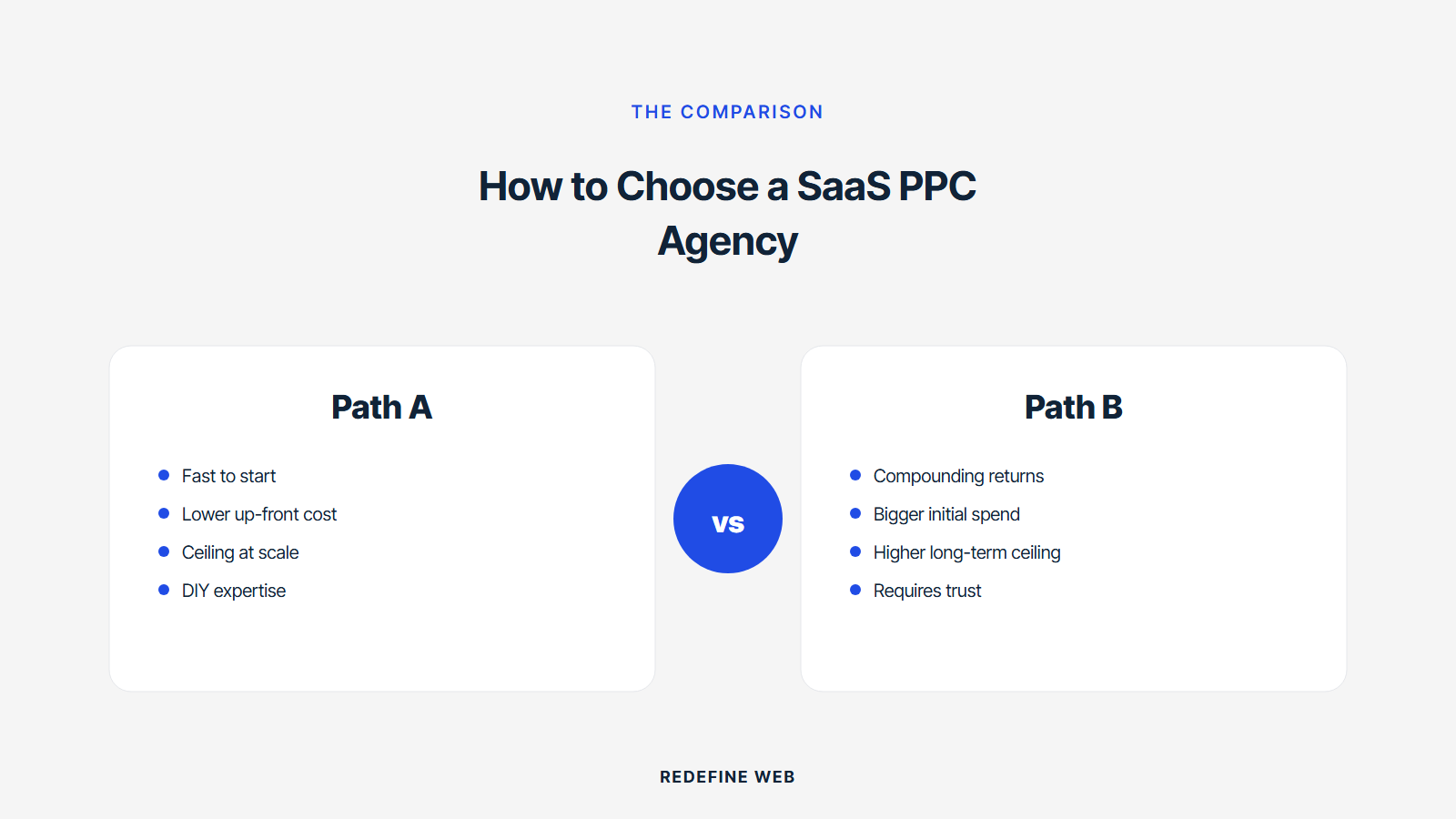
The problems hiring wrong ppc agency for saas show up on a predictable timeline. Month two: reporting is thin and vague. Month four: CPL trends look decent but trial-to-paid rate is flat. Month six: the QBR reveals paid channel spending is not tied to MRR growth. Month nine: leadership questions the paid channel viability. Month twelve: you fire the agency and start over.
The wrong-hire timeline is depressingly consistent because the failure modes trace back to the same root cause. The agency measures success against a metric that does not correspond to MRR growth. Every optimization decision then compounds in the wrong direction. Landing page tests optimize for form fills instead of trial-to-paid. Bid strategy optimizes for signup volume instead of retained subscribers. Budget shifts follow CPL improvements that hide worsening trial quality. By month six, the numbers look decent on the dashboard the agency owns and terrible on the dashboard the CFO owns.
The month-six divergence problem
The month-six divergence problem is the classic failure signal. The agency reports CPL down 20 percent quarter over quarter. The CFO reports MRR from paid channel flat or down. Both reports are correct. The gap is what they measure. Cheaper form fills that convert to paid at a lower rate produces flat MRR at lower CPL. That is efficient signup marketing and inefficient revenue marketing. The specialist would have caught the divergence in month three by measuring both views together. The generalist did not have the reporting stack to see the divergence at all.
Sunk cost and re-onboarding cost
Sunk cost from a wrong-agency hire runs about $80,000 to $220,000 for a mid-market SaaS by the time the mismatch surfaces. That covers the retainer, the ad spend the agency misdirected, the internal team hours managing the relationship, and the opportunity cost of channels that did not get built while the agency ran the wrong playbook. Re-onboarding a new agency adds another $40,000 to $60,000 in ramp cost across the first two months. Getting the hire right the first time saves you a full quarter of runway.
The tell we look for on every intro call is how the agency describes their process. Real specialists talk about server-side conversion tracking, offline conversion imports, and LTV-weighted bidding in the first five minutes without any prompting. Fake specialists talk about strategic partnership and full-funnel alignment for twenty minutes without saying anything the client can act on. The gap between those two conversations is worth about $150,000 of avoided regret. If the words you hear on the intro call sound like a pitch deck template, the reporting will look like a pitch deck template too. If the words sound like a Slack message from a growth marketer, the reporting will look like a growth marketer’s dashboard.
SaaS-focused PPC agencies vs general PPC management comparison table
The saas-focused ppc agencies vs general ppc management comparison flattens to a small set of operational differences. Reporting stack. Bid strategy setup. Landing page approach. Weekly cadence. Founder access. Each dimension separates a specialist from a generalist inside 30 days of onboarding.
The comparison table below is the shape we see across most engagements. Not every dimension is deal-breaking, and generalists occasionally win on a specific dimension. What matters is the overall pattern. A specialist wins on four or five of the six dimensions. A generalist wins on one or two. That pattern predicts engagement outcomes better than any single interview answer. Bring this table to your shortlist calls and score each agency across the six dimensions during the first meeting.
| Dimension | SaaS-focused agency | General PPC agency |
|---|---|---|
| Reporting stack | MRR-by-campaign live dashboard, Stripe or Chargebee integrated at day 30 | Google Sheet snapshot monthly, CPL and CTR as headline metrics |
| Bid strategy | Value-based bidding tied to LTV cohort, offline conversion imports live | Target CPA on signup event, browser-only conversion tracking |
| Landing pages | ICP-filtered forms, comparison pages built per competitor term | Generic pricing or contact page, minimal segmentation |
| Weekly cadence | Working session with growth lead, search-term hygiene, creative rotation | Monthly PDF report, quarterly business review |
| Founder access | Direct Slack channel with operator running the account | Account manager mediates all communication with the operator |
| Failure conversations | Specific recent failure with named change to process | Vague reference to challenges without ownership |
Where the two agency shapes overlap
The two agency shapes overlap on Google Ads platform mechanics. Both can build campaigns, write ad copy, and monitor performance. The overlap ends when the conversation moves to what success means. A specialist frames success as MRR sourced from paid. A generalist frames success as CPL improvement. Both are legitimate metrics. Only one predicts SaaS unit economics. For a growth-stage subscription business, that specific difference decides whether the paid channel scales or stalls. Read the specialist’s proposal side by side with the generalist’s. The framing gap is usually visible in the executive summary.
When a generalist actually fits
A generalist agency fits for very early SaaS with under $5,000 monthly ad budget, or for mature SaaS with an in-house paid marketing team that just needs execution support. In both cases, the specialist’s overhead does not pay back. The very early SaaS does not have enough conversion volume to justify complex bid automation. The mature SaaS already has the specialist knowledge in-house and needs an executor, not a strategist. For the vast middle band between $8k and $80k monthly ad spend, specialists win almost every time.
Selection process for how to choose a saas ppc agency
The selection process for how to choose a saas ppc agency runs across three weeks. Week one for sourcing and filtering. Week two for intro calls and shortlist scoring. Week three for reference calls, contract review, and decision. Anything faster and you miss signal. Anything slower and momentum stalls.
Three weeks is the sweet spot for how to choose a saas ppc agency because it forces prioritization without collapsing depth. Week one narrows the initial 40 candidates to 6 through the four filters. Week two runs structured 45-minute intro calls with each of the six against the twelve interview questions. Week three runs reference calls with the top two, contract review with the winner, and the go-decision. Founders who compress the timeline to one week miss key signal. Founders who let it stretch to two months lose the executive sponsorship needed to make the hire happen.
Week one sourcing and filtering
Sourcing runs across three inputs. Peer founders in your funding cohort who have spent more than $500k on paid in the last 12 months. Directory listings like Clutch and G2 filtered to agencies with named SaaS case studies. LinkedIn searches for growth marketers who left in-house SaaS roles for agency roles, because those operators concentrate at the agencies worth interviewing. Cross-reference the three sources. Agencies appearing on two of the three lists are the ones to interview. That process usually takes an afternoon.
Week two intro calls and scoring
Intro calls run 45 minutes with a structured scorecard covering the four filters and the twelve interview questions in the last section. Score each answer 1 to 5. Sum the scores. Rank the six agencies. Top two get the reference call and second interview. The rest get a polite decline. Structured scoring cuts through the pitch charisma that trips up unstructured selection. The agency with the best slides is rarely the agency with the best operators.
Twelve questions to ask on every intro call
The intro call decides more than the pitch deck. Twelve questions, ninety minutes, real signal. The questions ordered from easiest to hardest surface the agency’s comfort level with hard answers. A confident agency answers all twelve without deflecting. A struggling agency deflects on the last four.
These are the same questions we use ourselves when we vet strategic partners, and they are the core of how to choose a saas ppc agency without wasting a quarter. The failure question and the MRR reporting question are the most diagnostic. Any agency that claims to have no recent failure has stopped trying new things, which is a slow death for a marketing operator. Any agency that cannot demo a live MRR dashboard has never actually reported against MRR. Both patterns are disqualifying at the price point a specialist agency commands.
- What is the median client tenure on your active SaaS roster right now
- Show me a live client dashboard with MRR sourced by campaign, redaction is fine
- What is the trial-to-paid rate on your top three active SaaS accounts
- Who runs my account by name and what is their prior SaaS PPC experience
- How do you handle account team continuity when someone leaves
- Walk me through your first 30-day reporting cadence and stack
- What was your most recent SaaS client failure and what did you change after
- How does your pricing tie to scope, team size, and media budget
- How do you charge for media spend and what is the mark-up structure
- Who owns the ad account, creative files, and conversion data at engagement end
- What is your termination clause and notice period
- Which three named SaaS references can I call this week
The failure question in detail
The failure question tells you whether the agency has honest self-awareness. Every agency has lost a client, missed a target, or picked the wrong channel bet. A confident agency has a specific recent story, a clear articulation of what they learned, and a change to the process they implemented afterward. An unconfident agency denies failure or blames the client. Both patterns are disqualifying at a top saas ppc agency price point. The industry gets weird about failure. The best operators talk about it directly and use the failure as a signal for their own new operator hiring.
The termination clause reveals confidence
The termination clause reveals how confident the agency is in their ongoing value. A 30-day notice period is standard and healthy. A 90-day notice period signals the agency knows they will not earn the last month of the contract. A no-cause termination clause with 30 days is the sign of an agency confident enough to let you leave if the work stops delivering. Read the termination clause before you read anything else in the contract. It tells you what the agency believes about their own retention math.
The reference call as the final test
The reference call is the final test before signing. Ask for three named SaaS references that grew MRR through paid in the last twelve months. Not testimonials on the website. Real references you can call this week. If the agency deflects or takes two weeks to schedule, that is your answer on how their calendar runs.
The reference call is the moment where the agency’s real reputation shows up in the room, and it is the last real test in how to choose a saas ppc agency worth signing. A specialist gets you on the phone with a named CMO or founder inside 48 hours. A generalist takes two weeks and produces someone who reads from a script. On the call, ask three specific questions. What did the agency do differently in month two versus month six. What did they miss or get wrong. What would the reference change about the working relationship if they were hiring the agency again today. Honest answers on all three tell you the reference is real and the agency is trusted.
Three questions for the reference call
The three questions above surface what the case study leaves out. What the agency changed between month two and month six tells you whether they iterate on strategy or run one playbook forever. What they missed tells you where their blind spots are. What the reference would change tells you the friction points in the working relationship. Coached references answer the questions with generalities. Real references answer with specifics. The gap is easy to hear in the first 90 seconds of the call.
Automation Anywhere reference pattern
Automation Anywhere is one of the references we point new SaaS prospects to when they want to understand what a real specialist engagement looks like. The account came to Redefine Web paying $1,936 per lead with campaigns chasing conflicting KPIs. We ran an audit-led restructure that split campaigns by goal, rebuilt landing pages with pain-point copy, introduced a free-trial offer to compete against analyst reports, and shifted bid strategy from rank to cost-efficiency. Cost per lead dropped 97 percent to $63, customer acquisition scaled 100x, ad impressions grew 300 percent globally. That is the shape of a specialist engagement, verifiable through the reference. Broader industry benchmarks from Search Engine Journal PPC coverage confirm the CPL ranges we see across SaaS accounts.
Wrapping up how to choose a saas ppc agency
How to choose a saas ppc agency comes down to four filters, twelve interview questions, and one reference call. Rank the finalists on the pattern of their answers, not on the polish of their slides. The right hire compounds. The wrong hire costs 12 months. That is why founders who ask how to choose a saas ppc agency deserve a straight answer, not a slide deck.
If you take one thing from this guide on how to choose a saas ppc agency, take the twelve interview questions and run them on every shortlisted agency. The pattern in the answers will tell you more than any pitch deck. If you take two, add the four filters at the top of your research process, and cut your interview list from forty to six before you spend real time. For the broader shortlist of the best SaaS PPC agencies in 2025, see the companion post. For the tactical playbook once the agency is hired, see our SaaS PPC strategy guide. When you are ready to talk about your specific SaaS growth model, our SaaS PPC services and SaaS marketing agency engagement covers the workflow described above. For further reading, the Google Ads Help on conversion tracking gives you the platform-side view of what value-based bidding requires, and Think with Google search insights covers the industry baseline for search behavior.
Frequently asked questions
How do saas-focused ppc agencies compare to general ppc management?
How do saas-focused ppc agencies compare to general ppc management is the question every founder eventually asks. Short answer, a saas-focused agency understands subscription economics and reports against MRR sourced by campaign, LTV cohort curves, and payback period. A general PPC shop understands click-based optimization and reports against CPL and CTR. Both can run Google Ads. Only the specialist can defend a bid change against a payback-period argument. For a growth-stage SaaS between $8k and $80k monthly ad spend, the specialist typically produces 20 to 40 percent better MRR efficiency because their bid strategy optimizes for retained subscribers rather than raw signups. Below $5k monthly spend, the generalist overhead does not pay back.
What criteria should I use for selecting ppc agency for saas?
The criteria for selecting ppc agency for saas rest on four filters. Named SaaS clients past $5 million ARR, since that revenue band carries the operational complexity that reveals whether the agency understands subscription math. Live MRR-by-campaign reporting in their dashboards, demoed on the intro call with redacted account names. A named team of at least three operators dedicated to your account, with tenure and prior work identified. And a reference call answered inside 48 hours. Applying all four filters cuts 40 candidates to 6 or 7 in an afternoon. Rank the shortlisted 6 on the twelve interview questions in the last section. The winner is usually obvious by the third call.
What are the key features of a good saas ppc agency?
The key features of a good saas ppc agency show up in the first two intro calls. They lead with trial-to-paid rate and sourced MRR, not with cost per lead. They name the operator running your account by name, with tenure and prior SaaS accounts. They price transparently with defined scope, not one flat number. They walk through a recent client failure honestly with a specific process change afterward. Beneath those four features sits a reporting stack tied to CRM, product analytics, and billing platform, plus weekly working sessions with your growth lead. Any agency missing two of the features is a vendor pretending to be a partner.
What are the advantages of specialized saas ppc agencies?
The advantages of specialized saas ppc agencies compound across the engagement. Deep buyer knowledge speeds up landing page and creative iteration. Pre-built reporting stacks tied to Stripe, Chargebee, HubSpot, and Salesforce stand up MRR reporting inside 30 days instead of 90. A talent bench of operators who have run five to twenty SaaS accounts before yours means the pattern recognition compresses your learning curve. Specialists write ad copy in the ICP language on day one instead of finding it through six weeks of testing. Specialists know the negative keyword categories that drain SaaS budgets instead of adding negatives one by one from search-term data. Each advantage adds 30 to 60 days of compressed learning per quarter.
What problems come from hiring the wrong ppc agency for saas?
The problems hiring wrong ppc agency for saas show up on a predictable timeline. Month two, reporting is thin and vague. Month four, CPL trends look decent but trial-to-paid rate is flat. Month six, the QBR reveals paid channel spending is not tied to MRR growth. Month nine, leadership questions the paid channel viability. Month twelve, you fire the agency and start over. Sunk cost from a wrong-agency hire runs about $80,000 to $220,000 for a mid-market SaaS by the time the mismatch surfaces. Re-onboarding a new agency adds another $40,000 to $60,000 in ramp cost across the first two months. Getting the hire right the first time saves you a quarter of runway.
When does a saas ppc agency vs general digital marketing agency comparison favor the generalist?
The saas ppc agency vs general digital marketing agency comparison favors the generalist at three specific stages. Pre-seed to seed SaaS with $2,000 to $5,000 monthly budget and no in-house marketer, because there is not enough conversion volume to justify complex bid automation. Post-Series C SaaS with $80k plus monthly paid budget and a mature operational stack that can absorb multi-channel coordination, because integration payoff is real at that scale. And any stage where the client explicitly wants one throat to choke and is willing to trade depth for consolidation. Between seed and Series C, specialist agencies for paid, SEO, and content usually deliver 20 to 40 percent better efficiency per channel.
How long does the process of how to choose a saas ppc agency take?
How to choose a saas ppc agency runs across three weeks in the sweet spot. Week one for sourcing and filtering, using peer founders, Clutch and G2 listings, and LinkedIn searches for growth marketers who joined agencies. Cross-reference the sources to build a shortlist of 6 agencies from an initial pool of 40. Week two for structured 45-minute intro calls against the twelve interview questions, scored 1 to 5 per answer. Week three for reference calls with the top two, contract review with the winner, and the go-decision. Faster than three weeks and you miss signal. Slower than three weeks and executive sponsorship stalls.
Book your free 30-minute strategy call.
No spam, no sales rep. We use your email to schedule your call with a senior strategist. That is it.
More from the blog
View all articles → PPC
PPC Healthcare PPC Advertising Channels Compliance and Targeting
Read article PPC
PPC Dental Facebook Ads Guide for Practices That Book Patients
Read article PPC
PPC