
Book More Patients With Instagram Ads for Dental Clinics
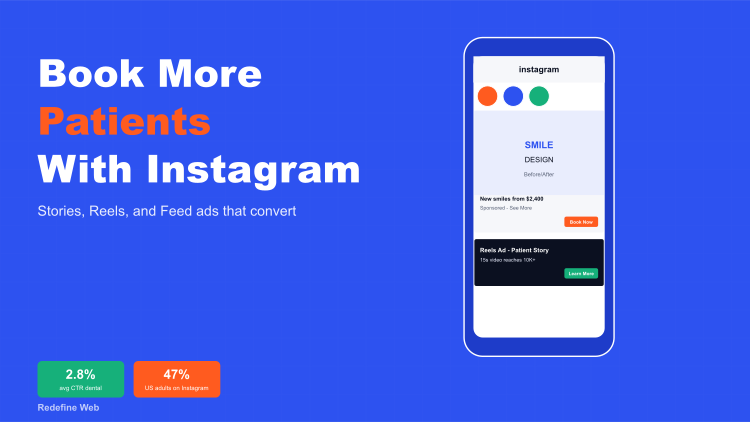
Instagram ads for dental clinics give you direct access to the 35-50 age bracket that books the most cosmetic and restorative treatment. The platform’s visual-first format rewards practices with real patient results to show. If you’ve got before-and-after photos and a dentist willing to shoot a 30-second video, Instagram can fill a cosmetic schedule faster than most other paid channels at equivalent spend.
[key_takeaways]
Instagram Reels ads currently produce the lowest CPL of any Instagram placement for dental clinics, outperforming Stories and Feed in most markets. Cosmetic dentistry posts, whitening offers, and Invisalign content perform best in Instagram Feed and Stories placements. Instagram shopping demographics skew 25-45, making it a strong channel for Invisalign, veneers, and whitening, but less effective for implants targeted to 55-plus patients. Video creative earns more reach than static images at the same daily budget across all Instagram placements. Running Instagram ads from the dental practice account, not the Meta Ads Manager business page, produces higher engagement rates because it looks organic.
[/key_takeaways]
Instagram Ads for Dental Clinics vs. Facebook Ads
Instagram and Facebook ads run from the same Meta Ads Manager account, but they reach different audiences in different mindsets. Understanding the difference shapes your creative, your targeting, and your offer.
| Dimension | Facebook Ads | Instagram Ads |
|---|---|---|
| Core age bracket | 35-65 skews older | 25-45 skews younger |
| Content mindset | Browsing, reading, news | Visual inspiration, discovery |
| Best dental procedures | Implants, dentures, general new patient | Invisalign, veneers, whitening, cosmetic |
| Creative that wins | Video, lead forms, carousel | Reels, Stories, before-and-after carousels |
| Typical dental CPL | $25-$80 | $30-$90 |
| Ad review sensitivity | Moderate for dental | Similar to Facebook, same policies |
For most dental clinics, the right approach is to run both platforms from the same campaign with separate placements. Meta’s automatic placements feature lets the algorithm allocate budget to whichever placement earns the cheapest results. The catch: if you let Meta auto-allocate, check the placement breakdown weekly. Audience Network placements (outside Facebook and Instagram) often produce cheap leads that your front desk can’t convert. Exclude them.
Instagram Placement Strategy for Dental Clinics
Instagram has three main placement types for dental ads. Each works differently.
Reels ads
Reels is Instagram’s highest-reach placement right now. Meta pushes Reels content to non-followers, which gives dental clinics exposure to cold audiences at lower CPM than Feed. A 15-30 second Reels ad that looks native (vertical format, captions, no heavy branding in the first 3 seconds) earns significantly more views and click-throughs than a produced brand video in the same slot.
The first 3 seconds of a Reels ad determine whether someone watches the rest. Lead with the visual or the question, not your logo. “Before and after: three missing teeth replaced in two months” with the image in frame immediately outperforms “Hi, I’m Dr. Smith from ABC Dental…” as an opener.
Stories ads
Stories ads run between users’ Stories and are full-screen vertical. They’re fast. Users swipe through Stories quickly and your ad lasts 5-15 seconds. The swipe-up (now “Tap to learn more”) CTA drives traffic to a landing page or opens a lead form.
Stories work best for time-limited offers. “New patient exam this month, specific offer amount.” The ephemeral format matches the offer urgency. Keep text minimal. The image or video does the work. Put one clear CTA at the bottom and nothing else.
Feed ads
Feed ads run in the main Instagram scroll. They look like organic posts but carry a “Sponsored” label. Before-and-after carousels work exceptionally well here. Swipeable carousels showing multiple patient transformations earn more engagement per impression than single static images and give you more real estate to tell the story.
Feed placement also works for social-proof posts: a real patient photo with a genuine caption about their experience, linked to a lead form or consultation booking page.
The dental social media ads post covers how Instagram placements compare across organic and paid in terms of reach and patient acquisition cost.
Creative Formats That Work for Dental Instagram Ads
Instagram is a visual platform, and dental has some of the strongest visual content potential in any service vertical. Before-and-after results, confident patient portraits, and short procedure explanations all perform well. Here’s the breakdown by format:
Before-and-after carousels
Show 3-5 patient transformations in one carousel. Each card: one before, one after, brief case note. Cosmetic and restorative cases work best here. Whitening, veneers, Invisalign, implants. Label each case clearly. “Invisalign treatment, 14 months.” “Full-arch implant restoration, 3 visits.” Specificity signals credibility.
Dentist-to-camera Reels
A dentist explaining a procedure or answering a common question on camera, vertical format, 30-60 seconds, with captions. “Three questions people always ask before their first Invisalign consultation” generates strong watch time and saves the questions for the end to keep people watching. The conversational format builds trust faster than any produced creative.
Patient Stories
If you can get a patient willing to talk on camera for 30 seconds, this creative format produces the highest consult conversion rate of anything in Instagram dental ads. Real people, real words, specific results. “I was nervous about the implant surgery, but I was back at work the same day.” That one sentence answers a fear that’s holding back dozens of prospective patients in your area.
Audience Targeting for Instagram Dental Ads
Instagram shares Meta’s full targeting infrastructure. For dental clinics, the most effective Instagram audience layers:
- Core demographic: Ages 25-45, 5-15 mile radius, household income top 40% for cosmetic procedures
- Life events: Engaged (perfect for whitening and Invisalign pre-wedding), new parent (family dentistry and pediatric)
- Custom Audience retargeting: Instagram profile visitors, people who engaged with your posts or ads, website visitors
- Lookalike: 1-2% lookalike from your existing cosmetic patient list, constrained to metro area
One targeting consideration unique to Instagram: the platform’s user base is younger than Facebook’s. Implant targeting for ages 55-70 performs better on Facebook placements. Invisalign and cosmetic targeting for ages 25-40 performs better on Instagram placements. Running both platforms with placement-specific creative produces better overall results than splitting one creative across both.
What Scannable Showed Us About Meta Audience Precision
The Meta targeting mechanics that drive dental clinic Instagram ads are the same ones that work across industries. Scannable, an environmental asset SaaS, used Meta’s targeting to turn niche audience outreach into 450x more webinar leads, a 92% lower CPL, and 7 new clients in 6 months.
The key: tight audience segmentation instead of broad interest targeting. Scannable’s prior campaigns targeted generic “environment” and “sustainability” interest categories. We rebuilt around specific behavioral and professional targeting that matched their actual buyer profile. CPL dropped from over $200 to under $20.
For dental clinics running Instagram ads, the same principle applies. “People interested in dentistry” is the equivalent of targeting “environment.” It’s too broad and mostly wrong. Targeting homeowners aged 28-42 who recently got engaged and live within 8 miles of your practice is the equivalent of Scannable’s professional audience layer. The difference in CPL is real and consistent.
Campaign Structure and Budget for Dental Instagram Ads
A practical campaign structure for a dental clinic running Instagram ads for the first time:
- Campaign 1 – Cosmetic awareness: Reels ad to cold audience (25-45, geographic radius, lifestyle targeting). Objective: video views. Budget: $20-$30/day.
- Campaign 2 – Retargeting warm audience: Before-and-after carousel to video viewers and page visitors. Objective: traffic or engagement. Budget: $15-$20/day.
- Campaign 3 – Lead generation: Stories lead form to retargeting audiences plus lookalike. Objective: leads. Budget: $35-$60/day.
Total: $70-$110/day, $2,100-$3,300/month. This covers the full funnel from cold to converted. Expect 4-6 weeks before the lead generation campaign exits the learning phase and CPL stabilizes.
The targeting dental patients with Meta ads post covers the audience structure across both Facebook and Instagram in detail, with specific CPL benchmarks by procedure type.
The dental PPC management post covers how to integrate Instagram ad results into your overall paid media reporting alongside Google Ads data.
Instagram Ad Policies for Dental Clinics
Instagram (through Meta) has specific policies that affect dental ads. Know these before you run:
- Before-and-after restrictions: Meta’s policies restrict before-and-after imagery in the context of “ideal or perfect” physical appearance. Factual dental case documentation (replacing missing teeth, straightening teeth) has historically been permitted. Avoid language like “perfect smile” or “flawless results.” Use clinical terminology and specific case descriptions.
- Health claims: Ads cannot make unsubstantiated health claims. “Dental implants prevent bone loss” needs to be framed carefully. Factual procedural information is fine. Guaranteed outcomes are not.
- HIPAA: Don’t include patient identifiers in ad content without written consent. Your patient release form should cover digital marketing use of before-and-after photos explicitly.
Meta reviews dental ads in the Personal Health and Appearance category. Expect 24-48 hour review times and occasional holds even on compliant ads. Build review time into your campaign launch schedule.
The dental marketing hub covers our full paid media setup for clinics, including compliance review in the Meta ad creation process.
Frequently Asked Questions
Do Instagram ads for dental clinics work for general family dentistry?
Instagram ads for dental clinics work for general dentistry, but they work better for cosmetic and aesthetic procedures where the visual result is the selling point. For general new patient acquisition (cleanings, checkups, family plans), Facebook placements tend to produce lower CPL than Instagram because Facebook’s older demographic is more likely to be actively seeking a new dentist. Instagram performs best when the creative shows visible transformation, which general dentistry offers less of. Run both platforms and let the placement breakdown data tell you where your specific practice’s budget performs best.
What is the average cost per lead for Instagram dental ads?
Instagram ads for dental clinics typically produce CPL of $30-$90 depending on procedure type, geographic market, and creative quality. Cosmetic procedures like Invisalign and veneers tend to produce CPL of $40-$80. General new patient campaigns run $25-$55. The lower end of the range comes from well-optimized Reels campaigns with strong creative and tight audience targeting. The higher end reflects competitive urban markets with broad targeting.
Should I use Instagram Stories or Reels for dental clinic ads?
For most dental clinics, Reels currently produce better results than Stories for awareness and consideration objectives. Reels reach non-followers through Meta’s content discovery algorithm, giving you organic-style distribution at paid-media scale. Stories are better for time-limited offers and retargeting warm audiences who already know your practice. A full Instagram dental campaign uses both: Reels for cold audience awareness, Stories for retargeting and conversion. Don’t choose one exclusively.
How do I measure Instagram ad performance for a dental clinic?
Primary metrics for Instagram dental ads: cost per lead (CPL), click-through rate (benchmark 1.5-3.5% for dental), and lead-to-appointment rate. Secondary: video view rate (benchmark 15-25% watching to 50% of video), engagement rate, and frequency. Track these metrics weekly by placement to understand whether Instagram, Facebook, Stories, or Reels is producing the best results for your specific practice. Don’t optimize based on impressions or reach alone. Those metrics don’t fill the schedule.
How long does it take for Instagram dental ads to produce bookings?
Instagram ads for dental clinics in a three-stage funnel typically produce the first booked consultations in weeks 3-4. Stage one video runs for 2 weeks to build warm audiences. Stage two retargeting runs in weeks 2-4. Stage three lead generation begins producing appointments in weeks 3-6 as the audience pools grow and the algorithm exits the learning phase. Expect to assess real CPL after 6-8 weeks of running, not after the first week.
See how we run Instagram ad campaigns that book patients, not just impressions. The dental marketing hub covers our full paid social strategy for dental clinics across every procedure type.
Book your free 30-minute strategy call.
No spam, no sales rep. We use your email to schedule your call with a senior strategist. That is it.
More from the blog
View all articles → PPC
PPC Home Services PPC Marketing: What a Strong Campaign Looks Like
Read article PPC
PPC PPC for Home Service Businesses: How to Lower Cost Per Lead
Read article PPC
PPC