
Marketing Tools for Chiropractors That Actually Book More Patients
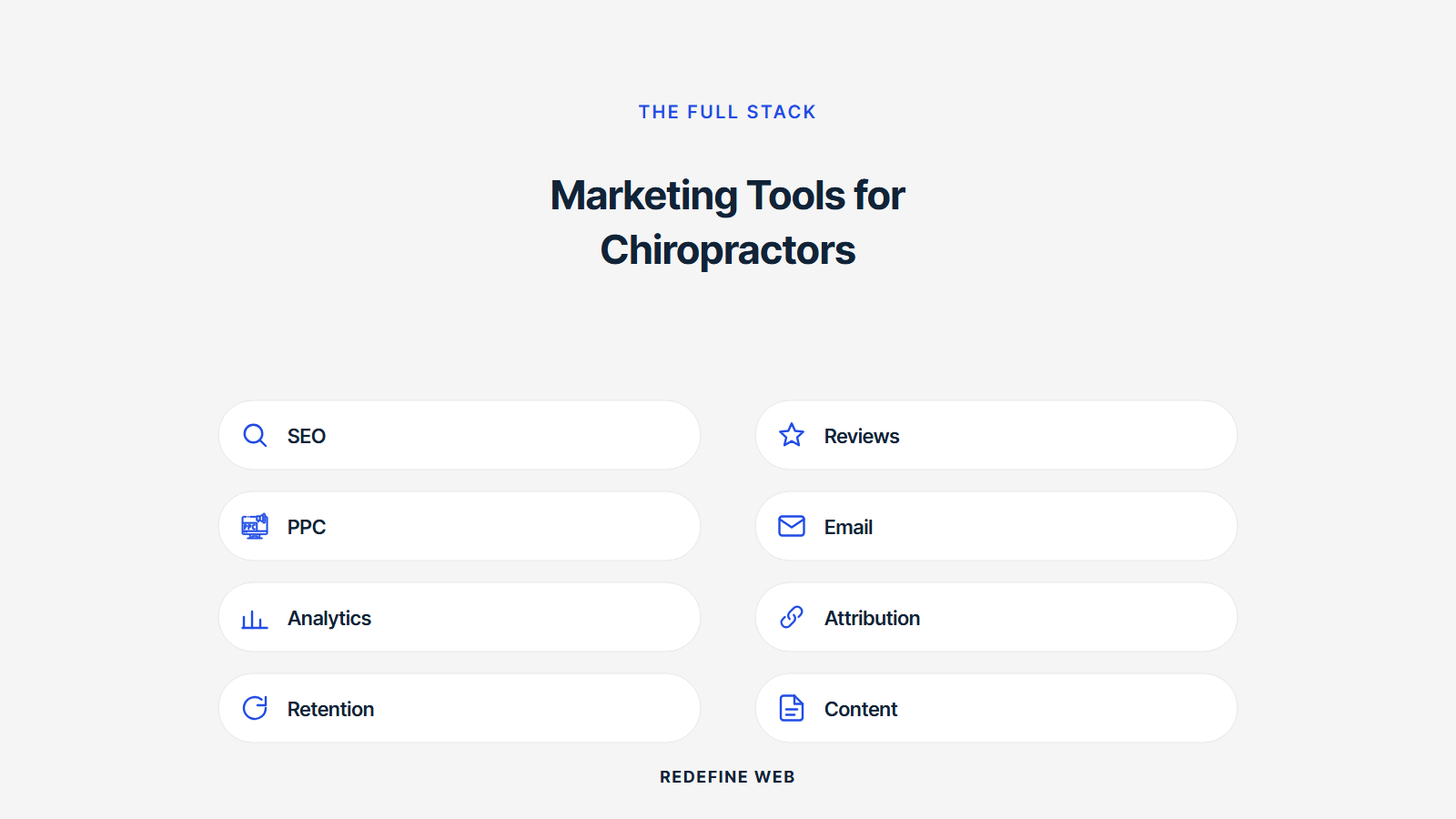
- Stack has seven layers. Website, GBP, ads, tracking, email, reviews, reactivation.
- Call tracking pays for itself in month one.
- EMR source field is the cheapest attribution tool available.
- Email plus SMS covers reactivation and reminders.
- Budget the tool stack at 8 to 12 percent of ad spend.
- Call tracking and analytics tools that prove ROI
- Email marketing tools for chiropractors that fill the schedule
- Review management tools for chiropractors
- SMS and messaging tools for chiropractors
- Advanced marketing tools for chiropractors past year one
- Marketing tools chiropractors should avoid in year one
- The stack setup order that avoids wasted setup time
- How Redefine Web runs the marketing tools for chiropractors
Marketing tools for chiropractors are only useful if they book a new patient this month. This guide is the working stack we run at independent practices booking 30 to 90 patients a month. Real prices. Real setup times. The tools that pay for themselves inside 30 days and the ones that quietly waste $89 a month for two years. Nothing here needs a developer, and none of the picks require a three-year contract.
You will end this guide with a seven-tool stack, a monthly budget, and a written setup order. Marketing tools for chiropractors work when they are connected, not when they are collected. Owners who add a new SaaS every quarter without wiring it into tracking end up paying for tools that do not talk to each other. The stack below is small on purpose. It covers the whole funnel with less overlap than what most practices already own.
Call tracking and analytics tools that prove ROI
Call tracking is the single highest-use tool in the chiropractic marketing stack. Without it, 40 to 60 percent of new patient calls from Google Ads are invisible in the account. With it, the practice can pause underperforming campaigns weekly instead of monthly, which cuts cost per booked exam by 20 to 40 percent inside 60 days.
The two picks that hold up for chiropractic are CallRail and WhatConverts. Both integrate with Google Ads and GA4. Both let the practice assign different phone numbers to different campaigns, landing pages, and channels. Both record calls (with proper HIPAA-aware handling) and score calls by keyword. CallRail wins on integrations. WhatConverts wins on form tracking. Either is fine.
| Tool | Monthly cost | Best for | Setup time |
|---|---|---|---|
| CallRail | $45 to $145 | Multi-campaign attribution | 2 hours |
| WhatConverts | $30 to $130 | Form plus call tracking | 2 hours |
| Google Voice (free) | $0 | Starter setup under $1,500 ad spend | 30 minutes |
| CallTrackingMetrics | $79 to $299 | Multi-location practices | 4 hours |
GA4 and Search Console are free and non-negotiable
Google Analytics 4 and Google Search Console are free and both critical. GA4 tracks traffic, conversion events, and user flows. Search Console tracks which queries the site ranks for. Both take under 30 minutes to set up. Both feed into Search Central’s analytics documentation. Any practice not running both is guessing about SEO progress.
The EMR source field is the cheapest attribution tool
Add a source field to the EMR intake form. “How did you first hear about us?” Google, referral, sign, drive-by, other. The field costs nothing. It lets the practice pull cost per new patient by channel at the end of every month without cross-referencing four dashboards. Practices that skip it end up in the marketing manager’s office arguing over whether Facebook or Google produced last month’s growth. The answer was on the intake form.
Email marketing tools for chiropractors that fill the schedule
Email is the highest-ROI marketing tool in the chiropractic stack. A reactivation sequence to the 90-day lapsed file books 25 to 55 exams on the first send. The cost of the email tool that sends those messages is $10 to $30 a month for most solo practices. The math is not close.
MailerLite is the pick for practices under 3,000 subscribers. Simple interface, five-message sequences run out of the box, integrates with WordPress natively. ActiveCampaign is the pick above 3,000 or when the practice wants patient tagging, behavioral triggers, and CRM-style workflow. Skip Constant Contact and Mailchimp paid tiers. Both charge more for less on the features chiropractic practices actually use. Read email marketing software for chiropractors for the full software comparison.
What the reactivation sequence actually books
A first send to a lapsed file of 600 to 1,200 patients typically opens at 35 to 45 percent, clicks at 4 to 7 percent, and books 25 to 55 exams within seven days. The math beats every paid channel for those two weeks. After that the file is worked and the returns fall until the next 90-day cohort ages in. Practices that run this quarterly instead of once a year book 100 to 220 extra exams over 12 months at basically zero incremental cost.
The Mailchimp migration trap
Practices already on Mailchimp Standard pay $20 to $75 a month for features they never use and get charged extra for automation. Migrating to MailerLite takes about two hours and saves $180 to $600 a year on a 2,000-subscriber list. The migration is boring and pays for itself in three months. Skip it if the practice is happy. Do it if the bill has drifted up over three years.
Review management tools for chiropractors
Review software automates the request, monitors the platforms, and pushes replies. Practices that use it collect 3 to 8 times more reviews than practices that ask manually. The math on a 4.9-star rating versus a 4.5-star rating is worth 15 to 30 percent more booked exams from the map pack over 12 months.
Two paid picks and one free workflow. Birdeye at $299 a month gives multi-channel review requests, sentiment analysis, and reply automation. Podium at $249 a month combines review requests with a chat widget for the site. The free workflow is a printed QR code at checkout linking to the Google review page, plus a manual weekly reply pass on any new reviews. The free workflow gets 40 percent of the return for zero dollars. Add the paid tool once the practice is booking 60 plus new patients a month.
The review language that moves rank
Reviews mentioning the neighborhood and the specific service outrank generic five-star reviews for local ranking. A patient writing “Dr. Smith helped my sciatica after months of pain, the Highland Park office is right off the parkway” is worth ten generic reviews. Every review tool has a prompt template. Change the default prompt to ask the patient to mention the town and what they came in for.
Why review response templates quietly fail
Templated “Thank you for the kind words” replies applied to every review look robotic and get penalized. Vary the reply. Reference the patient’s specific comment. Keep it under 30 words. A short human reply beats a long templated one every time. Somewhere around review number 200, a practice quietly realizes the reply queue is now a full-time job and hires a virtual assistant for four hours a week. This is fine. That VA is the highest-ROI hire in the marketing stack.
Open your card statement. Any tool under nobody uses is a rounding error. Kill the unused ones first. Most practices carry 3 they forgot about.
SMS and messaging tools for chiropractors
Text messaging is the reminder channel every chiropractic practice needs and most run poorly. Appointment reminders drop no-shows from 12 percent to under 5 percent. Slot-fill texts to the last 30 patients on a slow Tuesday afternoon book 1 to 3 same-day appointments. The tool costs $30 to $60 a month and pays for itself in the first week.
SimpleTexting, EZ Texting, and TextMagic all work for chiropractic. Any of the three is fine. Pick the one that integrates with the EMR the practice already uses. Read SMS marketing for chiropractors for the compliance and consent side.
Consent and compliance basics
Every text tool needs a consent checkbox on the intake form. “Yes, I agree to receive appointment reminders and health tips by text.” Practices that skip this get complaints, fines, and platform bans. TCPA rules apply. HIPAA rules apply to any message referencing treatment or condition. Keep the reminder texts generic. Send condition-specific messaging only through email or through a HIPAA-compliant patient portal.
The Tuesday afternoon slot-fill text
Every Monday at 4 pm, send a text to the last 30 patients who visited saying “We have three open Tuesday afternoon slots tomorrow if you would like a check-in.” That single text fills one to three of the three slots most weeks. Compound that over a year and it is 100 extra adjustments booked at almost zero cost. Simplicity beats sophistication here.
Advanced marketing tools for chiropractors past year one
Once the core seven-tool stack is producing consistently, practices can layer in advanced tools that move specific metrics harder. CRM, marketing automation platforms, SEO software, and heatmap tools all pay off once the base is measurable. Add them one at a time so the practice can attribute the return.
HubSpot Starter at $50 a month adds lead scoring and campaign attribution. Ahrefs Lite at $129 a month gives keyword and backlink data for SEO. Hotjar Free tier gives heatmaps on the top four condition pages. Zapier Starter at $30 a month connects the EMR to the email tool without a developer. Each of these adds visibility. None of them should be the first tool a practice buys.
When to add a CRM to the stack
Above $50,000 monthly production, three plus doctors, or two plus locations. Below any of those thresholds, the EMR plus the email tool is enough. Practices that add HubSpot at $12,000 monthly production spend six months importing data and never see the ROI. The tool is not wrong. The timing is.
SEO software worth the monthly check
Ahrefs Lite at $129 a month is the pick for practices doing content marketing. Semrush Pro at $139 a month is the alternative. Both cover keyword research, competitor analysis, and backlink tracking. Skip them until the practice has published 12 blog posts and needs data to decide which topic to cover next. The Ahrefs keyword research guide is the working reference.
Marketing tools chiropractors should avoid in year one
Some tools sound useful and quietly waste money. The list below has burned every chiropractic client we have audited at some point. Skip these until the core stack is producing consistently for six months.
Loyalty apps at $79 a month. AI content generators bought for $1,200 annual with no editorial oversight. Chatbot builders that add friction to the booking flow. “All in one” marketing platforms that do six things badly instead of one thing well. Any tool sold on a three-year contract with no flexible monthly option. Any tool where the sales rep will not name the price on the first call.
Why all-in-one platforms fail for independent practices
Platforms like PatientPop, Weave, and Solutionreach package website, email, reviews, and reminders into one bill at $400 to $900 a month. The bundle looks convenient. The reality is a mediocre version of every tool with no export path when the practice wants to switch. Every module underperforms the best-in-class tool it replaced. Practices lock in for two years and then pay to migrate off. The best marketing tools for chiropractors are chosen one at a time, not bundled.
The contract terms to never sign
Three-year lock-ins. Auto-renewal without 90-day notice. Data-export fees. Any clause that keeps the practice’s patient list inside the platform. If a marketing tool cannot be canceled with 30 days notice and the data cannot be exported to CSV, walk away. The tool is not worth losing the patient file over.
The stack setup order that avoids wasted setup time
Setting up the seven core marketing tools for chiropractors in the wrong order costs four to six hours of rework. The order below reflects what depends on what. Follow it and the stack is live in 10 to 15 hours over two weeks.
Website first. Then GA4 and Search Console. Then Google Business Profile. Then call tracking (which needs the site tags). Then Google Ads (which needs call tracking and conversion tracking). Then email tool with the reactivation sequence loaded. Then review workflow. Then SMS. Every step depends on the previous step being wired properly. Skipping one step to move faster ends up costing time on the rebuild.
Week one setup plan
Monday: audit the site and fix the top-of-page booking flow. Tuesday: install GA4 and Search Console. Wednesday: claim and fully populate Google Business Profile. Thursday: install CallRail with campaign-specific numbers. Friday: build the four Google Ads campaigns with conversion tracking pointed at CallRail numbers and the booking form. End of week one, the practice can measure new patient sources by channel from day one of any campaign.
Week two setup plan
Monday: import the patient list into MailerLite or ActiveCampaign and set up the five-message reactivation sequence. Tuesday: build the review request workflow and print QR-code cards for the front desk. Wednesday: set up SimpleTexting with the appointment reminder and slot-fill templates. Thursday: launch the reactivation send to the 90-day lapsed cohort. Friday: review the first week of data and adjust the ad campaigns based on cost per booked exam.
How Redefine Web runs the marketing tools for chiropractors
Redefine Web sets up and runs the full seven-tool stack as part of a monthly retainer. Practices come to us with a mix of tools, some working, some not. We audit, consolidate, wire the tracking, and run the campaigns end to end.
We opened the case work with Pain Cure Clinic on the same foundation of tools: education-driven SEO content, condition pages, targeted Google Ads and Facebook ads on the highest-intent conditions, an automated intake and reactivation sequence, and a written referral loop tied to a review workflow. Twelve months later the practice had 205 percent more new appointments, 289 percent more organic traffic, and reviews up 162 percent to a 4.9-star average. The tool stack was not exotic. The wiring was tight.
What a typical tool audit engagement looks like
Two-hour audit of the current stack. Written recommendation on which tools to keep, replace, or add. New tools installed inside two weeks. Tracking wired in week one. Ad campaigns migrated in week two. Retainer starts at $599 per month for the base package and scales with market size and ad spend. Read Marketing plan for chiropractors for the full 90-day plan that wraps around the tool stack.
Which tools to buy first if the budget is tight
Buy MailerLite ($10). Buy CallRail Starter ($45). Everything else on the core stack is free. Skip Birdeye, skip advanced SMS, skip CRMs. Run that lean stack for 90 days. Add the paid review tool and the SMS tool once the reactivation sends and the paid ads are producing consistently. Book a strategy call through the chiropractor marketing services page when the practice is ready to run the full stack with support.
Frequently asked questions
What marketing tools does a chiropractor actually need in year one?
The core year-one stack for a chiropractic practice is seven tools: a WordPress or Webflow site with booking, Google Business Profile, Google Ads, CallRail or a comparable call tracker, an email tool like MailerLite or ActiveCampaign, a review tool like Birdeye or a free Google review workflow, and a text messaging tool for appointment reminders and reactivation. Everything else layers in later. Total monthly cost lands at $180 to $450 depending on ad spend and list size. This is the smallest useful stack for a solo practice trying to book 30 to 60 new patients a month.
How much should a chiropractor budget for marketing tools each month?
Tool costs typically run 8 to 12 percent of monthly ad spend for a chiropractic practice. A practice spending $3,000 a month on Google Ads should budget $240 to $360 on tools including call tracking, email software, review requests, and appointment reminders. Larger multi-doctor practices with 2,000 plus patients on file often reach $600 to $900 a month once patient CRM, marketing automation, and premium analytics get added. The rule is to grow the stack when the practice can measure the return, not before.
Are free marketing tools enough for a chiropractic practice?
Free tools cover about 40 percent of the stack. Google Business Profile is free and essential. Google Analytics 4 and Google Search Console are free and both critical. Mailchimp free tier works for the first 500 patients on the email list. Google reviews cost nothing to request. The gaps free tools leave are call tracking, marketing automation, review workflow at scale, and text messaging. Skip those in month one if the budget is tight, but plan to add them by month three or the schedule stops growing.
What is the best call tracking tool for a chiropractor?
CallRail is the practical default for most independent chiropractic practices. It runs $45 to $145 a month depending on line count, integrates directly with Google Ads and GA4, and lets the practice assign different phone numbers to different campaigns and landing pages. WhatConverts is a strong alternative with tighter form tracking. For practices under $1,500 a month in ad spend, a free Google Voice number plus manual tagging in the EMR source field works fine as a starter setup until the ad spend justifies the tool cost.
Which email tool works best for chiropractic reactivation campaigns?
MailerLite for practices under 3,000 subscribers, ActiveCampaign for practices over 3,000 or any practice that wants CRM-style tagging. MailerLite runs $10 to $30 a month, handles the five-message reactivation sequence, and does not require a developer to set up. ActiveCampaign runs $50 to $200 a month and adds behavioral triggers, patient tagging, and integration with EMR systems through Zapier. Skip Constant Contact and Mailchimp paid tiers. Both charge more for less on the features chiropractic practices actually use.
Do chiropractors need a CRM tool or is the EMR enough?
For solo and two-doctor practices, the EMR plus a well-set-up email tool is enough. Adding a separate CRM creates data silos and doubles the admin work. For practices with 2,000 plus patients, multiple locations, or a growth plan targeting five-figure new patient counts, a marketing CRM like HubSpot Starter or Keap gives referral tracking, campaign attribution, and lead scoring the EMR does not. The decision point is around $50,000 monthly production or three plus doctors.
How long does it take to set up the full chiropractic marketing tool stack?
The core seven-tool stack takes about 10 to 15 hours of setup across two weeks. Google Business Profile takes an hour. Google Ads plus conversion tracking takes three hours. Call tracking installation takes two hours including the site tags. Email tool with the reactivation sequence loaded takes four hours. Review request workflow takes two hours. SMS setup takes an hour. Analytics and Search Console take two hours combined. Practices that try to set it all up in one Sunday afternoon miss half the wiring and spend the next month debugging.
Book your free 30-minute strategy call.
No spam, no sales rep. We use your email to schedule your call with a senior strategist. That is it.
More from the blog
View all articles → Digital Marketing
 Dental Marketing Tips That Compound Into New Patients
Read article Digital Marketing
 Ecommerce Marketing Strategies That Drive Real DTC Revenue
Read article Digital Marketing