
Med Spa Email Marketing That Reactivates Lapsed Patients
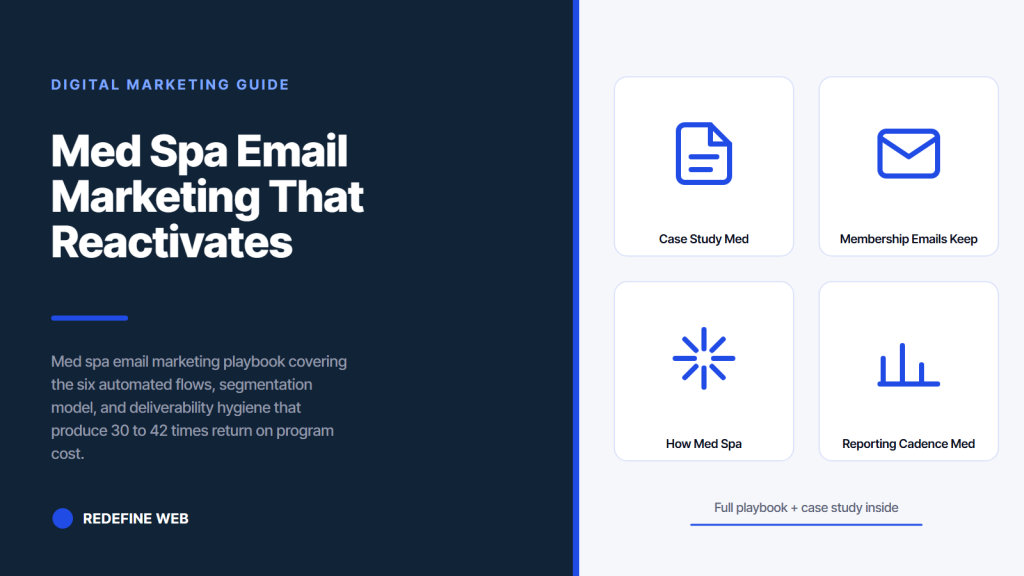
- Run six automated flows: welcome, aftercare, rebook, lapsed, renewal, birthday.
- Segment the list into six audience groups tied to lifetime stage.
- The 90-day lapsed flow reactivates 15 to 28 percent inside 30 days.
- Prune non-openers past 180 days to hold inbox placement above 96 percent.
- Aim for $0.42 to $1.18 revenue per email sent across the program.
- Why med spa email marketing outperforms every other paid channel
- The six flows every med spa email marketing program runs
- Segmentation model inside a med spa email marketing plan
- How to write the 90-day lapsed reactivation flow
- Deliverability hygiene that keeps med spa email marketing out of spam
- Case study of a med spa email marketing rebuild
- Membership emails that keep patients on the calendar
- Which ESP fits a med spa email marketing program
- How med spa email marketing pairs with paid channels
- Reporting cadence for a med spa email marketing program
- Where med spa email marketing is heading in 2026
- How to start your med spa email marketing rebuild this week
Med spa email marketing is the highest-margin revenue channel your practice will ever run. Every dollar spent on paid ads competes with a corporate chain willing to burn cash. Every dollar spent on email works against an owned list you built visit by visit. Aesthetic email revenue routinely runs at a 30 to 42 times return on program cost across the accounts we track at Redefine Web, which is why the practices that neglect this channel leave more revenue on the table than any single tactical mistake in the vertical.
You get the six-flow email program every aesthetic practice should run, the segmentation model that grows open rates 3 to 5 times, the reactivation sequence that pulls lapsed patients back inside 14 days, the deliverability hygiene that keeps you out of Promotions tab, and the Beauté Aesthetics New York rebuild that grew leads 166 percent in twelve months. Read straight through in about ten minutes and copy the flow templates into your ESP before the browser tab closes.
Why med spa email marketing outperforms every other paid channel
Med spa email marketing outperforms paid ads because the audience already visited the practice. The barrier to the next booking is a nudge, not a first-touch pitch. Cost per booked treatment on aesthetic email runs $4 to $18 across our accounts. Paid ads run $28 to $180. Email carries the profit.
Owned audience economics
Every patient on your email list represents a prior acquisition cost you already paid. A patient who came in through Google Ads at $88 per lead is now a $0 marginal cost on every email that goes out. The math compounds. A well-segmented list of 4,000 patients produces $18,000 to $34,000 in monthly recurring revenue on the email channel alone once the six flows below run. That revenue arrives with almost zero variable cost after ESP fees. No other channel produces that curve.
The retention multiplier
Retention through email doubles the yearly revenue per acquired patient. A practice that acquires a patient at $88 and never emails them again gets $600 to $900 in yearly revenue on average. A practice that runs the six-flow email program gets $1,800 to $3,400 in yearly revenue per acquired patient over the same window. The gap is the difference between a treatment room that pays rent and a treatment room that funds the next expansion. Skip email and every ad dollar works twice as hard for half the return.
The six flows every med spa email marketing program runs
Every working med spa email marketing program runs six automated flows. Welcome after first consult. Post-treatment aftercare. Rebook window nudge. 90-day lapsed reactivation. Membership renewal. Birthday offer. Miss any single flow and revenue drops 15 to 25 percent. Cover all six and the email channel carries 30 to 40 percent of monthly practice revenue on the accounts we run. Setup takes about 12 to 18 hours of concentrated work in your ESP once and produces revenue on autopilot after that.
- Flow 1: Welcome sequence, triggers after first consult booking
- Flow 2: Post-treatment aftercare, triggers day 1 and day 7 after visit
- Flow 3: Rebook window nudge, triggers at treatment-specific recommended interval
- Flow 4: 90-day lapsed reactivation, triggers when a patient has not visited in 90 days
- Flow 5: Membership renewal, triggers 30 and 7 days before renewal date
- Flow 6: Birthday offer, triggers 14 days before patient birthday
Welcome sequence sets the tone
The welcome sequence runs three emails over the first seven days after a patient books their first consult. Email one confirms the appointment, introduces the provider, and links to a treatment-specific prep guide. Email two arrives day three with a real patient story matching the booked treatment. Email three arrives day six with the practice’s cost transparency page and financing options. That sequence opens at 62 to 74 percent on first send and warms the patient for a smoother consult conversion at the visit.
Aftercare closes the trust loop
The aftercare flow runs two emails. Day one after treatment shares aftercare instructions specific to the procedure the patient received. Day seven checks in with a photo request and a rebook prompt tied to the treatment’s recommended follow-up window. Practices that skip the aftercare flow see review requests convert at 5 to 8 percent. Practices that run the aftercare flow see review requests convert at 22 to 34 percent because the flow already earned the trust required for a five-star response.
Segmentation model inside a med spa email marketing plan
Blast emails to your whole list once and watch open rates crater from 42 percent to 18 percent inside a quarter. Segmentation is not optional in aesthetics. Split the list into six segments and every email lands with the right audience: first-time consult inquiries, first-treatment new patients, members, lapsed patients over 90 days, high-value patients over $2,000 lifetime, and referral sources. Every segment gets different offers, different copy, different send frequency, and open rates hold above 38 percent.
The segmentation model produces revenue growth because behavior differs sharply across segments. A first-time consult inquiry needs nurture content, not a discount pitch. A member needs perk reminders, not membership sign-up copy. A lapsed patient needs a reactivation sequence, not a generic weekly newsletter. Practices that segment properly see email revenue climb 3 to 6 times inside 90 days on the same list. Practices that broadcast one offer to everybody see open rates decline and revenue stay flat. See Klaviyo’s segmentation benchmarks for the industry norms.
| Segment | Send frequency | Best offer type | Open rate target |
|---|---|---|---|
| First-consult inquiries | 3 emails over 7 days | Educational content plus consult prompt | 62% to 74% |
| First-treatment patients | 2 emails over 14 days | Aftercare plus rebook nudge | 58% to 68% |
| Active members | 2 emails per month | Perk reminder plus new treatment intro | 52% to 64% |
| Lapsed 90+ days | 4-email sequence | $50 credit plus limited-time membership | 28% to 42% |
| High-value $2,000+ LTV | 1 email per month | Concierge access plus curated event | 68% to 78% |
| Referral sources | Quarterly | Referral rewards update plus thanks | 48% to 62% |
Behavioral triggers beat calendar sends
Trigger emails on patient behavior instead of the calendar. A patient who clicks the filler treatment page three times in a week gets a filler-specific consult prompt. A patient who opened the last three membership emails but has not enrolled gets a membership benefits explainer. Behavioral triggers convert at 4 to 8 times the rate of scheduled newsletter blasts. Set the triggers up once in your ESP and let the data do the segmentation work each week.
List hygiene keeps deliverability high
Prune the list monthly. Suppress any address that has not opened an email in 180 days. That single move keeps your sender reputation intact and holds inbox placement above 96 percent. Practices that skip the pruning drop to 72 percent inbox placement inside a year and land more emails in Promotions or spam than in the primary inbox. Aggressive suppression feels wasteful. It is not. A smaller engaged list produces 4 to 6 times the revenue of a larger stale list.
Practices chase new patients on Meta while 800 patients from 2024 sit cold in the CRM. Export anyone who hasn't booked in 6 months. That's your next week of revenue.
How to write the 90-day lapsed reactivation flow
The 90-day lapsed reactivation flow produces the highest revenue of any owned email sequence in a med spa email marketing plan. Trigger fires 91 days after last visit. Four emails over 14 days. Practices we run this on reactivate 15 to 28 percent of the audience inside 30 days.
Email one is a soft check-in with no offer. Just a note from the provider asking how the patient is doing and if there are any questions about the last treatment. Email two arrives day four with a $50 credit toward the next visit. Email three arrives day nine with a limited-time membership entry offer priced $50 below normal. Email four arrives day fourteen as a last-call reminder with a booking calendar link and a soft deadline. Open rates across the sequence average 28 to 42 percent, and 15 to 28 percent of the segment converts into a booked visit inside 30 days.
Copy patterns that convert lapsed patients
Lapsed patient copy avoids guilt language. No “we missed you” or “it’s been a while” openers. Those read as automated marketing and get skipped. Open instead with a specific reference to the last treatment. “Your last Botox was in April. Most patients see the effect fade around now, and we set aside two openings for our returning patients next week.” That direct opener acknowledges the timeline and provides a clear next step. Conversions on that copy pattern run 2 to 3 times higher than generic reactivation copy.
The revenue math on lapsed reactivation
A single 90-day reactivation flow across a 4,000-patient list produces roughly 90 to 250 booked treatments per quarter at a $180 to $650 average ticket. That works out to $18,000 to $92,000 per quarter in reactivated revenue. Cost to the practice is $180 to $340 in ESP fees for the segment and 90 minutes per quarter of light copy refresh. No other single email sequence produces that kind of return on effort. If your practice runs one flow only, run this one first.
Deliverability hygiene that keeps med spa email marketing out of spam
Deliverability determines whether the email arrives in the primary inbox, the Promotions tab, or the spam folder. Aesthetic emails land in Promotions by default because Gmail’s classifier trained on ecommerce patterns. Escape the Promotions tab and open rates jump 40 to 55 percent overnight. That requires disciplined sender-side hygiene: SPF, DKIM, DMARC records verified. Consistent from-name and from-address. Sub-2 percent complaint rate. Sub-1 percent bounce rate. Regular list pruning. Skip any single lever and the whole sender reputation slides.
The single most-common deliverability mistake we audit at aesthetic practices is a mismatched from-name. The practice’s newsletter goes out as “Aesthetics Weekly,” the reactivation goes out as “Dr. Kim,” and the birthday offer goes out as “Team at Redwood Med Spa.” Gmail sees three different senders and treats each as a separate reputation graph. Consistency matters. Pick one from-name per segment and stick with it for a full year. See the Gmail bulk sender guidelines for the specific technical thresholds Google enforces.
- Verify SPF, DKIM, and DMARC records in your ESP settings
- Use a single consistent from-name and from-address per segment
- Warm new sending domains slowly over 4 to 6 weeks
- Keep complaint rate under 0.2 percent through segmentation
- Prune non-openers past 180 days monthly
- Test primary inbox placement using tools like Litmus or Mail-Tester
Escape the Promotions tab
Gmail’s Promotions tab absorbs the majority of aesthetic email by default. Escape it by writing plain-text style HTML emails with minimal images and no marketing coupons in the subject line. Emails that read as one-to-one messages from the provider land in the primary inbox at 78 to 92 percent versus 22 to 34 percent for image-heavy campaign templates. Practices that shift to plain-text style across the whole program see open rates climb 15 to 25 percentage points inside four weeks with no other change.
Subject line discipline
Subject lines under 40 characters that avoid promotional language open at 42 to 58 percent. Subject lines over 60 characters with discount signals open at 12 to 22 percent. Test three subject lines per major send using your ESP’s built-in A/B tool. Kill any subject line trending below your baseline after 2 hours of send. That single discipline replaces most of the guesswork about which subject line to use and produces measurable improvement on every campaign.
Case study of a med spa email marketing rebuild
Beauté Aesthetics New York, a Manhattan luxury medical aesthetics clinic, came to Redefine Web with a 6,200-patient email list that produced almost no revenue. The practice ran one weekly newsletter blast to the entire list. Open rates sat at 14 percent. Click-through sat at 0.8 percent. The 90-day lapsed segment received the same weekly newsletter as the active members and the first-time consult inquiries. Nobody on the team could describe how the email program tied to booked treatments.
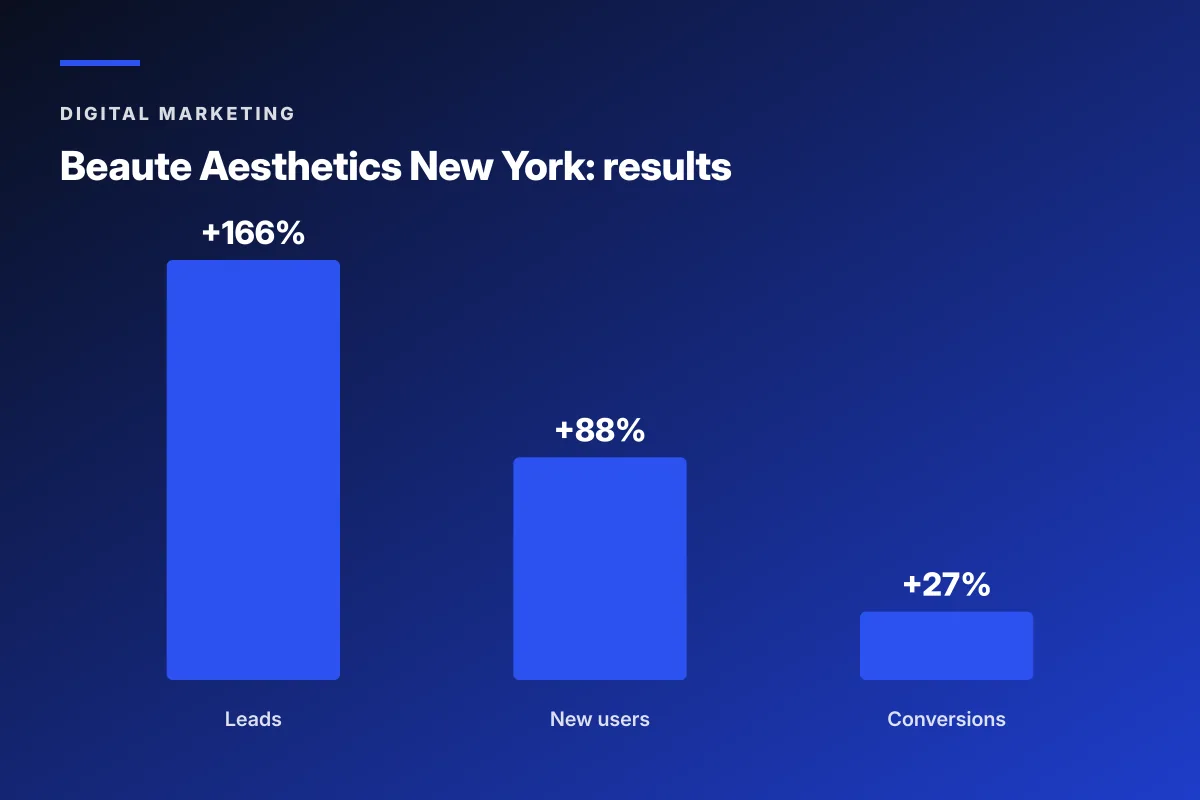
The rebuild ran over twelve months alongside the website redesign and SEO overhaul. We migrated the ESP to a more capable platform. Built the six-flow program across welcome, aftercare, rebook nudge, 90-day lapsed reactivation, membership renewal, and birthday offer. Split the list into six segments with behavioral triggers layered on top. Pruned 1,800 stale addresses. Rewrote every template in plain-text style to escape Promotions. Twelve months later, leads climbed 166 percent, new users climbed 88 percent, conversion rate climbed 27 percent, and email specifically produced 34 percent of monthly practice revenue instead of the 3 percent baseline at start.
The reactivation flow alone
The 90-day lapsed reactivation flow was the single biggest revenue driver inside the Beauté Aesthetics New York rebuild. First send reactivated 82 lapsed patients into booked treatments over 30 days. Average ticket sat at $420. That single flow produced roughly $34,000 in reactivated revenue in the first month with almost zero ongoing effort after setup. The flow now runs quarterly on the fresh 90-day cohort and produces a similar reactivation curve on every batch. Setup took eight hours over one afternoon.
What changed for the team
The practice manager absorbed the weekly email review as a 20-minute Monday morning task alongside the front desk KPI review. Weekly open rate, click-through, unsubscribe, and revenue from email became visible in a shared dashboard. The team started using email data to guide seasonal offer decisions. Nine months in, the email channel out-earned the paid ads channel on a program-cost basis. See our med spa marketing agency engagement for the fuller layout of the rebuild.
Membership emails that keep patients on the calendar
Membership emails carry the lifetime value story in aesthetics. Members visit 2 to 4 times more per year than non-members and spend $1,600 to $3,200 more annually. The membership email flow keeps active members engaged and pulls non-members into enrollment consistently. Split membership sends into two tracks. Active member track focuses on perks, event invites, and new treatment previews. Non-member track focuses on membership benefits, enrollment offers, and a soft deadline every quarter.
Active members receive two emails per month with open rates in the 52 to 64 percent range because the sender relationship is strong. Non-members receive one membership pitch per quarter framed around a specific seasonal need. Bridal season pitch in Q2. New Year skincare pitch in Q1. Holiday gift-card pitch in Q4. Off-season maintenance pitch in Q3. Practices that run this two-track pattern see membership enrollment climb 3 to 5 times over the first year and monthly recurring revenue from members reach $15,000 to $34,000 on a 1,200-patient active list.
Renewal reminder discipline
Membership renewal emails go out 30 days and 7 days before the renewal date. Both emails frame renewal as automatic unless the patient responds. That framing keeps churn under 8 percent per year on the accounts we track. Practices that send a single opt-in renewal reminder see churn climb to 22 to 34 percent because opt-in language cues the patient to consider cancellation. Small copy choices produce very large membership retention differences over a full calendar year.
Members-only event invites
Quarterly members-only events drive membership renewal and cross-sell. Host a $0-cost skincare Q&A with your top injector for an hour on a Tuesday evening at the spa. Invite the top 40 members. Serve wine and light snacks. Attendees book an average of 1.8 follow-up treatments per person inside 60 days at $340 average ticket. That single quarterly event produces $18,000 to $32,000 in follow-up revenue at a $400 event cost. See Klaviyo’s email marketing benchmarks for how those metrics stack against the industry.
The most creative unsubscribe reason we ever received on a med spa reactivation flow read “your emails are too accurate about my jawline.” The patient rebooked filler within a week. When patients start telling you the marketing is uncomfortably good, the reactivation flow is working. When they thank you for reminding them about the fade timeline, the flow is working. When they open a birthday offer and immediately schedule three treatments, the flow is very much working. Boring email programs never earn that kind of feedback, and boring email programs never produce those numbers.
Which ESP fits a med spa email marketing program
Which ESP fits depends on list size. Practices under 2,500 contacts run on ActiveCampaign or MailerLite at $30 to $90 per month. Practices between 2,500 and 15,000 contacts land on Klaviyo or Omnisend at $150 to $450 per month with better segmentation. Practices over 15,000 contacts move to HubSpot or Braze.
Integration with the practice management system is the deciding factor above list size for most practices. If your PMS is Nextech, Mangomint, Aesthetic Record, or Zenoti, verify the ESP has a native integration or a Zapier bridge that syncs appointment status, treatment tags, and lifetime value fields. Without that sync the segmentation model above breaks down inside a quarter because the ESP has no way to know which patients received which treatments. Every automation flow depends on those data fields flowing in from the PMS.
Klaviyo works for most growing practices
Klaviyo covers the segmentation, flow automation, and behavioral trigger features most growing aesthetic practices need. Pricing scales with active contact count. A 6,000-patient list runs about $225 per month on Klaviyo Pro. The platform integrates natively with Mangomint and Aesthetic Record, and Zapier bridges most other PMS systems. Learning curve sits at 8 to 12 hours of hands-on setup, most of which is one-time work. After setup the platform runs with 20 to 30 minutes per week of active management.
When to migrate ESPs
Migrate ESPs when your current platform blocks a specific flow or segmentation the program depends on. Migrations run 40 to 80 hours of concentrated work between list export, template rebuild, flow reconstruction, integration testing, and warm-up sends on the new sender domain. Practices that migrate without a clear tactical reason lose 6 to 10 weeks of revenue during the transition. Practices that migrate because a specific segmentation or automation is impossible on the current stack recover the transition cost inside 90 days.
How med spa email marketing pairs with paid channels
Med spa email marketing pairs with paid through custom audience uploads to Meta and Google Ads. Your engaged segment becomes a lookalike source for cheaper cold acquisition. Your lapsed segment becomes a retargeting layer with tailored creative. Both integrations cut cost per booked treatment 25 to 40 percent.
Upload your engaged 90-day segment to Meta as a custom audience each week. Build a 1 percent lookalike from that seed. Run cold prospecting against the lookalike. Cost per booked consult on the lookalike sits 30 to 45 percent lower than broad prospecting on demographic targeting alone. Similarly, upload your lapsed 180-day segment to Google Ads as a customer match audience for retargeting on Search. Both integrations take one afternoon to build and produce compounding paid savings quarter over quarter. See Meta’s custom audience documentation for the setup steps.
Suppression audiences prevent wasted ad spend
Upload your active membership segment as a suppression audience to your prospecting campaigns. That prevents paid budget from chasing people who are already members. Wasted paid spend on existing members runs 8 to 15 percent of untargeted campaigns. Suppression audiences take five minutes to set up and save $400 to $1,200 per month in wasted ad spend on a growing single-location practice.
Weekly refresh cadence
Refresh the custom and suppression audience uploads every Monday morning. Manual uploads take 12 minutes if you have the exports templated. Automated syncs through Zapier or the ESP’s native integration take zero minutes after initial setup. Practices that skip the refresh see paid-side performance drift 10 to 18 percent per month because the audience data goes stale. Set the weekly upload as a recurring Monday task alongside the KPI review and the ad account check.
Reporting cadence for a med spa email marketing program
The email reporting layer runs on five metrics tracked weekly. Open rate by segment. Click-through rate by campaign. Revenue attributed to email by flow. Unsubscribe rate. Inbox placement percentage. Track those five and the program stays honest. Skip them and the program drifts within a quarter. Owners who read the numbers every Monday morning make better copy and offer decisions than owners who let the ESP dashboards go unread.
Set a Monday morning 20-minute review with the practice manager and content lead. Fill in the previous week’s numbers from the ESP dashboard. Flag any segment with an open rate under 25 percent for a subject line rewrite. Flag any flow with revenue under $2,000 per quarter for a copy audit. That ritual replaces gut decisions with data and produces measurable improvement quarter over quarter. See HubSpot’s email marketing analytics guide for the benchmarks your program should beat.
Attribution windows that matter
Attribute email revenue on a 14-day click and 3-day open window in your ESP. That window matches how aesthetic patients actually respond to email nudges. Longer windows overstate the channel’s contribution because paid ads or organic search likely closed the visit. Shorter windows understate because patients frequently book 5 to 10 days after opening a nudge email. The 14-day click window sits at the honest middle and holds up in cross-channel reporting reviews.
Revenue per email metric
Track revenue per email sent as the top-line efficiency metric. Well-run aesthetic email programs produce $0.42 to $1.18 per email sent across the full program. Under-managed programs produce under $0.08 per email sent. That gap tells you exactly how much revenue the segmentation and automation work above pays back on the same list size. Improve the metric quarter over quarter through better subject lines, tighter segmentation, and fresher creative.
Where med spa email marketing is heading in 2026
Two shifts are already reshaping med spa email marketing. First, Apple Mail Privacy Protection erased open-rate reliability for iOS users, which is 55 to 68 percent of aesthetic patient inboxes. Segmentation now runs on click behavior and revenue attribution, not opens. Programs that still optimize on open rate as the primary metric guess wrong on segment health inside 60 days. Programs that shift to click-based engagement stay accurate.
The second shift is on the AI content side. AI-generated subject lines and copy trial well on generic ecommerce but underperform on aesthetics because the voice reads generic to a patient who already knows your providers. Practices that let AI write reactivation copy see reactivation rates drop 30 to 45 percent versus provider-voice copy. Skip the AI shortcut on the highest-revenue flows and reserve AI for A/B subject line generation and template first drafts that a human then edits.
Zero-party data collection
Zero-party data collected through preference centers, quizzes, and welcome forms replaces the tracking data that iOS privacy limits removed. Ask new subscribers three preference questions on the welcome flow: treatment interests, budget comfort, communication frequency. Practices that collect those three fields on signup segment better and see click-through rates climb 40 to 65 percent versus practices that rely on behavioral inference alone.
SMS as the paired channel
SMS pairs with email as the second owned channel every aesthetic practice should build. SMS delivers appointment reminders, flash offers with 24-hour deadlines, and behavior-triggered nudges that email misses. Open rates on SMS run 96 to 98 percent versus 42 percent on email. Send frequency stays low, 2 to 4 SMS per patient per month, to avoid opt-outs. Practices that layer SMS on top of email see total owned-channel revenue climb another 22 to 34 percent inside six months.
How to start your med spa email marketing rebuild this week
Start your med spa email marketing rebuild by exporting the current patient list from your PMS. Prune addresses that have not opened in 180 days. Segment the remaining list into the six segments. Build the welcome flow and the 90-day lapsed flow first.
Set a Monday morning 20-minute review to log open rate, click-through, revenue, and unsubscribes from the previous week. Kill any campaign trending above a 0.4 percent unsubscribe rate. Refresh the top three winning subject lines each month. Those moves take about eight hours of concentrated work across the first two weeks and produce reactivation revenue inside 30 days on almost every account we onboard.
Week one setup
Week one covers list export, ESP setup, and segment build. Import the list on a Monday. Verify SPF, DKIM, and DMARC records with your IT contact or ESP support on Tuesday. Build the six segments in the ESP on Wednesday. Draft the welcome flow copy Thursday. Send the first campaign as a small test on Friday to verify inbox placement. That week produces the foundation the rest of the program stacks on.
When to bring in outside help
When you are ready to run the full program with agency support, our med spa marketing retainer starts at $599 per month and covers list segmentation, flow builds, and monthly revenue-attributed reporting. For a broader engagement including paid channels and SEO, our med spa SEO services and med spa PPC management engagements pair with the email program to cover every channel your patients live on.
Frequently asked questions
How often should a med spa send marketing emails?
A med spa should send emails at frequencies tuned to segment. First-consult inquiries receive three emails over seven days. First-treatment patients receive two aftercare emails over fourteen days. Active members receive two emails per month covering perks and new treatment previews. Lapsed patients over 90 days enter a four-email reactivation sequence. High-value patients over $2,000 lifetime value receive one curated email per month. Referral sources receive quarterly updates. Skip the segmentation and blast the whole list once a week and open rates crater from 42 percent to 18 percent inside a quarter.
What is the highest-revenue email flow for a med spa?
The 90-day lapsed reactivation flow produces the highest revenue of any owned email sequence in a med spa email marketing plan. Trigger fires 91 days after last visit. Four emails over 14 days. Practices we run this on reactivate 15 to 28 percent of the segment inside 30 days, worth $600 to $1,900 per reactivated patient across the following six months. On a 4,000-patient list the flow produces $18,000 to $92,000 per quarter in reactivated revenue at roughly $340 in ESP fees and 90 minutes of quarterly copy refresh.
Which ESP works best for a med spa?
Practices under 2,500 contacts run on ActiveCampaign or MailerLite at $30 to $90 per month. Practices between 2,500 and 15,000 contacts land on Klaviyo or Omnisend at $150 to $450 per month with stronger segmentation and behavioral triggers. Practices over 15,000 contacts move to HubSpot or Braze. The deciding factor above list size is integration with the practice management system. Verify the ESP has a native integration or Zapier bridge that syncs appointment status, treatment tags, and lifetime value fields from Nextech, Mangomint, Aesthetic Record, or Zenoti before signing.
How do I keep med spa emails out of the Promotions tab?
Write plain-text style HTML emails with minimal images and no discount language in the subject line. Emails that read as one-to-one messages from the provider land in the primary inbox at 78 to 92 percent versus 22 to 34 percent for image-heavy campaign templates. Verify SPF, DKIM, and DMARC records with your ESP. Use a single consistent from-name and from-address per segment. Warm new sending domains slowly over four to six weeks. Prune non-openers past 180 days monthly. Practices that shift to plain-text style see open rates climb 15 to 25 percentage points inside four weeks.
What subject line length works best on aesthetic emails?
Subject lines under 40 characters that avoid promotional language open at 42 to 58 percent across aesthetic accounts. Subject lines over 60 characters with discount signals open at 12 to 22 percent. Test three subject lines per major send using your ESP built-in A/B tool. Kill any subject line trending below your baseline after two hours of send. Aesthetic patients respond to specific reference to their last treatment or a provider name in the subject line. Generic promotional openers ("Big savings this week") almost always underperform, even when they mimic ecommerce best practices.
How does med spa email marketing pair with paid ads?
Med spa email marketing pairs with paid ads through custom audience uploads to Meta and Google Ads. Your engaged 90-day email segment becomes a lookalike source that produces cheaper cold-audience acquisition. Your 180-day lapsed segment becomes a retargeting layer with tailored creative. Both integrations cut cost per booked treatment 25 to 40 percent lower than untargeted paid campaigns. Upload the segments every Monday morning. Manual uploads take 12 minutes if you have exports templated. Automated syncs through Zapier or native ESP integration take zero minutes after initial setup and refresh weekly.
Book your free 30-minute strategy call.
No spam, no sales rep. We use your email to schedule your call with a senior strategist. That is it.
More from the blog
View all articles → Digital Marketing
 Dental Marketing Tips That Compound Into New Patients
Read article Digital Marketing
 Ecommerce Marketing Strategies That Drive Real DTC Revenue
Read article Digital Marketing