On-Page SEO for Healthcare That Books Real Patients
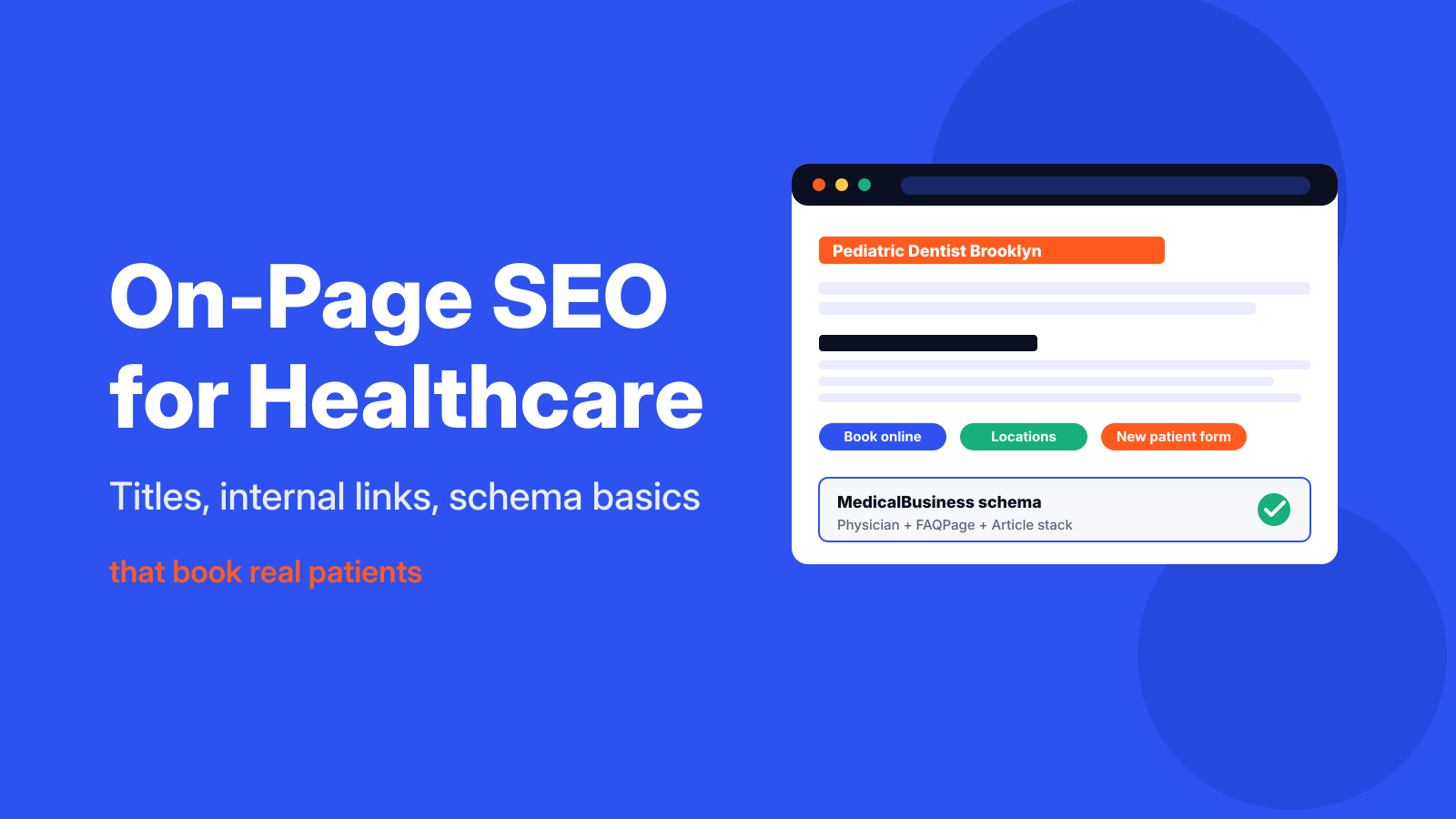
- On-page SEO for healthcare is the layer that turns raw traffic into booked patients, and every H1, meta description, and internal link either helps that conversion or blocks it.
- Title tags and headings work when the primary keyword sits at the front, the location is present when the intent is local, and the promise matches what the page actually delivers.
- Internal links from blog posts and service pages should point at the money pages (booking, insurance, provider bios), not just sideways to other blog posts.
- MedicalBusiness, Physician, FAQPage, and Article schema are the four types a real healthcare site publishes, and none of them ship automatically.
- AI Overviews and People Also Ask lift 40-60 word answers that sit directly under a clear question-style H2, so structure the page to be liftable, not just readable.
On-page SEO for healthcare is the layer between raw traffic and a booked appointment. A dermatology practice can rank on the first page for “eczema treatment brooklyn” and still lose the visit when the title reads like a corporate brochure, the H1 buries the specialty, the booking link is stuck in a footer, and Googlebot never finds the MedicalBusiness schema that would put the practice in a local health panel. On-page SEO fixes all of that at once. The engine is boring in the best way. Title, meta description, H1, H2 pattern, internal links to the money pages, schema stack, and answer-first structure for AI Overviews. Every practice site we audit is missing at least three of those. This guide walks the on-page SEO for healthcare websites playbook exactly the way we run it during a live engagement, with the tickets a real content team can act on.
What on-page SEO for healthcare actually covers
On-page SEO for healthcare is the set of edits that live on the page itself. Title tag, meta description, canonical, H1, H2 subheadings, body copy structure, internal links, image alt text, schema markup, and the answer-first blocks that feed AI Overviews. It sits between technical SEO (crawl, index, speed) and off-page SEO (backlinks, PR). The three layers work together, but on-page is the one a content team can move without a developer sprint on most templates.
The healthcare wrinkle: every on-page decision runs through a HIPAA and E-E-A-T filter. A page that ranks with vague copy about “compassionate care” and no schema will still lose to a page written by a licensed provider, reviewed by a specialty board member, and marked up with Physician + MedicalBusiness. Google’s Search Quality Rater Guidelines treat health as a Your Money or Your Life topic, which is Google’s way of saying they hold health pages to a higher trust bar than a recipe blog. On-page SEO for healthcare is where that trust bar is either cleared or missed. Our healthcare SEO overview covers the wider program, and this article zooms into the on-page layer inside it.
Title tags and meta descriptions that earn the click
A title tag is the single most-clicked line of copy on a healthcare page. It sits in the search result, the browser tab, the LinkedIn share preview, and the AI Overview citation card. Get it wrong and the ranking barely matters, since nobody clicks. On-page SEO for healthcare sets a strict title pattern: primary keyword first, location or specialty second, brand third if space allows, and every character under 60. A pediatric dental office in Brooklyn ranks a landing page as “Pediatric Dentist Brooklyn NY. Kids and Teens Care” not “Welcome to Our Practice.”
Meta descriptions are the deck under the title. Google rewrites them roughly 62 to 70 percent of the time based on the query, but a written meta description still controls the fallback preview and still gets bolded on the query match. Keep it under 160 characters, use the primary keyword once, and write for the human. Practical framing beats keyword stuffing. “Open Saturdays. Same-week appointments. In-network with UnitedHealthcare, Aetna, Cigna” earns more clicks than a keyword-jammed description that reads like an XML file. The healthcare SEO strategy playbook shows how the title and meta description choices ladder up into a practice-wide standard.
H1 and H2 structure that Google and patients both read
H1 is the page’s single main title. One per page, primary keyword present, written for a human. A rheumatology practice landing page reads “Rheumatologist in Atlanta” as the H1, not “Welcome to the Practice” and not “Compassionate Care for Every Patient.” The H1 answers the query the visitor typed. H2s under it map to the subtopics the top three ranking pages already cover: conditions treated, insurance accepted, provider bios, hours and location, booking. When a practice covers what the winners cover plus one topic the winners miss (a same-day appointment guarantee, an in-network specialty, a language spoken), the page picks up the topical shape Google rewards.
H2s written as clear section titles beat H2s written as clever brand lines. “Conditions we treat” earns more topical relevance than “Where healing begins” every time. Inside each H2, the first 40 to 60 words should self-contain a direct answer that Google can pull into a featured snippet or AI Overview. The rest of the section builds context, adds proof, and cites the specialty. Heading order stays logical: H1, H2, H3. Skipping levels breaks accessibility and confuses screen readers, which drops the accessibility score in a Lighthouse audit and quietly hurts the E-E-A-T signal.
Primary keyword placement without the stuff
Primary keyword placement is a distribution problem, not a density problem. On-page SEO for healthcare websites hits the same seven spots on every page: title tag, slug, H1, first 100 words of body, at least two H2 titles, once in the meta description, and once in the featured image alt text. Get those seven right and the natural body density falls between 0.5 and 0.6 percent, which is the tight band that ranks without triggering a keyword-stuffing pattern. Anything above 1 percent reads like an SEO agency wrote it in 2011.
Close variants count. “SEO for healthcare websites,” “healthcare website SEO,” and “on-page SEO services healthcare” all reinforce the same topical spine. Google’s language model treats them as related, not duplicate. The article you are reading uses all three variants across sections since that is how a native speaker writes about the topic. What Google penalizes is exact-match repetition of the same phrase every 40 words, not close variant coverage. If a focus keyword does not fit the intent, log it and skip it. A page written for a query that the article does not answer will not rank no matter how many times the keyword appears.
Internal links from blog posts to the money pages
Internal links are the on-page channel that turns organic traffic into booked patients. A healthcare blog post that ranks for “signs of an ACL tear” and then links only to three other blog posts wastes the visit. The page needs to link to the money pages: the sports medicine service page, the physical therapy scheduling flow, the ACL specialist bio, the insurance verification form. Every blog post carries 8 outgoing internal links distributed across the article body, and at least 3 of them point at pages that book a visit or hand off to a booking intake.
The distribution matters. Never stack all 8 links in the intro or the outro. Roughly one internal link per H2 keeps the density natural and the reading flow intact. Anchor text stays descriptive: not “click here,” not “read more,” not “our page.” Use the primary keyword of the target page, or a close variant, as the anchor. When a page in the cluster is not live yet, the article links to the closest live pillar (the vertical hub or the cornerstone service page) and moves on. Our healthcare SEO audit walkthrough shows the internal linking gap that most practice sites hit at scale.
Schema basics that unlock rich results and AI citations
Schema markup is where on-page SEO for healthcare separates from on-page SEO for a recipe blog. Four schema types run the healthcare stack, and none of them appear automatically. MedicalBusiness with a specialty subtype (Dentist, Optometrist, Physiotherapy, Psychiatric, Pediatric) tells Google what kind of practice the location is, the insurance plans it accepts, its NPI number when the location is a single-provider clinic, and its parent organization when part of a network. Physician schema on each provider bio ties the doctor to their license, education, hospital affiliations, and specialties. FAQPage schema on FAQ blocks feeds People Also Ask and AI Overviews. Article schema on blog posts unlocks author-linked ranking signals and shows the reviewer chain for medical accuracy.
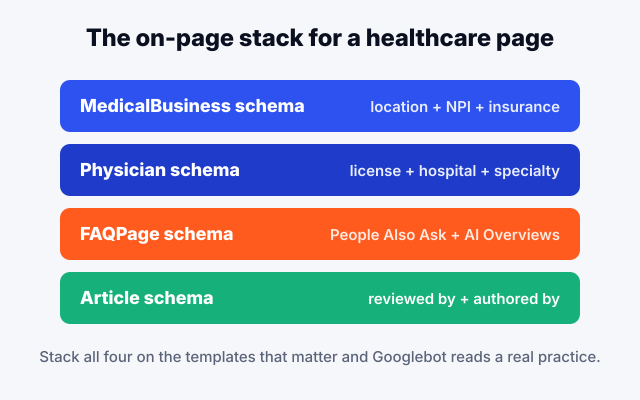
The stack is the point. A dermatology page on “eczema treatment options” that carries MedicalCondition schema, treatment-specific FAQPage schema, and Article schema pinned to a licensed dermatologist reviewer has a real path to a citation inside an AI answer. A page with the same body copy and no schema does not. Structured data is now part of ranking, not just rich results, and a solid schema stack often gains 20 to 30 percent in click-through rate on informational healthcare queries. The technical SEO for healthcare guide covers the schema audit inside the wider technical layer.
Answer-first structure for AI Overviews and People Also Ask
AI Overviews and People Also Ask reward pages that write for extraction. A question-style H2 followed by a 40 to 60 word self-contained answer is the shape both surfaces pull from. The direct answer sits at the top of the section, the context and depth follow. The first sentence of the answer includes the primary keyword or a close variant so the extraction is unambiguous. Answer-first structure is what turns a page from a ranking asset into an AI citation asset, and the split is now roughly 25 percent of clicks going to AI-pulled answers and 75 percent to traditional rankings on informational healthcare queries.
Comparison tables move the same signal even harder. Pages with structured tables that compare treatment options, cost ranges, or insurance coverage earn roughly 25.7 percent more AI citations than the same page with the data buried in prose, per the AI-extraction research published across 2025 and 2026. On-page SEO for healthcare uses tables the way a real reference site does, not the way an SEO template does. Every table earns its place by comparing two or more real options a patient is weighing.
Image optimization and alt text that helps patients find you
Image alt text on a healthcare page is not just an accessibility line. It is a small but real ranking signal for image search, and image search sends real traffic on queries like “orthodontic braces before after,” “invisalign example,” “dermatology skin condition photos.” Every image carries alt text under 125 characters that describes what is in the image and includes a relevant keyword when honest. A featured image on a pediatric dental page reads “Pediatric dentist Brooklyn NY exam room with kid-friendly seating,” not “IMG_2831.jpg.”
File names carry the same weight. Descriptive, hyphenated, lowercase, keyword-forward. Compression matters too. Every image compressed to WebP with a JPG fallback, aim for under 100KB each on non-hero images, keep the hero at reasonable size with fetchpriority high so LCP still lands under 2.5 seconds. Every image gets explicit width and height attributes so the layout does not shift while the image loads. A cumulative layout shift over 0.1 hurts both the Core Web Vitals score and the perceived professionalism of the site, which quietly reduces the booking rate on the same traffic.
Multi-location patterns for practice networks and DSOs
On-page SEO for a multi-location healthcare practice is where most agency work falls apart. A single-location dermatology practice can produce a strong page in a week. A 10-location behavioral health network needs a template that scales without turning every location page into a duplicate of the last one. The pattern that works: one templated location page per office with unique H1 including the city, unique H2 for local providers, unique meta description with the city, local reviews block, MedicalBusiness schema with the office’s real NAP and insurance list, and a body copy differentiator that is not just the city name find-and-replaced.
When LifeStance Health Inc. scaled Georgia Behavioral Health Professionals across 10-plus Atlanta-area offices, the paid media stack did most of the visible work (CPL of $19 against a $25 target, tripled patient volume, full impression share for TMS therapy). What made the paid media work at that scale was the on-page consistency underneath it. Every office page ran the same title pattern, the same MedicalBusiness schema template with the office’s specific NPI and insurance, the same booking CTA, and location-specific H2s for the providers who practiced there. That consistency is what let the paid team scale spend without watching CPL blow up per office. The healthcare SEO company comparison covers how multi-location coordination changes what an agency actually delivers.
Content depth and E-E-A-T signals a healthcare page needs
Google’s Your Money or Your Life bar applies to every page that could influence a health decision. A page written by “Admin” with no author bio, no medical reviewer, and no citation trail will lose to a page written by a licensed provider whose bio links to their state license, board certifications, hospital affiliations, and NPI. Every clinical page carries a named author who has a real credential line and a “medically reviewed by” line naming the licensing provider who signed off. Every stat cites the original source, not the article that quoted it.
Content length follows the top three winners, not a template minimum. On-page SEO for healthcare websites lands within 20 percent of the average word count of the top three organic results for the target keyword. Longer for pillar pages, tighter for symptom-explainer pages. Every H2 section runs 250 to 400 words with a concrete number, dollar figure, or timeframe where honest. Sentences stay under 22 words. Paragraphs stay under four sentences. Read every page out loud before shipping. If it sounds like an SEO template, rewrite it in the practice’s real voice.
Comparison of on-page SEO tactics by page type
On-page SEO for healthcare shifts weight depending on the page type. Location pages carry the schema and NAP load. Service pages carry the keyword and internal-link load. Blog posts carry the FAQPage and answer-first load. Provider bios carry the Physician schema and E-E-A-T load. The table below shows how the on-page checklist changes across the four page types most practice sites publish.
| Page type | Primary on-page focus | Schema priority | Internal link target |
|---|---|---|---|
| Location page | City in H1, NAP block, insurance list, hours, booking widget | MedicalBusiness with specialty subtype | Booking flow, provider bios, insurance page |
| Service page | Condition or procedure keyword in H1, treatment options, cost bands | MedicalProcedure, FAQPage | Related conditions, booking flow, provider bios |
| Blog post | Question-based H2s, answer-first blocks, 8 internal links, FAQ | Article with author, FAQPage on FAQ block | Service pages, location pages, other cluster posts |
| Provider bio | Provider name in H1, credentials, conditions treated, insurance | Physician with license and hospital affiliations | Service pages, booking flow, location page |
Common on-page SEO mistakes healthcare practices make
The mistakes repeat across every practice site we audit. Duplicate title tags across every location page (“Welcome to Our Practice” on all 12 offices). Missing or empty meta descriptions on the pages that generate the most impressions. H1s that read as brand statements (“Healing Starts Here”) instead of keyword-forward answers (“Physical Therapy in Boston MA”). Internal links stacked in a footer widget with generic anchor text like “Learn more” or “Read more.” No schema on 60 percent of pages, or a partial MedicalBusiness block with the wrong specialty subtype.
Below the visible layer, the deeper mistakes: pages published by “The Team” with no real author or reviewer bio, no citation trail on clinical claims, no reviewed date on symptom articles, no HTTPS canonical when the site has mixed HTTP redirects, and a robots.txt that quietly blocks the sitemap directory. Each of those looks small on its own. Stacked, they cost roughly 40 percent of the ranking potential the site should be earning at the same technical baseline. The healthcare SEO agency selection guide covers what to demand when hiring a partner to fix these systematically.
Where on-page SEO sits inside the wider healthcare SEO program
On-page SEO for healthcare is one leg of a three-leg stool. Technical SEO handles crawl, index, and speed. Off-page SEO handles backlinks, digital PR, and citations. On-page sits between them and turns the traffic into booked patients. Skip any leg and the other two waste effort. A blazing-fast site with clean schema and no keyword-forward titles will get crawled quickly and rank for nothing. A site with strong backlinks and no on-page structure will rank generic queries that never convert to a booking.
The order we run in a real engagement: technical foundation first (fix HIPAA tracking, HTTPS, Core Web Vitals, indexation), on-page structure second (titles, headings, internal links, schema stack), content depth third (E-E-A-T signals, provider bios, condition pages, blog cluster), off-page authority fourth (digital PR, medical publication mentions, local citations). The healthcare SEO strategy playbook maps the sequencing across a 90-day and 12-month horizon.
Frequently asked questions about on-page SEO for healthcare
What does on-page SEO for healthcare websites cover
On-page SEO for healthcare websites covers every ranking signal that lives on the page itself. Title tags, meta descriptions, H1s and H2s, body copy structure, internal links, image alt text, MedicalBusiness and Physician schema, and answer-first blocks that feed AI Overviews. It sits between technical SEO and off-page SEO in the ranking stack.
The healthcare wrinkle is that every on-page decision passes through a HIPAA and E-E-A-T filter. Google treats health pages as Your Money or Your Life topics, which means author credentials, medical review, and schema markup carry more weight than they would on a generic blog. A practice with clean titles and schema still needs a named licensed reviewer on every clinical page. A practice with strong author bios still needs the schema stack to feed the AI Overview citations.
How does structured data improve healthcare SEO
Structured data improves healthcare SEO by telling Google exactly what a page is about in a machine-readable format. MedicalBusiness schema puts a practice in the local health panel with insurance and hours. Physician schema ties providers to their license and hospital affiliations. FAQPage schema feeds People Also Ask and AI Overviews. Article schema strengthens author credibility.
The compound effect matters more than any single schema type. A page with the full stack (MedicalBusiness + Physician + FAQPage + Article) earns rich results, AI citations, and local panel placement in ways a page with a single schema type does not. Structured data is now part of ranking itself, per Google’s own 2024 and 2025 guidance updates, not just a rich-result add-on. Click-through rate typically gains 20 to 30 percent on the same ranking position when a full schema stack is added.
What are SEO best practices for healthcare websites
The SEO best practices for healthcare websites cover technical, on-page, and off-page work at once. HIPAA-safe server-side tracking, HTTPS with valid canonicals, Core Web Vitals in the green, clean XML sitemap, MedicalBusiness schema on every location page, Physician schema on every provider bio, keyword-forward title tags and H1s, 8 internal links per blog post pointing at money pages, and answer-first H2 structure for AI Overviews.
The compounding factor is E-E-A-T. Every clinical page carries a named author with a real credential line and a “medically reviewed by” line. Every stat cites the original source. Every symptom page shows the last reviewed date. Every location page carries a real NAP block and a booking CTA above the fold. Practices that hit the full stack outrank practices that hit only the technical basics within two to three quarters.
How long does on-page SEO take to move healthcare rankings
On-page SEO changes on a healthcare site typically show measurable ranking movement in 30 to 90 days for informational queries and 60 to 180 days for commercial queries. The lag depends on how competitive the keyword is, how strong the domain authority already is, and how many pages the fix covers at once.
A single-page title and H1 rewrite on an established domain can move a keyword three to five positions within 30 days if the rewrite matches search intent better than the current version. A full on-page overhaul across a 40-page practice site with schema stack, internal linking, and answer-first structure typically shows organic traffic movement at day 60, ranking gains at day 90, and booked-patient impact at day 120. Consistency matters more than speed. Ranking gains compound when the on-page pattern is applied across the whole site, not just the highest-value pages.
What is the difference between on-page SEO and technical SEO for healthcare
On-page SEO for healthcare covers the ranking signals a content team can move: titles, headings, internal links, body copy structure, schema. Technical SEO for healthcare covers the foundation a developer team owns: HIPAA-safe tracking, Core Web Vitals, indexation, HTTPS, rendering, XML sitemap. Both are on the page, but on-page is edited in the CMS and technical is edited in the code or server config.
The two overlap on schema markup. Schema is written in the code but often edited in the CMS via an SEO plugin. A healthcare practice needs both teams to talk. A blazing-fast site with the wrong H1 pattern ranks for nothing. A site with perfect titles and schema on a slow, HIPAA-broken tracking stack loses to the paid team’s frustration. Run technical first, then layer on-page on top.
How many internal links should a healthcare blog post carry
A healthcare blog post carries 8 outgoing internal links distributed across the body. At least 3 of them point at money pages (booking flow, service page, provider bio, insurance page). The remaining 5 point at other cluster posts, the vertical hub, or supporting pillar pages that build topical depth.
Distribution matters as much as count. Roughly one internal link per H2 section keeps the density natural. Never stack all 8 in the intro or conclusion. Anchor text stays descriptive and keyword-relevant, never “click here” or “read more.” When a target page is not live yet, link to the closest live pillar and log the substitution for the next audit cycle. Older posts pick up backlinks retroactively as each new sibling goes live (that is the retroactive backlink pass that runs after every new post lands).
See how we help practices apply on-page SEO changes that actually move booked-patient volume on our healthcare SEO services page.
Book your free 30-minute strategy call.
No spam, no sales rep. We use your email to schedule your call with a senior strategist. That is it.