
Pet Treat Products Market Functional and Subscription Guide
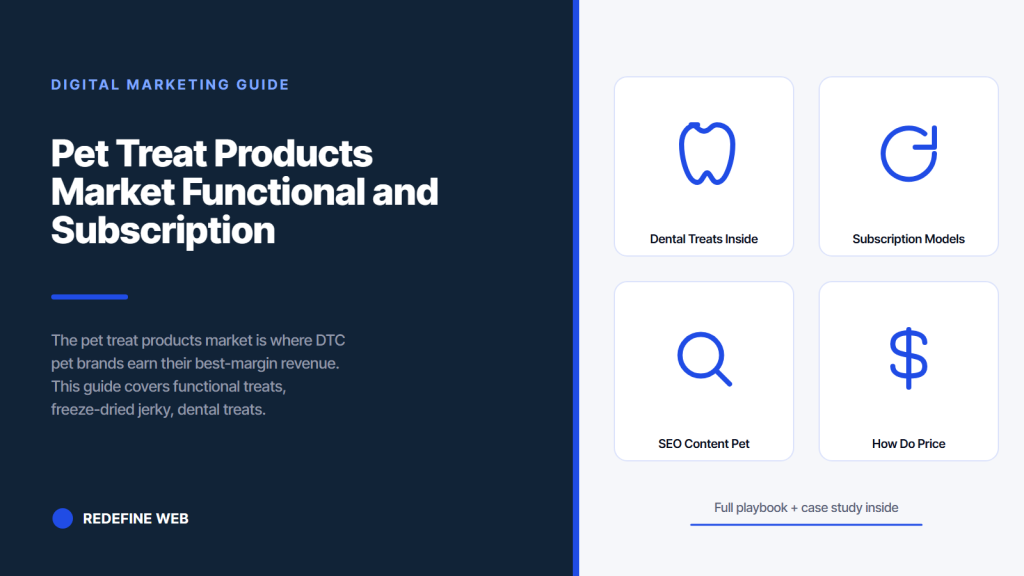
- Treats drive higher subscribe attach than any other pet category.
- Dental treats are the subscription workhorse at 58 to 64 percent attach.
- Functional treats grow 26 percent per year on real search intent.
- Freeze-dried needs raw-diet food anchor to hit strong LTV.
- Meta and Google run the paid spine, Amazon runs discovery.
- Packaging teaches the ingredient story in four seconds.
- Dental treats inside the pet treat products market
- Subscription models that work in the pet treat products market
- Paid acquisition inside the pet treat products market
- SEO and content for the pet treat products market
- How do you price inside the pet treat products market
- Packaging and brand in the pet treat products market
- A real pet treat products market scenario
- Where the pet treat products market fits your stack
The pet treat products market is where DTC pet brands earn their best-margin repeat revenue and where founders most often overspend on ads that never build a subscriber base. You have three real categories to plan against. Functional treats with a job (calming, joint, digestion). Freeze-dried and jerky as premium single-ingredient rewards. Dental treats and chews as the daily habit that pulls subscription retention higher than any other pet SKU. Get the merchandising and the auto-ship offer right and the treat category funds the rest of the store. Get them wrong and you are running paid ads against a one-time buyer who never renews. This guide covers the pet treat products market the way we build it for our DTC clients on Shopify and WooCommerce every week, with numbers from Mission Pet Health, category benchmarks you can plan a real 12-month roadmap against without guessing, and the subscription math that decides which SKU you launch first.
Dental treats inside the pet treat products market
Dental treats are the subscription workhorse of the pet treat products market. You are selling a daily habit, not a discretionary reward. That converts to 58 to 64 percent auto-ship attach rate on cold Meta traffic and a 71 percent year-one repeat purchase rate. If you build one great DTC SKU in the treat category, make it dental. It funds the rest of the store because the subscribe cadence is monthly by default and pet parents forget they subscribed until they run out.
You will compete against Greenies at the mass shelf and against Whimzees on Amazon. Neither owns the premium DTC lane with a real ingredient story and a veterinary-clean formulation. That lane is the opening for a treat-first DTC brand under $30 million in revenue. Formulation-wise you either partner with a veterinary dental co-manufacturer or you get a Veterinary Oral Health Council seal on the pack. VOHC certification is the shortest path to trust for a dental treat brand and the certification cost runs $8,000 to $18,000 depending on the third-party lab schedule.
The dental treat lifecycle for a DTC customer runs about 14 to 20 months average subscription length. Your CAC needs to pay back inside month four for the unit economics to work. Meta and Google paid CAC for dental treat SKUs runs $34 to $52 as of Q2 2026 depending on offer and creative fatigue. That gives you a payback window between 3.2 and 4.8 months and a 24-month lifetime value between $340 and $460 per subscriber. Dental is why treat-first brands out-earn kibble-first brands on year-two subscription revenue by roughly 2.1x on the same media budget. If you want the natural bolt-on categories that pair with dental treats on a DTC store, the pet care products market guide covers grooming and supplements against the same subscription math.
Subscription models that work in the pet treat products market
Subscription is not a checkout add-on. It is the offer. The three subscription models that work in the pet treat products market are subscribe-and-save on a single SKU, curated treat box on monthly cadence, and treat-plus-food bundle on a 4 or 8 week rotation. Each has a different customer acquisition cost profile, a different churn pattern, and a different merchandising story on the product page.
| Subscription model | Cold CAC | Attach rate | 12-month churn | 24-month LTV per subscriber |
|---|---|---|---|---|
| Single SKU subscribe-and-save | $28 to $44 | 32 to 41 percent | 44 percent | $280 to $360 |
| Curated monthly treat box | $46 to $72 | N/A (subscription is the product) | 52 percent | $340 to $480 |
| Treat + food bundle rotation | $62 to $98 | 68 percent | 28 percent | $620 to $840 |
| Dental daily subscribe-and-save | $34 to $52 | 58 to 64 percent | 32 percent | $420 to $560 |
The curated box gets the founder excited and burns cash. The bundle wins on LTV but needs a food SKU as the anchor. The single-SKU subscribe-and-save is the cleanest path for a first-year treat brand. Pick the model that fits your merchandising and the ad accounts you can actually run, not the model that reads best in a pitch deck. Every subscription model in the pet treat products market rewards the brand that treats subscribe-and-save as the offer, not as a checkout add-on. The merchandising order matters. Subscribe first, discount second, upsell third. Our pet products marketing retainer starts at $599 per month and covers the subscription-first merchandising work on Shopify or WooCommerce for treat-focused stores.
Paid acquisition inside the pet treat products market
You run Meta and Google as the two-channel spine for a treat-focused DTC brand. Meta earns the top-of-funnel demand with problem-aware creative for the functional treat and dental treat SKUs. Google Shopping and search catch the branded and category demand for freeze-dried and jerky. TikTok Shop is worth a $6,000 to $12,000 test on the calming and dental treats where the demonstration video sells the pack faster than a static image. Amazon runs alongside your DTC store as a discovery layer, not as your main revenue engine.
Cold Meta CAC for the four treat sub-categories as of Q2 2026: calming $38 to $58, dental $34 to $52, freeze-dried $52 to $78, biscuit and everyday $22 to $38. Your creative fatigue window sits around 21 to 28 days on Meta before frequency climbs past 3.6 and cost-per-purchase spikes 40 percent. You need a 6-video creative refresh queue at minimum, which is why treat brands running paid without an in-house or retainer video producer stall at $180,000 to $260,000 monthly ad spend. The HubSpot DTC breakdown covers the wider paid-plus-organic mix if you want a broader read.
Google Shopping in the treat category runs 3.4 to 4.8 return on ad spend on branded search and 1.6 to 2.4 on non-brand category terms. Non-brand Google acquires new customers at a higher cost than Meta on first purchase but the average order value runs 22 percent higher because Google shoppers reach the pack with more intent. Split your budget roughly 55 percent Meta, 25 percent Google, 10 percent TikTok, 10 percent Amazon as a starting mix and rebalance monthly on payback data, not on return on ad spend by itself. Our pet products marketing hub covers the wider agency stack we run alongside paid.
Look at your subscribe-and-save mix per SKU. Dental habit-treats hold subscribers longest. Lead with dental in the auto-ship offer, not the jerky hero.
SEO and content for the pet treat products market
Search is where treat brands earn cheap subscription customers on year-two. You build a category page for each functional intent (calming, joint, digestive, dental) and a set of 8 to 14 blog cluster pages per pillar that answer real pet parent questions. Every product detail page carries the same clean schema, real reviews, and a subscribe-and-save option above the fold. Google reads the whole site as a treat authority once the content graph clicks into place, which usually happens month 7 to 11 for a new DTC treat store.
The cluster topics that convert best in the treat category: safe treat count per day by weight, single-ingredient allergen guides, calming treat timing for storm and vet-visit anxiety, senior-dog joint treat protocols, dental treat comparison against professional cleaning cost, freeze-dried transitioning for raw-diet-curious pet parents, and puppy training treat sequencing. Each cluster earns 400 to 1,800 organic sessions monthly at peak and pulls 1.8 to 3.4 percent of that traffic into a subscribe-and-save signup within 60 days of first visit. That is where treat brands beat food brands on organic revenue per session.
Product schema and review schema on every PDP is non-negotiable. Merchant Center feed hygiene decides half your Google Shopping performance and most treat brands leave the GTIN, brand, and ingredient fields half-populated at launch. The Google product schema documentation is the reference sheet your developer works off if you are on Shopify or WooCommerce. Ingredient parity between the PDP body and the schema attribute is the small thing that decides which SKU shows on the ingredient-filtered Shopping search.
How do you price inside the pet treat products market
You price to a subscribe-and-save anchor. List price runs $16 to $32 for a functional soft-chew pouch, $18 to $28 for a dental treat pack, $14 to $22 for a 3.5-ounce freeze-dried treat, and $8 to $14 for a biscuit bag. Every SKU carries a subscribe option above the fold on the product page itself.
Subscribe-and-save discount lands at 15 to 20 percent for a first-year brand and drops to 10 to 15 percent once you have subscriber momentum. Never go under 10 percent. Under 10 percent reads as a rounding error and the subscribe attach rate drops 12 to 18 points on your product pages.
Bundle pricing is where you earn 24-month LTV. Treat plus food bundle at 20 percent off both SKUs pulls 68 percent attach and 24 to 32 percent lower 12-month churn than the single-SKU subscription. Bundle two treats (calming plus dental) at 18 percent off pulls 44 percent attach on a targeted email flow and pushes average order value from $34 to $58 within one send cycle. Bundle pricing rewards subscription-thinking merchandising over discount-thinking merchandising, which is the split that separates treat brands that scale from treat brands that stall around $2 million revenue.
Shipping thresholds are the third pricing lever. Free shipping over $49 pulls the pack size up 22 percent on average order value. Free shipping over $65 pushes it up 34 percent but drops conversion by 6 to 9 percent. Your unit economics decides which one you run. For a treat brand under $1 million revenue, free shipping over $49 is the safer setup while you build ad account and creative fluency. Move to $65 once your repeat-purchase engine holds a 42 percent subscribe attach across the store.
Packaging and brand in the pet treat products market
Packaging in the pet treat products market does three jobs at once: it stores the product safely, it merchandises on the Amazon shelf and the Meta ad, and it teaches the pet parent the ingredient story in about four seconds. Front-of-pack claims sell the pack. Back-of-pack detail earns the second purchase. Get the front wrong and you never sell the first bag. Get the back wrong and you sell one bag and never see the subscriber again.
Every treat founder eventually shows us the packaging they designed on a Tuesday night at the kitchen table, which features a wet-nose photo of their own dog and a Comic Sans callout that reads Now With Salmon. Their dog is beautiful. The packaging is not. The moment you name your first treat after your dog is the moment you have crossed the line from founder to hostage, and the whole product roadmap for the next 18 months bends around not hurting your dog’s feelings about the rebrand.
Brand-wise you pick between three positioning lanes: clinical-clean like a veterinary supplement brand, farm-and-heritage like a small-batch human snack brand, or design-forward like a Bark or Bocce’s Bakery. Each lane earns a different Meta creative library and a different Amazon photography setup. You cannot switch lanes at year two without repricing and refranchising the whole line. Pick the lane in month one and build every SKU, every ad, every email, and every packaging refresh against it. Brand consistency in the treat category compounds faster than in any other pet vertical because pet parents buy treats on emotion and re-buy on habit.
A real pet treat products market scenario
Mission Pet Health came in as a two-SKU treat brand on Shopify with $18,000 monthly revenue and a 26 percent subscribe attach rate across the store. Their calming soft-chew was their strongest SKU on cold Meta, running a $58 cold CAC on a hand-shot video from the founder’s kitchen. Their dental treat was under-merchandised, with the subscribe option buried below the fold. Their freeze-dried jerky ran a strong ingredient story and a weak repeat-purchase rate because it was not tied to any subscription anchor.
Our team rebuilt the Shopify PDP template around a subscribe-and-save first UI. Moved the subscribe option above the fold on every treat PDP. Added a bundle-builder on the dental SKU that let the pet parent add a calming pouch and take 18 percent off both. Rewrote the paid social creative brief around problem-aware angles (thunderstorm-anxiety for calming, breath-and-tartar for dental, raw-diet-curious for freeze-dried). Ran the six-video creative refresh queue on a 24-day cadence.
Over the following nine months, monthly revenue climbed from $18,000 to $146,000. Subscribe attach across the store hit 51 percent. Cold Meta CAC on the calming SKU dropped from $58 to $34 as creative and problem-aware targeting stabilized. Year-one repeat-purchase rate on dental hit 71 percent. The store was not doing anything the treat category did not already reward. It just needed the subscription-first merchandising and the paid creative discipline to earn what the pet treat products market already rewards on a Shopify store built the right way.
Where the pet treat products market fits your stack
The treat category sits at the top of a DTC pet brand’s merchandising stack because it drives subscription revenue and margin better than any other product line you can build. You use the treat category to earn the subscribe-and-save relationship, then you cross-sell food, supplements, and hardgoods against a customer who already trusts you. The alternative sequence, kibble first and treats later, works on paper and fails on paid social because kibble subscription attach caps around 32 percent and treat attach clears 55 percent on the same media budget. Treat-first sequencing also earns you the pet parent contact record early enough to run a real email and SMS cadence that food-first brands only get after month nine of paid acquisition spend.
You should read the wider category context next. Our pet product marketing agency guide lays out the retainer and staffing model that supports a treat-first roadmap and the paid-plus-organic channel mix a DTC-native treat brand needs to run every week to earn compounding revenue from the store.
External benchmarks worth reading alongside the internal work: the American Pet Products Association industry outlook for the vertical numbers by segment, and the HubSpot DTC playbook for the paid-plus-organic mix. The pet treat products market rewards treat-first merchandising, subscription-first offer design, and paid creative discipline. Get those three right and the category funds a whole DTC pet brand for the next decade.
Frequently asked questions
How big is the pet treat products market and how fast is it growing?
The pet treat products market runs about $12 billion in US retail with DTC and Amazon share climbing 18 to 24 percent year over year while big-box treat share flattens. Functional treats grow fastest at 26 percent per year. Biscuits and crunchy treats still hold 44 percent of shelf, freeze-dried and jerky hold 22 percent, dental holds 18 percent, functional holds 10 percent, and training treats hold 6 percent. Pet parents in the 28 to 44 age band drive most of the growth and they buy treats label-forward, ingredient-honest, and brand-loyal once you earn the first purchase. Treat-first DTC brands out-earn food-first brands on year-two revenue because treat SKUs pull better subscribe-and-save attach than any other pet product line.
Which treat category has the best subscription attach rate?
Dental treats have the best subscription attach rate in the pet treat products market at 58 to 64 percent on cold Meta traffic. Dental treats work as a daily habit rather than a discretionary reward, which pulls the subscribe-and-save option above the buying threshold for most pet parents. Year-one repeat purchase rate on dental treat subscriptions runs 71 percent. Functional treats hit 41 percent attach on single-SKU subscribe-and-save. Freeze-dried treats cap around 28 percent unless paired with a raw-diet food anchor, which pushes attach to 48 percent. Biscuits and everyday treats hold 22 to 32 percent attach. Dental is the subscription workhorse of the treat category and the SKU most treat-first brands should build first.
What is the cold customer acquisition cost for pet treat brands on Meta?
Cold Meta customer acquisition cost for pet treat brands as of Q2 2026 runs $22 to $38 for biscuit and everyday treats, $34 to $52 for dental treats, $38 to $58 for calming and functional treats, and $52 to $78 for freeze-dried and jerky. Creative fatigue windows sit around 21 to 28 days before frequency climbs past 3.6 and cost per purchase spikes 40 percent. You need a six-video creative refresh queue to sustain scale, which is the operational reason treat brands stall around $180,000 to $260,000 monthly ad spend without a dedicated video producer. Payback windows on the dental treat sit between 3.2 and 4.8 months on subscribe-and-save conversions, which is the healthiest payback window in the pet treat products market.
How should a new pet treat brand price the first SKU on Shopify or WooCommerce?
Price the first SKU to a subscribe-and-save anchor. List price runs $16 to $32 for a functional soft-chew pouch, $18 to $28 for a dental pack, $14 to $22 for a 3.5-ounce freeze-dried treat, and $8 to $14 for a biscuit bag. Subscribe-and-save discount sits at 15 to 20 percent for a first-year brand. Never drop below 10 percent because the subscribe attach rate drops 12 to 18 points at that point. Bundle pricing is where you earn 24-month lifetime value. A treat plus food bundle at 20 percent off pulls 68 percent attach and 24 to 32 percent lower 12-month churn than a single SKU subscribe. Free shipping over $49 is the safer threshold for a treat brand under $1 million revenue.
What subscription model works best in the pet treat products market?
The three subscription models that work are single SKU subscribe-and-save, curated monthly treat box, and treat plus food bundle rotation. Single SKU subscribe-and-save has the lowest cold customer acquisition cost at $28 to $44 and the cleanest first-year setup for a new treat brand. The curated monthly box hits a higher lifetime value but burns cash on acquisition at $46 to $72 cold cost and 52 percent 12-month churn. The treat plus food bundle carries the strongest lifetime value at $620 to $840 per subscriber over 24 months and the lowest churn at 28 percent, but the bundle needs a food SKU as the anchor. Pick the model that matches your merchandising, not the model that reads best in a pitch deck.
What content clusters should a treat brand build for search engine optimization?
The best content clusters for a treat brand in the pet treat products market answer real pet parent questions with product-level detail. Safe treat count per day by dog weight. Single-ingredient allergen guides for chicken, beef, and novel proteins. Calming treat timing for storm anxiety and vet visits. Senior dog joint treat protocols. Dental treat comparison against professional cleaning cost. Freeze-dried transitioning content for raw-diet-curious households. Puppy training treat sequencing. Each cluster earns 400 to 1,800 organic sessions monthly at peak and converts 1.8 to 3.4 percent of that traffic into a subscribe-and-save signup within 60 days of the first site visit. Google Merchant Center feed hygiene decides half your Shopping performance so treat schema on every product page is non-negotiable.
Why does the pet treat products market fund the rest of a DTC pet store?
Treats drive higher subscribe-and-save attach, higher gross margin, and higher year-two repeat purchase than any other pet product line. Dental treats hit 58 to 64 percent subscribe attach against 22 to 32 percent on kibble. Functional treats hold 62 to 70 percent gross margin against 42 to 48 percent on kibble. Treat-first brands out-earn food-first brands on year-two subscription revenue by roughly 2.1x on the same media budget. Once the treat category earns the subscriber relationship, you can cross-sell food, supplements, and hardgoods to a customer who already trusts you. The alternative sequence, kibble first and treats later, caps at 32 percent subscribe attach and fails on paid social because the payback window runs too long. Treats fund the store.
Book your free 30-minute strategy call.
No spam, no sales rep. We use your email to schedule your call with a senior strategist. That is it.
More from the blog
View all articles → Digital Marketing
 Dental Marketing Tips That Compound Into New Patients
Read article Digital Marketing
 Ecommerce Marketing Strategies That Drive Real DTC Revenue
Read article Digital Marketing