
Pet Product Marketing Agency for DTC Treat and Toy Brands
- Retainer covers paid social, Amazon, search, email, creator, and reporting.
- Channel mix defaults to 40-25-20-15 across Meta, Amazon, Google, and email.
- Amazon carries 61 percent of first pet product searches, so it needs weekly cadence.
- DTC pet economics only work when repeat orders carry lifetime value past CAC.
- Starter retainer sits at $599 monthly across a 6-month starter term.
- What a pet product marketing agency actually does
- Channel mix a pet product marketing agency actually runs
- Amazon inside a pet product marketing agency
- Email and SMS for repeat orders
- Organic search for a pet product marketing agency
- Paid social creative cadence for pet brands
- Reporting inside a pet product marketing agency
- Picking a pet product marketing agency
- Pet Insurance Australia and what a pet product marketing agency carries
- Pricing tiers for a pet product marketing agency
- Where a pet product marketing agency fits the stack
A pet product marketing agency is the operating partner a DTC treat, toy, supplement, or subscription-box brand hires when the founder has stopped believing the next TikTok video will crack the funnel. The Q3 launch for a mid-size dog-treat brand we watched last year burned $42,000 across Meta and TikTok, produced 11,400 clicks, and closed 187 first orders at a $224 blended acquisition cost against a $34 order value. The founder blamed the creative team. The creative team blamed the media buyer. The media buyer blamed the landing page. Nobody blamed the missing repeat-order flywheel that catches the 3.4 times a year a dog owner reorders soft chews. For DTC pet brands specifically, our affiliate marketing pet products guide breaks down vet, breeder, rescue, and creator tier commission structure.
This guide covers what a pet product marketing agency actually owns across paid social, Amazon, search, email, and creator seeding, how the retainer priced at $599 monthly for the starter tier scales against a specific catalog, and where the reporting cadence has to hold for the retainer to pay back inside a single 6-month term. Every recommendation runs on real DTC pet accounts our team has carried through 2024 and 2025. Founders sizing scope against a specific catalog can start with our pet products marketing retainer page.

What a pet product marketing agency actually does
A pet product marketing agency runs the paid social, search, Amazon, email, creator, and CRO layers of a DTC pet brand as a single monthly operating unit rather than five separate line items. The scope holds against a signed statement of work priced at $599 monthly for the starter tier and a 6-month starter term.
The six operating scope pillars
Six scope pillars carry a DTC pet retainer. Paid social on Meta plus TikTok that absorbs 40 to 200 creative iterations per month at the ad-set, hook, and product-tag layer. Amazon that runs Sponsored Products plus Sponsored Brands against 20 to 120 ASINs with weekly bid pacing. Organic search that covers 40 to 200 category, PDP, and blog URLs against the pet-owner search calendar. Email plus SMS that runs 8 to 14 flows around the reorder curve for treats, supplements, and subscription boxes. Creator seeding that ships product to 30 to 90 pet accounts per quarter for UGC. Reporting that closes the loop with the founder on the numbers that matter each Monday. A retainer holding all six together compounds. A retainer holding two and dropping the rest falls back into channel-thrash and burns the same hours every quarter.
Where the pet product marketing agency sits
The marketing retainer sits above the storefront platform and below the founder’s brand and merchandising decisions. Platform choices like Shopify vs WooCommerce, subscription tooling, and 3PL happen at the founder or ops-lead level. Brand tone, flavor lineup, and packaging get owned by the founder plus the creative director. The agency retainer runs the demand generation and reorder-capture rhythm on top of those decisions. That layering keeps the retainer scope tight enough to price at a starter tier without any single side blaming another when a campaign underperforms. Every account we hold gets a written scope that lists what the retainer owns and what triggers a change order for new work.
Channel mix a pet product marketing agency actually runs
Channel mix is the first strategic decision because DTC pet brands sit at the intersection of impulse buys, subscription reorders, and Amazon comparison shopping. A brand allocating budget on gut feeling routinely overpays for prospecting on channels that never convert and underinvests in the channels that carry repeats.
The 40-25-20-15 split that works
A working starter mix runs roughly 40 percent Meta plus TikTok for prospecting, 25 percent Amazon Ads for high-intent conversion, 20 percent Google Search and Shopping for branded and category queries, and 15 percent email plus SMS for retention. A treats-only brand tilts more toward Meta because impulse creative moves treats better than search intent. A supplement brand tilts toward Amazon and Google because the buyer is already researching joint mobility or skin conditions. A subscription-box brand tilts toward creator seeding plus Meta because the sell is aspirational rather than intent-driven. The split shifts against the brand’s product mix, but 40-25-20-15 is the default our team ships into on day 30 and tunes from there. The marketing ideas for ecommerce brands deep-dive covers the diagnostic that decides which lever to pull first.
Creator seeding as a channel not a favor
Creator seeding shows up as its own line item because pet content is the single strongest performing category on TikTok and Instagram Reels. A brand shipping product to 30 to 90 pet accounts per quarter at 3,000 to 40,000 followers each earns 12 to 40 pieces of UGC that go straight into the paid ad rotation as whitelisted content. Cost per piece runs $8 to $22 in product plus $0 to $150 in a small usage fee. Compared to a $2,400 studio shoot that produces 6 clips, the seeded UGC library pays back inside 3 weeks on paid social. The seeding budget lives in a shared airtable with a monthly ship list, a UGC brief, and a whitelisting workflow so nothing sits stuck at usage-rights approval for 3 weeks. The full creator-side rhythm sits inside our influencer marketing for pet products deep read.
Amazon inside a pet product marketing agency
Amazon is the second scope pillar because 61 percent of pet product searches start on Amazon before the buyer ever sees a DTC brand’s site. A brand ignoring Amazon burns paid social dollars sending prospects to Google, where the buyer immediately searches for the same product on Amazon and closes there against a competitor SKU. That is the exact problem a specialist amazon pet products marketing agency gets hired to solve.
Sponsored Products cadence
Sponsored Products cadence runs weekly against the top 20 to 40 ASINs. Bid pacing gets adjusted every Tuesday against the last 7 days of ACOS, keyword search-term reports, and inventory position. New ASINs land in a launch campaign at a 45 percent higher bid for the first 21 days to build sales velocity plus review flow before graduating to a standing campaign. Negative-keyword sweeps run every Thursday to cull queries that convert under a 12 percent rate. Return on ad spend targets sit at 4.5x to 6.2x for treats, 3.8x to 5.4x for toys, and 5.5x to 8.0x for supplements, priced against the reorder curve rather than first-order margin. A brand running Sponsored Products without weekly cadence routinely watches ACOS drift 8 to 14 points inside a single quarter because search-term intent shifts as competitor listings iterate. The ecommerce PPC management for DTC brands guide covers the diagnostic for spotting drift before it eats a full month of budget.
Sponsored Brands and DSP layer
Sponsored Brands runs above Sponsored Products for headline searches on the brand name plus 8 to 14 category keywords like organic dog treats, grain-free cat food, or hip and joint supplement for large dogs. The video variant gains 34 to 62 percent higher click-through rate over static Sponsored Brands. Amazon DSP runs on top of both against a 90-day view-through window for repeat purchase re-engagement, sizing at $1,200 to $4,800 monthly on brands past $250,000 in annual Amazon revenue. Below that threshold, DSP burns budget on impressions the retainer team cannot attribute back to first-party purchase data. Brands sizing the Amazon layer against a specific catalog and reorder curve often skip DSP for the first 6 months and put the same dollars into Sponsored Products bid ceilings, which produces measurable ACOS improvement inside a single reporting window.
Pet CAC is only ugly if repeat orders don't fund it. Pull your 90-day repeat rate first. Under 25 percent and no ad iteration saves the P&L. Fix the reorder email today.
Email and SMS for repeat orders
Email and SMS are the third scope pillar because DTC pet economics only work when repeat orders carry the customer lifetime value past the paid-acquisition cost. A treat brand acquiring at $34 first-order value against a $38 CAC needs 4 to 6 repeats over 18 months to hit a 3.2x lifetime value ratio, and repeats do not happen on their own.
The 8 to 14 flow backbone
A working DTC pet flow library carries 8 to 14 automated sequences against the reorder curve. Welcome (3 emails plus 1 SMS across 5 days). Post-purchase (5 touches across 21 days covering onboarding, feeding tips, and review request). Reorder reminder (3 touches timed against the SKU-specific reorder window, typically 24 to 45 days for treats, 30 to 60 for supplements). Winback (4 touches for lapsed customers at day 90, 120, 150, and 180). Cart abandonment (3 touches inside 48 hours). Browse abandonment (2 touches inside 72 hours). Subscription reactivation for cancelled subscribers. Birthday and adoption-anniversary flows if the brand collects pet birthday at signup. Each flow gets A/B tested on subject line, first-line preview, and offer format monthly. The marketing automation platforms and flows guide covers Klaviyo vs Attentive setup for pet accounts.
SMS discipline against the pet buyer
SMS discipline runs tighter than email because pet buyers unsubscribe fast when a brand texts them 3 times a week about a new flavor. A working retainer holds SMS to 4 to 8 sends per month plus transactional receipts, priced against a 22 to 28 percent click-through rate and a sub-0.4 percent unsubscribe rate. Segmentation on species (dog vs cat vs small animal) and life stage (puppy, adult, senior) matters more on SMS than email because the medium demands relevance. Brands running SMS as another blast channel routinely burn a hard-won list in a single quarter because the founder saw a competitor push a Black Friday text and copied the cadence without the segmentation. The Content Marketing Institute mistakes list is a useful outside read for founders comparing SMS cadence against text-fatigue benchmarks.
Organic search for a pet product marketing agency
Organic search is the fourth scope pillar because pet buyers research heavily before subscribing. A dog owner shopping for a joint supplement runs 4 to 9 comparative searches across brand, ingredient, and condition queries before adding to cart. Missing organic presence on any of those 4 to 9 touches sends the intent to a competitor site the retainer team never sees.
| Content type | Monthly output | Word count | Purpose | Reorder curve tie-in |
|---|---|---|---|---|
| Category page | 1 to 2 refreshes | 800 to 1,400 | Rank for "organic dog treats," "grain-free cat food" etc. | First-order acquisition |
| PDP copy refresh | 4 to 8 SKUs | 250 to 500 per SKU | Rank for SKU-specific and long-tail queries | Rank for reorder search intent |
| Comparison blog post | 2 per month | 2,200 to 3,400 | "Brand A vs Brand B for hip mobility" queries | Rank against competitor moats |
| Condition explainer | 2 per month | 1,800 to 3,000 | "Why my dog itches after eating chicken" | Feed post-purchase flow content |
| Feeding or dosing guide | 1 per month | 1,600 to 2,800 | "How much freeze-dried treats per day" | Prevent complaints, drive reorders |
| UGC roundup post | 1 per month | 1,200 to 2,000 | Trust signal for cold traffic | Whitelist for paid social re-use |
The table above assumes a DTC pet brand with a catalog of 40 to 200 SKUs on Shopify or WooCommerce running the starter or growth retainer tier. Category and PDP work compounds fastest because the queries carry commercial intent. Comparison posts pay back over 6 to 12 months as they earn backlinks and rank for competitor-brand queries where a mid-funnel prospect is deciding between two products. Condition explainers feed the post-purchase email flow with education content that reduces refund tickets from owners whose dog had loose stool during the first week of a new supplement. A brand publishing under 4 pieces per month rarely earns compounding search traffic on the pet vertical because Amazon and Chewy dominate the SERP for high-value queries, and the DTC brand needs volume plus depth to break through. The ecommerce SEO services strategy guide covers the pillar-cluster architecture our team ships against for pet brands. Sizing the target market for pet products by cohort is the strategic decision every DTC pet founder should make before scoping paid channels.
Paid social creative cadence for pet brands
Paid social creative cadence is the fifth scope pillar because Meta and TikTok algorithms punish creative fatigue faster on pet content than almost any other DTC vertical. Pet buyers scroll past a repeated ad within 3 to 5 impressions because the audience over-indexes on emotional novelty in short-form video.
The 40 to 200 creative iteration plan
A working paid-social retainer ships 40 to 200 creative iterations per month depending on spend level. A brand at $12,000 monthly spend runs 40 to 60 iterations covering 3 concepts, 4 to 6 hook variants, and 3 to 4 CTA closings. A brand at $80,000 monthly spend runs 160 to 200 iterations across 8 to 12 concepts. The retainer team scripts against a shared concept doc, briefs the seeded creators plus the studio partner, and lands each creative in ad manager tagged with the concept ID for reporting. Winners graduate to whitelisting from the creator handle for organic-looking placement. Losers get killed inside 72 hours if cost per click sits 40 percent above account average. Brands running static creative on a rolling 90-day rotation routinely watch CPM climb 30 to 50 percent inside a single quarter because the algorithm reads creative sameness as low relevance and prices bids up to compensate.
Hook architecture for pet content
Hook architecture on pet paid social breaks into 5 patterns that carry the vertical. The dog-doing-a-thing pattern (first 1.5 seconds shows the pet doing something charming that makes the viewer stop). The founder-with-pet pattern (small brand credibility). The transformation pattern (before-after on coat, breath, or mobility). The problem-solution pattern (my dog wouldn’t eat X so we made Y). The community pattern (30 dogs eating the treat at once). Each hook gets 6 to 12 iterations per month across concept, script, and delivery. A retainer team that ships hooks rather than concepts routinely produces 2 to 3x the winning rate against paid social because the algorithm rewards fresh openers rather than fresh offers on the pet vertical.
Reporting inside a pet product marketing agency
Reporting is the sixth scope pillar because a retainer without documented output becomes an invoice the founder cannot connect to the numbers that matter. Reporting is the artifact that keeps the retainer accountable and gives the founder the operating picture they need to plan the next quarter.
Every founder review call eventually reaches the moment where somebody points at a 2022 TikTok of the office cat batting at a bag of treats and asks why the retainer team is still cutting it into ad variants. Nobody remembers filming it. The cat lives with the founder’s sister-in-law now. Its all-time paid social spend is $47,000. The polite move is to retire it. The founder always insists on keeping it. Somewhere in the archive of every DTC pet brand, a single treasured office-pet clip is quietly outperforming half the studio-produced content the brand paid four figures to shoot.
The weekly report ships every Monday morning with a 30-minute review call. The monthly report ships on the first business day with a full deck plus a 60-minute strategy call. The report covers seven line items. Blended cost per acquisition against a 90-day rolling target. Return on ad spend by channel plus by campaign type. Amazon ACOS by ASIN cohort. Email plus SMS revenue per send and per subscriber. Organic sessions plus keyword rank movement on the tracked query set. Creative win rate against concept and hook cohort. Subscription retention at day 30, 60, and 90 cohorts. Brands running a marketing retainer without documented weekly reporting routinely rediscover the same channel drift quarter after quarter because the account team runs on memory rather than a written record.
Picking a pet product marketing agency
Picking a pet product marketing agency turns into a founder-time sink when the shortlist reaches 6 to 10 agencies pitching similar decks. The four questions below cut the shortlist to 2 in under an hour and surface the tradeoffs founders miss during a generic sales cycle. Read our pet web design for service businesses for the service-side view.
- Question one: how many DTC pet brands has the agency carried through a full 12-month cycle in the past 3 years. Under 3 is a red flag on vertical familiarity.
- Question two: what is the retainer team’s split between senior account leads and junior campaign managers, and who owns the weekly reporting call.
- Question three: what is the standard channel mix on day 30 versus day 180, and what triggers a shift.
- Question four: what is the change-order process, hourly rate, and 90-day cancellation window inside the 6-month starter term.
- Bonus: ask the agency to walk through one account they fired inside the past 12 months and why. The honesty of that answer predicts the working relationship better than any case study.
- Reference calls: request 3 references from brands at a similar catalog size and drop cadence, and ask each reference what the agency handled poorly on the first 90 days.
Founders often pick the agency with the flashiest deck or the biggest name, both of which produce mediocre first-quarter outcomes because deck design and brand recognition do not predict retainer fit. The agency that spends the discovery call asking about the reorder curve, the 3PL fulfillment window, and the founder’s tolerance for weekly creative kills usually delivers better first-90-day outcomes than the agency that walks in with a pre-built strategy deck. Fit-first sizing is the discipline that turns a 6-month starter term into a 3-year working relationship rather than a Q2 breakup call.
Pet Insurance Australia and what a pet product marketing agency carries
Pet Insurance Australia came to our team with a paid-search account running against generic pet-owner intent, a 1 to 3 percent click-through rate against the account average, weak landing-page conversion at roughly 2 to 5 percent, and no working remarketing loop against the 90-day comparison-shopping window a policy buyer runs before signing. The founder had tried two prior agencies. The first burned $18,000 across a Meta program that never cracked a 1.4x return. The second ran a Google Ads program that closed 41 conversions in 4 months at a $290 cost per acquisition against a $92 target.
Our team scoped a keyword-focused Google Ads program with custom landing pages tied to the top 8 policy-purchase queries plus a remarketing layer against the display and Meta placement grid. Week one rebuilt the account structure into 14 tightly-themed ad groups matched to search intent rather than product SKU. Week two shipped 8 landing pages against the top query themes, each tuned to a single call-to-action rather than a generic quote form. Week three set the remarketing layer against site visitors segmented by depth-of-visit and page category. Week four ran the first weekly reporting call with the founder covering the operating baseline the retainer would hold against.
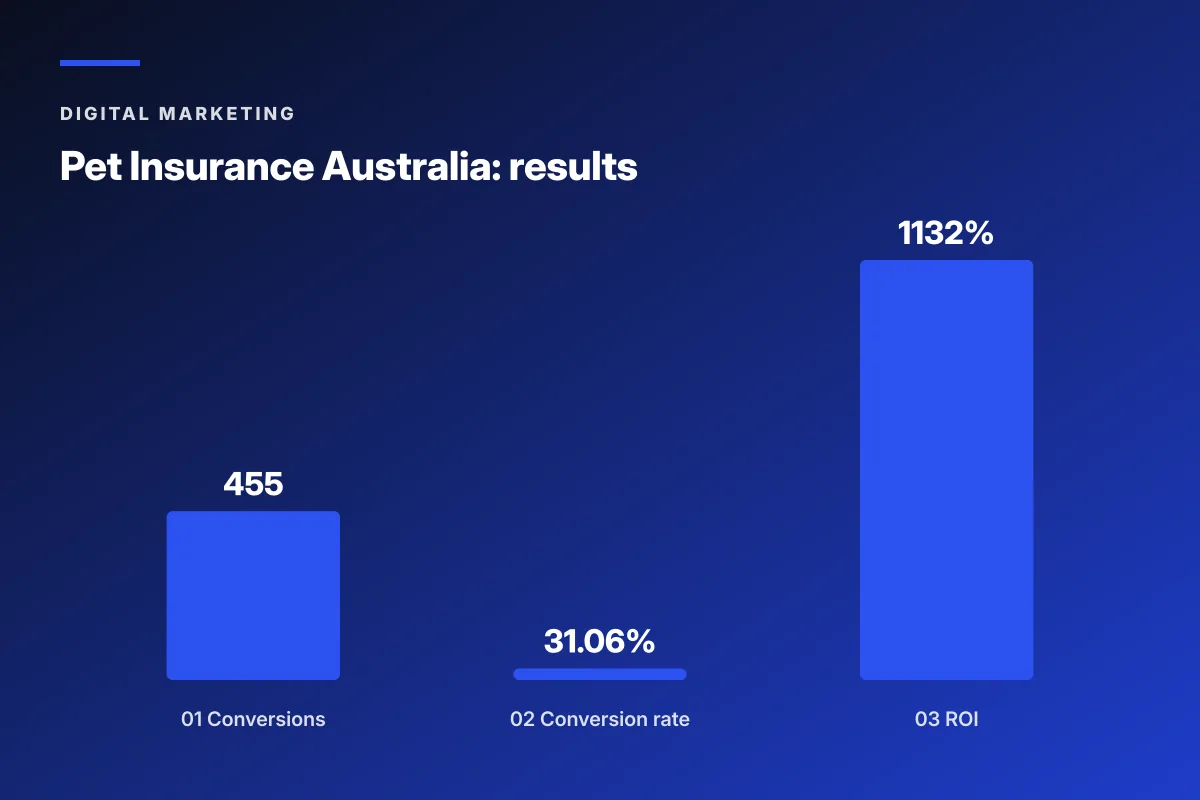
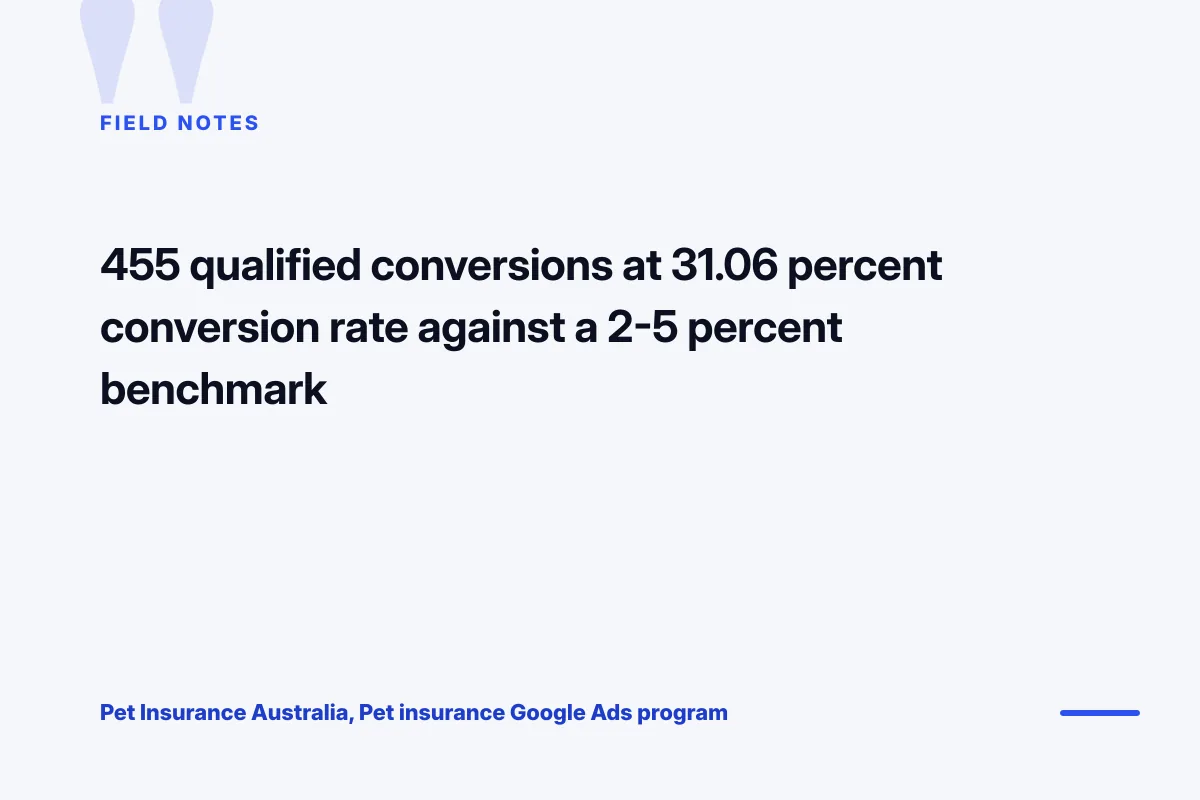
Over the following 5 months, the account closed 455 qualified conversions at a 31.06 percent conversion rate against a 2 to 5 percent industry benchmark. Click-through rate landed at 8.87 percent against the 1 to 3 percent baseline. Return on investment settled at 1,132 percent, meaning every dollar the founder put in returned 11 dollars back. The growth marketing testing and retention deep-dive covers the retention loop the same operating pattern feeds. The Pet Insurance Australia numbers held because the account structure, landing pages, and remarketing loop worked together as one funnel rather than three separate campaigns waiting for the media buyer to reconcile them.
Pricing tiers for a pet product marketing agency
Pricing tiers on a DTC pet retainer scale with catalog size, monthly ad spend, and channel count. Every tier runs on a 6-month starter term because two full reorder cycles are needed for the operating pattern to settle across the brand and the retainer team. Below the $599 starter tier, brands are better served by a freelancer or a small in-house media buyer rather than a full retainer.
Starter, growth, scale, and enterprise
Starter tier at $599 monthly covers a solo or small DTC pet brand under $200,000 in annual revenue, running Meta plus Amazon at $4,000 to $12,000 monthly ad spend, with basic email flows and a weekly reporting call. Growth tier at $1,200 to $1,600 monthly covers a mid-size brand at $200,000 to $2 million in annual revenue with all six pillars active, monthly ad spend between $12,000 and $60,000, and monthly strategy calls. Scale tier at $1,800 to $2,400 monthly covers a brand past $2 million in annual revenue with weekly creative sprints, DSP layer active, and a dedicated account lead. Enterprise tier at $2,400 to $3,500 monthly covers a brand past $8 million in annual revenue with quarterly business reviews, category-management support, and a dedicated on-call rotation for peak windows like Q4 and back-to-school.
What sits outside the base scope
Change orders trigger on work outside the base scope. New product photography or video production beyond seeded UGC. Custom landing page development beyond template updates. Migration to a new email platform or subscription tool. Custom reporting dashboards beyond the standard weekly plus monthly decks. Amazon storefront redesign or A+ content buildout on brand new ASINs. Every change order includes a written scope, a fixed price or hourly estimate, and a delivery timeline the founder signs off before work starts. Brands running a retainer without a change-order process routinely see the retainer team quietly under-deliver on the base scope because the extra work eats hours nobody documented. The Neil Patel ecommerce marketing playbook covers the channel-level scope rubric that pairs with the tier math above.
Where a pet product marketing agency fits the stack
A pet product marketing agency sits at the operating floor of the DTC pet growth stack. Every product launch, every subscription tier redesign, every 3PL swap, and every packaging refresh either compounds through a working marketing retainer or fights against a broken one. A brand paying $22,000 monthly on paid social against a broken email flow burns 20 to 40 percent of that spend on first-order acquisitions that never reorder. Fixing the retainer scope pays back inside the first 90 days of a 6-month starter term when the flywheel finally closes.
The $599 starter tier gives a solo or small DTC pet brand a documented operating rhythm across paid social, Amazon, search, email, SMS, and reporting. Higher tiers scale the same rhythm against larger catalogs and heavier spend levels without changing the underlying scope discipline. Our ecommerce marketing hub ties the pet vertical to the broader DTC growth stack for founders sizing the whole picture rather than a single channel line in isolation.
The HubSpot ecommerce marketing guide and the MarketingProfs ecommerce library are two outside reads every founder should keep on hand while sizing retainer scope against a self-service stack. A pet product marketing agency is the operating retainer that decides which growth investments compound through a brand that holds together across every launch window and which ones stay stuck behind a channel-thrash cycle that eats the same hours quarter after quarter.
Frequently asked questions
What does a pet product marketing agency actually cover?
A pet product marketing agency covers paid social on Meta and TikTok, Amazon Sponsored Products and Sponsored Brands, Google Search and Shopping, email plus SMS retention flows, creator seeding for UGC, and weekly plus monthly reporting. The retainer runs those six pillars as a single monthly operating unit rather than six separate line items. Redefine Web prices the starter tier at $599 monthly across a 6-month starter term because two full reorder cycles are needed to prove the operating pattern holds against real reorder economics. Scope gets written into a signed statement of work so the founder knows what the retainer owns and what triggers change orders on new work outside the base scope.
How is a pet product marketing agency different from a general ecommerce agency?
A pet product marketing agency runs against a reorder curve rather than a one-shot funnel because DTC pet economics only work when repeat orders carry lifetime value past first-order acquisition cost. A treat brand reorders 3.4 times a year on average. A supplement brand reorders every 30 to 60 days. A subscription-box brand runs on a monthly recurring rhythm. That reorder rhythm reshapes every channel the retainer touches. Amazon needs weekly bid cadence because 61 percent of pet buyers search Amazon first. Email needs 8 to 14 automated flows tied to the reorder window. Creator seeding runs as its own channel because pet UGC outperforms studio content on paid social by 2 to 3x.
How much does a pet product marketing agency cost per month?
A pet product marketing agency runs $599 to $3,500 monthly depending on catalog size, monthly ad spend, and channel count. A solo DTC pet brand under $200,000 in annual revenue sits at the $599 starter tier with Meta plus Amazon and basic email flows. A mid-size brand at $200,000 to $2 million runs $1,200 to $1,600 monthly with all six pillars active. A brand past $2 million runs $1,800 to $2,400 monthly with weekly creative sprints and a dedicated account lead. A brand past $8 million runs $2,400 to $3,500 monthly with quarterly business reviews. Every retainer commits to a 6-month starter term because two reorder cycles are needed for the operating pattern to settle.
What is the right channel mix for a DTC pet brand?
A working starter channel mix runs roughly 40 percent Meta plus TikTok for prospecting, 25 percent Amazon Ads for high-intent conversion, 20 percent Google Search and Shopping for branded and category queries, and 15 percent email plus SMS for retention. A treats-only brand tilts more toward Meta because impulse creative moves treats better than search intent. A supplement brand tilts toward Amazon and Google because the buyer is already researching joint mobility or skin conditions. A subscription-box brand tilts toward creator seeding plus Meta because the sell is aspirational rather than intent-driven. The 40-25-20-15 split is the default our team ships into on day 30 and tunes against the brand's product mix from there.
How does a pet product marketing agency handle Amazon?
A pet product marketing agency runs Amazon as its own scope pillar because 61 percent of pet product searches start on Amazon before the buyer ever sees a DTC brand's site. Sponsored Products cadence runs weekly against the top 20 to 40 ASINs with bid pacing adjusted every Tuesday against ACOS, search-term reports, and inventory position. New ASINs land in a launch campaign at a 45 percent higher bid for the first 21 days to build sales velocity plus review flow before graduating to a standing campaign. Sponsored Brands runs above Sponsored Products for headline searches. Amazon DSP activates on top of both for brands past $250,000 in annual Amazon revenue. Return on ad spend targets sit at 4.5x to 6.2x for treats, 3.8x to 5.4x for toys, and 5.5x to 8.0x for supplements.
What reporting does a pet product marketing agency provide?
A pet product marketing agency ships a weekly report every Monday and a monthly report on the first business day, each paired with a live review call. The weekly report covers blended cost per acquisition, return on ad spend by channel, Amazon ACOS by ASIN cohort, email and SMS revenue per send, organic session movement, creative win rate, and subscription retention at day 30, 60, and 90. The monthly report adds a full deck plus a 60-minute strategy call. Brands running a marketing retainer without documented reporting routinely rediscover the same channel drift quarter after quarter because the account team runs on memory rather than a written record. Reporting is where the retainer becomes an operating relationship rather than a service contract.
Book your free 30-minute strategy call.
No spam, no sales rep. We use your email to schedule your call with a senior strategist. That is it.
More from the blog
View all articles → Digital Marketing
 Dental Marketing Tips That Compound Into New Patients
Read article Digital Marketing
 Ecommerce Marketing Strategies That Drive Real DTC Revenue
Read article Digital Marketing