
PPC for Professional Services That Books Real Consult Calls
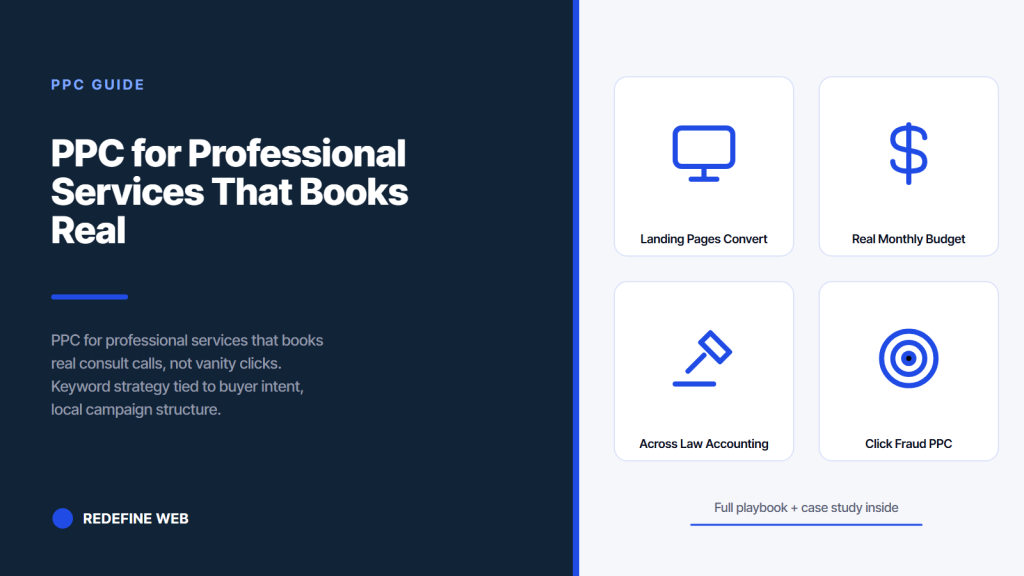
- Cost per consult sits at $80 to $340 by firm stage.
- Structure campaigns by practice area first, then location.
- Legal CPCs run highest, consulting the widest variance.
- Fraud detection saves 6 to 18 percent of budget.
- Retainer sits at 12 to 18 percent of ad spend.
- Landing pages that convert in ppc for professional services
- Real monthly budget bands for professional services ppc
- Ppc for professional services across law, accounting, and consulting
- A real client case for ppc management for professional services
- Click fraud in ppc for professional services accounts
- Ppc for professional services shortlist checklist
- Wrapping the ppc for professional services guide
PPC for professional services is where 50 to 70 percent of law firm, accounting practice, and consulting firm ad budgets disappear on clicks that never turn into consult calls. Most firms hire a generalist agency, get pointed at a consumer PPC playbook, and watch $6,000 monthly produce 300 clicks and 4 consult bookings. This guide walks you through the keyword strategy, local campaign structure, budget bands, and attribution model that actually books qualified consult calls for a professional services firm. Read straight through in ten minutes and you’ll know what to fix on your account by tomorrow morning.
You’re likely reading this because your firm is spending $3,000 to $18,000 monthly on Google Ads and booking fewer than 12 qualified consults. Below you’ll find real spend bands for solo, mid-market, and multi-partner firms, a keyword strategy tied to buyer intent by practice area, a working comparison table across law, accounting, and consulting verticals, and one Redefine Web client whose paid-media motion returned 5x ROI inside twelve months. Steal the shortlist, apply it to next Monday’s account review, and stop paying for clicks that never turn into pipeline.
Landing pages that convert in ppc for professional services
Landing pages that convert in ppc for professional services follow four rules. One dedicated landing page per practice area. Mirror the ad’s promise in the H1. Keep the consult request form to four fields (name, phone, matter type, preferred timeslot). Include social proof (recent case results, credentials, bar admissions) above the fold.
The mistake we see on 80 percent of professional services PPC audits: paid clicks land on the home page or a generic services page, and the buyer bounces because the message match breaks. Ad promises an estate planning attorney in Cincinnati. Home page talks about the firm’s 40-year history and lists eight practice areas. Buyer leaves in 8 seconds. Cost of that click: $12. Multiply by 500 clicks a month and the account bleeds $6,000 monthly on message-match failure alone. Fix landing pages first, keyword strategy second, bid strategy third.
Landing page speed matters more for a professional services firm than for a consumer brand. Decision-makers open your ad on a laptop with 30 tabs open during a workday. Every second past 2.5 loses 12 percent of them. Get to sub-2-second time-to-interactive on a mid-range Chrome laptop before scaling spend past $4,000 monthly. For a professional services landing page build with the CRM integration wired at launch, our Custom Web Design and Development Services practice runs the pattern for law, accounting, and consulting firms.
Real monthly budget bands for professional services ppc
Professional services ppc budgets sit in three real bands by firm size and practice area. Solo practitioners spend $2,000 to $5,000 monthly and book 12 to 30 consults. Mid-market firms with 3 to 8 attorneys or partners spend $5,000 to $15,000 and book 30 to 80 consults. Multi-partner firms with 10+ professionals spend $15,000 to $50,000 and book 80 to 200 consults.
The budget band decides the account structure. Solo practitioners run 2 to 3 search campaigns and one branded campaign. Mid-market firms run 4 to 8 search campaigns split by practice area, one branded, and Local Service Ads where the practice area qualifies. Multi-partner firms run 10 to 25 campaigns segmented by practice area plus geography plus buyer stage, with a dedicated PPC strategist watching the account daily. Buying above your stage burns cash on complexity you can’t manage. Buying below burns cash on missed coverage.
The retainer that runs the account matters as much as the ad spend. A working professional services PPC retainer runs 12 to 18 percent of ad spend at the mid-market level, with a floor at $1,600 monthly and a cap at $9,600. Below $1,600 you’re paying for a checkbox review, not real optimization. Above $9,600 you’re paying for a strategist with too many other accounts. For a comparable retainer scope, our PPC Management Services practice runs the account shape on service businesses.
| Firm stage | Attorneys/partners | Monthly ad spend | Consults per month | Cost per consult | Retainer |
|---|---|---|---|---|---|
| Solo practitioner | 1 to 2 | $2,000 to $5,000 | 12 to 30 | $80 to $180 | $1,600 to $2,400 |
| Mid-market firm | 3 to 8 | $5,000 to $15,000 | 30 to 80 | $120 to $240 | $2,400 to $4,800 |
| Multi-partner firm | 10+ | $15,000 to $50,000 | 80 to 200 | $160 to $340 | $4,800 to $9,600 |
Ppc for professional services across law, accounting, and consulting
Ppc for professional services runs differently across law, accounting, and consulting verticals. Legal ads carry the highest CPCs at $12 to $32 for personal injury and $6 to $18 for other practice areas. Accounting ads run $4 to $14 across tax and audit queries. Consulting runs $3 to $12 depending on specialization.
Legal firms face the tightest CPC market because contingency-fee cases with six or seven-figure settlements make personal injury CPCs the most competitive in Google Ads. State bar rules also restrict how firms can advertise, so the compliance layer matters. Accounting firms sit in the middle band because tax season demand spikes CPCs from January to April but softens May through November, leaving budget to test new practice areas at half the yearly average CPC. Consulting firms have the widest CPC variance because niche practice areas (M and A advisory, industry-specific strategy) run at $3 to $8 while broad management consulting runs at $12 to $28.
The strategy shape stays the same across verticals: campaign structure by practice area, buyer stage bidding, landing pages per practice area, CRM tied for attribution. The bid ranges shift with the vertical. Don’t try to run legal PPC bids on an accounting firm’s budget: you’ll cap out before you get a real signal. Don’t try to run accounting bids on a legal account: you’ll get outbid by every personal injury firm in the metro. External reference on B2B vertical CPC patterns lives at the Search Engine Land paid search library.
Cost per consult is fake if half the consults are wrong matter type. Ask intake to tag every call with practice area. That's your true cost per qualified consult.
A real client case for ppc management for professional services
Stonehenge Consulting PLC, a UK-based tax advisory firm, ran ppc management for professional services tied to a growth-tier site build that returned 5x ROI on ad spend, tripled local visibility, and built a predictable weekly consult pipeline. The engagement pattern maps directly onto what a working professional services PPC account looks like at the mid-market level.
The Stonehenge engagement started with a Google Ads account tied directly to the CRM so every consult booking traced back to keyword, ad, and landing page. Practice-area campaigns rotated creative against real buyer personas. Weekly review cadence caught underperforming campaigns before they burned budget. Monthly reporting showed cost per consult booking by campaign rather than clicks or CTR. The result was a 5:1 return on ad spend and a consult pipeline the founder could plan capacity against quarterly.
The takeaway for a professional services firm considering a PPC engagement: the account isn’t the strategy. The strategy is practice-area segmentation, buyer-stage bidding, landing pages per practice area, and a CRM that closes the loop between click and consult. Ask any vendor pitching you a professional services PPC retainer to walk you through how they attribute a consult back to a specific keyword. If they can’t, they’re watching the account, not running it. For a comparable retainer scope tied to the shape, our Google Ads Management Services practice publishes the reporting on every account.
Click fraud in ppc for professional services accounts
Click fraud eats 6 to 18 percent of a professional services PPC budget when the account has no fraud detection wired in. Competitors clicking your ads. Bots crawling for pricing. Ad networks logging traffic they never delivered. A $10,000 monthly account bleeds $600 to $1,800 monthly to fraud alone if nothing is monitoring click quality.
Fix the fraud problem with three moves at account launch. Install ClickCease, Fraud Blocker, or PPC Protect at $65 to $340 monthly. Enable Google Ads’ built-in invalid click protection under Account Settings. Add IP exclusion lists for known competitor networks and bot ranges. The stack pays back inside 60 days on any professional services account spending over $5,000 monthly. Legal firms in high-competition metros need the stack immediately because personal injury CPCs make competitor click abuse a real ROI-killer inside the first 90 days of a new account.
The single most predictable line on a law firm’s PPC account is the one broad match keyword “attorney near me” that eats $3,800 a month producing zero consults and 620 clicks from people looking for jobs at law firms, students researching career paths, and folks who typed “attorney near me” when they meant to type it into a dictionary because they weren’t sure how to spell it. Four months in the firm asks the agency what’s going on. The agency runs a Loom explaining the search terms report. The firm cancels the keyword. Everybody moves on. Nobody mentions the $15,200.
Ppc for professional services shortlist checklist
Ppc for professional services worth signing a retainer on passes a nine-point checklist. Campaign structure split by practice area and buyer stage. Keyword strategy tied to matter type and geography. Landing pages built per practice area with message match. CRM integration for consult attribution. Fraud protection wired at launch. Monthly reporting on cost per consult, not clicks. Local Service Ads added where practice qualifies. Bar or state compliance review on ad copy for legal firms. Retainer at 12 to 18 percent of ad spend.
Run the checklist against every quote you get. The vendor who passes all nine is worth a follow-up call. The vendor who passes six of nine is worth a conversation about the three gaps. The vendor who passes fewer than five is a generalist agency with a PPC checkbox, and the account they run will bleed budget for at least twelve months before anyone catches it. This is the pattern we see repeatedly across professional services owners coming to us after a bad first retainer engagement.
- Campaign structure split by practice area and buyer stage
- Keyword strategy tied to matter type and geographic market
- Landing pages built per practice area with message match to the ad
- CRM integration for full consult booking attribution
- Fraud protection wired at account launch, not month four
- Monthly reporting on cost per consult, not clicks or impressions
- Local Service Ads added where practice area qualifies
- Bar or state compliance review on ad copy for legal firms
- Retainer priced at 12 to 18 percent of ad spend, floor $1,600, cap $9,600
Wrapping the ppc for professional services guide
Ppc for professional services that books real consult calls runs on a repeatable pattern. Campaign structure by practice area. Keyword discipline on matter type and location. Landing pages that match the ad. CRM tied to the account. Fraud protection wired at launch. Monthly reporting on cost per consult.
If you take one thing from this ppc for professional services guide, take the nine-point checklist and run it against the next retainer proposal you review. If you take two things, insist on consult-level attribution before the deposit clears, not at month six when the account is already bleeding budget. When you’re ready to talk through the retainer shape tied to your practice areas, our PPC Management Services practice walks through the shape in a 30-minute call.
Frequently asked questions
How much does ppc for professional services cost per month?
PPC for professional services runs at three real spend bands. Solo practitioners spend $2,000 to $5,000 monthly and book 12 to 30 consults at $80 to $180 per consult. Mid-market firms with 3 to 8 attorneys or partners spend $5,000 to $15,000 and book 30 to 80 consults at $120 to $240 each. Multi-partner firms with 10 or more professionals spend $15,000 to $50,000 and book 80 to 200 consults at $160 to $340 each. Add a retainer at 12 to 18 percent of ad spend with a $1,600 floor and a $9,600 cap for real account management, not a checkbox monthly review.
What are effective local ppc ad strategies for professional services?
Effective local PPC ad strategies for professional services start with campaign structure. Split search campaigns by practice area first, not one bloated campaign with 400 mixed keywords. Split ad groups inside each campaign by buyer intent stage: bottom-funnel matter type plus location, mid-funnel comparison and cost queries, top-funnel educational queries. Use phrase or exact match, never broad match on category terms like lawyer or accountant. Add location bid adjustments prioritizing the firm's primary office radius. Run Local Service Ads separately from search where the practice area qualifies. Bid bottom-funnel at $8 to $32, mid-funnel at $3 to $12, top-funnel at $1 to $4.
How to select keywords for professional services ppc campaign structure?
How to select keywords for professional services PPC campaign structure runs on three tiers by buyer intent. Bottom-funnel targets specific matter type plus location: probate lawyer Cincinnati, tax audit defense Denver, business valuation San Diego. Mid-funnel targets comparison and cost queries: best estate planning attorney, average cost of tax audit defense. Top-funnel targets educational queries: what does an estate planning attorney do. Bottom-funnel bids at $8 to $32 max CPC. Mid-funnel bids at $3 to $12. Educational queries bid at $1 to $4 or get paused. Add negative keywords for jobs, careers, salary, student, and practice-area-adjacent terms that don't fit your firm's book.
What does good ppc management for professional services look like?
Good PPC management for professional services shows up in six operational moves. Weekly negative keyword additions from the search terms report, usually 20 to 40 negatives a week for the first three months. Landing page changes tested monthly on the highest-spend practice areas. CRM integration wired so every consult booking traces back to keyword, ad, and landing page. Monthly reporting that shows cost per consult by campaign, not just clicks or CTR. Fraud protection stack including ClickCease or Fraud Blocker at $65 to $340 monthly. And a named account lead who runs no more than 15 to 20 accounts total, not a portfolio of 40 that guarantees your account gets 90 minutes of attention weekly.
How is professional services ppc different from consumer PPC?
Professional services PPC differs from consumer PPC in three specific ways: buyer intent, sales cycle, and attribution model. Consumer PPC optimizes for e-commerce transactions inside a 7-day window with a single-session conversion path. Professional services PPC optimizes for consult bookings inside a 30 to 90-day evaluation window with 3 to 6 buyer touchpoints. Consumer campaigns can lean on Performance Max and Smart Bidding. Professional services campaigns need manual bid strategy, buyer-stage segmentation, and CRM-tied attribution to catch consults booked 45 days after the first click. Generalist agencies running consumer playbooks on professional services accounts kill campaigns at day 30 that would have booked pipeline at day 60.
What's a good cost per consult in ppc for professional services?
A good cost per consult in PPC for professional services sits at $80 to $340 depending on firm stage and vertical. Solo practitioners in mid-competition metros hit $80 to $180. Mid-market firms in competitive metros hit $120 to $240. Multi-partner firms bidding into high-CPC verticals like personal injury hit $160 to $340. Legal firms face the tightest market because contingency-fee cases make personal injury CPCs the most competitive in Google Ads at $12 to $32. Accounting sits in the middle band at $4 to $14 across tax and audit queries. Consulting runs $3 to $12 with the widest variance across niche versus broad practice areas.
Book your free 30-minute strategy call.
No spam, no sales rep. We use your email to schedule your call with a senior strategist. That is it.
More from the blog
View all articles → PPC
PPC Healthcare PPC Advertising Channels Compliance and Targeting
Read article PPC
PPC Dental Facebook Ads Guide for Practices That Book Patients
Read article PPC
PPC