
E-commerce PPC management services run paid ad accounts for online stores across Google Shopping, Performance Max, Search, Meta Advantage+, TikTok Ads, and Amazon Ads inside one weekly budget with a human specialist owning the account. In 2026, most stores pushing over $20K a month in ad spend touch three or four platforms at once. The gap between profitable growth and quiet spend waste sits in how the specialist sequences those platforms, not in the ad copy alone. You want an operator who can read a Shopify or WooCommerce cart report by 9 a.m. Monday and rewrite bids by 10.
What follows is the full anatomy of an e-commerce PPC agency scope, the platforms sitting in the modern stack, the retainer math by revenue band, what a real week on your account actually reads like, and how RAFZ Cirkulära Interiörer pushed conversions up 28% and cut server requests 82% through a paired rebuild-plus-paid-media effort. Read this before signing a scope with any paid media vendor promising 10x returns in 60 days.
Product feed hygiene inside e-commerce PPC management
Every Google Shopping and PMax campaign pulls straight from the Merchant Center product feed. Feed hygiene decides which SKUs show, which land in disapproved purgatory, and which impressions the store earns without lifting a bid. Most stores under $15K in monthly ad spend never re-audit the feed after initial setup. 20% to 40% of SKUs sit in a disapproved or limited state for months, and nobody on the account notices.
Feed fields that carry the most weight
Product title is the one field Google matches query intent against. Rewrite every product title to lead with brand, category, style, size, and color inside the first 70 characters. Description matters less than the title but still shapes match quality. The primary image needs a white or transparent background, with lifestyle shots living in the additional images slot. GTIN and MPN populate for every SKU or the platform quietly caps impressions. Product type and google_product_category map to Google’s taxonomy, not the store’s internal one. Miss any of these and Shopping impression share tops out below 40%.
Feed tools worth the license
DataFeedWatch, Feedonomics, and GoDataFeed sit between the store and Merchant Center to transform, split, and enrich the feed without touching Shopify or WooCommerce product data. License cost runs $100 to $800 a month depending on SKU count. Stores past 500 SKUs almost always need one of these. Below 500 SKUs a specialist can maintain the feed manually inside Shopify or a Google Sheet. A paid media agency usually bundles the tool license inside the retainer at cost, so the store never pays retail.
Creative rotation inside the paid ads stack
Meta and TikTok ad performance decays 40% to 60% inside 14 days on the same creative. Google Shopping performance decays slower since the ad is a product image and price, not a video hook. Still, every platform in the modern PPC for e-commerce stack needs a creative refresh cadence baked into the retainer, or performance drifts down inside 30 days and the store blames the platform for a rotation problem.
Creative refresh cadence per platform
Meta and TikTok want 4 to 6 new assets per week per top-spending ad set, with Meta Advantage+ handling the rotation once assets are uploaded. Google Search wants 3 to 5 new headlines and 2 new descriptions per Responsive Search Ad per month. Google Shopping wants fresh product images every 60 to 90 days with new lifestyle shots. YouTube wants one new 15-second bumper every 4 weeks. Skip any of these cadences and the account decays. The retainer either bundles a creative team or names creative production as a separate line the client owns.
UGC and creator content changed the math in 2025
User-generated content and creator partnerships now beat polished studio creative on Meta and TikTok by 30% to 60% on cost per acquisition. Every serious paid media agency wires a creator sourcing motion into the retainer at 4 to 8 creators per quarter, at $300 to $1,200 per deliverable. Studio creative still carries brand campaigns and premium positioning. UGC carries the performance workload on prospecting. Both live in the stack. Pretending one replaces the other is where retainers go sideways.
Budget allocation across paid channels for online stores
Every store past $10K a month in ad spend faces a budget allocation call across Google, Meta, TikTok, Amazon, and sometimes Microsoft Ads. The wrong split wastes 20% to 40% of budget. The right split compounds. There is no universal answer. There is a math per store shaped by margin, average order value, brand equity, and audience temperature.
Starting allocation by store type
Lifestyle and apparel run 45% Google (Shopping and PMax), 35% Meta, 15% TikTok, 5% brand Search. Home decor and furniture run 55% Google, 30% Meta, 10% Pinterest, 5% brand. Beauty and skincare run 30% Google, 40% Meta, 20% TikTok, 10% brand. Consumer electronics and gadgets run 60% Google, 25% Meta, 10% Amazon Ads, 5% brand. These are starting points, not a policy. The specialist reallocates every 30 days based on blended ROAS by channel, not last-click ROAS on the platform dashboards.
Amazon Ads inside the paid stack
Stores selling on Amazon and Shopify at once need a paired Amazon Ads program alongside the DTC paid stack. Amazon Sponsored Products, Sponsored Brands, and Sponsored Display run on a completely different auction and playbook from Google Shopping. A dedicated Amazon PPC specialist inside the agency runs these, not the DTC lead wearing two hats. Retainer for Amazon Ads sits at $750 to $3,500 a month on top of the DTC retainer, priced against Amazon monthly ad spend.
Reporting cadence that keeps a retainer alive
Every paid media engagement runs on a reporting rhythm the client and specialist lock in during week one. Daily is too much. Monthly is too little. Weekly plus monthly plus quarterly is where working retainers land. Reporting cadence is where cheap retainers fall over first. The specialist has 3 hours a week and none of it goes to summarizing. The Loom or Slack summary is not a nice-to-have. It is the artifact keeping the client in the loop between formal reports, and skipping it inside a busy quarter is how retainers quietly end at month 6.
Weekly Loom or Slack summary
Weekly means a 5-minute Loom or a 300-word Slack summary covering blended ROAS, top-spending campaign, biggest creative winner, biggest creative loser, and one action planned for next week. Not a PDF. Not a dashboard link. A human-written summary landing in the client’s inbox by Monday lunch. That single artifact separates an engaged agency from a set-and-forget vendor. Clients who receive it stay on retainer 3x to 5x longer than clients getting a monthly PDF only.
Monthly one-page report
Monthly is a one-page PDF or Notion page covering blended ROAS by channel, top 3 wins, top 3 losses, next month plan, and a small budget reallocation recommendation. One page. Not 12 pages. The one-page constraint forces the specialist to name the two or three signals that really mattered. Twelve-page reports read as busywork and clients skim them. Every serious agency uses the one-page format after 2023.
Retainer pricing for e-commerce PPC management
Pricing follows the store’s monthly ad spend and platform count, not vanity metrics. Redefine Web tiers the program at $999, $1,499, $2,499, and from $4,500 per month. Ad spend is billed separately and goes straight to the platform. The $999 tier fits stores under $5K in ad spend on one or two platforms. $1,499 covers most Shopify stores in the $5K to $20K range. $2,499 buys the full Google plus Meta plus TikTok stack for $20K to $60K accounts. Enterprise starts at $4,500 and covers stores past $60K a month with Amazon Ads, retail media, and a dedicated pod.
What ad spend goes on top
Ad spend never gets bundled into the retainer. That is a hard rule. The store owns the credit card on Google Ads, Meta Business Manager, TikTok Ads, and Amazon Ads. The agency owns the strategy, the bids, the creative brief, and the reporting. Bundled ad spend is where hidden markups live. A clean scope keeps the retainer and the media buy on separate invoices so every dollar is auditable.
Red flags when hiring a paid ads agency
Every store owner reads a proposal that promises 10x ROAS in 60 days. The red flags below catch the majority of pitches that do not survive contact with a real Shopify or WooCommerce account.
- No week-one tracking or feed audit in the scope. The platforms cannot outrun broken data.
- Retainer under $999 a month promising full multi-platform coverage. That budget buys 4 hours of specialist time. Tool licenses alone eat $200.
- Vague description of which specific Meta Advantage+ or PMax bid strategies sit in the plan.
- Account owned by the agency instead of the client through a shared Google Ads MCC or Meta Business Manager access. Ownership transfer takes 48 hours on cancellation.
- No mention of blended ROAS attribution tools (Triple Whale, Northbeam, Rockerbox). Last-click platform ROAS overstates by 30% to 60%.
- Guaranteed ROAS numbers on the first call. No serious agency guarantees a return before 60 days of account data.
Green flags in a real pitch
A written scope naming exact platforms plus bid strategy per platform. A tracking QA and feed audit inside week one. A client-owned MCC and Meta Business Manager link with 48-hour termination. A weekly Loom or Slack summary format sample. A monthly one-page report sample. Case studies with named brands, real ad spend, and real ROAS across at least 12 months. Any pitch hitting five of the six is worth a follow-up call.
Timeline to see real results from paid ads
Store owners arrive at the retainer conversation with wildly different timelines in mind. Some expect a 5x ROAS in week one since the last proposal promised it. Others expect nothing since the prior vendor let them down. Real outcomes sit in a narrow window shaped by category, ad spend, and how clean the tracking was wired up on day zero. The bands below reflect roughly 40 e-commerce accounts our team manages or has audited in the last 18 months.
Month-by-month what to expect
Month one is tracking QA, feed audit, campaign restructure, and the first creative refresh. Blended ROAS often dips 10% to 20% as learning phases reset. Month two is the first real signal as the model learns on cleaner data. Month three is where most stores hit break-even against retainer plus ad spend. Months four through six are where compounding kicks in and blended ROAS climbs 30% to 60% above the pre-engagement baseline. Skip the tracking and feed audit in month one and every downstream number lands 3 to 5 months late.
Returns by category with clean tracking
Apparel and lifestyle land at 3x to 5x blended ROAS after 6 months. Home decor and furniture land at 4x to 8x after 6 months given higher AOV. Beauty and skincare land at 2.5x to 4x on the first purchase, 6x to 10x on lifetime value once subscription flows work. Consumer electronics land at 3x to 5x on high-margin SKUs, 1.8x to 2.5x on low-margin commodity items. According to Think with Google’s paid search benchmarks, e-commerce accounts running Smart Bidding on clean tracking beat industry averages by 40% to 60% on cost per acquisition.
In-house versus outsourced e-commerce PPC management
Every store owner eventually asks whether to run paid ads in-house or hire an outside team. The honest answer depends on ad spend, in-house creative capacity, and whether the founder has time to review reports every Monday. Below $15K a month in ad spend, an agency retainer wins on math since tool licenses alone eat $500 to $900. Above $100K, a hybrid model with an in-house lead plus agency oversight usually wins.
The tool license math for in-house
Triple Whale or Northbeam ($199 to $900 a month), DataFeedWatch or Feedonomics ($100 to $800), Optmyzr ($250 to $500), and Adalysis ($150 to $300) stack to $700 to $2,500 a month for a single in-house lead. Agencies spread those license costs across 15 to 20 accounts, so the per-account share drops to $50 to $130. That is one of the biggest cost efficiencies an agency delivers on paid media. Founders who insist on in-house tooling below $30K in monthly ad spend usually spend 3x what they need to.
When in-house wins
In-house wins when the store spends over $100K per month, custom conversion logic needs daily internal collaboration, and the founder wants a permanent paid media capability living on the team. Even then, an agency oversight arrangement (fractional paid media director, quarterly audits) catches blind spots a solo in-house lead misses. Full replacement of external oversight rarely pays off below $300K in monthly spend. Our PPC management services team runs into this decision often with mid-market Shopify clients.
Case study proof from a paired rebuild plus paid stack
RAFZ Cirkulära Interiörer is a Swedish sustainable furniture brand that came in with a plugin-heavy site loading in 15+ seconds. Cart abandonment ran high, trust was thin, and paid traffic bounced before the product page finished rendering. The paired play was a lightweight custom theme rebuild plus WooCommerce optimization plus a place2place API integration feeding the product catalog into a fresh paid ads setup on top.
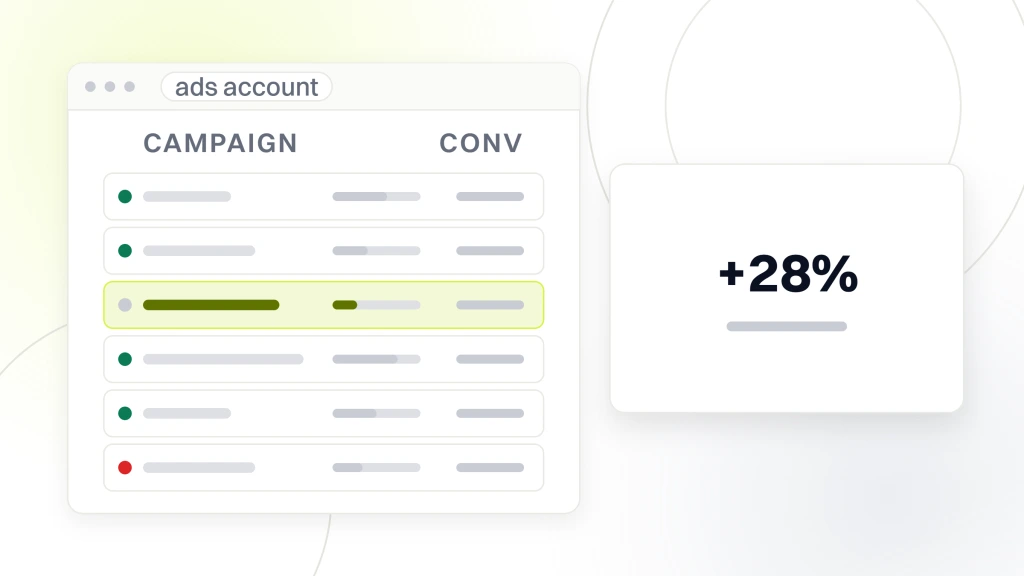
Post-launch the store lifted conversions 28%, cut server requests 82%, and pulled fully loaded time from 15s+ down to 2s. Paid campaigns finally had a landing surface that could hold intent. The lesson repeats across the 40-plus accounts we have audited. Ad money follows page speed and product-page clarity. Send $10K a month to a 15-second load and the platform quietly caps your impressions. Fix the surface first, then let the specialist optimize on top.
Wrapping up e-commerce PPC management for online stores
E-commerce PPC management in 2026 is a stack of platforms (Google Shopping and PMax, Meta Advantage+, TikTok, Amazon) a human specialist orchestrates on top of clean tracking, a healthy product feed, and a creative refresh cadence baked into the retainer. Every platform has a specific job. Every retainer has a math tied to monthly ad spend. Skip the tracking audit and the model overspends. Skip the creative refresh and performance decays inside 30 days.
Real accounts see 3x to 8x blended ROAS inside 6 months when the specialist, the tracking, and the creative rotation all show up every week. RAFZ Cirkulära Interiörer lifted conversions 28% and cut load time from 15s+ to 2s through a rebuild plus paid stack. Ask three vendors for line-item scopes, look for the green flags above, and pick the one giving you full account ownership on both the MCC and Meta Business Manager side. Redefine Web offers a fixed-scope retainer from $999 to $4,500 a month with the full stack included, plus a Google-first Google Ads Management Services program, an Ecommerce PPC Agency for DTC Brands package, and a broader Ecommerce Marketing Agency for DTC and Shopify Brands retainer.