
Ecommerce marketing companies get picked the same way store owners pick a Shopify theme. A founder browses ten sites at 11pm, likes the color palette on one, books a demo, signs a proposal that reads like a menu, and three months later cannot name which line item moved the Shopify dashboard. The vendor works. The vendor is even good. The fit is wrong for the brand. Fit is the single variable that predicts retainer outcomes six months in, yet fit rarely gets weighed against the logo wall or the case study revenue claim during the sales cycle.
For DTC brands in the pet vertical, our pet product marketing agency scope guide covers the channel mix, Amazon cadence, and reorder flywheel that hold across a full 6-month starter term.
This guide walks how to evaluate ecommerce marketing vendors the way a founder would evaluate a merchandising vendor or a fulfillment partner. You’ll see what the four agency types deliver, where each one earns its retainer and where each one drifts, which evaluation signals predict outcomes and which ones don’t, the red flags that surface in the sales cycle if you look for them, and where the DIY-versus-hire cutoff lands for real DTC brands. The retainer tiers and case studies that back the numbers below sit on the ecommerce marketing agency hub.
Red Flags Inside Top Ecommerce Marketing Companies Sales Cycles
Sales cycles show how agencies operate. Founders who watch for the red flags below usually save $30K to $80K a year in wasted retainer spend. The flags almost always show up during the pitch and get ignored, since the founder wants to trust the vendor. Trust the pattern more than the pitch. Vendors who mishandle the sales cycle usually mishandle the retainer the same way.
- Sales rep answers strategy questions the account team should own, then disappears at signature
- Case studies quoted with revenue percentages but no dollar baselines or timeframes
- Proposal listed in channel buckets without a monthly output count under each bucket
- Retainer priced by hours rather than by delivered output
- Reporting cadence described as monthly with no reconciliation against Shopify booked orders
- Contract length shorter than six months or longer than twelve for no reason tied to your brand stage
- Every question about creative volume gets deflected to a general “we scale as needed” answer
The bait-and-switch account team pattern
Agencies staff sales calls with a founder or director for the pitch and swap in a junior account manager after signature. That swap usually costs the brand three to six months of relationship-building the founder thought was baked into the price. Ask by name who runs the account in month one and month six. Ask to speak with the actual media buyer, not the sales rep, on the second call. Agencies that stall on this ask are staffing calls with people who don’t run accounts. Founders who skip the by-name question find out at kickoff.
The dollar-blind percentage claim
A revenue growth claim of 340% means nothing without the dollar baseline and the timeframe. Growing a brand from $20K to $88K a year is a 340% gain that any competent freelancer could produce. Growing a brand from $5M to $22M is a 340% gain that reshapes the whole company. Both get the same percentage headline in case study PDFs. Ask for dollar baselines on every case study cited. Agencies that hesitate usually cited the numbers to sell a retainer, not to demonstrate real work.
Ecommerce Digital Marketing Agency Pricing Tiers Explained
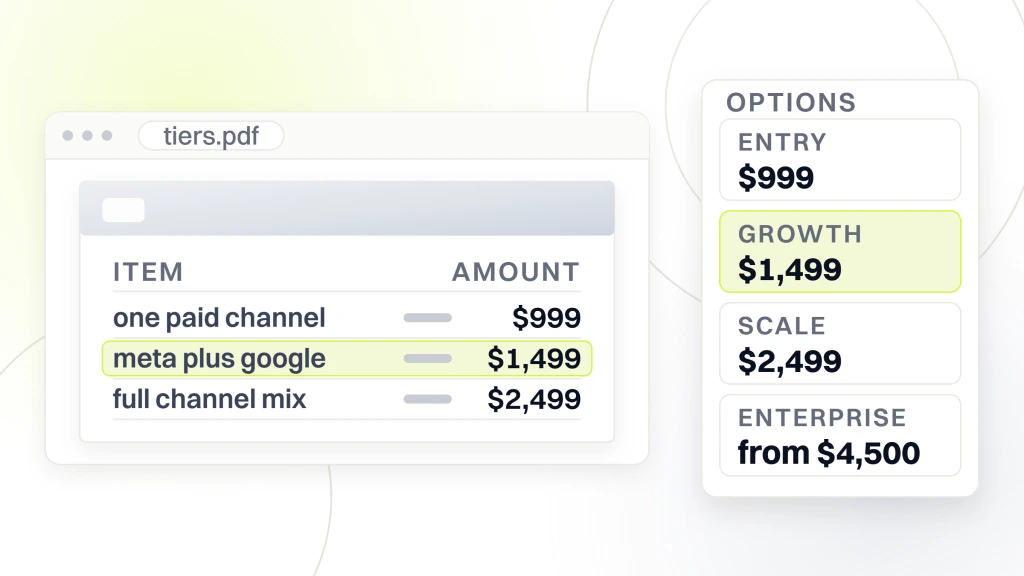
An ecommerce digital marketing agency at real market pricing runs four tiers that map to brand revenue. SEO retainer tiers run $999, $1,499, $2,499, and from $4,500 per month. PPC retainer tiers match at $999, $1,499, $2,499, and from $4,500 per month. Full-stack retainers combine both and add creative, email, and reporting on top. Contracts run six months on every tier since paid, SEO, and email each need at least that window to hit their real optimization cycles.
The entry tier fits the first year of DTC
The entry tier at $999 per month covers one paid channel, five core Klaviyo flows, and one monthly reporting sync. That scope fits brands under $500K in yearly revenue where the founder still owns strategy and the agency owns execution on a single channel. Founders who buy above their stage at this pricing usually pay for capacity they cannot yet use, and the retainer feels overpriced by month three. The retainer terms sit on the ecommerce marketing retainer page with a scope-by-tier breakdown.
Growth tier is where compounding starts
The growth tier at $1,499 to $2,499 per month covers Meta plus Google plus SEO plus Klaviyo with 12 to 20 creative assets per month and weekly reconciled reporting. That scope fits brands from $500K to $5M in yearly revenue. This tier is where the four-channel loop actually compounds. Ad spend usually sits at 15 to 25% of revenue at this stage. Retention math starts to matter here. Repeat purchase rate above 25% at day 90 pulls the whole brand into a healthier acquisition-to-lifetime-value ratio.
Enterprise tier for scale-stage DTC
The enterprise tier starts at $4,500 per month and covers all nine channels with dedicated ad ops, weekly creative refresh, and daily paid pacing. That scope fits brands past $5M in yearly revenue where each channel needs its own bench. At this stage, a full-time agency team of 3 to 5 people runs the account, and reporting reconciles against Shopify daily. Founders who try to run enterprise-stage volume on a growth-tier retainer usually watch CAC drift up 30 to 50% inside a quarter, since the media buyer’s account load is too high to catch fatigue in time.
Real Work. Abigail Ahern and the Agency Fit That Produced 179%
Abigail Ahern, a luxury home decor brand out of London, partnered with Redefine Web in August 2020 after a vendor evaluation that ran four agency shortlists. The brief centered on cutting discount reliance that had trained buyers to wait for promotions, tightening Google Shopping campaign structure, and rebuilding category page SEO around non-branded high-intent search terms. Full-stack retainer covering paid media and SEO under one team, not three vendors.
The evaluation weighed three signals more than any others. Written monthly deliverable sheet inside the second sales call. Named account team across paid, SEO, and creative rather than a rotating sales pod. Weekly reconciliation practice against Shopify booked orders rather than a monthly Meta-fed slide deck. Two of the shortlisted vendors couldn’t produce the deliverable sheet inside 48 hours. One stalled on naming the account team. The fit ended up being the vendor who answered all three cleanly on the second call.
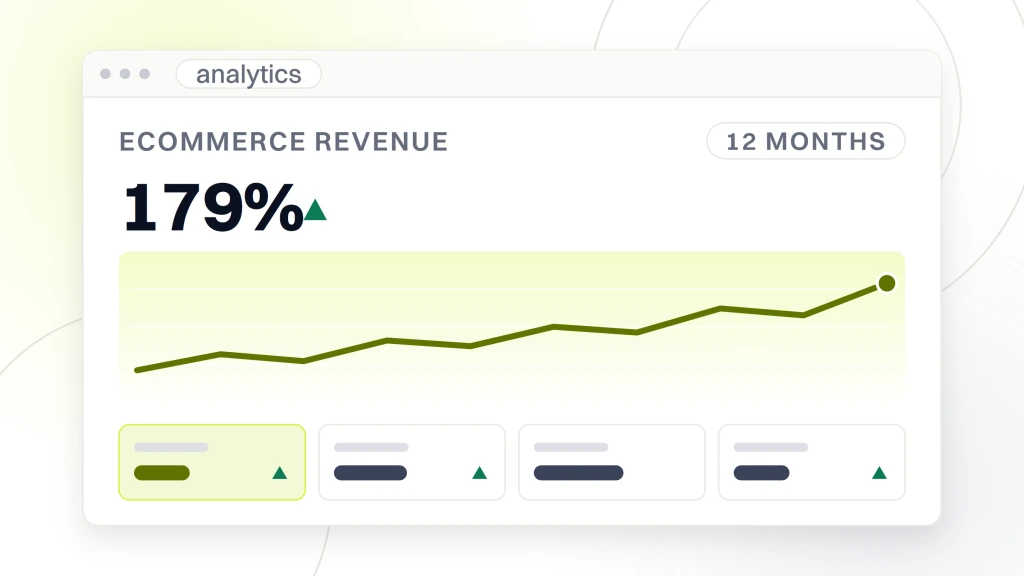
Over the 12-month rebuild window, Abigail Ahern grew ecommerce revenue 179% year over year on the same scope the deliverable sheet had listed on day one. Paid search ROAS climbed from around 700% to 1,588%, more than doubling the previous year’s efficiency. Paid social ROAS reached 3,000% through disciplined retargeting and prospecting audience work. Conversion rate roughly doubled from the pre-partnership baseline. That result rolled out of the fit signals that scored highest during the evaluation, not from a tactical breakthrough in month seven.
When to Hire Ecommerce Marketing Companies Versus Run It In-House
The DIY versus hire cutoff for ecommerce marketing companies sits at three data points. Yearly revenue, channel count, and founder calendar bandwidth. Founders who run three channels themselves usually plateau at $800K to $1.2M in yearly revenue. Founders who hire at $800K usually clear $2M within 18 months.
DIY fits under $500K in yearly revenue
Under $500K in yearly revenue, a founder running Meta paid at $3,000 to $8,000 a month, five Klaviyo core flows, and one organic content channel can cover the whole marketing job on 15 to 20 hours a week. The job at this stage is getting product-market fit signal from the first thousand customers, not building a 12-channel machine before the product proves it converts.
Hire at $800K to protect the next 18 months
At $800K in yearly revenue, the founder becomes the bottleneck on every channel decision. Creative production stalls at four assets a month when the account needs 12. Reconciliation between Meta and Klaviyo gets skipped since Wednesday budget shifts eat the reconciliation hour. Hiring a growth-tier agency at $1,499 to $2,499 per month usually returns the founder’s 15 to 20 hours a week back to product, merchandising, and hiring. That returned time is where the next 18 months of compounding lives. Companion reading sits on our ecommerce marketing strategies post.
Comparing Full-Service Versus Channel Specialist Ecommerce Marketing Firms
Full-service and channel-specialist ecommerce marketing firms both work. Which one fits depends on how many channels are already handled well and how much coordination time the founder wants to spend across vendors. A brand that runs Meta prospecting with one agency, Klaviyo email with a second, and Shopify SEO with a third pays three project management fees, three onboarding fees, and three reporting frameworks that never reconcile inside one dashboard. That vendor split usually costs $8,000 to $15,000 monthly in overlapping fees plus lost coordination time.
Full-service wins on coordination cost
One team pulling four channels into one weekly standup produces the output of three vendors at $1,499 to $2,499 per month and closes the reconciliation loop that vendor splits cannot. Paid keyword data feeds into SEO planning the same week. Paid audience learnings feed into email segmentation the following sprint. Split those channels across three vendors and the loop breaks. Brands under $20M in yearly revenue almost always default to full-service. The exception is when one specific channel is running at a level no full-service shop can match.
Channel specialists earn their retainer when the internal team already coordinates
Channel specialists earn their retainer at two brand shapes. Enterprise DTC brands past $100M with an internal marketing director already coordinating three specialists. Brands where one channel is running at world-class scale and the specialist’s depth is genuinely differentiated. Outside those two shapes, the split-vendor pattern usually loses money to overlapping fees and unreconciled reports. Read the Content Marketing Institute ecommerce coverage for framing on content-plus-commerce coordination inside larger orgs.
The Questions Founders Should Ask in the Second Sales Call
The first sales call gets used for vendor introduction. The second sales call is where the founder tests fit. The questions below cut past the pitch and expose the operating pattern. Vendors who answer these cleanly usually run the retainer the same way. Vendors who deflect on more than two of them usually sell a retainer that reads differently from how it operates once the ink dries.
- Who runs paid, SEO, creative, and email on this account by name, and how long has each person been in that seat?
- What gets delivered every month across the five deliverable buckets, and can we see a sample sheet from a current client?
- How do you reconcile Meta ROAS against Shopify booked orders, and how often does that reconciliation happen?
- What is the contract length, and why is it that length rather than shorter or longer?
- What three current clients sit in our revenue band, and can we speak with two of them before signing?
- What happens in month one, and what does the written audit cover?
- How many creative assets get produced monthly at our tier, split by statics, motion, and UGC?
Reference calls with current clients beat case studies
Two reference calls with current clients in the same revenue band predict retainer outcomes more accurately than any case study PDF. The call shows how the agency handles the third month, the fifth month, and the moment when a channel misses target. Ask the reference how the agency responded when a quarter came in under plan. Vendors whose current clients cannot describe a specific misstep and the fix that followed are usually run by sales rather than by the account team. Reference calls take 45 minutes total and change the decision more than 20 hours of proposal review.
The month-one audit reveals real operating capability
Month one at a working retainer produces a written audit covering paid account structure, Shopify or WooCommerce tracking integrity, GA4 event mapping, Klaviyo flow status, an SEO baseline on the top 20 pages, and a prioritized fix map. Nothing goes live yet. Agencies that skip the audit and jump straight to campaign launches usually rebuild the measurement layer six months later since the data was never trustworthy from day one. Ask what the audit covers before signing. Vague answers on this question signal poor retainer outcomes at month six.
Vertical Fit Versus Agency Scale Inside Top Ecommerce Marketing Agencies
Top ecommerce marketing agencies usually pitch vertical experience as the top signal. Vertical matters at the creative brief layer, the copywriting layer, and the audience research layer. Vertical does not matter as much at the operational layer, the reporting layer, or the retention math layer. Founders who over-index on vertical fit usually pick a boutique with three current clients in the same space and no operational bench to run the account through a stress moment.
Vertical adjacency usually works fine
A skincare brand hiring a beauty agency picks a fit that runs seven haircare clients and four wellness clients on top of skincare accounts. That adjacency is fine. The creative brief translates. The audience research translates. The channel mix stays similar. A cookware brand hiring a beauty agency picks a fit that will not translate at all. Adjacency matters within one to two categories. Outside that range, general DTC operational fit beats a mismatched vertical specialist every quarter. The ecommerce marketing definition post covers the channel-mix framing behind that decision.
Operational scale beats vertical specialization past growth stage
Past $3M in yearly revenue, operational scale beats vertical specialization on retainer outcomes. A four-channel firm running 30 mid-market clients has the media buying bench, the creative production bench, and the reporting layer to absorb the operational load of a growing brand. A three-person boutique that specializes in your vertical usually cannot. Founders who prioritize vertical fit at scale usually rebuild the retainer inside 18 months since the boutique cannot keep up with the channel-count growth.
How Ecommerce Marketing Companies Should Price and Report
Ecommerce marketing companies should price by delivered output, not by hours logged, and should report by reconciled Shopify revenue, not by Meta’s self-reported ROAS. Founders who accept hour-based billing usually pay for capacity that flexes downward. Founders who accept Meta-only reporting usually over-invest in prospecting audiences and under-invest in retention channels.
Deliverable-based pricing protects the retainer
Deliverable-based pricing ties the invoice to delivered output. Growth tier delivers 12 to 20 creative assets, four category page rewrites, three Klaviyo flow builds, and one weekly reconciled report per month. That output is the retainer, priced at $1,499 to $2,499 per month. Hour-based pricing bills for whatever the account manager logged, which usually rewards accounts that need firefighting over accounts that run smoothly. The pricing pattern predicts the retainer’s behavior. Founders picking on hourly rates usually pay less monthly and receive less monthly output at the same time.
Six KPIs that decide whether the retainer earns its keep
Six numbers decide whether the retainer keeps growing or gets cut. Blended ROAS across all paid channels combined, not per-platform ROAS in isolation. Marketing efficiency ratio, total revenue divided by total marketing spend. New customer acquisition cost split from returning customer acquisition cost. Contribution margin per order after product cost, shipping, payment fees, and returns. Repeat purchase rate at 30, 60, and 90 days after the first order. Email plus SMS revenue as a share of total revenue, target 25% to 35% at mid-market. Agencies that report on two or three of these usually cherry-pick the flattering ones.
Where Ecommerce Marketing Companies Fit Inside the Growth Stack
Ecommerce marketing companies sit between the product side of the brand and the customer surface where every channel touches the buyer. Product owns what gets sold. Merchandising owns how it gets priced and bundled. Marketing owns how the offer meets the customer across every channel from Meta ad to post-purchase email. When those three seats coordinate well, the store compounds through market cycles. When they miscommunicate, retainer dollars vanish into channels the product side isn’t ready to support.
The founder who evaluates ecommerce marketing companies well reads a retainer proposal the same way a founder reads a P&L. Not as jargon. As a tool that names what sits inside the four walls of the marketing job and what sits outside. Founders who cannot draw the five deliverables on a whiteboard from memory usually delegate the marketing seat by default rather than by choice. Founders who can name the deliverables, the cadence, and the reconciliation practice usually keep the strategic seat regardless of who runs the tactical execution.
Store owners ready to talk retainer scope with Redefine Web can start with a free tracking and paid account audit. The audit produces a written fix map and a channel-priority order before any retainer conversation opens. Whether the brand is a starter Shopify store doing $200K a year or a scale-tier DTC brand pushing past $20M, the audit-first pattern beats the demo-first pattern every quarter. Founders comparing options can start from the wider ecommerce marketing agency hub for retainer tiers and case study depth. For the retail-side playbook that pairs with this guide, our pet shop marketing covers local SEO, Google Business Profile, and breed clubs for independent pet retailers.