Marketing automation for manufacturing is not the same product a SaaS company buys. 6-month sales cycles, buying committees of 5 to 7 people, and pipeline math that ties every touch back to a purchase order months later. Your stack has to speak that language. B2B manufacturing marketing automation looks different from every other flavor. The buyer is technical, the RFQ is the currency, and the trust bar is high. This guide is the plan the Redefine Web team runs when a shop walks in with a shiny CRM, a stalled pipeline, and 4,000 unnurtured contacts.
Inside you’ll find flows that drive manufacturing RFQ automation, the ABM structure that fits a mid-market shop, the tool stack that pays back, a lead scoring model that survives real usage, and a reporting cadence that ties automation output to closed pipeline. Read it in 10 minutes. Then hand the plan to a marketing operations lead and expect real pipeline movement inside 90 days.
Account based marketing for manufacturers at the mid-market band
Account based marketing for manufacturers works when the target list stays small and the outreach is genuinely personal. 50 named accounts. Not 200. Not 500. 50 accounts your sales team already wants on the board, with the buying committee mapped, the pain point named, and the outreach cadence documented for every role at every account.
ABM at a manufacturer is a joint operation. Marketing owns content, ads, and automation. Sales owns outreach, calls, and meetings. Both share the account list and metrics. Marketing-only ABM stalls inside quarter 2 so sales never committed. Sales-only ABM stalls so no automated nurture keeps accounts warm. Joint ownership is the price of entry.
Account list construction
The account list starts with your top-10 current clients. Match their firmographic pattern. Then pull every CRM prospect that fits. Score each on revenue potential, buying committee accessibility, and technical fit. Rank the list. Take the top 50. Everything past 50 gets deprioritized until the top 50 produces 3 closed accounts. This discipline is what separates real account based marketing for manufacturing from vague list-building that ends with 400 accounts and no traction.
Committee mapping per account
Committee mapping means naming the engineer, procurement manager, operations director, and CFO at every target account. Names, not titles. Names with LinkedIn URLs, email addresses, and one line about what they care about. Mapping takes 2 hours per account. 50 accounts equals 100 hours of research spread across your marketing lead and an SDR. Without it, ABM devolves into cold email blasts flagged as spam inside 3 weeks.
Pro tip. Rank the 50-account list every 30 days and swap out any account with zero engagement in the last quarter. A stale list drags down every metric downstream.
Choosing a manufacturing marketing automation agency partner
A manufacturing marketing automation agency partner is worth hiring when your internal team is under 3 people and the platform sits idle. Solo ops leads cannot build, test, and maintain full flow sets alongside daily work. An outside partner covers implementation, and your lead focuses on strategy and reporting.
Agency partners split into 2 types. Platform specialists focus on one tool. HubSpot Diamond partners, Salesforce Certified integrators, Marketo consultants. They know one platform deeply. Industry specialists focus on manufacturing across any platform. They know your buyer, your funnel shape, and your sales cycle length. Pick industry-specialist if your platform is standard and your funnel is complex. Pick platform-specialist if your platform is unusual and your funnel is standard. Most mid-market manufacturers benefit more from industry specialists.
Callout. A manufacturing marketing automation agency worth its retainer will show you a live client dashboard on the first call, not a case-study PDF from 3 years ago.
Interview questions for the agency
Every intro call with a manufacturing marketing automation agency needs 6 questions. Show me a live dashboard from a current manufacturing client. Name 3 RFQ-producing flows built in the last 12 months. Walk me through your lead scoring model for a 6-month sales cycle. What is the implementation timeline. What is the pass-through for platform licensing. Who owns the built flows at engagement end. Answers tell you whether the agency has real manufacturing experience or is bending a SaaS playbook to an industrial buyer.
Retainer bands and scope
Redefine Web SEO retainers for manufacturing automation clients tier at $999, $1,499, $2,499, and from $4,500 per month. The $999 Visibility tier suits shops with an internal ops lead who need light strategy oversight. $1,499 Traffic covers content plus reporting. $2,499 Scale runs full-service automation plus ABM. Enterprise starts at $4,500 and covers predictive scoring, multi-channel orchestration, and a dedicated analyst. Pick the band that fits your automation ambition, sign a 6-month minimum, and set clear success metrics before month 1 begins.
Lead generation marketing for manufacturing with the automation layer
Lead generation for manufacturing works when the automation layer and the lead gen program run as one system, not 2 teams passing spreadsheets back and forth. Every form fill hits automation the same day. Every RFQ hits sales inside 15 minutes. Every warm lead moves through nurture on schedule. Delays kill industrial deals faster than any other B2B category, so industrial marketing automation lives and dies on speed to reply.
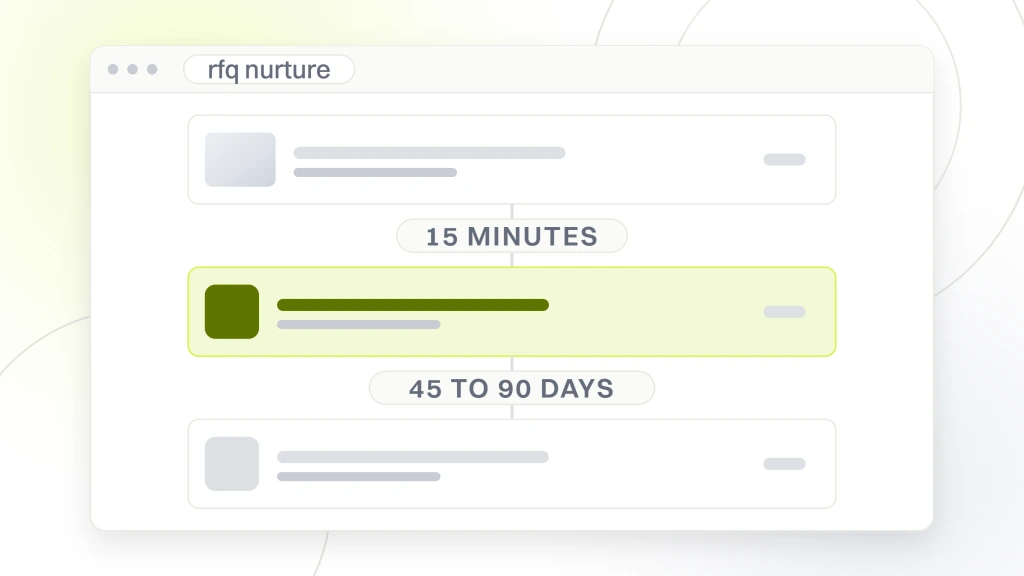
Manufacturing lead generation runs on 5 sources. Organic capability page traffic. Google Ads on procurement keywords, which our manufacturing PPC service runs against buyer-intent terms. LinkedIn account programs. Trade show follow-up. Referral network activation. Automation ties all 5 sources back to the same CRM record, tags source, and starts the right nurture flow. That tie-back is what makes source attribution work at the QBR level 6 months later. Without it, marketing has no proof for a $180K RFQ that closed in June about which channel opened the door in January.
| Lead source | Automation flow triggered | Average RFQ conversion | Time to close |
|---|---|---|---|
| Organic capability page | First-touch nurture + page follow-up | 4% to 7% | 90 to 180 days |
| Google Ads procurement keywords | Fast-track nurture, sales alert in 15 min | 6% to 12% | 60 to 120 days |
| LinkedIn account program | Account-specific sequence, committee routing | 2% to 4% monthly | 120 to 210 days |
| Trade show follow-up | 72-hour video, then technical PDF, then meeting ask | 8% to 18% | 45 to 90 days |
| Referral network | Immediate sales alert, no automation | 22% to 40% | 30 to 60 days |
Sales alert timing that matters
Sales alerts on high-intent activity need to fire inside 15 minutes. A procurement manager who requested a quote at 10:47am on a Tuesday wants a callback by 11:02am. Not tomorrow. Same-hour. Platforms that route alerts through email and rely on the rep checking inbox miss the window every time. Direct SMS to the rep phone plus a Slack notification to the sales manager beats email routing by roughly 20 minutes. That 20 minutes converts to 30% higher call answer rate on the first attempt.
Nurture cadence per lead source
Different sources need different cadences. Organic capability page visitors get a 45-day flow (early stage). Google Ads leads get a 21-day accelerated flow (high intent). LinkedIn account leads get a 90-day slow flow (warm but not buying). Trade show leads get a compressed 14-day flow (attention decays fast). Running one cadence for every source is the top mistake we see at mid-market shops rolling out this program.
Pro tip. Audit your bounce and unsubscribe rates by source every 30 days. If any source clears 2% unsubscribes, the cadence for that source is too aggressive and needs a rewrite.
How manufacturing lead generation marketing scales past $50M revenue
Manufacturing lead generation marketing past $50M revenue adds 4 capabilities on top of the base setup. Predictive lead scoring driven by a data warehouse. Account-based sequences with role-specific content routing. Multi-channel orchestration across email, LinkedIn, and paid retargeting. ERP-tied revenue attribution running to the shipment line item.
Callout. Manufacturing lead generation marketing at $80M revenue is a different animal than at $20M. Do not port a Starter-tier playbook into an Enterprise-tier funnel or the math breaks by month 4.
Scale rewrites the whole stack. HubSpot Starter at $20M needs HubSpot Enterprise or Salesforce Marketing Cloud at $80M. Single-channel nurture becomes multi-channel orchestration. Monthly measurement becomes weekly cohort analysis. The upgrade is real dollars. $60K to $180K annual license, $12K monthly retainer, $40K one-time implementation. Payback is a 30% to 60% gain in pipeline attribution accuracy and a 20% gain in RFQ velocity from tighter lead scoring.
Predictive lead scoring in practice
Predictive lead scoring runs on machine learning trained against your closed-won history. The model reads dozens of signals per contact. Capability page depth, time on pricing calculator, email click patterns, firmographic match, LinkedIn engagement. It outputs a score every night. Sales reps work leads scored 80-plus. Automation nurtures 40 to 80. Under 40 stays in low-touch until behavior signals a change. This produces 40% higher rep productivity than manual scoring so reps only touch leads with real buying signal.
Multi-channel orchestration flows
Multi-channel orchestration means one flow triggers touches across email, LinkedIn, paid retargeting, and sales SMS in sequence. A high-intent lead gets an email, then a LinkedIn connection from the rep, then a retargeting ad on a capability page, then SMS follow-up. Each channel reinforces the last. This shape works past $50M so the tech cost is real and ROI only clears at higher pipeline volumes. Below $50M, single-channel email nurture is the cleanest form of marketing automation for manufacturing without orchestration overhead.
Case study. Poly Processing turned trade shows into 10x ROI
Poly Processing is an industry-leading manufacturer of rotationally molded polyethylene tanks for safe storage of corrosive and hazardous chemicals. Their clients span industrial plants and municipalities across North America. Before working with our team, the company depended almost entirely on offline trade-show lead generation.
We rebuilt the funnel around inbound. An interactive tank configurator captured buyer intent on-site, tied every submission to CRM, and routed leads into role-specific nurture. Automation kept engineers, procurement leads, and plant managers on separate content tracks. Sales alerts fired inside 15 minutes on high-intent scoring events.
The numbers. 10x return on investment, 90% lower cost per lead, and hundreds of qualified monthly leads from the configurator plus nurture stack. Poly Processing went from trade-show-dependent to a digital-first inbound machine inside a single fiscal year. That is the shape marketing automation for manufacturing produces when the buyer, cycle length, and RFQ mechanics get respected end to end.
Marketing automation for manufacturers implementation timeline
Marketing automation for manufacturers implementation runs 90 to 180 days depending on scope. Base setup with 3 nurture flows takes about 90 days. Full setup with 5 flows plus lead scoring plus ABM sequences takes 180 days. Enterprise setup with predictive scoring plus multi-channel orchestration runs 240 to 300 days. Do not skip phases to save time.
Manufacturers that rush and try to launch 6 flows in the first 45 days end up with broken flows, wrong data mappings, and unsubscribed contacts. The timeline exists for a reason. Days 1 to 30 go to platform setup and CRM cleanup. Days 31 to 60 go to first-touch nurture design and testing. Days 61 to 90 go to launch and monitoring. Everything else stacks on top after the base flow runs clean numbers for 2 straight months. That staged pattern is what serious programs run on.
Callout. Marketing automation for manufacturers is a staged build, not a sprint. Rushing the CRM cleanup phase alone destroys sender reputation inside 60 days and takes 6 months to recover.
Days 1 through 30 CRM cleanup
CRM cleanup means deduplicating contacts, standardizing company records, tagging every contact with role/source/stage, and archiving inactives quiet for 24 months. Shops with 5 to 10 years of CRM data typically start with a 20% to 40% duplicate rate and 15% to 25% bad email data. Cleanup takes 60 to 120 hours of dedicated ops work. Skip it and flows send to bad addresses, get flagged as spam, and destroy sender reputation inside 2 months. Do the cleanup first. Every time.
Days 31 through 90 flow build
Flow build focuses on one flow at a time. First-touch nurture goes live around day 60. It runs through days 61 to 90 in monitoring mode, sending real emails to real contacts and the ops team watches every metric. Open rate, click rate, unsubscribe rate, and pipeline conversion get logged daily. Adjustments happen weekly. By day 90, the flow either produces reliable numbers and gets locked, or gets a targeted rebuild with lessons from live traffic. Then flow 2 enters build mode. Sequential, not parallel.
Pro tip. Keep a weekly “flow one” report open for the entire monitoring window and share it in the sales stand-up. If sales cannot see the numbers, they will not trust the alerts.
Does marketing automation work for manufacturing given the long sales cycle
Yes, marketing automation works for manufacturing when the flows respect the long sales cycle. Base setup produces 22 to 45 extra RFQs per quarter for a mid-market shop. Full setup with ABM adds another 12 to 30 quarterly RFQs from named accounts. The math holds for shops that stay operational for 18 consecutive months.
The reason automation works over a long cycle is compounding. Every capability page visitor gets 45 to 90 days of nurture. Every trade-show contact gets a 14-day compressed sequence. Every warm account gets 90-day slow-touch content. All flows run at the same time against a growing contact list. By month 12, 40% to 80% of monthly RFQs trace back to an automation touch as the first touch or closing touch. That compounding is invisible in month 1 but dominates pipeline by month 14.
Callout. Does marketing automation work for manufacturing over 6 quarters. Yes, once compounding kicks in. Does it work in month 2. No, and any agency that says it does is selling you a story.
What breaks the math for automation ROI
Automation ROI breaks on 3 patterns. Sales ignoring alerts, CRM data quality decaying, and the content library stalling. All 3 are internal team failures, not platform failures. Shops that blame the tool are usually running one of these patterns and hunting a scapegoat. Fixing sales adoption, running quarterly data hygiene sprints, and publishing one asset per month keep the flows healthy. The tool is not the bottleneck. Operations discipline is.
ROI reporting shape at month 12
ROI reporting at month 12 reads. Total contacts in nurture. Percentage touched by at least one automated email. Percentage opened at least one email in the last 30 days. RFQ count sourced from automation touches. Revenue closed from automation-sourced RFQs. Those 5 numbers on a weekly dashboard give the honest picture of automation contribution. Manufacturers that skip reporting cannot justify platform cost at renewal, and the program dies at year 2 even after real work.
Manufacturers marketing automation stack picks by size and budget
Manufacturers marketing automation stack picks depend on revenue band, funnel complexity, and existing CRM. HubSpot Starter for shops under $10M. HubSpot Professional for $10M to $50M. HubSpot Enterprise or Salesforce Marketing Cloud past $50M. Marketo Engage only when the existing CRM is Adobe Experience Cloud. Pardot only when the CRM is Salesforce Sales Cloud with heavy customization.
Platform picks matter less than most people think, but the wrong pick costs 6 months of pain. The tool your team already knows beats the tool a consultant recommends every time. If your ops lead has 3 years of HubSpot, buy HubSpot. 3 years of Marketo, buy Marketo. Skill match beats feature match at 4 to 1. The Redefine Web team runs manufacturing accounts on HubSpot Professional with a custom integration layer so it matches our skill set and platform depth handles the mid-market band cleanly.
Integration layer with the CRM
The integration layer between automation and CRM is where most manufacturing setups fail. HubSpot to HubSpot works fine. HubSpot to Salesforce needs middleware or a custom API sync built by an engineer. Marketo to any CRM needs the same pattern. Manufacturers that assume the native integration will “just work” discover in month 3 that half their contacts are out of sync, alerts fire late, and reporting numbers do not match. Budget $20K to $60K for integration work if your automation and CRM are different vendors.
Reporting layer separate from automation
Reporting should not run inside the automation platform. Run it in Looker Studio, Domo, or a custom warehouse view. Native reporting is thin, non-configurable, and does not answer QBR questions. A separate reporting layer pulling from automation, CRM, and ERP produces one view of truth for the whole pipeline. Manufacturers that rely on native reports for QBRs discover in year 2 they cannot answer the CFO’s questions and lose executive support.
Turn marketing automation into booked RFQs for your shop
Marketing automation for manufacturing pays back when the team respects the sales cycle, builds flows sequentially, cleans the CRM first, and reports separately from the platform. Every other pattern fails inside 18 months and takes budget approval down with it. External benchmarks on B2B marketing automation ROI from Forrester Research give you outside references to compare against your dashboard.
If you take one thing from this guide, take the 90-day implementation timeline and do not compress it. If you take 2 things, add the 5 base flows and skip the specialty programs for the first year. Every capability page you publish becomes automation fuel. Every RFQ that comes in becomes a nurture record. When you’re ready to run this against a real budget with a real team, our manufacturing marketing agency engagement covers the automation build, the ABM sequences, and the reporting layer. See our manufacturing marketing strategy guide for the broader plan and our content marketing for manufacturers playbook for the assets that fuel these flows. Sales cycle benchmarks from Gartner Marketing back the timeline math above.