
The real estate marketing tools catalog exploded from 40 vendors to more than 800 across the last 4 years, and 90% of that catalog is noise. The right stack of 8 to 12 picks books 20 to 45 conversations a month for a solo agent and 60 to 150 for a mid-size team. The wrong stack drains $1,200 to $3,800 a month on overlapping subscriptions and produces nothing you can measure. Picking correctly decides whether your marketing runs a real pipeline or feels like an expensive hobby.
This guide covers the 12 real estate marketing tools categories every agent needs, the specific vendor picks that work in 2026 at 3 budget tiers, the tools you can safely skip even when the vendor pitches hard, the free alternatives that still get the job done, and a buying-signal checklist for evaluating a new tool before you sign anything. Every pick comes from live 2026 accounts we run across solo agents, teams, and brokerages between $180K and $9.4M in annual GCI. If you want a partner running this discipline for you, the Real Estate Marketing Retainer from $1,499/mo program pairs the tool stack with the strategy.
What’s in this guide
- The 12 category real estate marketing tools stack map
- Budget tiers from solo agent to brokerage
- Tools you can safely skip in 2026
- AI real estate marketing software worth adding
- Free real estate marketing tools that still deliver
- Case reference from our real estate books
- Buying-signal checklist before you sign anything
- Common mistakes stacking the wrong tools
- Redefine Web SEO and PPC pricing for real estate
- Wrapping up your tool stack as a discipline
The 12 category real estate marketing tools stack map for 2026
Every working real estate marketing platform sits inside one of 12 categories. Skip a category and the stack has a hole. Duplicate a category and you’re burning budget on overlap. The 12 are CRM plus IDX, email marketing, SMS and dialer, social scheduling, video hosting and editing, design and template, reviews and reputation, listing syndication, ad platform, analytics and attribution, meeting scheduling, and paid retargeting. Every agent needs at least 1 vendor covering each row.
The stack map matters because vendor pitches always try to blur category lines. HubSpot pitches itself as CRM, email, and analytics in one, which is fine until you already own kvCORE for CRM plus IDX and now you’re paying twice. Real estate marketing tools accounts we audit average 14.2 active subscriptions, and 4 to 6 of those overlap on category. Kill the overlap and monthly spend drops 20% to 35% without hitting pipeline output.
| Category | Solo pick | Team pick | Brokerage pick |
|---|---|---|---|
| CRM + IDX | Follow Up Boss $69 | Sierra Interactive $500 | kvCORE $1,499 |
| Email marketing | Mailchimp $20 | ActiveCampaign $79 | HubSpot Marketing $890 |
| SMS + dialer | OpenPhone $19 | Mojo Dialer $99 | PhoneBurner $149 |
| Social scheduling | Buffer $6 | Metricool $65 | Sprout Social $299 |
| Video | Loom $15 | Descript $30 | Wistia $200 |
| Design | Canva Pro $15 | Canva Team $60 | Adobe CC $60 |
| Reviews | Google Reviews free | Podium $299 | Birdeye $399 |
Where solo agents get the map wrong
Solo agents chronically overweight social scheduling and underweight CRM. A $6 Buffer plus a $500 Sierra Interactive is a working solo stack that books calls. A $60 Sprout Social plus a $69 Follow Up Boss produces polished Instagram grids and zero pipeline. The order goes CRM first, dialer second, email third, social fourth. Any stack that flips that order optimizes for looking busy instead of being booked. Fix the order and monthly booked conversations climb 30% inside 8 weeks with zero incremental spend.
Real estate marketing platforms priced by 3 budget tiers
Marketing tools for real estate agents scale on 3 tiers that map to production volume, not personal preference. The solo tier fits agents doing 8 to 20 transactions a year at $180K to $400K GCI. The team tier fits 25 to 80 transactions a year at $500K to $2M GCI. The brokerage tier fits 100+ transactions a year above $2M GCI. Buying a tier ahead of your production drains cash. Buying a tier behind bottlenecks pipeline once the leads start coming in.
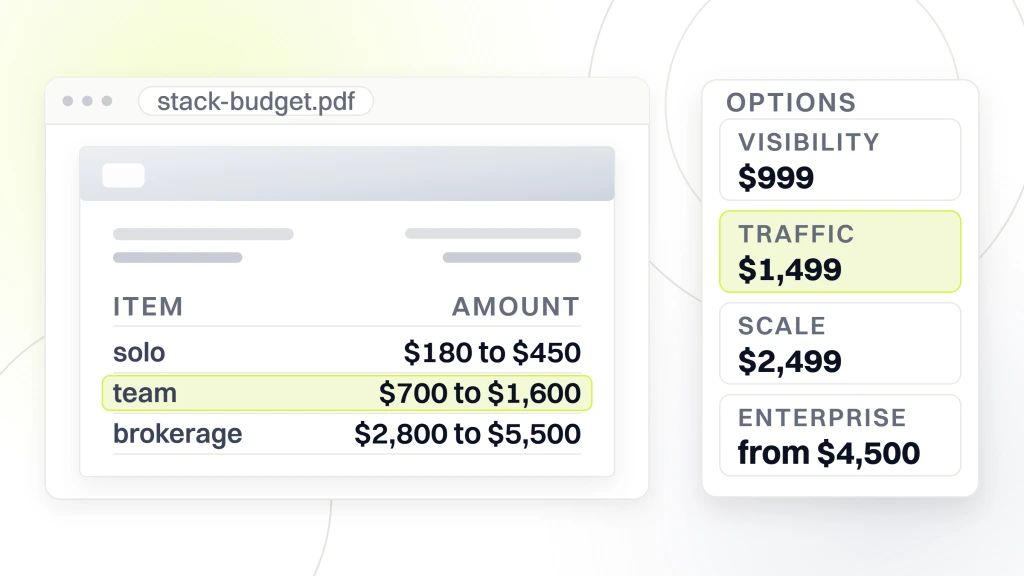
Solo tier runs $180 to $450 monthly all in. Team tier runs $700 to $1,600 monthly. Brokerage tier runs $2,800 to $5,500 monthly. Every tier above solo requires a dedicated marketing operations person, not the agent doing tool admin at 11pm on Wednesday. When we take on a team-tier account through our real estate marketing agency hub or the real estate marketing plan template engagement, the first fix is usually cutting the stack from 16 tools back to 9 and reassigning the saved $600 monthly to paid retargeting on the highest-intent listing pages.
Solo tier stack that books 20 conversations monthly
Solo tier locks in at 8 tools totaling $310 monthly. Follow Up Boss at $69 covers CRM. Mailchimp Standard at $20 covers email. OpenPhone at $19 covers SMS and calls. Buffer at $6 covers social scheduling. Loom at $15 covers video. Canva Pro at $15 covers design. Cal.com at $12 covers scheduling. Google Analytics 4 plus Search Console at $0 covers analytics. The stack books 20 to 30 conversations monthly at 4 to 6 hours of tool admin weekly. It’s the honest floor before scaling.
Brokerage tier stack that runs a 24-agent operation
Brokerage tier locks in at 12 tools totaling $4,800 monthly. kvCORE at $1,499 covers CRM plus IDX for the full agent roster. HubSpot Marketing at $890 covers email plus workflows. PhoneBurner at $149 per seat covers dialer. Sprout Social at $299 covers publishing. Wistia at $200 hosts video with heatmaps. Adobe Creative Cloud at $60 per seat covers design. Birdeye at $399 covers reviews across every agent. Google Ads plus Facebook Ads platform fees run around $800 monthly on top for the paid retargeting layer.
Real estate marketing tools you can safely skip in 2026
Not every tool the vendor pitches earns its slot. Some categories overlap so heavily with what you already own that adding another vendor produces zero incremental output. Others target problems most agents don’t have. Agents who overspend usually stack 3 to 6 overlapping tools that one better pick could handle alone, or that the agent could kill entirely without missing a beat.
Dedicated PR and press-release tools
PRWeb, PR Newswire, and eReleases at $299 to $600 per release produce almost zero outcome for solo agents and small teams. The press release lands on 200 wire sites nobody reads and generates 3 to 8 low-quality backlinks that Google discounts inside 90 days. Budget spent on PR wire services returns $0 to $200 in traceable pipeline value against a $299 to $600 cost. Skip unless you’re a brokerage above 40 agents with genuine local news value on the calendar every quarter.
Standalone chatbot builders
Drift, Intercom, and standalone chatbots at $50 to $500 monthly produce mixed results in real estate because visitors expect a human when they hit the site. Real estate marketing platforms that force a chatbot into the buyer journey see bounce rates rise 15% to 25%. The exception is a CRM-native chat widget (kvCORE, Sierra, and Chime all include one) that hands off to a human inside 30 seconds. Standalone chatbot subscriptions are usually a skip.
Postcard and direct-mail automation platforms
ProspectsPlus and Corefact at $180 to $600 monthly produce decent results in specific farm areas but rarely earn back the subscription plus print cost for solo agents. Direct mail works better as a manual campaign built for a specific listing or farm zone. Automating the funnel at monthly cadence tends to burn budget on generic sends no household reads twice. Skip the platform and run manual campaigns instead. According to the NAR real estate in a digital age report, digital channels now outperform mailed marketing across most agent operations by a 6-to-1 pipeline ratio.
AI real estate marketing software worth adding in 2026
AI moved from novelty to genuinely useful for real estate marketing software across 2025. The 3 categories that produce measurable output are listing description generation, market-report drafting, and social caption writing. AI tools that produce templates rather than raw final content save 4 to 8 hours weekly. Pair them with the real estate SEO strategy playbook so the AI-drafted assets feed the organic and paid amplification layers instead of sitting inside a Google Doc nobody reads.
Listing description AI tools that save 4 hours weekly
ChatGPT Plus at $20 monthly plus a custom real estate prompt library produces first-draft listing descriptions in 90 seconds against the 15 to 20 minutes it takes from scratch. Claude at $20 monthly does the same with better tone matching for luxury listings. Jasper at $49 monthly is the specialist option with built-in listing templates and MLS-import connectors. An AI-only sub-stack stays under $70 monthly at solo agent scale and produces 4 to 8 hours of weekly time savings, provided the agent edits the draft rather than publishing raw AI output.
Market report and social caption AI tools
Descript at $24 monthly transcribes agent talking-head videos and auto-generates caption plus hashtag posts across Instagram and LinkedIn. Ocoya at $19 monthly handles social captions plus market-report drafting. Hootsuite AI at $99 monthly is the enterprise option for teams above 15 agents. AI additions to real estate marketing tools should sit at the workflow-augmentation layer rather than the content-generation layer. Publishing raw AI output tanks reader trust and drops reply rates 40% to 60% because readers detect the pattern inside 2 sentences.
Callout. AI does the first 60% of the draft. You do the last 40%. Publishing 100% AI output is the fastest way to burn the trust you spent 5 years building with your sphere.
Free real estate marketing tools alternatives that still deliver
Not every category needs a paid tier. Several have free alternatives that produce 70% to 90% of the paid tier output at zero cost. The best real estate marketing tools at the solo agent starter tier can substitute 4 to 6 free picks without losing meaningful capability. Freemium alternatives that survive scrutiny across a full 90-day test include analytics, screen recording, meeting scheduling, and stock imagery.
Analytics and attribution on free tier
Google Analytics 4 at $0 handles website analytics for accounts sending under 10 million events monthly, which covers every real estate account we’ve seen. Add Search Console at $0 for organic search attribution. Add Google Tag Manager at $0 for event-tracking flexibility. Budget spent on paid analytics platforms like Adobe or Mixpanel is wasted at solo and team scale because GA4 plus Search Console covers 90% of what an agent reviews inside a reporting cycle. See the Google Analytics 4 property setup guide for the initial event-tracking configuration.
Screen recording and meeting scheduling on free tier
Loom free gives 25 videos and 5-minute recordings. Calendly free gives 1 event type. Cal.com free gives unlimited event types with meeting reminders. Google Meet free gives 60-minute unlimited meetings. Paying for these categories rarely pays back at solo scale because the free limits cover most agent use cases. Upgrade only when the limits genuinely block the workflow, not because the vendor pushes an upgrade during onboarding. Solo agents who upgrade every free tool inside 30 days burn $60 to $180 monthly on capacity they never use.
Free real estate content and image sources
Unsplash and Pexels cover 80% of the lifestyle and neighborhood photography an agent needs for social and blog posts, both at $0. Canva Free covers 90% of what a solo agent produces for flyers, social graphics, and listing brochures. RealScout gives free CMA branding pages for agents inside the platform. Google Business Profile at $0 is the single highest-ROI free listing every real estate agent should be posting to every week. Skip paid alternatives to any of these unless you hit specific volume ceilings.
A real estate marketing tools case reference from our books
The LA Luxury Team is a top-tier Los Angeles luxury group we’ve partnered with for over a decade. Their marketing software for real estate agents evolved from a Follow Up Boss plus Mailchimp starter setup at year 2 into a full brokerage-scale stack running HubSpot Sales Hub, kvCORE for IDX, Adobe Creative Cloud, Sprout Social, Birdeye, and Wistia by year 10. Across that decade the team doubled users, doubled new-user share, and grew pageviews 102.6% against the prior baseline.
The stack evolution mattered as much as the content investment. Every upgrade got driven by a specific pipeline volume threshold, not a vendor pitch. The team moved off Follow Up Boss onto HubSpot when the database crossed 8,000 contacts and they needed branching workflow logic. Mailchimp gave way to HubSpot native email when deliverability dipped on shared IPs. According to the G2 real estate CRM category listing, software evaluations happen 3 times more often in real estate than any other vertical because agents keep discovering they outgrew the prior stack.
What the LA Luxury Team stack looked like at year 3
By year 3 the team had graduated to a $1,200 monthly stack. Sierra Interactive at $500 for CRM plus IDX plus automation. Metricool at $65 for scheduling. Descript at $30 for video editing. Canva Team at $60 for design. Podium at $299 for reviews. Wistia at $200 for hosted video. Calendly Team at $46. Software spend hit the point where every dollar produced measurable pipeline movement inside 45 days. Booked conversations sat at 62 monthly across the 6-agent team.
Abels Residential and McCarthy Court reference points
Abels Residential is a 4-agent residential team we onboarded in year 2 of their business. The stack started at 5 tools totaling $210 monthly and grew to 9 tools at $780 monthly by year 4, when booked conversations climbed from 14 to 47 per month. McCarthy Court is a mid-market brokerage running 18 agents across 2 offices. The stack sits at 11 tools totaling $3,100 monthly, and average cost per booked conversation dropped from $220 in year 1 to $118 in year 3 as the workflow libraries stabilized. Both accounts prove the same rule. Tool spend compounds only when the workflows around the tools stabilize.
What the LA Luxury Team stack looks like at year 10
By year 10 the stack ran the full brokerage-tier setup at $3,600 monthly. Booked conversations monthly climbed to 148 across a 24-agent operation. Cost per booked conversation dropped from $195 at year 3 to $85 at year 10 as the tool investment compounded and the workflow libraries stabilized. Our commercial real estate marketing agency playbook brings the same tool-stack discipline to every client account across residential sales, luxury, commercial, and investment operations.
Buying-signal checklist before you sign a new real estate marketing tool
Every tool the vendor pitches gets scored against a 7-item checklist before signing anything. Skip the checklist and you’ll buy 3 tools a year you never actually use. Real estate marketing tools accounts we audit typically show 40% to 60% of monthly spend going to unused subscriptions the agent forgot to cancel after the 30-day trial. The checklist takes 20 minutes and saves $400 to $2,800 a year in wasted subscription fees.
The 7-item pre-purchase checklist
- Does this tool integrate natively with your current CRM.
- Does it solve a problem you have this quarter, not one you might have next year.
- Do you have 3 to 5 hours weekly to actually run the tool.
- Does it replace an existing tool or just add to your stack.
- Can you exit the contract inside 90 days if it doesn’t work.
- Will the vendor show you a case study with real client names and real dollar values, not aggregate percentages.
- Does the pricing scale down with usage in slow months, not just up in busy ones.
Red flags that mean walk away
12-month contracts with no exit clause. Setup fees above $1,500 without a written scope. Case studies with only percentage improvements and no dollar values attached. Pricing pages hidden behind a “book a demo” gate. Sales reps unwilling to run a 30-day trial. Support tickets that take 3+ business days to answer. Any of these means walk away regardless of how compelling the pitch sounds. Vendors playing by these rules are optimizing for retention through friction rather than value delivered.
Common mistakes stacking real estate marketing tools
Every real estate marketing tools stack we audit shows the same 6 mistakes on intake. Fix them and monthly spend drops 20% to 40% while pipeline output holds steady. Skip the fixes and the account keeps writing checks to 12 tools when 8 would produce the same result at 60% of the cost.
- Stacking 3 tools that each cover the same category burns budget with zero incremental output.
- Buying tools ahead of production capacity produces annual subscriptions to features nobody uses.
- Skipping the CRM integration check locks data into silos that break attribution reporting inside 90 days.
- Paying for annual plans on tools you haven’t tested for 90 days risks $1,200 to $4,800 in stranded budget.
- Buying enterprise-tier features at solo-agent scale produces overhead nobody needs inside the workflow.
- Forgetting to cancel 30-day trials wastes 40% to 60% of the monthly software budget across a year.
The audit habit that fixes the stack
A quarterly stack audit takes 90 minutes and always cuts monthly spend by $200 to $1,200. List every tool. List the monthly cost. List actual usage across the last 30 days. Kill anything under 5 hours of monthly usage that costs over $30. Kill anything that overlaps with a tool higher up the stack. Kill anything without a clear integration to the CRM. Real estate marketing tools accounts that run this audit quarterly stay 30% to 40% leaner than accounts that let subscriptions accumulate uncontrolled across 3 years of drift.
Callout. If your monthly software spend is above $600 and you haven’t done a stack audit in the last quarter, you’re burning 25% to 45% of that budget on tools you don’t fully use.
Redefine Web SEO and PPC pricing for real estate teams
Tools are only half the story. The strategy that runs those tools is where most real estate accounts leave money on the table. Our SEO retainer tiers for real estate operations run $999, $1,499, $2,499, and from $4,500 monthly. Our PPC management services run the same $999, $1,499, $2,499, and from $4,500 monthly, with ad spend billed separately. Every tier includes strategy, execution, and monthly reporting against booked conversations, not vanity clicks. Teams running paid alongside organic usually pair the retainer with our marketing automation services so the tool stack, workflows, and reporting layer sit under 1 accountable partner instead of 3.
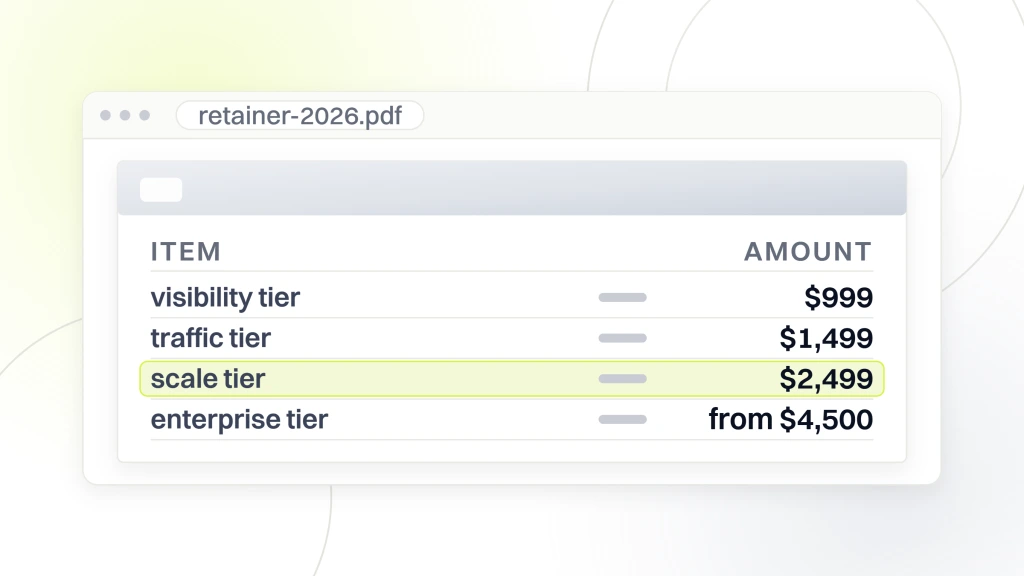
The Visibility tier at $999 fits solo agents just starting the paid or organic build. The Traffic tier at $1,499 fits 2 to 5 agent teams pushing into flagship city terms. The Scale tier at $2,499 fits established teams competing against Zillow and Redfin on organic. The Enterprise tier starts at $4,500 and fits brokerages running multiple market pages and paid retargeting layers. Match the tier to production, not ambition. Buying Scale at solo-agent volume drains cash and burns 6 months of runway.
Wrapping up real estate marketing tools as a discipline
Real estate marketing tools stack decisions decide whether your budget produces a real pipeline or feels like an expensive hobby. The 12 categories cover every function you need. The 3 budget tiers scale from solo agent to brokerage. The skip list saves 20% to 40% of the potential monthly spend. The free alternatives keep the starter tier truly affordable. The buying-signal checklist keeps you out of the traps most vendors set. Every layer works together as 1 live discipline. The real tool nobody talks about is the discipline itself, not the SaaS logo.
If your real estate marketing tools spend is above $600 monthly and you haven’t audited the stack in the last quarter, you’re burning 25% to 45% of that budget on tools you don’t fully use. Redefine Web builds and audits real estate marketing stacks for agents and brokerages inside the Real Estate Marketing Retainer from $1,499/mo program. Book a discovery call and we’ll walk you through the last 3 stack audits we ran, line by line, with the exact changes and monthly savings each account produced inside 60 days.