
The way to choose an SEO agency is to score every candidate on the same weighted sheet, ask each one the same questions, and treat the answers that make you uncomfortable as data rather than noise. Testimonials and award badges are not a comparison. A scorecard is, because it forces three different pitches into one column of numbers you can read side by side.
Getting this wrong is expensive in a way that hides. A bad agency does not fail loudly. It sends a tidy report, moves keywords you do not sell on, and burns nine months before anyone says the word attribution out loud. You pay twice, in fees and in the year you did not spend building something that compounds.
Redefine Web is an SEO agency, and we sell the thing this article is teaching you to buy, usually as part of a website design and SEO package. So read every line knowing we have a commercial reason to want you to hire someone and to want that someone to be us. The scorecard below is the one we use on ourselves, and our own marks are published at the end. Four of the ten come out mixed and one comes out weak.
What an SEO agency actually does for the money
A search engine optimization agency sells five workstreams, and almost every retainer is some mix of them. Words like holistic and data driven tell you nothing about which mix you are buying. Ask which five you are getting, in what proportion, and who does each one.
- Technical work. Crawl access, index control, page speed, structured data, redirects, and the tracking that proves any of it happened.
- Content. Keyword research, briefs, drafting, editing, internal linking, and the unglamorous job of updating pages that rank and are slipping.
- Digital PR and links. Earning mentions from sites a real person would visit. The slowest line item and the most often faked.
- Local and entity work. Your business profile, citations, reviews, and the structured data telling a search engine which organization you are.
- Measurement. Analytics, Search Console, call and form tracking, and a monthly read connecting the work to pipeline, not positions.
The spread matters more than the list. An seo services agency that puts most of your retainer into blog posts is a content shop wearing an SEO label, which is right if your problem is thin content and wrong if search engines struggle to crawl your site. Ask for the split in hours before you sign.
Almost no firm sells all five well, and nobody puts that in a pitch. The ones claiming to are usually strong in two and subcontracting the rest. Full seo agency services means five workstreams staffed, not listed.
Why we are the wrong people to ask, and why you should read this anyway
Run that search again and count the neutral results. There are none. The first page is agency service pages, review directories paid for the referral, and ranked lists written by companies that place themselves first. We are on that page too, so the conflict does not disappear because we named it.
What the conflict does to a buying guide is predictable in three moves. The criteria get chosen to match the writer’s strengths, so a firm with a big content team publishes a guide where content volume decides everything. Pricing disappears, because a published number invites comparison. And the questions arrive without the disqualifying answers, so you leave with something to ask and no idea what a bad reply sounds like.
Read this the way you would read a competitor’s sales deck. Check whether each criterion can be turned around and used against us, and whether the pricing bands cut in our favor. If a section only works when you point it at somebody else, it is marketing. Throw it out and keep the rest.
Before you hire anyone, is an SEO agency even the right buy
Sometimes the honest answer is that you should not hire an agency yet. Below roughly $1,000 a month, a retainer cannot fund enough senior hours to move anything, so most of what you buy is account management and a report. That budget goes further with a good freelancer, and saying so costs us leads.
There are four realistic ways to buy this work, and they fail in different places.
- A freelancer. Works when you have one clear problem and someone internal who can implement. Breaks when the work needs three skills at once.
- A consultant. Works when your team can execute and needs direction. Breaks when nobody internally has the hours. Our guide to choosing search engine optimization consultants separates a good one from an expensive one.
- An in-house hire. Works when search is a permanent channel and you can carry a salary plus tools. Breaks in year one, because one person rarely covers technical, content and links well.
- An agency. Works when you need several skills, continuity, and one party accountable. Breaks when your budget only reaches the cheapest tier, or nobody on your side can approve content.
Write down which of those four your situation describes before you take a sales call. The search engine optimization agencies you speak to will not do it, because three of the four answers end the conversation.
The scorecard, ten things to score every SEO company on
Score each firm from 1 to 5 on every line below, multiply by the weight, and add it up. Three candidates produce three numbers, and the gaps are wider than the pitches suggested. Use the same sheet on every seo company, including us.
| Criterion | Weight | A good answer sounds like | A bad answer sounds like |
|---|---|---|---|
| Who does the work | 15 | Named people, their seniority, how many accounts each carries | You will have a dedicated team |
| Proof in your business model | 15 | A client who makes money the way you do, with the starting position given | A logo wall and a case study offered as close enough |
| Reporting tied to revenue | 12 | Leads, qualified leads, pipeline, and a plan for your CRM | A rankings dashboard and a chart that only goes up |
| Scope in hours | 10 | A written split of hours by workstream, and what drops if you cut the budget | Ongoing optimization and continuous improvements |
| Technical capability to ship | 10 | They write the change, test it and deploy it, or say plainly they cannot | We will send your developer our recommendations |
| Content process | 10 | Who writes, who reviews, how subject knowledge reaches a draft, the AI policy | We produce four blogs a month |
| Link practice you can defend | 8 | How mentions are earned, which sites, what they will not do | We have relationships with high authority publishers |
| Access and ownership | 8 | Your accounts, your content, documented before work starts | We set the accounts up, it is easier |
| Willingness to say no | 7 | A recent prospect they turned down, and why | We can help any business in any industry |
| Cadence and escalation | 5 | A named contact, a fixed call rhythm, what happens when you are unhappy | We are always available |
The weights are ours, set because delivery and proof sink more engagements than call cadence does, so change them if your own risk sits somewhere else. If you are still working out what belongs in scope, our breakdown of SEO services is the deeper read.
What SEO agency pricing actually looks like in 2026
Published prices are rare and scattered, which is why nobody assembles them. Here are the four public ones against the bands they inform. Only two are monthly floors. Ignite publishes a range crossing three bands and Clutch publishes an hourly rate, so treat the band edges as scope labels rather than market research.
| Monthly band | What it realistically funds | A published figure, and its source |
|---|---|---|
| Roughly $500 to $1,500 | A few senior hours. One narrow workstream at best, and at the floor, barely that. | Thrive Agency publishes SEO pricing starting at $500 a month with no long-term commitment |
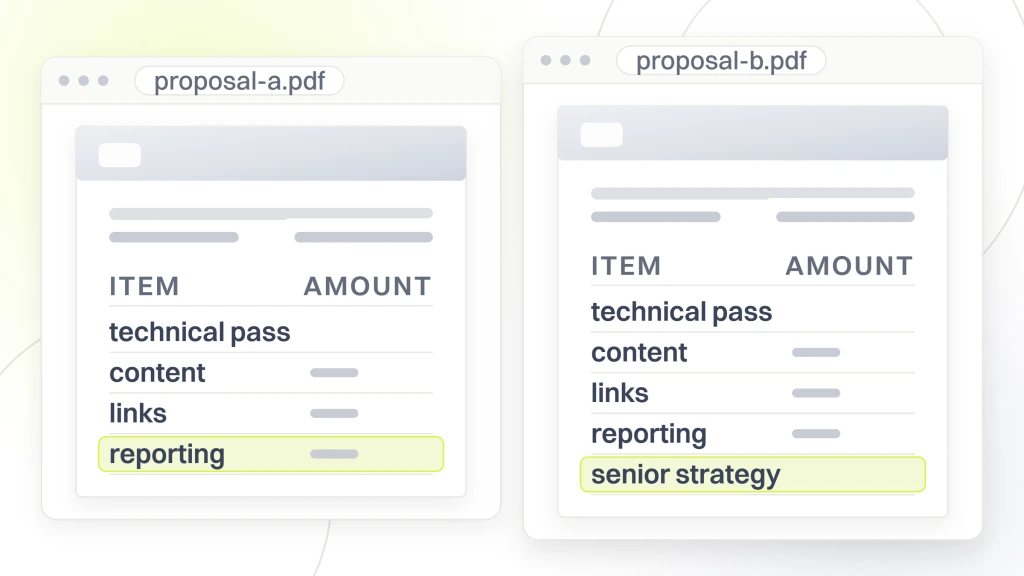
| Roughly $1,500 to $3,500 | Two workstreams with a real owner. A technical pass, then content, reporting past rankings. | WebFX publishes SEO plans starting at $3,000 a month |
| Roughly $3,500 to $8,000 | Three or four workstreams together, senior strategy, and hours enough to implement rather than recommend. | Ignite Visibility publishes a range of $2,000 to $10,000 and up per month for SEO |
| Roughly $8,000 and up | A full channel team including digital PR, custom CRM reporting, usually a minimum term. | Clutch lists SEO firms at $100 to $199 an hour, with minimum project sizes from $1,000 to $50,000 and up |
Two things fall out of that. The published floor and ceiling sit about an order of magnitude apart, so the word affordable carries no information until somebody attaches hours to it. At the band Clutch publishes, $100 to $199 an hour, a fee at the bottom of this table buys a few hours.
So ask for the retainer as hours, then divide. If the arithmetic does not fund what the proposal lists, the proposal is fiction. Strip any seo company services list back to hours and a cheap seo optimization company stops looking like a bargain.
The questions to ask on the call, and the answers that end the meeting
Most buyer guides hand you questions. Very few write down the reply that should end the meeting, which is the half that protects you, because a confident bad answer sounds like a good one until you see both written out.
| Ask this | The answer that ends the meeting |
|---|---|
| Who does the work each month, by name and seniority | We assign that once you are onboarded |
| How many other accounts does that person carry | We do not share that |
| What did your last audit of a site like mine find first | A generic list, nothing specific to your site |
| Show me a client who makes money the way I do | Everything relevant is under NDA |
| What will you stop doing if I cut the budget by a third | We would work more efficiently |
| How do you earn links, and what will you not do | Anything that avoids naming the method |
| Who owns the content and the accounts if I leave | We would sort that out at the time |
| What does a bad month look like in your reporting | We have not had one |
| Which prospect did you turn down last year, and why | We have never had to turn anyone down |
| What would make you tell me to fire you | Nothing |
Send those in writing before the call and read the replies for specificity, not enthusiasm. A good answer names a person, a constraint or a trade-off. A bad one names a value. If you are comparing individuals, our guide to choosing SEO consultants covers where the questions change.
Red flags, including the ones that apply to us
Some are obvious. One of them we have been guilty of, which is the point, because a red flag list that only indicts other people is a sales page with bullet points.
- A guaranteed ranking. Nobody controls the result page. A firm guaranteeing position one is buying ads, targeting terms nobody searches, or lying.
- No named humans. If you cannot find out who does the work before you sign, you will not find out afterwards.
- Case studies from another model. A run of ecommerce wins tells you little about a long sales cycle where one contract outweighs a year of orders.
- Rankings as the headline metric. Positions are an input. If the report leads with them, nobody has connected the work to money.
- A cheapest tier that cannot fund itself. Run the hours arithmetic and see whether the deliverable list can physically exist.
- Never having turned a client away. An seo service company that has never called a prospect the wrong fit is optimizing for signatures.
- Vague answers on links. If the method cannot be named in a sentence, it is a network you do not want.
- The one we had to fix. Our own early reporting led with rankings and traffic, because those charts are quick to produce and always look like progress. Clients were happy and none of it proved anything. We rebuilt the template to lead with leads and to call a flat month flat. It still stops at leads, though, because closed revenue needs CRM access we often do not get. That one is live, not historical. Ask any search engine optimization firm, us included, what its report looks like in a bad month.
One more is structural rather than dishonest. Firms sell what they staff, so a shop full of writers finds a content problem and a shop full of developers finds a technical one. A second read handles it. If the scope keeps drifting, our breakdown of search engine optimization services sets out what each line item holds.
How to read an SEO agency’s case studies without being fooled
A case study is a controlled story, and the control is in what got left out. Four checks strip most of it back to what happened.
- Business model match. Same revenue mechanics, same sales cycle, same buyer. A win on a transactional store does not transfer to a business where a form fill starts a six month conversation.
- The baseline. A percentage increase from near zero is arithmetic, not skill. Ask for the starting number, not the lift.
- The timeframe. Over how many months, and is the end point the peak or the current position. A chart that stops two years ago is telling you something.
- The attribution. What else was running. A brand campaign, a launch, a competitor closing, a migration finishing. Good firms volunteer this.
Apply the same four to the ranked lists you land on when you search for the best search engine optimization agency. Those lists are ordered on firmographics, year founded, headcount, review score, rather than outcomes, and several are published by seo optimization companies that place themselves first.
One case study in your model, with a baseline, a timeframe and an honest account of what else was running, beats twenty logos. If the example involves a rebuild as well as a campaign, our guide to choosing an SEO web company picks apart which half produced the result.
Contracts, notice periods and who owns the work
Nobody on the first page of results writes this section, and it costs the most when it goes wrong. You will eventually leave the agency you hire. What you walk out with was decided the day you signed.
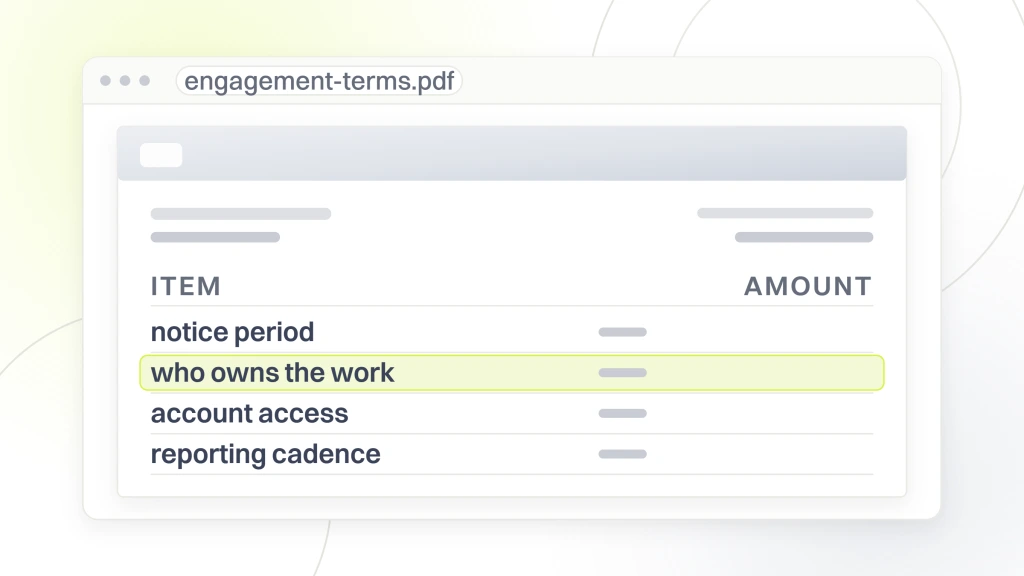
- Accounts in your name. Analytics, Search Console, your business profile, Tag Manager, Ads. Create them under an account you own, then grant access. A firm insisting on owning them holds your data, whether it means to or not.
- Content ownership. Get it in writing that copy, briefs, images and anything built for you transfers on exit. Assigning content until final payment is fair. Assigning it permanently is not.
- Links and mentions. Nobody owns a link, but you should own the record. Ask for the running list of earned mentions, updated monthly.
- Notice period. Thirty days is normal. Ninety is a warning unless a genuine build is being paid off. A team that downs tools the day you give notice has told you what the retainer bought.
- Rate lock. Get the hourly rate for out-of-scope work written down before you need it.
Read the exit clause before the strategy deck. It is the only part describing what happens when the relationship is not working, which is what a contract exists for. Every website seo company will walk you through the plan. Far fewer walk you through the ending.
What to expect in the first 90 days from a good SEO marketing agency
The first ninety days should look boring and produce little traffic. Anything exciting in month one is usually a slide. A credible seo marketing agency spends the first quarter making the next three measurable.
- Days 1 to 30. Access, a full crawl, a technical audit, and a baseline you both sign off on. The baseline matters more than the audit, because without an agreed starting point every later claim is unfalsifiable.
- Days 31 to 60. The first fixes shipping rather than sitting in a spreadsheet. A page by page map of what each URL should rank for and which ones compete. The first content briefs, approved.
- Days 61 to 90. Content live, internal links rebuilt around it, and a report saying what moved, what did not, and what changed in the plan.
Two warning signs sit in that window. If nothing has shipped by day sixty, you bought a recommendations service. And if on-site work keeps going back to your developer, you are paying a marketing seo agency to keep a to-do list. Our tier-by-tier breakdown of SEO maintenance packages sets out which fixes are normally inside a retainer and which get billed separately.
Ask for this sequence in the proposal, with dates. An seo marketing company that will not commit to a first quarter plan in writing has not built one.
How AI search changes what you should ask for
It changes what you measure more than what you do. AI answers get assembled from pages that are crawlable, specific and attributable, broadly the properties that made a page rank before. What breaks is the reporting, because a citation inside an answer can produce no click and no session, so your traffic line falls while your brand gets quoted more often.
So the questions worth asking are about measurement, not a new service line with a new acronym.
- How will you tell me whether we are cited in AI answers, and what are the limits of that method
- What happens to your reporting if sessions fall while lead volume holds steady
- Which pages are you making quotable, and what makes a page quotable
- Are you tracking the questions people ask assistants about this category
Be skeptical of anyone selling this as a separate product with its own line on the invoice. Ask what they do differently in the work. If the answer is clearer page structure, more specific pages, tighter entity data and better attribution, accept it. An seo internet marketing company that gives you something vaguer is selling the news, not a service.
When one supplier for design and SEO is the right call
Splitting design and SEO across two suppliers works when both are strong and someone on your side owns the seam. It fails at handover. The rebuild launches, the redirects are half done, the new template quietly drops the structured data, and each side explains why it was the other one’s job.
One supplier is right when you are rebuilding anyway, when nobody internally can arbitrate between a designer and an SEO, or when the site is small enough that a seam is overhead. Two is right when the site is already sound, when you need specialist depth, or when the design work is a brand project.
The trap in the single supplier route is that one discipline is usually the loss leader. Look at the seo company website itself. If every case study is design work and the search side gets a paragraph of adjectives, you are buying a studio with an add-on. Ask for the hour split, and ask who owns the search outcome after launch, by name.
If a single website design and seo company is the shape you want, our SEO services page is where to go next.
Score us on the same scorecard
Here is Redefine Web against the ten lines above. We are not giving ourselves a total, because a self-assigned number is worth nothing. What follows is where we would be marked down.
| Criterion | How we would score | Why |
|---|---|---|
| Who does the work | Strong | You meet the people doing the work before you sign, and talk to them after. |
| Proof in your business model | Mixed | Our published work leans to some verticals. If yours is not one, ask how close the match is. |
| Reporting tied to revenue | Mixed | The revenue half needs CRM access. Without it we report leads, not closed business. |
| Scope in hours | Strong | The hour split by workstream is in the proposal, with what drops if the budget moves. |
| Technical capability to ship | Strong | We build sites, so on-site changes get implemented rather than emailed out. |
| Content process | Mixed | We depend on your team for subject depth, and when that time is not there our drafts come out generic. |
| Link practice you can defend | Weak | We do far less link work than a pure-play firm. If links decide your market, a specialist beats us. |
| Access and ownership | Strong | Accounts are created in your name and everything transfers on exit. |
| Willingness to say no | Strong | We turn work down regularly, including budgets where a freelancer is the better buy. |
| Cadence and escalation | Mixed | A named contact and fixed call rhythm, though reporting has run late in busy build periods. |
That is four lines where we lose points and one where we lose them badly. If your market is won on links, hire a specialist.
Whatever you decide, run the scorecard against three firms before you sign, and make the first thing you buy a diagnosis rather than a retainer. If you want ours, start with a free website audit and score us on what comes back.