
Ask four agencies what an seo audit cost looks like and you will get four answers that do not overlap. One published survey puts most businesses under $750. One well known marketing blog opens by asking why one audit costs $150 and another costs $15,000. A third agency says to expect $650 to $14,000. A fourth publishes three and a half thousand words under the headline question and prices the whole thing in pounds.
The spread is real and it is not mostly dishonesty. The same two words cover an automated scan that took ninety seconds and a two week engagement where somebody crawled half a million URLs and then read the output. This page is about what moves the price between those, and about the cheerful possibility that you do not need to spend anything. Our free website audit exists for that reason, and our SEO services page is where the paid work sits.
What drives seo audit cost, and what does not
Three things move the number, and almost everything else in a quote is decoration on top of them.
How big the site is. Whether anybody runs a real crawl of it. And whether a human being reads what the crawl produced, or whether the tool’s export is handed to you with a cover page. Those three account for nearly all of the honest variation, and the rest of this page works through them one at a time.
What does not move it, in any way you should accept, is the length of the document. Page count is the easiest thing in this market to inflate and the easiest thing for a buyer to mistake for value. A tool export runs to hundreds of pages by itself. So does a list of every image missing alt text. Neither took anybody a day.
Nor does the brand on the invoice, at least not in a way that is being sold to you honestly. Larger firms do charge more and sometimes deliver more, but the premium is not itself evidence of depth, and no published pricing table separates the two.
Why we are not neutral about this
We sell SEO and we give away audits, so read this knowing both halves of that.
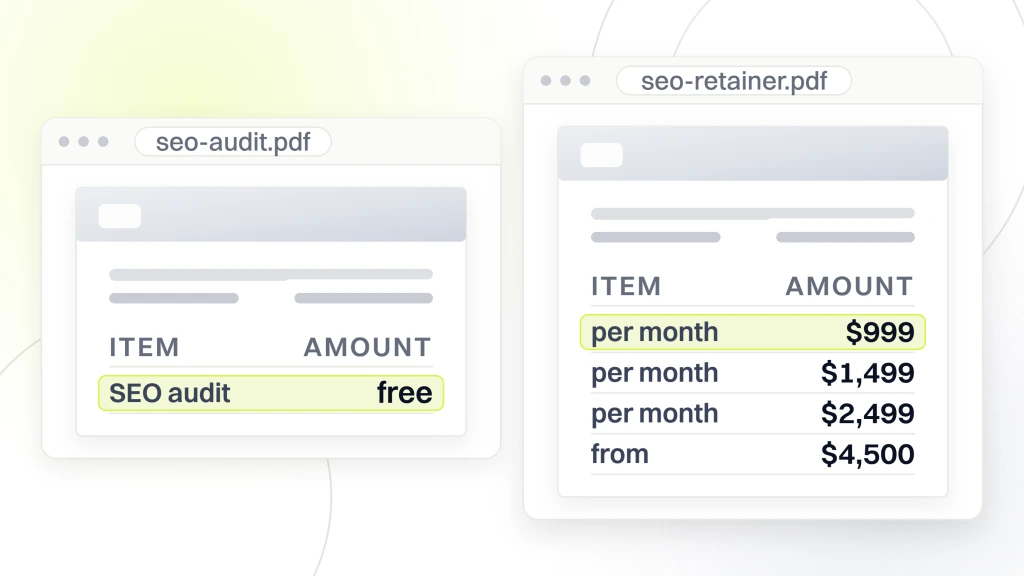
Our audit is free. It is seventeen points reviewed by hand, a written report inside twenty four hours, a walkthrough, and the top three fixes pushed live at no charge. There is no card and no paid tier of it. So an article telling you that expensive audits are frequently thin is an article that happens to favor the thing we give away, and you should hold that against every paragraph below.
The interest runs further than that. We give the audit away because it sells retainers, and ours start at $999 a month and go to $1,499, $2,499 and from $4,500 for multi location work. Our own page says roughly one in five audited sites hires us afterward. That is the business model stated plainly, and it means a free audit from us is a sales process you are being invited into, however useful the report is on its own.
The published prices, and what they actually show
Most articles on this subject give you a range. One gives you a distribution, which is far more useful, because a range tells you the extremes and a distribution tells you where people actually land.
WebFX publishes the spend of surveyed businesses in bands. Under $50, 1.72 percent. Fifty to $100, 9.48 percent. $101 to $500, 20.69 percent. $501 to $750, 22.41 percent. $751 to $1,000, 11.21 percent. $1,001 to $2,500, 12.07 percent. Above that it thins fast, with 7.76 percent to $4,000, then single digits through to $15,000, and nobody at all above it. Its own headline is that audits cost $101 to $750, which is where 43 percent sit.
Add the bottom four bands and a slight majority, a little over 54 percent, paid less than $750. Add everything above $1,000 and you get roughly 35 percent. So this is not a market with a typical price. It is two markets sharing a phrase, one buying a document and one buying somebody’s attention.
The others are ranges and they broadly agree on the shape. Another agency article gives $650 to $14,000 or more. A third splits by who does the work, at $500 to $3,000 for a freelancer, $2,500 to $15,000 for an agency, and free to about $200 in tool costs if you do it yourself.
The tempting thing to do with three sources like that is to average them into one reassuring number, and it is the one move guaranteed to be wrong. An average across a distribution with a cluster near the bottom and a long thin tail describes nobody. It lands in the gap between the two real markets, which is precisely where the fewest buyers sit. If somebody quotes you an industry average for an audit, ask which survey it came from and what the bands were, because the average is almost always the least informative figure the survey produced.
Check which market a price belongs to
We went looking for the agencies that refuse to publish a number, because that is the usual complaint about this market. On this search the complaint does not hold, and what we found in its place is worth more to you.
Every editorial result we opened prints prices. The trap is not silence. It is which market the prices describe. One page ranking on the first page for this question runs to about three and a half thousand words, sits on a US web address, and quotes both its range and its own standalone audit fee in pounds rather than dollars, from a firm whose listed offices are London and Dublin. Another ranks from a United Arab Emirates domain and quotes throughout in dollars. Neither the web address nor the domain tells you which market you are reading.
This matters more than it sounds. A figure in another currency is not one conversion away from being useful to you, because it also carries that market’s rates, a sales tax line that does not apply to you, and a scope written for buyers who are not you. Set next to a dollar quote in a comparison, it looks like evidence and behaves like noise.
The practical version is short. Before you put any published figure next to a quote you have been given, check the currency it is printed in and where the firm actually works. And ask every firm, in the first message, for a starting figure in writing and in your own currency, before a discovery call. The answer to that question is itself the audit.
Site size is the first multiplier
Nearly every published tier in this market is really a page count wearing a name, and once you notice that, the tiers stop looking arbitrary.
One of the agency breakdowns makes the mapping explicit. Its basic tier, $300 to $800, is described for small sites and startups under fifty pages, covering a technical health check and the top issues. Its comprehensive tier, $1,500 to $5,000, is for sites of fifty to five thousand pages in competitive niches, adding on page, content, backlink and competitive gap work. Its enterprise tier starts at $10,000 and is for large and multi region sites, with log files and migration preparation.
The reason size drives price is not that big sites have more problems per page. It is usually the opposite, because a big site is templated and its problems repeat. Size drives price because finding which template is broken means crawling everything, reconciling the crawl against what is indexed, and sampling enough of each page type to be sure. That work scales with the catalog whether or not the findings do.
Which gives you a test to run before you ask for a quote. Count your own pages. If you are a twenty page local business, a quote pitched at the comprehensive tier is being sold a scale you do not have, and you should ask what specifically justifies it. If you run twelve thousand product URLs, a $400 audit cannot have crawled you.
Whether anybody runs a crawl
This is the cleanest line in the whole market, and it is the one that separates the bottom half of that distribution from the top.
Below a few hundred dollars, what you are buying is almost always a scan. A tool visits your site, applies a fixed rule set, scores you and produces a report. That is not a scandal. The tools are good, the rule sets are mostly sensible, and the output is genuinely worth reading.
What it cannot do is decide which of its findings matters to you. A scan will flag a missing meta description on a page nobody will ever search for, and it will score that the same as a category page that has been quietly serving a soft error for eight months. Ranking the list against your business is the part that costs money, because it is the part a person does.
So the question to put to a quote is not whether it includes a crawl. Nearly all of them do. It is what happens to the crawl afterward, and whether anybody will tell you which five things to fix first and why those five.
Whether a human reads the output
Everything above this line is preamble. This is the actual product, and it is the only thing in an audit that cannot be automated or padded.
An audit is worth its price when somebody who has seen a few hundred sites looks at yours, throws away most of what the tool said, and tells you the three or four things that are costing you money. That judgment is why the upper tiers exist, and it is also why a long document is weak evidence of one. Judgment shortens reports. It does not lengthen them.
You can test for it before you buy, which almost nobody does. Ask for a sample audit of somebody else’s site, redacted if need be. Read it for sentences that could only have been written about that specific business. If every finding would apply equally to any site in the world, you are looking at an export with a cover page, whatever it cost.
Our own free audit is built around this claim, so apply the test to us as well. Seventeen points, reviewed by hand rather than by a crawler, is either true of the report you get back or it is not, and you will know within a page or two of reading it. If our report reads like an export, we have failed our own test and you should say so.
Where our own page overstates the market
We checked our own published claims against the published data while writing this, and one of them does not survive the comparison. It seems dishonest to run that check and not print the result.
Our free audit page states that paid SEO audits run from about $500 for a light checklist review to $5,000 or more for a deep enterprise teardown, and that most small business owners land in the $1,000 to $2,500 range for a serious human reviewed audit. The first half is consistent with everything else published. The second half is not.
In the one survey that publishes a distribution rather than a range, the $1,001 to $2,500 band holds 12.07 percent of the businesses surveyed. A little over 54 percent paid under $750. That survey counts businesses of every size rather than small ones alone, so it is not a like for like test of our sentence. It does not need to be. No band in the whole distribution reaches a majority, and the largest single one is $501 to $750 at 22.41 percent. Our page says most. The only published distribution has no most to give it.
There is a second mismatch and it runs the same way. Ours says serious human reviewed audit and the survey says audit, so some of the gap is definitional. That defense only goes so far, because a reader of our page is not being handed the distinction. The sentence reads as a market fact and it is closer to a description of the work we think is worth buying. It is being corrected.
When a free audit is genuinely enough
This is the section that costs us something to write, so here it is without hedging. A large share of the people reading this do not need to pay anybody.
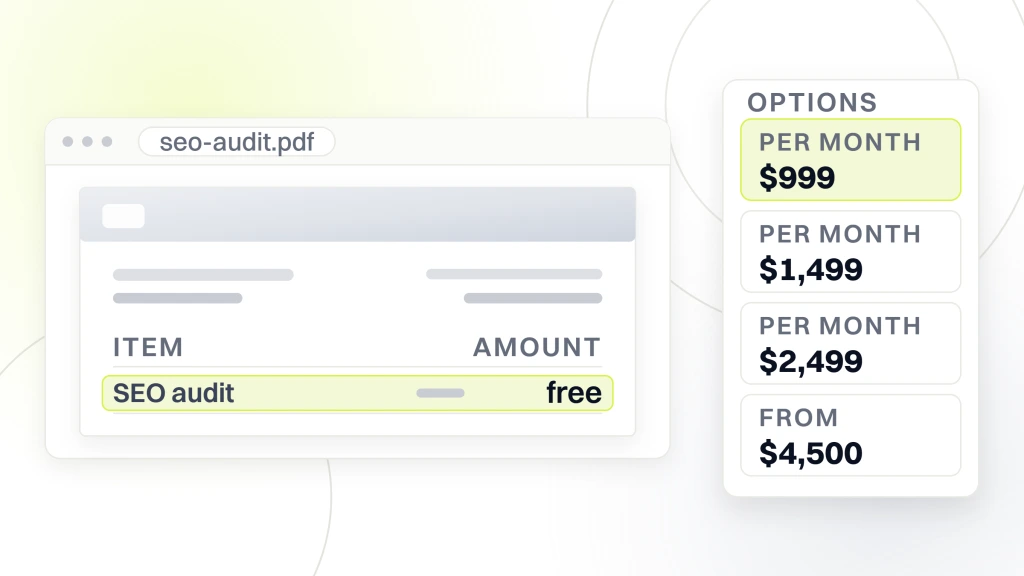
If your site is under about fifty pages, a free scan plus Search Console will find nearly everything a paid audit at the basic tier would. The published basic tier exists for exactly that site size and it is mostly a technical health check, which is the part the free tools already do well. Our comparison of free SEO tools covers which ones to run and what each is blind to.
If nobody on your side is going to implement the findings, an audit at any price is a document you will feel bad about. This is the most common way audit money is wasted, and it has nothing to do with the quality of the audit. Buy the implementation or buy nothing.
And if you have already had one in the last year and did not action it, buying a second is buying the same list again. Reopen the first one instead. Our guide to conducting a website audit sets out the passes you can run yourself, and whether the audit was worth having at all is the subject of why an SEO audit is important rather than this page.
When paying is the right call
The case for spending real money is narrower than the market implies and it is genuinely strong where it applies.
Pay when the site is large enough that the problem is finding the broken template rather than fixing it. Pay when traffic fell and nobody can say when or why, because reconstructing that needs someone reading history rather than scanning the present. Pay before a migration or a replatform, where the published tiers put log file analysis and migration preparation at the top end for a reason. And pay when you are about to spend far more on a retainer and want to know whether the site can carry it.
What to expect for the money, from the published tiers rather than from us, is roughly this. The comprehensive band of $1,500 to $5,000 is where technical, on page, content and backlink work appear together on sites up to a few thousand pages. Five figures is enterprise, multi region and log file territory, and one published tier puts that at $10,000 and up.
One structural point is worth raising before you sign, because it is the cheapest protection available and almost nobody asks for it. Split the engagement. Pay for the crawl and the findings first, read them, and only then commit to the presentation, the roadmap and the implementation planning that the upper tiers bundle in. A firm confident in its findings will take that structure. A firm whose value is in the length of the deck will resist it, and the resistance tells you which of the two you are dealing with before the larger half of the money has moved.
Set the re-check before you pay, not after. Agree what you will look at in ninety days and what number would mean the audit worked. Our guide to knowing whether your SEO is working is that half of the problem, and what goes in an SEO report covers what the ongoing version should contain.
Where this stops being a cost question
This page is about the price of an audit and what moves it. Three questions sit next to it and none of them is answered by a number.
Whether to have an audit at all, and when the answer is honestly no, is a separate argument that we make separately. This page assumes you have decided to price one and stays on the pricing. Where the two touch is only at the point where a price is so low that what you are buying is not really an audit.
The other two are about the money after the audit rather than the money for it. What a monthly program costs is a different market with different economics, covered in our breakdown of SEO services pricing, and the local version of the same question is in local SEO cost. An audit is a one time diagnostic. A retainer is a standing bill. Confusing the two is how a $600 decision turns into a $12,000 one without anybody deciding.
What we would check first
Before you price anything, count your pages and decide who implements. Those two answers settle most of it. Under fifty pages with nobody to do the work means the honest spend is zero. Several thousand pages with a developer waiting means the published comprehensive band is the realistic place to look.
Then ask every firm for a starting figure in writing before a call, and ask for a sample. The firms that answer both are already a shorter list than you expected, and a figure printed in somebody else’s currency is not a number you can compare.
If you want ours, it is free, it is seventeen points by hand and it comes back inside a day. The report is yours to keep and to hand to anybody, including an agency that is not us. If it tells you the site is fine and the problem is that nobody has written a category page in two years, that is the finding, and it is the one we report most often.