
An enterprise SEO package is priced from a scope rather than from a menu, which is why the single figure you came looking for does not exist. Across the pages ranking for this search and the pricing queries beside it, all read on 18 September 2026, published monthly figures start as low as $2,500 and run past $50,000, and the two pages naming a starting price put it at $7,000 and $11,500.
Getting this wrong costs you in both directions. Underbuy and you fund a program with too few hours to reach your release cycle, so you pay every month for findings that never become tickets. Overbuy and you commit a year of budget to content volume your approval process cannot physically clear, then renew anyway because canceling looks like admitting the first decision was wrong.
A disclosure, since this is an article about price written by a company that charges one. We sell enterprise SEO programs, so we have a commercial interest in you concluding that your site needs one and in the number sounding reasonable when it lands. Every figure below names a page you can open and check yourself. Two of those pages are ours, and they do not agree with each other.
What the first page of results actually publishes about price
Ten pages rank for this search. One refused every request, so it is excluded and nothing about it appears below. Of the nine we could read on 18 September 2026, four publish no price for an enterprise program, two publish a floor with nothing above it, and three publish a range.
| Page | What it publishes about enterprise pricing |
|---|---|
| WebFX, enterprise services | “Enterprise SEO Plans Starting At” $11,500 a month in the hero, and further down the same page “Most organizations invest between $2,500 – $7,500 per month” |
| Clarity Ventures | “Smaller enterprise engagements might cost $5,000-$10,000 monthly, while comprehensive seo solutions for large organizations can exceed $50,000 monthly” |
| SEOProfy | “$7,000 to $21,000+ per month”, built from monthly hours times an hourly rate |
| BrightEdge | No figure, in any currency, anywhere on the page |
| Siege Media | No agency band. One content budget statistic, that “31% of content teams budget $15,000-$45,000 monthly for content marketing” |
| Ignite Visibility | No figure in the copy. Budget bands appear only as options inside its contact form |
| OuterBox | “Enterprise starts at $7,000+/month and scales with program complexity.” |
| eSEO Space | $15,000 to $50,000+ in a comparison table the page itself describes as ranges |
| Infidigit | A page headed enterprise SEO packages, with no figure in any currency |
Four pages that will not print a price for the thing they sell is not evidence of anything underhanded. It is evidence that the thing being sold has no list price. The harder problem is the one none of the nine solves. Not one of them helps you hold two quotes side by side and work out which is cheaper, because a floor, a market range and a rate card are three different instruments and the pages mix them freely.
Why one page can carry an $11,500 floor and a $2,500 range
Start with the clearest example, because it shows you the whole problem in one document. The result ranking first for this search puts “Enterprise SEO Plans Starting At” $11,500 a month near the top of the page, then answers “How much do enterprise SEO services cost?” in its own FAQ with “Most organizations invest between $2,500 – $7,500 per month”. Both statements are true. They answer different questions.
The $11,500 is a rate card. It is what one seller charges. The $2,500 to $7,500 is market data, and the same company publishes where it comes from on its pricing page, which opens “We surveyed 250 enterprise businesses to find out!” and reports that “Enterprise SEO costs $1,001 – $7,500 per month on average” for 52% of them. The spread inside that survey is the part worth reading. On the same page, “20% of businesses spend more than $15,000 on enterprise SEO while 15% spend between $500 – $1,000”, and the company’s own enterprise plans “range from $12,550–$23,750 per month”.
So a self-described enterprise buyer paying under $1,000 a month and a self-described enterprise buyer paying more than $15,000 are both inside that one survey, and the seller’s own plans sit above both of the numbers it quotes you. None of that is dishonest. It is what happens when a word with no size test attached gets used as a price band, which is a separate question from whether the word enterprise describes you at all.
Your working rule from this section is short. Never average a rate card against a survey. Ask every number you find which of the two it is before you let it near your budget.
What actually drives the price of an enterprise SEO package
Six things move the number, and page count is not the first of them.
- Distinct templates, not URLs. The work happens once per template and then applies to every page built on it, so a 200,000-URL catalog running on nine templates is cheaper to fix than a 9,000-page site with sixty hand-built layouts.
- Your release cycle. A fix that ships in the next sprint is billed once. A fix that waits two quarters gets re-crawled, re-verified and re-explained to a new engineer, and every one of those passes is time somebody charges for.
- The number of approvers. Legal, brand, regional marketing and engineering each add a review loop. On our own enterprise page the commitment is that “Every recommendation arrives as a ticket with scope, owner, and acceptance criteria”, and writing findings that survive four reviewers costs more than writing findings that survive one.
- Markets and languages. Each market adds an hreflang cluster to maintain, a rank set to track, and content that has to be produced or translated rather than copied.
- Who writes the content. Briefs handed to your writers cost a fraction of finished drafts produced by the agency, and the two arrive in quotes under the same word.
- Authority work. Digital PR and original research are the most variable line in any quote, because output is measured in placements nobody can guarantee.
One newer line is worth naming, because it arrives as an add-on rather than inside the original scope. Visibility inside AI answers is priced either as a percentage uplift or as a standalone layer. Indexable AI puts the uplift at 15 to 30 percent, and it sells AI search software, so read that as a seller describing its own market. Treat it as a scope change, price it separately, and check what AI tools inside a search program are actually doing first.
Hours times rate, the only model you can rebuild yourself
One page on that results set shows its arithmetic, and it is the most useful thing published anywhere on the first page. SEOProfy states that “Most programs require 80 to 240+ hours per month at an average rate of ~$90.7/hour”, sourcing the rate to a third party with the line “According to recent data from Clutch, hourly pricing for enterprise SEO services is approximately $90”. It then splits the range into bands, from “80–120 hours/month” for a single main market up to “180–240+ hours/month” for an international footprint with frequent releases.
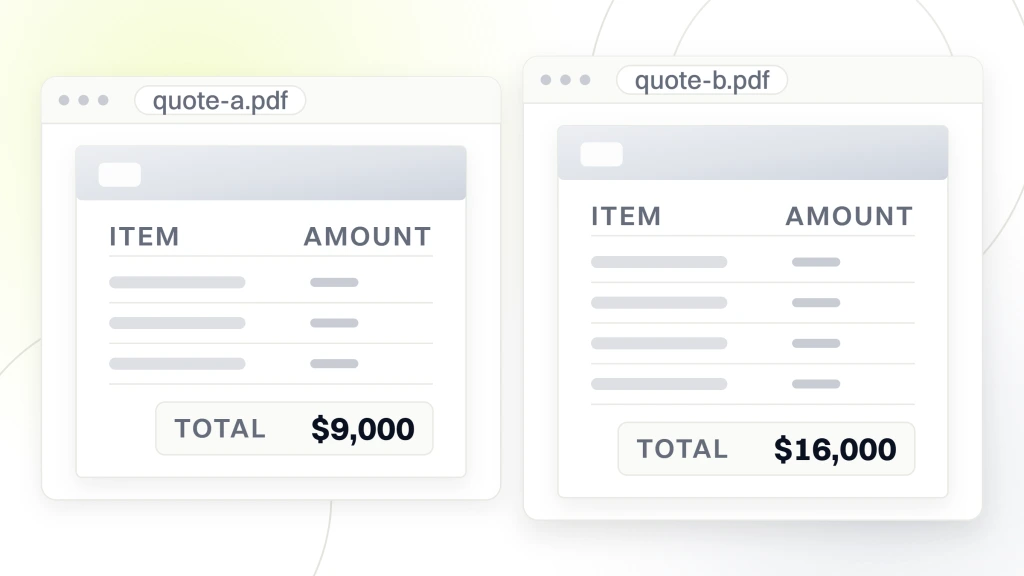
That model matters more than its output, because you can run it with your own assumptions. Take any quote in front of you and divide it by an hourly rate. A $9,000 retainer at $90 an hour is 100 hours a month. A $16,000 retainer is 178. The gap between those two quotes is 78 hours, which is roughly half a full-time person, and now you have a question a vendor can answer rather than a number you can only accept or refuse.
Rates are not flat, which is the other half of this. A senior specialist’s hourly rate and a generalist’s are not the same number, so the same retainer buys very different amounts of work depending on who does it. A quote that is cheap per month can be expensive per senior hour, and that is the comparison that decides whether anything gets built.
What sits inside an enterprise SEO package at this level
Scope at this level splits into five workstreams, and every credible quote you receive will be some arrangement of them. Our own enterprise page sets the bar for how they should be presented, promising “Five workstreams, every item listed. Nothing hides in a phase two column.”
| Workstream | What belongs in it | What a vague quote hides here |
|---|---|---|
| Audit | Full-site crawl with no sampling, log file analysis, rendering and Core Web Vitals per template, an inventory of what your platform can and cannot change | Whether the crawl covers every URL or a sample, and whether log files are included at all |
| Technical at scale | Faceted navigation and parameter control, internal linking by rule, canonical and hreflang and pagination, migration and replatform cover | Whether a replatform in your roadmap is inside the retainer or a separate project |
| Content and intent | Keyword and intent mapping, briefs per cluster, thin and duplicate cleanup, schema validated template by template | Whether you get briefs or finished drafts, and how many of each per month |
| Authority | Digital PR, original research, backlink risk review and disavow, author and brand entity work | Placement counts, and whether links are earned or bought |
| Reporting | Live dashboard, a monthly written report, organic tied to pipeline stages, a quarterly review with budget holders | Whose accounts the data lives in when the contract ends |
Two of those rows deserve a price of their own in your sheet. A standalone technical audit at this size is a real project with a real cost, and the ground it covers is set out in what a standalone audit runs. And reporting is where most programs quietly fail their renewal, so check that the deliverable includes the numbers your leadership already uses rather than the measures a board reads being assembled by you after the fact.
Which line items are genuinely custom, and which are just blank
Our own published comparison table is a fair place to see the difference, because it works against us. Three rows in the Enterprise column read Custom where the tier below answers with a number. New service pages per quarter, blog and education content, and authority links per month all resolve to a figure at the lower tiers and to the word Custom at the top.
Some of that is honest. Page volume really does depend on how many templates you run and how fast your approvals move, and a vendor promising four pages a month to a site with eleven approvers is promising something it cannot control. Some of it is not honest, and the test between the two is simple. A Custom is acceptable only when the vendor will convert it into a written number for your scope before you sign. If it stays Custom through the proposal, through the scoping call and into the contract, it is not a custom line. It is an empty one.
This is also why buyers who do not need this tier should look down the ladder rather than up it. Below the enterprise tier our monthly SEO packages and national SEO packages publish fixed line items by count and cadence, and that comparability is exactly what you give up the moment a quote becomes bespoke. Give it up on purpose, not by default.
What our own two pages say, and what to do with it
Both were live on our own site on 18 September 2026, and you can check. Our SEO services page publishes a four-tier ladder whose top card reads “Starts at $4,500 MONTHLY” against the audience line “Multi-location, multi-brand or large site estates”, and states in its own FAQ that “Enterprise starting at $4,500 per month runs a custom page count and adds international hreflang and dedicated digital PR”. The same page promises “Every line item listed. The quote you get is the invoice you pay.”
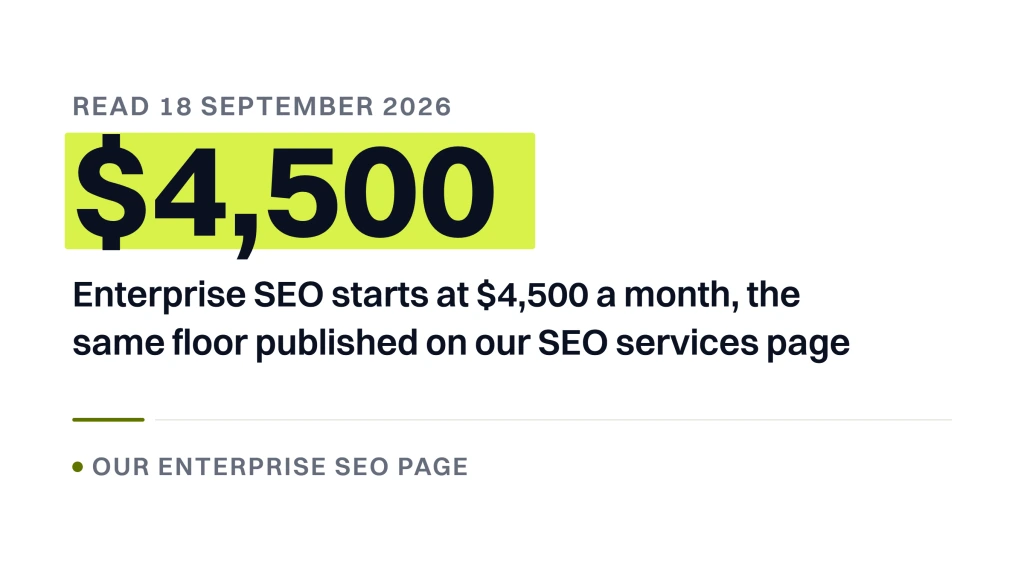
Our enterprise page answers with the same floor. It says “Enterprise SEO starts at $4,500 a month, the same floor published on our SEO services page”, then “Where a program lands above that depends on site size, platform, and how much your in-house team runs”, and closes with “Ask for a scoped quote and you get a written breakdown before you sign anything.” That FAQ published no number at all while this article was being written, which put it at odds with a ladder two clicks away on the same site. We changed the page rather than the sentence.
A matching floor is not the same as a quote, and the part still worth pressing us on is what it leaves open. The $4,500 sits on the top rung of a general SEO ladder written for multi-location, multi-brand or large site estates, and the program this article describes is a different shape of work, so make us tell you in writing which of the two you are being priced for. Then run the same test on every vendor you shortlist. Open their pricing page and their enterprise page in two tabs and read them against each other, because the gap between those two documents tells you more about how a company sells than either page does alone.
The costs that sit outside the retainer and land on you anyway
The retainer is rarely the whole invoice. Six lines routinely sit outside it, and a comparison that ignores them will pick the wrong vendor.
- The platform license. Indexable AI, which sells software in this category, puts enterprise SEO and AI-SEO platforms at “$1,000–$10,000+ per month”, and that is before seats. Ask whose contract it sits on, and check what those platforms cost to license before you accept a bundled figure.
- Content production. Briefs are in most retainers. Words, design, video and translation usually are not.
- Your own developer time. Nothing in a search program ships without it, and it is the one line no agency can invoice you for or spend for you.
- Digital PR placements. Some vendors price outreach hours, some price placements, and the two look identical in a proposal until you count what arrives.
- Ad spend. Our services page states plainly that “Ad spend on paid platforms is billed separately from the SEO retainer”, and most vendors do the same. Check rather than assume.
- Coordination on your side. Every approval loop consumes hours from people whose time is already allocated. That cost is real even though nobody sends you a bill for it.
How to compare two enterprise SEO quotes that are not comparable
Two proposals almost never arrive in the same shape, which is why buyers fall back on the total and pick the cheaper one. Normalize them in five passes instead, on one sheet, before you look at any total.
- Normalize the period. Convert everything to a monthly figure, including one-time audit fees amortized across the term, so a cheap retainer with a $20,000 onboarding charge stops looking cheap.
- Normalize the unit. Per brand, per domain, per market and per seat are four different meters. Two quotes priced on different meters cannot be compared until you fix your own counts for each.
- Normalize the exclusions. Move license, ad spend, translation, content production and placements onto their own lines for both vendors, filling in zeros where a vendor includes them.
- Normalize the hours. Ask both for monthly hours split by role. A vendor that will not answer has told you something useful.
- Normalize the output. Count deliverables by cadence rather than by name. Four briefs a month and four pages a month are not the same promise, and both get written as content.
Only after those five passes is the total meaningful. Do the arithmetic in the other direction too, because it catches the quote that cannot be delivered. If a proposal promises eight optimized templates, twelve briefs and a monthly log file analysis for 60 hours, the hours do not cover the promise, and the part that gets dropped will be the part you cannot see from outside.
The questions that make a quote comparable
Send the same list to every vendor, in writing, and compare the answers rather than the proposals. Eight questions do most of the work.
- How many hours a month, split by role, and who is the most senior person touching the account weekly?
- Which line items are custom today, and what number will you write against each one for our scope?
- Does the crawl cover every URL or a sample, and are log files included?
- Do we receive briefs or finished content, and how many of each per month?
- Whose name is on the platform license, and what happens to the crawl history if we leave?
- What is outside this retainer that we will be invoiced for or have to buy elsewhere?
- What does the first 90 days produce, and what are the acceptance criteria for each deliverable?
- What does the same scope cost in year two, and what triggers a rate change?
Keep the answers. A vendor that answers all eight in writing has already shown you how it will run the account, and a vendor that answers four of them has told you something too. Send the list before the second call rather than after the proposal, because the answers usually change what you ask for.
What the same program costs if you build it in house
Every agency quote has an implied alternative, which is hiring the team yourself, and the honest way to compare them is on loaded cost rather than on salary. A comparable in-house team is a director, a technical specialist and a content strategist, plus the tooling all three need, so price all four lines before you decide a retainer is expensive.
Read any published in-house total with the source in mind. An agency that sells retainers has a commercial reason for the in-house figure to look large, in exactly the way we have a commercial reason for the numbers on our own price list to look reasonable. The useful part is not the total. It is the shape of it, because it tells you which roles a retainer is standing in for, and that is the list you should map your own quotes against.
Most large teams end up somewhere in between, with one senior person inside the business owning priorities and an outside team supplying capacity. That split changes the quote more than any other decision you make, since a program that only supplies execution is a different purchase from one that also supplies the person who decides what gets executed. The tradeoffs in hiring for the work instead run deeper than cost alone.
Where the contract moves the price more than the retainer does
Two quotes at the same monthly figure can differ by a year of spend once the terms are read. Five clauses do most of the damage.
- Term and auto-renewal. A 6-month term that rolls into another 6 months unless you cancel in a narrow window is a 12-month commitment with extra steps.
- Notice period. Thirty days and ninety days are a two-month difference in real money at this level.
- Account ownership. Our own enterprise page commits that “Everything stays in your accounts”, which is the standard to hold everyone to. Search Console, analytics, tag manager and the rank platform project should all be in your name from day one.
- Rate escalation. Ask what year two costs at the same scope. A quote with no answer has an answer.
- Scope-change pricing. Agree the hourly or per-project rate for work outside the retainer before you need it, not during the migration when you have no leverage.
None of these clauses is unreasonable on its own. They become expensive when you compare two vendors on the monthly number and sign the one whose terms you never read side by side. Put the five clauses in the same sheet as the five normalization passes, and the cheaper quote often changes identity.
What we would do first with two enterprise quotes on your desk
Before you score anything, count two numbers about your own company, because they decide which quote is even relevant. Count your distinct templates, not your URLs. Then count the people who must approve a template change. Those two numbers tell you whether you are buying capacity or buying coordination, and most quotes are built to sell one or the other.
Then do this in order. Run the five normalization passes on one sheet. Send all eight questions to both vendors on the same day, in writing. Divide each normalized monthly total by a rate you choose, so you are comparing hours rather than brand names. Read the five contract clauses last, because that is where a quote that won on price loses on cost.
One last check that costs nothing. Ask each vendor which single deliverable they would cut first if you reduced the budget by 20 percent. The answer tells you what they think is load-bearing, and a vendor who says nothing can be cut is either not listening or not planning to do the work.
You do not need a market average to buy this well. You need two quotes converted into the same units, an hours figure behind each, and a written answer to what happens in year two. If you want to see how a published ladder behaves before a scope is written, our published retainer tiers list every line item by count and cadence, and the enterprise row is the one to read hardest.