
An SEO content audit is the exercise of going through everything you have published and deciding, page by page, whether it still earns its place. It is unglamorous, it is mostly a spreadsheet, and on a site that has been publishing for a few years it is usually the highest-value work available.
It also has a reputation problem. The word audit suggests finding things to delete, and the version of this that circulates is a purge, where anything without traffic gets removed and the graph is expected to rise. That is one of four possible verdicts and it is the rarest of them.
We sell audits, so treat this as interested testimony. The judgment criteria below are not ours. Google publishes a list of questions for evaluating whether content is worth having, and the useful part of this job is applying somebody else’s published standard to your own pages rather than inventing one that happens to suit whoever is being paid.
What an SEO content audit is, and the two audits it is not
Three things get called an audit and they inspect different objects, so settle which one you need before opening a spreadsheet.
A website audit inspects the site as a delivered thing, whether pages load, whether they can be used, whether they work. Our guide to conducting a website audit is that one. A search audit inspects whether the right page answers each query and whether search behavior changed, which our walkthrough of SEO performance step by step covers. This one inspects the writing, one page at a time, and asks whether that page should exist in its current form.
The reason it is separate is that its findings are not technical and cannot be fixed by a developer. A page that is thin, or duplicated across four near-identical posts, or written for a search that nobody performs, is a writing and editorial problem. No configuration change addresses it, which is why it tends to fall between the technical people and the marketing people and never get done.
The trigger is usually the same in every case. Somebody has published for years, the archive is in the hundreds, traffic is flat, and nobody can say which of those pages is doing anything. That is the condition this work exists for.
Build the inventory before you judge anything
The first half of this job is not judgment at all, it is listing, and skipping it is why most attempts stall.
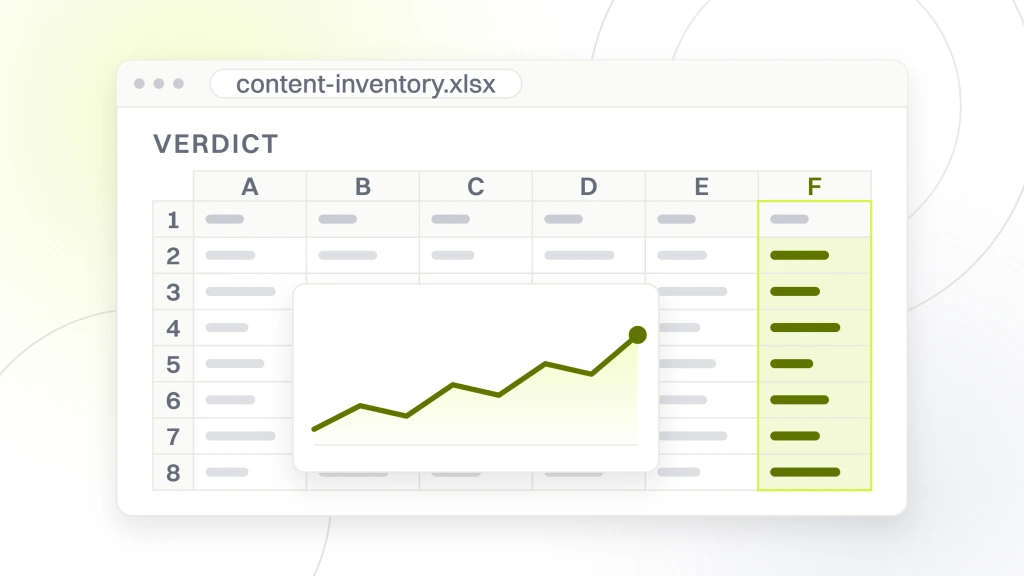
An inventory is every published URL with what it is. A verdict is what you have decided to do about it. Those are two different documents and doing them at once produces a list of opinions with no coverage, where somebody has strong views on nine pages and has never seen the other four hundred.
So crawl the site, export every indexable URL, and put one row per page in a sheet. Add the title, the publication date, the last meaningful update, the section it lives in and roughly what it is about. That is the inventory and it is finished when the row count matches what the crawl found, not when it feels complete.
Count the rows before you go further, because the number itself is often the finding. Teams who believe they have about eighty blog posts routinely have three hundred and forty, most of them from a period nobody remembers. Our free SEO template prints a grid you can copy for the verdict half of this, and the same discipline applies here, one row per thing and no merged cells.
Decide what counts as content before you crawl, and write the rule down. Tag and category archives, author pages, paginated listings and printer-friendly duplicates will all come back in a crawl and none of them is content in the sense this exercise means. Judging them alongside articles inflates the row count, buries the pages that matter and produces a delete pile made mostly of things your platform generated rather than things anybody wrote. Exclude them, note the exclusion, and handle them as a technical finding somewhere else.
The four verdicts, and why three of them are not delete
Every page gets exactly one verdict and there are only four available. Forcing a single choice is what makes the sheet actionable.
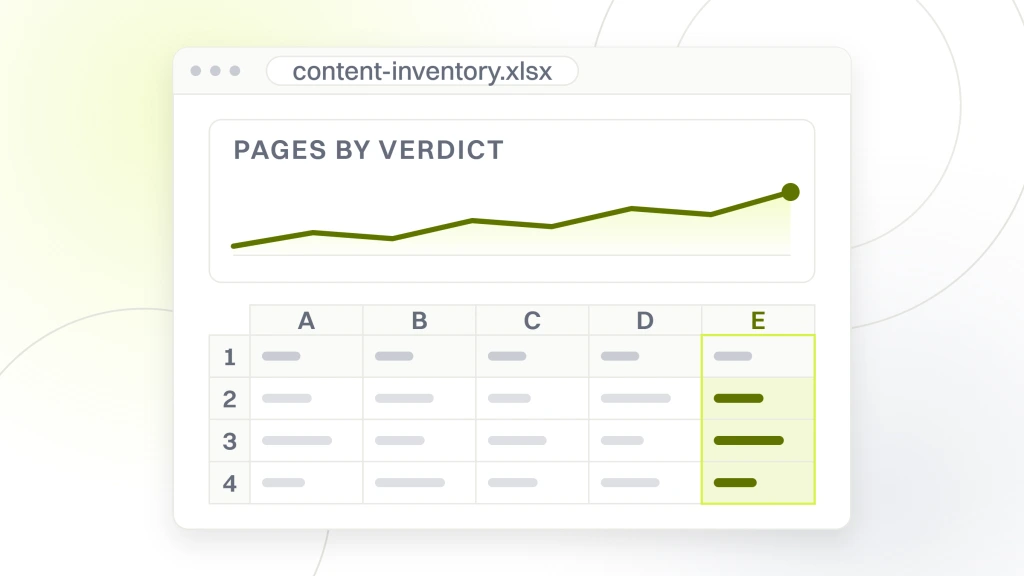
Keep means the page is doing its job and nothing needs to happen. Improve means the page is aimed at something real and is not yet good enough at it. Merge means several pages are competing to answer one thing and should become one. Delete means the page should not exist and nothing replaces it.
On most sites we have worked through, the delete pile is by far the smallest, and that surprises people who arrived expecting a cull. The large piles are keep and merge, because the usual failure of a long-running blog is not rubbish, it is five adequate articles about the same subject, none of which is the definitive one.
Resist the fifth verdict that always tries to get in, which is some version of revisit later. It is not a decision, it is a way of finishing the sheet without finishing the thinking, and a row marked that way is still there at the next audit.
Google publishes the questions to judge a page by
This is the part of the job most guides invent, and there is no need to, because the platform publishes its own list and it is free to read.
Google’s documentation on creating helpful content carries a set of self-assessment questions. Among them are “Does the content provide original information, reporting, research, or analysis?”, “Does the content provide a substantial, complete, or comprehensive description of the topic?”, “If the content draws on other sources, does it avoid simply copying or rewriting those sources, and instead provide substantial additional value and originality?” and “Is this the sort of page you’d want to bookmark, share with a friend, or recommend?” (developers.google.com/search/docs/fundamentals/creating-helpful-content, read 16 September 2026).
The same page lists warning signs pointed the other way, including “Are you producing lots of content on many different topics in hopes that some of it might perform well in search results?” and “Are you mainly summarizing what others have to say without adding much value?” Read down that list with your own archive open and the verdicts mostly assign themselves.
One line on that page kills a metric that appears in almost every content audit template sold. “Are you writing to a particular word count because you’ve heard or read that Google has a preferred word count? (No, we don’t.)” So a column scoring pages against a target length is measuring something the platform says it does not want, and any verdict driven by it should be re-derived.
Google also recommends the exercise itself, suggesting you “consider an audit of the drops you may have experienced. What pages were most impacted and for what types of searches?”, and adds a point about who should judge, that you “consider having others you trust but who are unaffiliated with your site provide an honest assessment.” The author of a page is the worst available judge of it.
The data to attach to each row, and the number that misleads
Judgment needs evidence beside it, and three numbers per page are enough. More than that and nobody finishes the sheet.
Take from Search Console, per URL, how many searches the page appears for and how many arrivals it gets. Add whether any of those searches are things you sell, which is a human judgment rather than an export. That is it. Those three tell you whether a page is found, whether it is chosen, and whether either matters commercially.
The misleading number is pageviews, and it misleads in a specific direction. A page with high views that arrive from your own navigation is being read because you link to it, not because anybody searched for it, and removing it from the menu would reveal that. Views measure internal promotion as much as external demand, and an audit driven by them keeps the wrong pages.
The other trap is judging a recently published page against an old one. A page from last month has not had time to be found, and marking it as underperforming is measuring its age. Exclude anything too new to have settled and say in the sheet that you did. Our explanation of SEO visibility covers reading that pattern without fooling yourself.
Read the searches themselves, not only their count, on any page you are unsure about. A page appearing for a hundred searches that are all versions of one question is a focused page doing its job. A page appearing for a hundred unrelated searches and chosen for none of them is usually a page about several things at once, and that diagnosis points at merge or improve rather than delete. The count alone cannot tell those two apart, and it is the single most common reason a verdict gets assigned wrongly.
Keep, and why most pages are this
Keep is the default and it deserves defending, because an audit that keeps nothing is usually an audit performed by somebody who was paid to find work.
A page earns keep if it answers something people search for, it answers it at least as well as whatever outranks it, and it is still true. That is the whole test. It does not have to be popular. A page receiving a handful of arrivals a month from exactly the right buyers is doing more for a business than a viral post read by nobody who could purchase anything.
Low traffic on its own is not a verdict. It is a question, and the question is why. If the answer is that nobody searches for this, that leads somewhere. If the answer is that plenty of people search for it and somebody else is answering it better, that is a different page and a different plan.
One thing does need checking on every kept page, which is whether it is still true. Facts drift, products change, and a page that was correct when published and is wrong now is worse than a thin page, because it is confidently misleading somebody who trusted you.
Improve, and telling an improvable page from a dead one
Improve is the verdict that costs the most, so the test for entering the pile has to be strict or the pile swallows the project.
A page is improvable when the demand is real and the execution is the problem. Somebody is searching for this, the page appears for it, and people are not choosing it or are leaving unsatisfied. That is fixable by writing, and Google’s own question is the sharpest test of whether you have that problem. “Does your content leave readers feeling like they need to search again to get better information from other sources?”
A page is not improvable when the demand is not there. No amount of rewriting creates searches for a subject nobody looks for, and this is where most content programs quietly waste a year. Check that real searches exist before committing anybody to a rewrite, and if they do not, the verdict is merge or delete rather than improve.
Then order the improve pile by what it would be worth rather than by how bad the page is. The worst page on the site is often about something nobody needs. Fixing the third-best page about the thing you actually sell is worth more, and that reordering is usually the most valuable single decision in the whole exercise.
Decide as well whether improve means editing the page or replacing it at the same address, because those are different jobs with different costs. Editing suits a page whose structure is sound and whose substance is thin. Replacing suits a page built on the wrong premise, where every paragraph would need rewriting anyway and keeping the old text around only constrains the new one. Either way the address stays, because the address is what carries whatever standing the page has earned.
Merge, the verdict that does the most work
Merge is the most useful and the most avoided, because it means admitting that several things somebody wrote should have been one thing.
The pattern is easy to spot once you look for it. Four posts published over three years, each covering roughly the same question, none of them the definitive treatment, all of them appearing for the same searches and none of them winning. They are dividing whatever standing the subject could earn between four addresses.
Merging properly means writing the piece those four should have been, publishing it at the strongest of the existing URLs, and redirecting the others to it. Not deleting them and starting again, and not leaving them live with a link to the new one, which keeps the competition running. The point is to have one address that is clearly the answer.
Choose the surviving URL on standing rather than on which draft you prefer. The page with the most established address and the most links pointing at it should absorb the others, even when its writing is the weakest of the four, because the writing is the part you are about to replace anyway.
Delete, and what happens to the URL afterward
Delete is last because it is rarest, and the decision people get wrong is not whether to delete but what to do with the address afterward.
A page earns delete when there is no real search behind it, nothing on the site replaces it, and it is not serving any other purpose. Announcements about events long past, posts about products you no longer sell, and pages published to hit a monthly quota are the usual occupants.
If something on your site genuinely answers what that page answered, redirect to it. If nothing does, let the URL return a not found status rather than redirecting to the homepage. A blanket redirect to the homepage tells a visitor nothing and tells a crawler the page still exists, which is the worst of both outcomes and is the most common way this gets handled.
Keep a record of what was removed and when. Six months later somebody will ask what happened to a page, and an audit that cannot answer that will be blamed for whatever else changed in the same period. Keep the text of deleted pages somewhere too, not just the list of addresses, because occasionally a decision gets reversed and rewriting from memory is worse than restoring.
What Google says about publishing at scale
One finding turns up on enough archives to be worth naming, which is a period where somebody was producing a great deal of content very quickly.
Google’s spam policies address this directly. “Scaled content abuse is when many pages are generated for the primary purpose of manipulating search rankings and not helping users. This abusive practice is typically focused on creating large amounts of unoriginal content that provides little to no value to users, no matter how it’s created.” (developers.google.com/search/docs/essentials/spam-policies, read 16 September 2026).
Read the last clause carefully, because it settles an argument people keep having. The policy is about what the pages are and whether they help anybody, not about the method used to produce them. Volume produced by hand qualifies on the same terms as volume produced any other way.
If your inventory shows a burst like that, audit it as a block rather than page by page. Ask what it was for, whether anybody on your side would defend those pages individually, and whether they answer questions your buyers actually ask. The answer is usually obvious once the block is looked at as a block, and that section of the sheet then fills in quickly.
Re-measuring, and how long to leave it
Set the re-measure date before you execute anything, for the same reason you set a baseline before a fix rather than after.
Record what the numbers were on the day you finished the sheet, which pages were in each pile, and when you will look again. Do not go looking a week later. A content audit changes a lot of addresses at once and the period straight afterward is genuinely unreadable, with merges consolidating, redirects settling and removed pages dropping out.
We deliberately do not put a number of weeks on that, because there is no published figure for it and anybody who gives you one is quoting themselves. What we can tell you is that the useful date is the one chosen before you knew the result, so fix it in advance, write it in the sheet beside the baseline figures, and then do not argue with it when the day arrives.
Expect the count of pages that receive any search arrivals at all to rise while the total page count falls. That is the shape of a content audit working, and it is the pair of numbers worth putting in the report. Our breakdown of what goes in an SEO report covers how to present that without the comparison moving to suit the result.
Warn whoever is watching the numbers before you execute, because a content audit looks alarming while it lands. The page count falls, some individual pages lose arrivals as merges consolidate them, and anybody checking a total in the middle of that will conclude something has gone wrong. Say in advance which numbers are expected to fall, which are expected to rise, and on what date the question gets answered. An audit that was correct but got reversed halfway through because somebody panicked is the worst outcome available here.
What we would audit first, and what to ask us
Given an unfamiliar archive, we count before we judge, and the count usually changes the plan.
How many published URLs exist against how many anybody remembers. How many received any search arrival at all in the last complete period. How many clusters of near-duplicate pages are competing with each other. Those three numbers decide whether this is a merge project, an improve project or a much smaller job than the client expected, and we would rather find out it is the last one before quoting for the first.
Now point that at us, since we sell audits and this is an argument for having one. The test this article sets is that the judgment criteria are quoted to a published page with a date rather than invented, that keep is the expected verdict rather than delete, and that no word count target appears anywhere. Ask whoever proposes a content audit which published standard they are judging your pages against, and what proportion they expect to keep. An answer that implies most of your archive is disposable is a commercial answer, and that applies to us as much as to anybody. Our guide to telling whether your SEO is working is the wider version of that question, and our SEO services page is where this work is priced.
The first move costs nothing and needs nobody. Crawl your own site, count the published URLs, and see whether the number is the one you expected. If you would rather have the inventory built for you, our SEO audit is where we would start.