
A DTC skincare brand in Portland spent 14 weeks writing 640 product pages, launched with a strong brand narrative and polished photography, then watched 380 of those pages sit at position 40 for their exact SKU keywords by month four. Nothing on the site was broken. Everything looked ready. SEO for ecommerce product pages had been treated as an afterthought instead of a template decision, so every product page inherited the same weak title tag, the same syndicated manufacturer copy, the same missing schema stack, and the same orphaned link at the bottom of a category grid nobody scrolled to. Ranking never arrived.
This guide covers SEO for ecommerce product pages the way our team builds it for DTC stores between $500K and $8M annual revenue. Title tag and H1 structure. Meta description writing that earns the click. Product description depth against manufacturer syndication. Schema stacks for Product, Offer, Review, and Breadcrumb. Variant handling. Out-of-stock and discontinued page policy. Internal linking from category pages. Image and media rules. The ranges below reflect the patterns our team sees across DTC accounts.
Writing product descriptions that beat manufacturer copy
Original product descriptions are the single most expensive SEO call a new DTC store makes. Writing them once, correctly, at launch saves 6 months of ranking regression and 20 hours of rework at month twelve. Skipping them, or padding manufacturer copy with 20 extra words, guarantees the ranking gap that every audit at month nine names as the top issue. Google’s classifier reads syndicated text as thin and demotes the URL by default. Original body copy earns the crawl slot back within one refresh cycle.
| Description approach | Word count | Typical rank outcome | Organic click gain | Rewrite cost per SKU |
|---|---|---|---|---|
| Manufacturer copy pasted | 40 to 80 | Weakest | Baseline | 0 |
| Manufacturer copy plus 60 words original | 100 to 140 | Slightly better | Small lift | 10 min |
| Original body 220 to 350 words | 220 to 350 | Materially better | Solid lift | 25 to 40 min |
| Original body plus 3 buyer questions | 300 to 450 | Stronger | Larger lift | 35 to 55 min |
| Original body plus buyer questions plus expert commentary | 400 to 600 | Strongest | Largest lift | 55 to 90 min |
What the 220 to 350 word body covers
A product description in the 220 to 350 word range covers five things. What the product is. Who it fits. Sizing or material detail. Comparison against similar SKUs. And 3 real buyer questions answered directly. Each element gets one short paragraph. Cut the marketing preamble about what the brand stands for. Google reads that as thin. Buyers scroll past it. The product description is a buying decision tool, not a brand story. Write it that way.
Title tag and H1 template that holds
The title tag on a product page leads with the product name plus a primary buyer modifier, then closes with the store name if space allows under 60 characters. Mesa Trail Runner Trailmax Grip Men beats Mesa Trail Runner alone by 4 to 8 positions in a 60-day window across every DTC vertical the team audits. The H1 restates the product name in plain text with no store name at all. Duplication between title tag and H1 hurts nothing. Cannibalization comes from missing modifier discipline, not from repeat wording. Keep both under 65 characters and both readable to a buyer scanning the SERP.
Schema stacks that qualify for rich results on ecommerce product pages
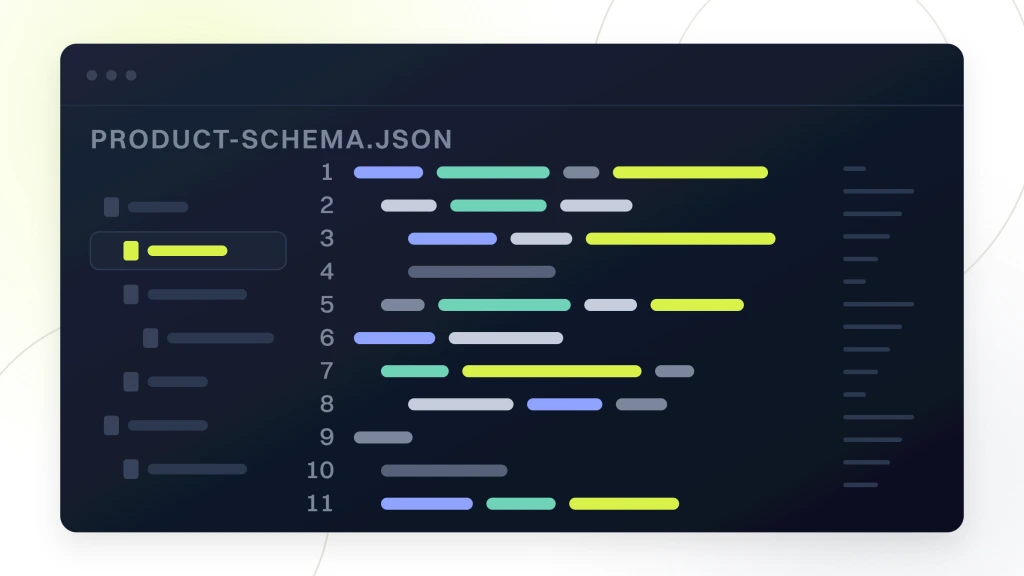
Schema tells Google what a product page describes at the entity level. Missing schema costs rich result eligibility across 100% of the catalog and cuts citation signal on AI Overviews and Perplexity. Every schema block belongs at the template layer, generated per SKU from the product record. Never hand-written per page.
The mandatory schema types on a product page
- Product. Includes name, description, brand, sku, gtin13 or gtin8, mpn, image, and category. Missing any of these fields disqualifies the page from Google Shopping organic listings.
- Offer. Includes price, priceCurrency, availability (InStock, OutOfStock, PreOrder), priceValidUntil, itemCondition, and shippingDetails when applicable. Price and availability must match what the buyer sees on page render.
- AggregateRating and Review. Populates once real reviews exist. Do not fake ratings. Google penalizes review schema on pages without matching visible review content.
- BreadcrumbList. Reflects the category tree from homepage down to the product. Qualifies the page for the SERP breadcrumb display line.
- FAQPage. Optional but valuable when the product page carries 3 to 6 real buyer questions in the description body. Match the schema question and answer text to the visible page text verbatim.
Validation and the plugin trap
Plugin-driven schema stacks on WooCommerce output broken JSON-LD about 30% of the time across our audit sample. Test every schema block with Google Rich Results Test and the Schema Markup Validator at schema.org before pushing template changes live. Broken schema costs rich result eligibility and confuses AI systems about the product entity. Google’s guidance on product structured data is the reference every engineer building this stack should keep open during template work.
How to optimize an ecommerce product page for SEO across variants
Pick a canonical variant URL for the SKU family, point every color and size variant at that canonical via rel canonical, and let Google index only the parent URL. Splitting ranking signal across 15 near-duplicate variant URLs dilutes page authority and caps ranking growth on every color and size.
Variant URL strategy that keeps ranking signal intact
Shopify handles variants inside a single parent product URL and appends variant selection to the query string as a parameter (for example, ?variant=42891). This is the correct default behavior for SEO. Do not create separate URLs per color, size, or material variant. WooCommerce ships with three variant handling modes. The parent product page holding all variants inline is the SEO-preferred pattern. The child product per variant pattern splits ranking signal 15 ways and rarely earns rankings above position 20 on any variant. The redirect-to-parent pattern works as a compromise when the store already has 8,000 legacy child variant URLs pointing at the same parent SKU.
When variants get their own URL
A variant earns its own indexable URL only when it carries distinct buyer-search intent. A running shoe in men’s size 9 does not. A phone case for the iPhone 15 Pro Max in the sunset orange colorway does, if that colorway ranks in Google Shopping for its own long-tail phrase. Test the search demand in Google Trends and Search Console before splitting. Splitting without demand cuts total ranking signal across the SKU family without adding search visibility. Store the rule in the merchandising SOP so every SKU launch follows the same variant policy. Our writeup on technical SEO for ecommerce covers the crawl budget angle for stores past 5,000 SKUs, where variant handling starts eating into Googlebot’s daily allowance.
Handling out-of-stock and discontinued products
Out-of-stock and discontinued products carry accumulated ranking signal that most DTC stores destroy the moment inventory runs out. Deleting a product page 404s a URL that Google spent 8 months ranking. The right pattern keeps the ranking authority live and communicates the current buying state honestly.
The four states an out-of-stock product page can hold each have a distinct SEO consequence. Temporary stockouts inside a 30-day window should stay live with an updated schema availability flag and a visible restock date. Longer stockouts add sibling SKU recommendations to keep the visitor moving through the catalog. Discontinued SKUs with a direct replacement need a 301 redirect at the URL level to preserve backlink authority. Discontinued SKUs without a replacement stay live at 200 status and surface adjacent products from the same category. Each policy is a template decision made once and applied across every future inventory rollover.
The four states an out-of-stock product page takes
- Temporary out of stock, restocking within 30 days. Keep page live, keep URL indexed, update Offer schema availability to OutOfStock, add restock date to the visible page, offer email waitlist signup.
- Temporary out of stock, restocking within 30 to 90 days. Keep page live, keep URL indexed, add prominent restock date, add three related SKU recommendations in the sidebar, keep Offer schema OutOfStock.
- Discontinued but a direct replacement exists. 301 redirect the old URL to the replacement product page. Preserves accumulated ranking signal and passes it forward.
- Discontinued with no replacement. Keep the page live at 200 status, remove the buy button, add the strongest 3 to 5 related SKU recommendations from the same category, and let the URL keep its ranking signal aiming visitors at replacement products.
The delete pattern that costs money
Deleting a discontinued product page and returning 404 or 410 destroys every backlink signal the URL earned and 100% of the category referral traffic. Stores on this pattern lose 8% to 15% of organic revenue per quarter as the delete queue grows through the SKU rotation cycle. The fix sits at the operations layer. Product management owns the discontinuation call. Marketing decides the URL disposition. Neither side owns it alone. Getting the handoff right at the process layer stops the ranking bleed downstream.
Internal links from category pages to product pages
Category page listing patterns decide how much ranking signal flows to each product page. The default Shopify grid links every product with product name anchor text, which passes some signal but not the strong descriptive anchor that Google rewards. Fixing the link pattern at the category template level raises product page rankings without touching product page copy at all.

Anchor text discipline on the category grid
Every product tile on a category page should link with a keyword-relevant anchor. The product name alone works but underperforms Product Name plus Primary Modifier. A running shoe tile linking with anchor Mesa Trail Runner Trailmax Grip Men passes stronger ranking signal than a tile linking with only Mesa Trail Runner. The pattern lives at the category template, not per product, and takes 30 to 45 minutes on Shopify theme code or about 2 hours on WooCommerce with a proper child theme. Category tile anchor discipline moves product rankings 3 to 7 positions on average within 60 days of the template push, measured across DTC accounts our team ran in 2024 and 2025.
Related product blocks and cross-sell links
Related product blocks on the product page itself pass ranking signal to sibling SKUs and give buyers a next click. The block belongs above the fold on mobile, ideally between the buy button and the description body. Anchor text on related products follows the same Product Name plus Primary Modifier pattern. Cross-sell blocks below the fold pass weaker signal but still add value at the crawl layer. Category-page-to-product-page linking plus product-page-to-related-product linking form the two-layer internal linking pattern our ecommerce seo audit checks for on every audit engagement. Missing either layer caps ranking growth on the whole product catalog.
Ecommerce product descriptions SEO across large catalogs
Ecommerce product descriptions SEO looks different at 40 SKUs than at 4,000 SKUs. Small catalogs benefit from hand-written original copy on every SKU. Large catalogs need a hybrid pattern of template scaffolding plus original human writing on the top 20% of SKUs by revenue and traffic potential.
The 80-20 catalog writing strategy
The top 20% of SKUs by revenue drive 70% to 80% of catalog income. Give those SKUs hand-written original descriptions of 300 to 500 words. The remaining 80% of the catalog gets a template-scaffolded description built from product record fields (materials, dimensions, use cases, warranty terms) with a 3-question FAQ block appended. Template-scaffolded copy ranks below hand-written copy but above pasted manufacturer text. The economics hold. Writers finish a 4,000 SKU catalog rewrite in 3 to 4 months at 40 hand-written SKUs per week per writer plus template scaffolding on the balance. A two-writer team hits this pace comfortably.
AI-assisted drafting with human editing
Large-catalog stores that add AI-assisted drafting cut writer time per SKU, provided a human editor reviews every draft. AI copy without human editing hits three failure modes. Repetitive phrasing across sibling SKUs. Factual mistakes on materials and dimensions. And voice inconsistency that reads as templated. Human editing catches all three at about 5 to 8 minutes per SKU. Search Engine Land covers product page optimization patterns from the platform side for teams pressure-testing the workflow against Google evolving product ranking signals.
Images and media on SEO for ecommerce product pages
Product page images pull search traffic from Google Images, qualify the page for Google Shopping listings, and set the Core Web Vitals LCP score that gates ranking on mobile. Image work on a product template is a three-layer job. File quality. Alt text. And lazy-load discipline. Getting all three right costs about 20 developer hours at launch and raises rankings across the catalog measurably.
The image file rules that matter
- Format. WebP as the primary format with AVIF via picture element for progressive enhancement. JPEG fallback only for older browsers. Never PNG for photographic content, which triples file weight.
- File size. Under 100 KB per image after optimization. Product hero images under 150 KB. Mobile LCP over 2.5 seconds costs revenue, and every 500 milliseconds you shave off it is worth the engineering time.
- Dimensions. Set width and height attributes on every image tag to prevent Cumulative Layout Shift over 0.1. CLS under 0.1 is the ranking threshold.
- File names. Descriptive kebab-case names matching the SKU (mesa-trail-runner-trailmax-grip-men-side.webp), not IMG_2831.jpg. Passes ranking signal on Google Image Search.
- Alt text. Descriptive under 125 characters, includes the product name plus a distinguishing visual detail (color, angle, use case). Never keyword-stuffed alt text.
- Lazy loading. The hero image loads eagerly with fetchpriority high. Every image below the fold gets loading=lazy. Reversing this rule costs LCP score across the catalog.
Video and 360-degree product tours
Product videos lift conversion rate on considered purchases and add a modest ranking signal via the VideoObject schema when properly implemented. Host video on a dedicated video CDN (Wistia, Vimeo Business) rather than YouTube embeds, which drop 200 to 400 milliseconds of LCP from third-party script weight. 360-degree product tours qualify for the Google Product Rich Result 3D badge on select categories (apparel, furniture, electronics) via model-viewer implementation with matching schema. Neither video nor 360 tours belong on every SKU. Prioritize them on the top 20% of the catalog where the conversion gain covers the production cost.
Measuring what SEO for ecommerce product pages actually earned
Measurement closes the loop on product page SEO work. Numbers that never get tracked never get improved. The right measurement stack tracks ranking on the SKU keyword, organic sessions per product page, cart-add rate from organic sessions, and attributed organic revenue per SKU. Four numbers per SKU, aggregated to the catalog level, reviewed monthly.
The four KPIs that hold the answer
- SKU keyword rank. Tracked daily via AccuRanker or Nightwatch across the top 200 SKUs by revenue. Flags anything moving more than 5 positions in either direction within 7 days.
- Organic sessions per product page. Pulled from GA4 filtered to landing pages under the product path. Monthly trend by SKU.
- Cart-add rate from organic. GA4 enhanced ecommerce event filtered to organic sessions on product pages. Baseline usually lands 4% to 9% depending on category.
- Attributed organic revenue per SKU. GA4 revenue attribution filtered by product ID and organic session source. Answers the retainer ROI question directly.
The Looker Studio dashboard that runs monthly
Building a monthly Looker Studio dashboard aggregating all four KPIs at the SKU and catalog level takes 6 to 10 hours of setup and 2 hours of monthly maintenance. The dashboard shows top movers, top decliners, catalog-level trend, and cost per organic order calculated as SEO retainer spend divided by attributed order count. Search Engine Journal covers the ecommerce product page SEO measurement stack at more depth for teams building the dashboard in-house. Stores that build the dashboard measure ROI honestly. Stores that skip it usually cherry-pick two numbers that support the retainer they already wanted to keep.
A real SEO for ecommerce product pages engagement in production
Boogie Board came to our team as a DTC ecommerce brand running paid media at scale. Product pages ranked between position 15 and position 40 for their SKU keywords across the top 30 revenue-driving items. Every product page inherited the same weak title tag pattern (Product Name plus store name), the same 60 to 90 word description pulled from manufacturer spec sheets, and the same generic image alt text (IMG_xxxx.jpg). Paid was carrying the store. Organic was leaving money at the template layer.
Our team ran the ecommerce product page SEO work across the catalog in a phased sequence. Week one covered title tag and H1 template rewrites at the theme layer. Weeks two through six covered original 260 to 340 word descriptions on the top 30 SKUs by revenue. Weeks four through eight ran in parallel on schema stack expansion (Product plus Offer plus BreadcrumbList plus AggregateRating once real reviews existed) and image optimization (WebP conversion, descriptive alt text, fetchpriority high on the hero). Weeks nine through twelve rebuilt the category-to-product internal link pattern with descriptive anchor text and rebuilt the related product blocks with keyword-relevant anchors.
Boogie Board finished the engagement at a $31 cost per sale at scale on a managed budget of $650K, a conversion rate gain over 11%, and organic sessions to product pages up meaningfully as the rewritten SKUs picked up ranking. The product page SEO work paid back the retainer inside the first 90 days and compounded through the next 12 months of the engagement. The full case study on the Boogie Board account covers the paid plus organic split.
Where SEO for ecommerce product pages fits the growth stack
Product page SEO sits at the revenue floor of every DTC growth stack. Category page SEO drives the comparison-stage traffic. Blog content drives the informational-stage traffic. Product pages catch the buyer-intent traffic and close it. Skipping product page SEO caps every other layer of the stack. The closing surface is where organic revenue actually posts to the P&L.
Our ecommerce SEO hub covers the retainer scope for founders who want the product page work run for them across the catalog. SEO retainers on DTC ecommerce start at $999 per month for stores testing the waters, step up to $1,499 per month and $2,499 per month as the catalog and roadmap grow, and start from $4,500 per month for stores past 400 SKUs and multi-region rollouts. Contracts run 6 months so product page ranking work has time to hold up under load. The full-stack ecommerce marketing agency scope pairs SEO with paid media and email at the same retainer for founders who want one team running the growth stack across channels.
For hybrid retailers with physical showrooms alongside the ecommerce catalog, our writeup on local seo for ecommerce businesses covers the four-surface local ranking stack that pairs with product and category work.
Roll the product page template across the catalog
Adjacent reads on the ecommerce SEO checklist and ecommerce category page SEO pair well with this product page guide. Also see our complete ecommerce SEO checklist for everything beyond the product page. Google’s product structured data documentation is the correct outside read for engineers implementing the schema stack against Google own guidance before the next template push. Rewrite the top 30 SKUs first. Then hold the pace across the catalog and let the numbers compound.