
Bespoke SEO is the British name for what US agencies sell as custom SEO, a scope built outward from your site and your competitors instead of picked from a tier list. It is one of three ways to buy search work. The other two are packaged SEO, a fixed monthly scope at a published price, and a one-time engagement that ends when the work is delivered.
Picking the wrong shape costs you more than picking the wrong vendor. A package bought for a problem that needed diagnosis pays every month for tasks aimed somewhere else, and a custom quote bought for an ordinary local site pays for strategy you never needed. You should know where we stand before the argument starts. We sell packages, including website design and SEO packages that bundle a site build with the monthly search work. We also quote custom scopes and give away one-time SEO audits, so we have a stake in all three answers. Read the rest with that in mind.
What bespoke SEO means, and why US agencies call it custom
Bespoke is a tailoring word. A bespoke suit is cut from a pattern drafted for one person, where an off-the-rack suit comes in standard sizes. In marketing the word makes the same promise, work made for one client rather than adapted from a template. US agencies sell the identical thing as custom SEO or a custom strategy. The difference is vocabulary, not service.
What the word should buy you is an order of operations. In a custom engagement the investigation comes before the price. Someone reviews your site, your rankings, your competitors and how you actually win customers, and the scope and fee come out of what they find. In a package the price and the task list exist before anyone opens your site, and discovery decides which tier you land in rather than what the work is.
That order is the whole distinction, and it is checkable. A vendor can call anything bespoke. What you can test is whether the proposal contains anything that could only have been written after looking at your business.
Google’s guidance on hiring an SEO points at the same test from your side of the table. It says “Your SEO should ask questions about what makes your business unique, who your competitors are, how search results can help, and how your customers find you.” A vendor who sends a price before asking any of that is selling a package, whatever the cover page calls it.
Packaged, custom and one-time SEO compared side by side
The three shapes differ less in the tasks they contain than in who carries the risk when the tasks turn out to be the wrong ones. Read the table by row, not by column.
| Packaged SEO | Custom SEO | One-time SEO | |
|---|---|---|---|
| How the price is set | Published tier, set before anyone sees your site | Quoted after discovery | Quoted per project, paid once |
| What you are buying | A recurring list of tasks | A plan and the work it calls for | A defined deliverable with an end |
| Who carries scope risk | You, if your problem is not on the list | The vendor, if the scope is written down | You, once the deliverable is handed over |
| How easy to compare | Easiest, tier against tier | Hardest, every quote differs | Moderate, deliverable against deliverable |
| What it gets wrong | Delivers tasks whether or not they touch the problem | Costs more to scope and is easy to pad | Stops while the problem keeps moving |
| Best fit | Common problems in common markets | Unusual sites, markets or histories | Sites with someone in house to carry on |
No row makes one of these the better product. Each moves a different risk onto a different party, and the right buy puts that risk where you can manage it. If nobody on your team will act on findings, a one-off hands the risk to you and leaves it there. If your problem is unusual, a package hands it to you more quietly, because the tasks keep arriving on schedule while the real problem sits outside them.
What packaged SEO gets right, and what it gets wrong
A package gets one thing right that the other two cannot match. You see the number before you speak to anyone. Our SEO packages publish four tiers at $999, $1,499, $2,499 and from $4,500 a month, each on a 6-month term, and you can compare that against any other vendor’s sheet in minutes.
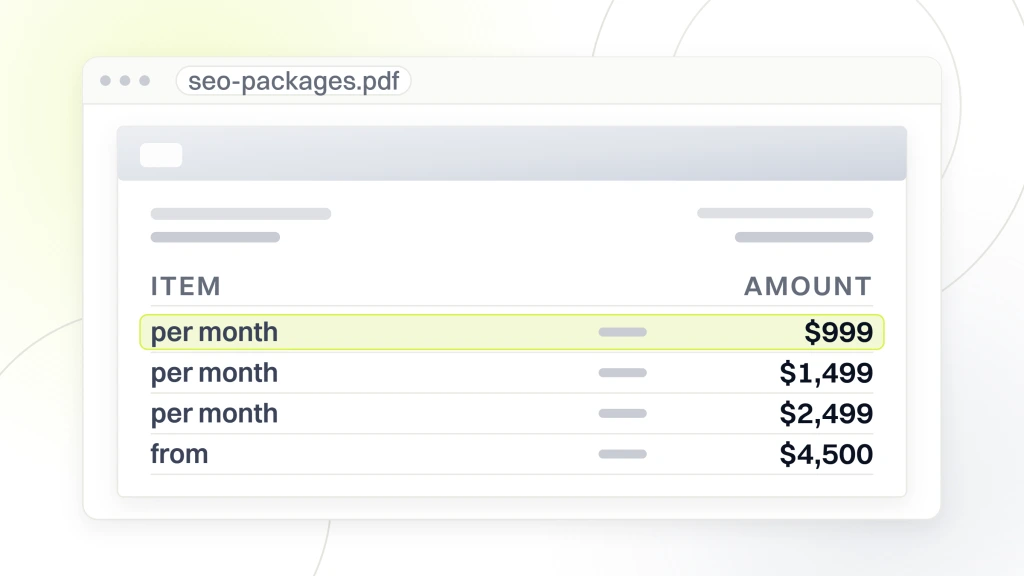
The second advantage is repetition. A vendor running the same scope for many clients has done each task often, so the process tends to run without much negotiation. For a problem that looks like everybody else’s problem, that is exactly what you want to pay for.
What a package gets wrong follows from the same fact. The task list was written for the typical customer at that price, not for you. When your site needs something the tier does not list, you have two choices, pay for an upgrade that adds a lot of things you did not ask for, or go without. And when the tier includes work you do not need, you pay for it anyway, because removing it would make the package custom.
Packages also reward counting. Pages a quarter, keywords tracked and reports delivered are easy to promise and easy to prove, so they become the thing delivered. If you want to know what each common line item actually does, what a monthly SEO retainer actually buys sets them out task by task.
What custom SEO gets right, and what it gets wrong
Custom work gets the fit right. The scope follows the problem, so a site whose trouble is technical does not pay for a content calendar, and a site with a sound build does not pay for a technical audit it already passed. Work that no tier lists becomes possible, such as a migration, a recovery after a traffic drop, or a structure that has to serve several locations with different competitors.
It also gets the sequence right when the diagnosis is good. The plan comes first, the tasks come out of the plan, and every line in the scope can be traced back to something found in your site. A custom engagement should hand you that plan in writing, and what a real SEO plan contains tells you what belongs in one.
What custom work gets wrong is almost everything around the price. Discovery takes time and somebody pays for it. Two custom quotes rarely describe the same work, so comparing them takes real effort. A loosely written custom scope is the easiest document in the industry to pad, because nobody can point at a published tier and say this costs less elsewhere.
The largest risk is quieter. Custom work is only as good as the diagnosis under it. A wrong diagnosis produces a carefully fitted plan aimed at the wrong problem, and it will look more convincing than a package while doing it.
What a one time SEO service gets right, and what it gets wrong
A one time SEO service gets the end right. You pay once, a defined thing is delivered, and there is no relationship to unwind afterward. The deliverable is usually an audit, a prioritized fix list, a keyword map, a technical cleanup or some combination, and it belongs to you.
A one-off worth paying for leaves you with more than a list of problems. Before you sign, check that the deliverable includes each of these.
- Every finding tied to a specific URL or template on your site, not to a category.
- An order of work, so whoever picks it up knows what to fix first and what can wait.
- A rough size for each fix, so you can tell a ten-minute change from a rebuild.
- A walkthrough, recorded or live, so the reasoning survives after the vendor has gone.
That ownership is the real value. A written diagnosis is portable. Your developer can work from it, a later vendor can be judged against it, and you can check in a few months whether the problems it named have actually gone.
What a one-off gets wrong is that search does not end when the invoice does. Competitors keep publishing, Google keeps updating its ranking systems, and your own site keeps changing every time someone edits a page. A fix list begins to go out of date from the day it is delivered.
Google is precise about what an audit is for. It says “An SEO audit should be about giving you realistic estimates of improvement, and an estimate of the work involved.” Read that closely. The output of a diagnostic one-off is an estimate of work, which means the work is still ahead of you. At the budget end of the market that can still be the smarter purchase, and what the cheap tier of affordable SEO buys makes that case against thin retainers in detail.
When a package is the right buy
Buy a package when your situation looks like the customer the tier was written for. That is not a compromise. It is the cheapest way to get routine work done by people who do it routinely.
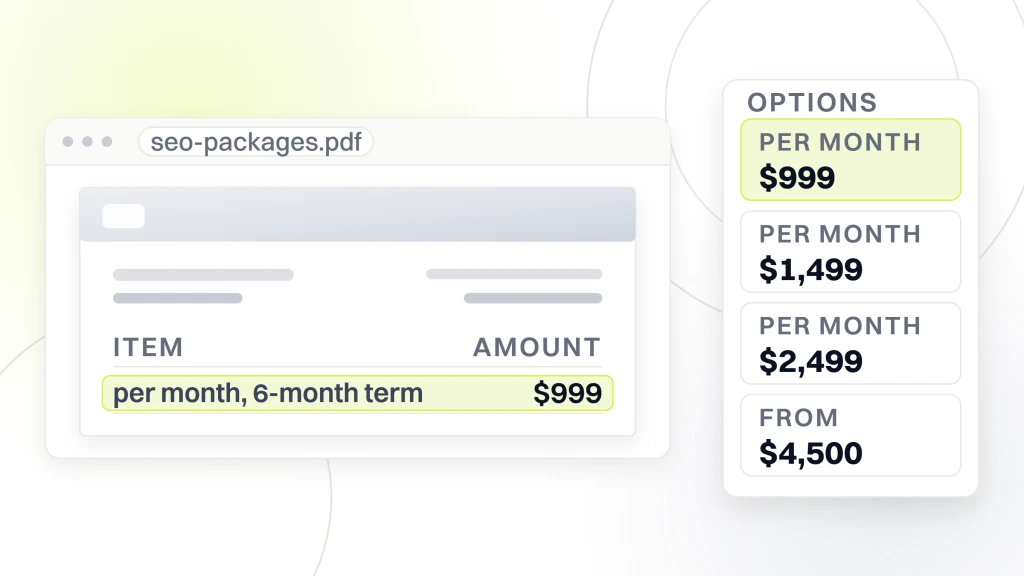
- Your site is ordinary in the good sense, a service business on a common content management system with no migration underway and no history of penalties.
- Your problem is common, such as thin service pages, weak local visibility, missing structured data or slow templates.
- You need a predictable monthly number you can budget against, and you can read a tier’s deliverables well enough to match them to your gaps.
- Nobody on your team has the time or skill to do the work, so a diagnosis alone would sit unused.
Local businesses fit this description more often than anyone else, because the work that moves a single-location service business is similar from one business to the next. If that is you, what local SEO really costs sets out what that work tends to run before you compare tiers.
A package also makes sense when the site is being built at the same time. Search work that starts on launch day avoids a first month spent fixing the build. Whether that should come from the same company that designs the site is its own decision, and whether web design and SEO belong with one company works through it.
When custom SEO is the better buy than any package
Buy custom work, and do not buy a package, in any of these situations. This includes ours.
- Your site is large or technically unusual, with thousands of URLs, faceted navigation, heavy JavaScript rendering or several languages. No tier lists the work these create.
- You are redesigning or migrating. Google says “a great time to hire is when you’re considering a site redesign (the earlier, the better)” and a redesign is a project with a deadline, not a monthly quota.
- Your site has a history, such as a sharp traffic drop after an update, a manual action, or links bought by a previous vendor that now need unwinding.
- Your keywords are national or heavily contested. Our own bundle page says “If your keywords are national or hyper-competitive, we quote custom.” That is us telling you the package does not fit.
- You run several locations or brands that face different competitors in different markets.
- You already have an in-house marketer or developer and need specific gaps filled. A package would pay an agency to repeat what your team already does.
In every one of these cases a package would still deliver its list each month. That is the problem, not the reassurance. You would be paying on schedule for work aimed at the typical customer while the thing actually holding your site back sits outside the tier.
When a one-off engagement beats both
Buy a one-off when the work has a real end and someone on your side will pick up where it stops.
- You have a developer or marketer with the hours to act on a fix list, and what you are missing is knowing what to fix first.
- The problem is bounded, such as a cleanup after a launch, a redirect map before a migration, or a structured data pass across your templates.
- You want a second opinion on a vendor you already pay, before the next renewal.
- You want to see what is actually wrong before committing to any retainer at all.
Google’s own guidance supports the do-it-yourself version for smaller sites. It says “If you run a small local business, you can probably do much of the work yourself.” A one-off diagnosis plus your own time is the shape that sentence describes.
Our position here should be stated plainly. The one-time SEO work we sell is diagnostic. Our SEO audits, including the technical, local and ecommerce versions, are free, fixed in scope and delivered as a written report you keep. Implementation is sold as ongoing work, priced from our package tiers, and our packages page describes its link work as “Ongoing, not a one-time push.” If what you need is paid implementation delivered once and finished, we do not list that, and you should buy it from someone who does.
How to tell a custom scope from a package with a new label
Plenty of packages are sold as custom work, because custom sounds more considered. You can separate the two with a few checks that need no expertise.
- Look for your own URLs. A scope written after discovery names specific pages, templates or problems on your site. A package names categories.
- Ask which standard tasks were removed for your site, and why. A custom scope drops things. A package never does.
- Check the timing. If the price arrived before the vendor asked for any access to your data, the scope was decided before your site was.
- Ask what happens when the work finds something new. A custom engagement reprioritizes. A package bills a change order or an upgrade.
- Look for counts next to every line. Custom work without counts is harder to grade than a package, not easier.
Access is worth one more sentence. Google advises that when an SEO offers an audit you “only grant read access to Search Console (at this stage, don’t grant them write access).” A vendor doing honest discovery needs to read your data, not change it.
Reading a proposal line by line is a skill of its own, and how to pick an SEO service covers the questions that expose a padded scope before you sign it.
How to move between packaged, custom and one-off work without losing ground
These three are not a permanent choice. Most sites need different shapes at different points, and the sequence usually matters more than the first pick.
The most common sensible order starts with a diagnosis. A one-off audit tells you what is wrong. If the gaps it finds match what a tier lists, buy the tier. If they do not, take the audit to vendors who quote custom and ask them to scope against it.
The second common order runs the other way. A custom project handles a migration or a recovery, then a package takes over the routine upkeep once the site is back to being ordinary. Paying custom rates for routine months is the mistake this sequence avoids.
What you keep between shapes decides whether a switch costs you anything. Our packages page says “Search Console, GA4, and Tag Manager stay in your accounts.” Whoever you hire, insist on the same, plus the audit document, the keyword map and a log of every change made to the site. Without those, each new vendor starts from zero and bills you for it.
Read the term before you plan any switch. Our own SEO services page says our contracts “run 6 months by default” and that after the initial term “you can pause or cancel with 30 days written notice.” Whoever you are leaving, find the equivalent sentence in their agreement before you book the next vendor, so you are never paying two of them for the same month.
Comparing a retainer quote with a project quote on equal terms takes some arithmetic, and what SEO pricing really runs shows how to reduce both to a cost per unit of work.
What we would do first with a bespoke SEO quote on your desk
We would write down, in one sentence, the problem you are paying to solve. Not a goal, a problem, such as service pages that never reach the first page or traffic that fell after a redesign.
Then we would hold every quote against that sentence. For a package, mark each line item that addresses the problem, and treat every unmarked line as cost. For a custom quote, ask to see the discovery findings the scope came from before you sign anything ongoing. For a one-off, name the person who will act on the findings and put their hours in the calendar first.
If most of a package’s lines are marked, buy the package. If few are, the problem is unusual and custom work is the honest answer. If you can name the person, price the one-off before either. And if you want a diagnosis to hold your quotes against, our free SEO audit gives you a written report you can hand to any developer.