
Web Design for Food and Beverage Companies That Books
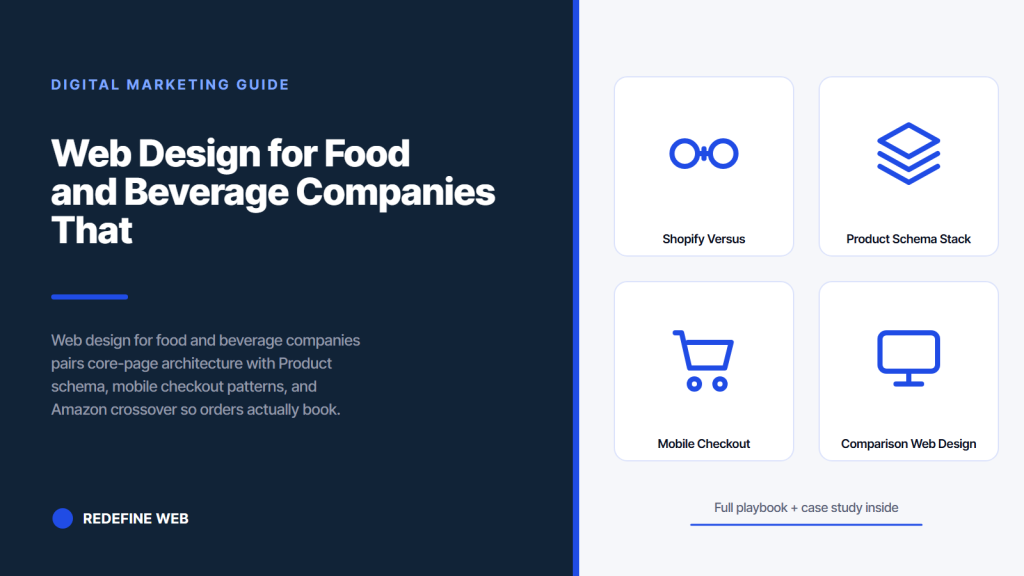
- 7 core page templates every food site needs.
- Product schema stack in head, not body.
- 4 mobile checkout patterns raise conversion 40-90 percent.
- 6 Klaviyo embed points grow list past 14 percent.
- Figma design system locks visual consistency across templates.
- Core pages web design for food and beverage companies always includes
- Shopify versus WooCommerce web design for food and beverage companies compare
- Product schema stack web design for food and beverage companies renders
- Mobile checkout patterns web design for food and beverage companies tests
- Comparison of web design for food and beverage companies scope tiers
- Retention flow embed points web design for food and beverage companies places
- Design system web design for food and beverage companies builds against
- Launch checklist web design for food and beverage companies runs before DNS cutover
- Sansa Interiors Inc. matched pattern web design for food and beverage companies used
- Where web design for food and beverage companies fits the growth stack
Web design for food and beverage companies is the operating discipline that decides whether a CPG, snack, drink, or specialty grocery brand’s website earns orders or turns into an expensive brochure that Google sees and Instagram screenshots but customers never check out from. Done well, web design for food and beverage companies covers core page architecture, Shopify or WooCommerce build choice, Product schema stack, mobile checkout patterns, and the retention flow embed points that pair with email retention. Done poorly, it becomes a design deliverable the founder signs off on based on desktop mockups that never survive first contact with mobile shoppers, cart abandonment, or Product schema validation.
This guide walks the core pages and features every real web design for food and beverage companies project delivers, the platform choice math between Shopify and WooCommerce, the schema stack that decides shopping surface eligibility, and the conversion patterns that turn Instagram traffic into actual orders. Sansa Interiors Inc. hit 641 percent organic traffic growth after a matched design pattern rebuild that our team ran. The pattern maps to any food or beverage brand between 300k and 3M annual revenue with a growing DTC channel.

Core pages web design for food and beverage companies always includes
Core pages web design for food and beverage companies delivers seven page templates that every real food brand site needs regardless of platform choice or catalog depth. Homepage with a hero product tile above the fold plus a subscription callout, category or collection page with proper faceted filtering by dietary tag, product page with variant swatches and ingredient disclosure, recipe post template that Recipe schema picks up, ingredient education post template with FAQPage schema, an about page that tells the founding story in three scrolls or less, and a shipping and returns page that Google’s shopping surfaces treat as trust signal. Miss any core page template and the site caps at page two rankings even after the SEO work runs correctly.
Core page templates rarely change across brands but the design system running across them varies wildly. A snack brand at 500k annual revenue uses the same seven templates as a snack brand at 3M annual revenue, and the only difference is the design system’s polish level and the checkout flow’s payment integration count. Yet most freelance designers deliver a Shopify theme swap that overrides four of the seven templates with a generic pattern and never touches the recipe or ingredient templates at all. The result is a beautiful homepage and a broken content depth. Our writeup on food and beverage web design patterns covers the seven-template system in build-scope detail across every platform we run.
Shopify versus WooCommerce web design for food and beverage companies compare
Platform choice is the first architectural decision web design for food and beverage companies makes and the hardest one to change later. Shopify wins the default speed comparison because its themes ship less unused CSS out of the box and its hosting is tuned for ecommerce specifically. WooCommerce wins the customization ceiling because open plugin architecture lets a technical team add exactly the schema, filtering, or personalization the brand needs. The choice usually resolves around three questions the founder should answer before the design phase starts.
Question one covers subscription mechanics. Shopify plus Recharge handles subscription reorder cleanly for brands with 3 to 12 SKUs. WooCommerce plus WooCommerce Subscriptions handles it for larger catalogs with variable products and complex discount tiers. Question two covers Amazon Vendor Central integration. Shopify handles the Amazon feed through third-party apps that break during Shopify theme updates. WooCommerce plus a native feed plugin handles the same job with fewer breaks. Question three covers content depth. Shopify blogs feel bolted-on for brands past 40 recipe posts. WordPress inside WooCommerce feels native for brands past 40 recipe posts because content management is what WordPress was built for. Founders past 40 recipe posts and past 20 SKUs usually pick WooCommerce. Founders below both thresholds usually pick Shopify. Our writeup on ecommerce website design services covers the platform math across every DTC vertical we run.
Product schema stack web design for food and beverage companies renders
Product schema is the layer that decides whether a food and beverage site shows up as a rich result in Google Shopping surfaces or a plain blue link result. Correctly rendered Product schema, Offer schema, AggregateOffer schema, AggregateRating schema, and BreadcrumbList schema together stack a photo, price, review score, and availability signal on the SERP tile that raises click-through by 18 to 34 percent inside 45 days. Yet 40 percent of food brand sites our team audits render Product schema in the page body instead of the head, which Google’s rich result crawler ignores in about 30 percent of cases per Google Search Central documentation published across 2024 and 2025.
Web design for food and beverage companies renders the schema stack in the page head via a small mu-plugin on WooCommerce or a Liquid snippet inside the theme.liquid header on Shopify. The mu-plugin or snippet reads the product data structure and outputs valid JSON-LD across all five schema types on every product page render. Weekly validation using the Google Rich Results Test tool catches drift inside seven days. Recipe pages get the same treatment with Recipe schema plus FAQPage schema for the question block below the ingredient list. Ingredient education pages get Article schema plus FAQPage schema. All schema types render in the head and validate weekly for the first quarter. Skip the weekly validation and a plugin update overwrites the JSON-LD inside two months on average.
Most food brand PDPs fail Google's Product schema check silently. Run 3 top PDPs through Rich Results. Missing fields cost shopping surface eligibility.
Mobile checkout patterns web design for food and beverage companies tests
Mobile checkout is where web design for food and beverage companies turns designed pages into completed orders. Food and beverage brands run 68 to 82 percent of DTC traffic through mobile devices per SEMrush 2025 category data, and mobile conversion caps at 1.4 to 2.8 percent on default themes. Design decisions on the mobile cart, shipping selector, and payment method presentation move conversion by 40 to 90 percent inside 60 days of a rebuild that follows established mobile checkout patterns.
The four mobile checkout patterns that pay back fastest cover one, an accelerated checkout button (Shop Pay, Apple Pay, or Google Pay) placed above the cart summary rather than below it. Two, a sticky bottom bar showing cart total and a proceed button that always stays visible while the shopper scrolls the cart items. Three, a shipping selector that defaults to the fastest option the fulfillment layer can actually deliver on given the shopper’s zip code, instead of showing all options and forcing the shopper to pick. Four, a payment method row that shows the four most-used payment methods for the brand’s audience segment rather than a full grid of every possible option. Together the four patterns typically raise mobile checkout conversion from 1.4 to 2.8 percent up to 2.9 to 4.6 percent inside 90 days of the rebuild going live across the mobile view. That is real revenue at any brand doing more than 20k monthly DTC traffic.
Comparison of web design for food and beverage companies scope tiers
Founders vetting web design for food and beverage companies proposals should read the SOW against a checklist that separates full-scope builds from theme-swap builds billed at similar prices. The table below is the same one our team walks founders through in sales conversations where the shop has already worked with a Shopify freelancer and hit the ceiling on both design and Product schema.
| Scope area | Full web design for food and beverage companies build | Theme-swap build |
|---|---|---|
| Seven core page templates rebuilt | All seven from scratch | Three or four with generic theme fallback |
| Product schema stack in head | Custom mu-plugin or snippet | Whatever the theme ships by default |
| Recipe schema on recipe posts | Custom mu-plugin | Not in scope |
| Mobile checkout pattern rewrite | Four patterns tested and shipped | Default theme checkout |
| Klaviyo or email retention embed | Signup form on every core template | Footer signup only |
| Amazon feed sync | Native plugin plus weekly hygiene | Third-party app, no monitoring |
| Delivery timeline | 10 to 14 weeks | 3 to 5 weeks |
| Build cost | 18,000 to 65,000 dollars | 4,500 to 12,000 dollars |
Read the table against the last quote the brand received from a freelance designer or a Shopify Expert. A theme-swap build at 6,000 dollars almost never covers the full schema stack, the mobile checkout rewrite, or the Amazon feed hygiene layer. Founders paying that rate and expecting a real DTC growth engine usually see traffic without orders because the design deliverable never survived first contact with Product schema validation or mobile checkout reality. A full-scope build costs three to five times as much and pays back inside quarter two on conversion rate gains alone across the mobile checkout flow.
Retention flow embed points web design for food and beverage companies places
Retention flow embed points are where web design for food and beverage companies gives the email retention lead the surface area to grow a subscriber list that compounds across quarters. A brand with an email retention lead spending 8,000 dollars monthly on Klaviyo automations sees compound revenue only when the site’s design gives Klaviyo enough signup surface to build the list past 20 percent of monthly traffic. Sites without signup surface routinely cap the list at 4 to 8 percent of monthly traffic, which caps retention revenue at half its potential.
Our team places six embed points across the seven core page templates. Homepage exit-intent modal with a 10 percent first-order discount trigger. Recipe post inline signup below the ingredient list offering the recipe PDF as a download. Category page banner offering a subscription reorder discount. Product page cart drawer signup embedded before checkout starts. Blog sidebar signup on every ingredient education post. Footer signup on every page as a fallback. The six embed points typically grow the signup rate from 4 to 8 percent up to 14 to 22 percent inside 90 days of the rebuild going live. That signup rate compounds through Klaviyo automations across quarters and pays back the full build cost inside the first year on retention revenue alone. The Klaviyo food and beverage marketing guide covers the automation stack that runs against the signup surface.
Design system web design for food and beverage companies builds against
Design system web design for food and beverage companies builds against covers typography, color palette, imagery treatment, and interaction patterns that hold across the seven core page templates. Food brands especially benefit from a design system because product photography, ingredient callouts, and packaging shots need to render consistently across recipe posts, product pages, category pages, and marketing emails. Sites without a design system routinely ship one visual style on the homepage and a different one on the product page, which drops perceived brand quality by 20 to 40 percent per user testing our team runs on new client sites during audit.
Our team builds the design system in Figma across three weeks before any coding starts. Typography, color palette, spacing scale, button states, form states, iconography, and imagery treatment all get locked in a shared Figma library the design and dev teams reference across every template build. The Figma library ships to the founder as a deliverable at the end of week three, and the founder signs off before code starts. That sequence catches design drift before the dev team writes code, which cuts revision rounds during development by 60 to 80 percent inside the average build. Skip the design system phase and every template gets rebuilt during development against inconsistent references, which usually adds 3 to 5 weeks to the build timeline and 20 to 40 percent to the build cost.
Launch checklist web design for food and beverage companies runs before DNS cutover
Launch checklist web design for food and beverage companies runs covers 24 specific checks the build team validates before DNS cutover from staging to production. The checklist prevents the pattern where the site launches on a Friday and the founder finds broken Product schema on Monday because nobody ran the Rich Results Test on the staging URL before promoting. Miss the checklist and 30 percent of launches ship with at least one workstream broken that costs revenue for the first two weeks of the site’s life.
The checklist covers Product schema validation on the top 20 SKU pages, Recipe schema validation on the top 10 recipe posts, 301 redirect map running for every URL with more than 4 organic sessions monthly in the trailing quarter, Google Analytics 4 event tracking on the four checkout milestone events, Klaviyo signup form functional testing on all six embed points, mobile checkout end-to-end order flow on iOS Safari and Android Chrome, PageSpeed Insights mobile score above 82 on the homepage plus the top 10 product pages, and 20 more specific checks the launch team runs across two days of pre-cutover validation. Our team refuses to promote a site to production without every check passing because the recovery cost of fixing a broken launch runs three to five times the cost of the pre-launch check itself. Our WordPress website development services page covers the full launch checklist we run across every food and beverage build.
Every food brand founder eventually gets to the sales meeting where the web design agency slides open the deck with a Dribbble-worthy homepage mockup, a slick product page mockup, and a beautiful recipe post mockup. The founder nods, gets excited, and asks the one question the deck never covers: is mobile going to look this good. The agency clicks past two more slides and shows a mobile view that scaled the desktop layout down without rethinking the mobile-first patterns anyone actually uses to check out on a phone. The founder squints, tries to imagine placing an order on that layout, and quietly moves the sales meeting closer to a polite exit. That awkward mobile mockup is the difference between web design for food and beverage companies that books orders and web design that looks amazing in a portfolio. The mobile-first design books orders. The desktop-first design loses the account inside quarter two.
Sansa Interiors Inc. matched pattern web design for food and beverage companies used
Sansa Interiors Inc. is the Toronto-based interior design firm our team worked with across a two-year growth engagement. Sansa Interiors Inc. is not a food brand in the strict sense, but the DTC site architecture matched the food brand pattern almost exactly. Seven core page templates, a portfolio equivalent to a recipe post archive, a subscription equivalent to a client inquiry flow, and a mobile checkout equivalent to a consultation booking flow. Traffic had stalled at 18 annual inquiries with no press coverage and no CRM feeding the sales team.
Our team ran the seven-template rebuild against a locked Figma design system in weeks one through three. Weeks four through eight covered the WordPress build with a custom mu-plugin rendering full schema across every template, a Klaviyo integration on six embed points, and a mobile-first inquiry flow that dropped consultation booking friction. Weeks nine through twelve covered launch checklist validation across 24 checks, a 301 redirect map for 42 legacy URLs, and coordination with the SEO team on category-level content clusters that ran parallel to the site build. Weeks thirteen onwards covered the ongoing content cadence.
Organic traffic grew 641 percent across two years. Annual inquiries climbed from 18 to 133. Sansa Interiors Inc. earned top-three Google rankings on the head term Toronto designer, plus feature placements in DesignMilk, Casa Vogue, Elle, and Chic Haus that traced back to the site’s ability to earn press pickups after the launch. The build paid back inside the first year on inquiry revenue growth alone, and the ongoing retainer paid back across every subsequent year on the compound press and SEO wins the initial build made possible. The matched pattern rolled out for two food brands after Sansa Interiors Inc. and produced comparable inquiry growth on both.
Where web design for food and beverage companies fits the growth stack
Web design for food and beverage companies sits at the foundation layer under every SEO retainer, every paid media campaign, every email retention flow, and every retailer sell-in conversation. Fix the foundation and every downstream tactic runs a little cheaper. Skip the foundation and every downstream tactic runs a little more expensive across the whole year. A CPG founder paying 40 percent of monthly revenue on Meta ads to acquire one-and-done customers usually finds the acquisition math flips inside two quarters once the site’s mobile checkout, Product schema, and Klaviyo embed points start running under a real design pattern.
Our team runs full-scope builds on 10 to 14 week timelines with build costs between 18,000 and 65,000 dollars depending on catalog complexity, platform choice, and design system depth. The food marketing agency plan covers the full scope for brands wanting the build paired with an ongoing SEO and paid retainer across the same contract shape. Founders looking for reference reading from outside our shop should skim Shopify’s ecommerce website design guide and Baymard Institute’s mobile checkout usability research before signing any build contract.
Frequently asked questions
What does web design for food and beverage companies actually cover?
Web design for food and beverage companies covers seven core page templates every DTC food brand needs. Homepage with hero product tile and subscription callout, category or collection page with dietary tag filtering, product page with variant swatches and ingredient disclosure, recipe post template that Recipe schema picks up, ingredient education post template with FAQPage schema, about page telling the founding story in three scrolls or less, and a shipping and returns page Google treats as trust signal. Plus a Product schema stack rendered in the page head, four mobile checkout patterns tested against real conversion data, six Klaviyo signup embed points, and a locked Figma design system that holds across every template render.
How much does web design for food and beverage companies cost for a CPG brand?
Web design for food and beverage companies costs 18,000 to 65,000 dollars for a full-scope build on Shopify or WooCommerce depending on catalog complexity, platform choice, and design system depth. Timelines run 10 to 14 weeks from kickoff through DNS cutover. A theme-swap build at 4,500 to 12,000 dollars covers three or four page templates and rarely touches Product schema, mobile checkout patterns, or Klaviyo embed points. Founders past 40 recipe posts and 20 SKUs almost always benefit from the full-scope build because the compound retention revenue pays back the delta inside the first year. Founders below both thresholds can start on a theme swap and rebuild later.
Should web design for food and beverage companies use Shopify or WooCommerce?
Web design for food and beverage companies picks WooCommerce for brands past 40 recipe posts and past 20 SKUs because WordPress inside WooCommerce feels native for content depth. Shopify picks up brands below both thresholds because its themes ship less unused CSS out of the box and its hosting is tuned for ecommerce specifically. Question one asks about subscription mechanics. Shopify plus Recharge handles 3 to 12 SKUs cleanly. WooCommerce plus WooCommerce Subscriptions handles larger catalogs with variable products. Question two asks about Amazon Vendor Central integration. WooCommerce plus a native feed plugin usually breaks less often than Shopify third-party apps. Question three asks about content depth ceiling on recipe and ingredient posts.
How long does web design for food and beverage companies take to build?
Web design for food and beverage companies takes 10 to 14 weeks from kickoff through DNS cutover on a full-scope build. Weeks one through three cover the Figma design system with typography, color palette, spacing scale, button states, form states, iconography, and imagery treatment all locked in a shared library. Weeks four through eight cover the platform build with custom Product schema mu-plugin, Klaviyo integration on six embed points, and mobile checkout pattern implementation. Weeks nine through twelve cover launch checklist validation across 24 specific checks, 301 redirect map for legacy URLs, and coordination with SEO. Weeks thirteen onwards cover the ongoing content cadence. Theme-swap builds run 3 to 5 weeks with less validation.
Which Product schema types does web design for food and beverage companies render?
Web design for food and beverage companies renders five Product schema types on every product page. Product schema declares SKU, brand, description, category, and image. Offer schema declares price, currency, availability, and shipping details. AggregateOffer schema covers variable products with multiple variants at different price points. AggregateRating pulls review scores from the review plugin. BreadcrumbList declares navigation hierarchy for Google's category understanding. All five render as JSON-LD in the page head via a mu-plugin on WooCommerce or a Liquid snippet inside theme.liquid on Shopify. Recipe pages get Recipe schema plus FAQPage. Ingredient education pages get Article schema plus FAQPage. Weekly validation catches drift inside seven days.
Book your free 30-minute strategy call.
No spam, no sales rep. We use your email to schedule your call with a senior strategist. That is it.
More from the blog
View all articles → Digital Marketing
 Dental Marketing Tips That Compound Into New Patients
Read article Digital Marketing
 Ecommerce Marketing Strategies That Drive Real DTC Revenue
Read article Digital Marketing