
White Label Website Maintenance Packages for Agencies and Freelancers
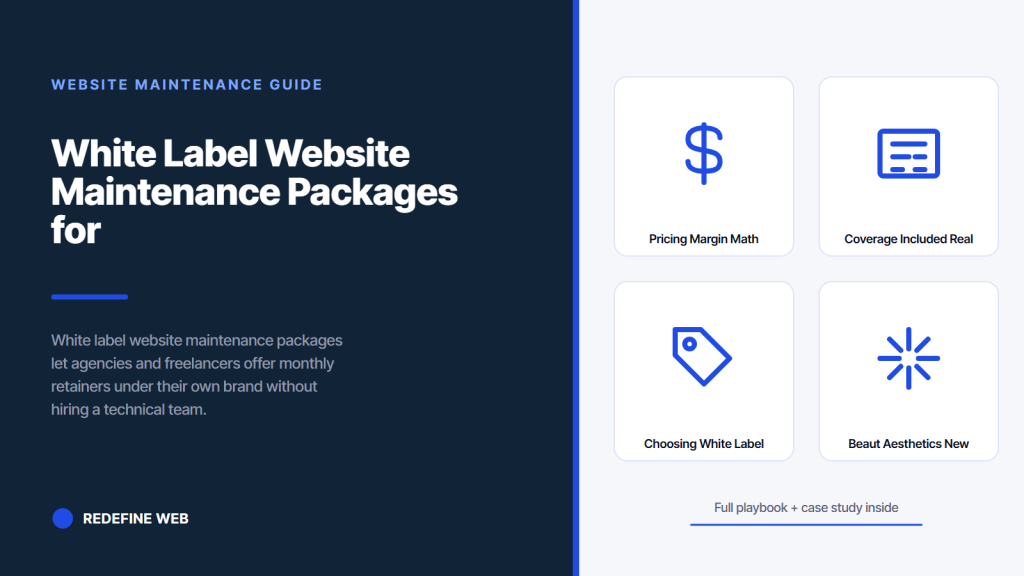
- White label lets agencies resell maintenance under their brand.
- Wholesale $60-$400 per site, retail markup 40-100 percent.
- Most agencies add $50K-$500K annual recurring revenue.
- Ask for a branded dashboard on the sales call.
- Start with existing clients. Attach rate hits 40-70 percent.
- What white label website maintenance packages are and how they work
- Who buys white label website maintenance packages
- Pricing and margin math on white label website maintenance packages
- Coverage included in real white label website maintenance packages
- Choosing a white label website maintenance packages provider
- Beauté Aesthetics New York case study on maintenance as an agency deliverable
- Common mistakes agencies make with white label website maintenance packages
- Launching white label website maintenance packages to your client base
- Scaling operations behind white label website maintenance
- Where to start on white label website maintenance packages this week
White label website maintenance packages solve a specific problem for agencies and freelancers. Your clients want recurring maintenance. You don’t have a technical team. Hiring a full-time WordPress developer costs $60,000-plus annually. Building an in-house support desk takes months. Meanwhile clients get poached by the next agency that offers monthly maintenance out of the gate. White label is how you offer the retainer today without building the infrastructure. This guide walks the reseller model, the margins, the coverage details, and the questions you should ask any partner before signing.
You’ll get the reseller economics, the coverage inclusions from a real partner, margin math on the common tiers, launch process for offering the service to clients, and the red flags that separate genuine white label programs from resellers of resellers. Read straight through in about eleven minutes. Then decide whether white label maintenance fits your agency’s positioning, pricing model, and growth plan.
What white label website maintenance packages are and how they work
White label website maintenance packages are wholesale retainers you buy from a technical partner and resell to your clients under your own brand. The partner runs the actual work: plugin updates, security patches, backups, uptime monitoring, page speed checks. You handle client communication, sales, and billing. Your client sees your agency name on every touchpoint.
The mechanics work in three layers. Layer one: you sign a partner agreement with a white label maintenance provider at wholesale pricing. Layer two: you sell the same service to your clients at retail markup, typically 40 to 100 percent. Layer three: the provider handles the technical work behind the scenes, sends you white-labeled reports you forward to clients, and stays invisible to the client. Every login, every email, every dashboard shows your agency brand. The client never knows a partner exists.
The reseller model in detail
The reseller model treats the maintenance partner as your production team behind the curtain. You keep the client relationship, the pricing power, and the strategic conversations. The partner keeps the technical execution, the tools, and the operations layer. This split lets a two-person agency offer maintenance at scale without hiring or building infrastructure. The partner charges wholesale (often $60 to $400 per site depending on tier). You charge retail ($150 to $800). The margin covers your sales, account management, and reporting overhead.
Branding mechanics that keep the partner invisible
Branding mechanics vary by partner. Good white label programs offer a fully-branded client dashboard with your logo, your colors, and your domain. Reports go out under your agency name. Support tickets get routed to your team or forwarded transparently. Emails come from your domain. Bad white label programs put the partner brand in front of the client on any of these touchpoints, which breaks the illusion. Ask specifically about every client-facing touchpoint before signing. A partner that can’t show you a fully-branded dashboard on the sales call isn’t ready to run at true white-label depth.
Who buys white label website maintenance packages
Three groups buy white label maintenance most often. Small marketing agencies (2 to 20 people) that specialize in SEO, PPC, or content and want to offer maintenance as a recurring revenue stream. Freelance WordPress developers and designers who build sites and want to keep the client relationship after handoff without hiring a support team. And digital marketing consultancies that provide strategic services and need a technical maintenance layer to round out the offering.
All three groups share the same operational bottleneck. They can sell maintenance easily. They just can’t produce it at scale without a technical team. White label bridges the gap. The agency keeps its brand and pricing power. The partner produces the work. The client gets consistent monthly maintenance at a fair price. Everybody wins. The alternative for the agency is either hiring a full-time developer (expensive, hard to keep busy) or referring the client to a competitor (loss of relationship, loss of revenue).
- Marketing agencies specializing in SEO, PPC, or content
- Freelance WordPress developers and designers post-project
- Digital marketing consultancies with strategic services
- Web design shops that build sites and want ongoing revenue
- Hosting providers wanting to add maintenance to their bundle
- Local business consultants managing sites for multiple clients
The sweet spot for agencies
The sweet spot for white label maintenance is a 3 to 15 person agency running 20 to 200 client sites. Below 20 sites, the setup overhead outweighs the revenue. Above 200 sites, hiring an in-house technical team starts to make sense. In between, white label is the highest-return operational lever for adding recurring revenue. Agencies at this size typically add $50,000 to $500,000 in annual recurring revenue from maintenance retainers without hiring anyone.
The freelance use case
Freelance WordPress developers face a specific dilemma. They build sites for $3,000 to $30,000, hand them off, then the client goes to a competitor for ongoing maintenance because the freelancer doesn’t offer it. White label solves this. The freelancer offers maintenance as an add-on at project close for $200 to $500 monthly. The partner runs the work. The freelancer keeps the client, adds recurring revenue, and preserves the relationship for future projects. Simple, high-return move for anyone doing custom WordPress builds.
Pricing and margin math on white label website maintenance packages
The pricing math on white label maintenance is straightforward. Wholesale rates from real partners run $60 to $400 per site depending on tier. Retail markup ranges from 40 to 100 percent, meaning retail prices land at $100 to $800 per site. The margin per site is $40 to $400 monthly. Multiply by 20 to 200 sites and you’re looking at $800 to $80,000 monthly gross margin from the maintenance line alone.
| Tier | Wholesale cost | Retail price | Gross margin per site |
|---|---|---|---|
| Starter | $60 to $100 | $150 to $200 | $50 to $100 |
| Growth | $100 to $250 | $250 to $500 | $100 to $250 |
| Ecommerce | $250 to $500 | $500 to $1,200 | $250 to $700 |
| Enterprise | $500 to $1,000 | $1,000 to $2,500 | $400 to $1,500 |
Markup strategy per tier
Higher markup works better on smaller tiers. Starter tier at $60 wholesale and $175 retail is a 191 percent markup. Feels aggressive but works because clients pay for the brand relationship, not the technical work they can’t see. Enterprise tier at $700 wholesale and $1,500 retail is a 114 percent markup, still healthy but tighter because clients at this tier scrutinize pricing more. Aim for 100 to 150 percent markup on Growth and Ecommerce tiers where the sweet spot lives.
Revenue stacking with maintenance as the recurring layer
Maintenance is the operational glue that makes agency revenue predictable. Project revenue is bursty. Maintenance revenue is monthly. An agency running 50 client sites at $250 monthly maintenance nets $150,000 annually in gross margin from that line alone. Add SEO retainers, PPC management, content services, and the agency has stable, predictable revenue that stops depending on the next project close. Every agency owner past year three should be thinking about maintenance as the layer that smooths the cash flow curve.
Some white-label sellers are resellers of resellers. Ask your prospective partner who actually holds the WP admin login and where their support team physically works.
Coverage included in real white label website maintenance packages
Real white label maintenance packages include the same seven-point monthly core that direct-to-client retainers include. Security updates, plugin updates, theme updates, verified backups, uptime monitoring, page speed check, and a monthly report. The report goes out under your brand. The work happens under the partner’s operations. Anything less is not a real white label offering.
Real programs also include quarterly deep work (database optimization, image compression sweep, plugin bloat review) and annual big-ticket items (PHP version planning, security posture audit, disaster recovery drill). Some programs include a set number of edit hours per site per month, useful when your clients ask for small content updates and you don’t want to bill them for each request. Ask specifically about edit hours in the wholesale contract. Programs without them force your team to handle every content edit, which erodes the operational savings.
Branded reporting standards
Reports go out under your agency name, with your logo, colors, and domain. Good partners generate the report automatically each month and route it through your agency email. Great partners let you customize the report template. Bad partners send you a PDF with the partner’s brand on it, expect you to rebrand it manually, and take 3 to 5 hours a month of your time to sanitize before forwarding. Ask to see the branded report template on the sales call. If the partner can’t produce it on demand, the white label depth isn’t real.
Support ticket handling
Support tickets from your clients route through your agency first, then get forwarded to the partner. This layer keeps the illusion intact. The client sees your agency responding within a set SLA. The partner handles the actual technical work. Ticket volumes on a well-run white label program run 2 to 5 tickets per site per month, mostly small content edits and minor questions. Any partner projecting less than that is either underestimating volume or handling tickets poorly.
Choosing a white label website maintenance packages provider
Vendor selection matters more than pricing on white label deals. The partner becomes your operational backbone. If they fail, your clients see your agency fail. Ask specific questions before signing. What’s the wholesale rate at each tier. Show me the branded client dashboard. Send me a sample branded report. Walk me through your staging workflow. What’s your response SLA. How do you handle escalations. What happens if I want to leave the program.
Also ask about client ownership. Some partners lock the client contract in a way that lets them poach the client if you leave the program. Standard fair contract: the client relationship belongs to you. If the partnership ends, the partner hands off the sites cleanly, provides backups, and stays out of the client conversation. Any partner that reserves the right to contact your clients directly is not a real white label partner. Walk away. Reference our website maintenance package pricing post for the underlying tier math and our what’s included in a website maintenance package guide for the full inclusion list any wholesale partner should match.
Trial period for the reseller
Most white label partners offer a 30 to 90-day trial period before committing to a longer agreement. Take the trial. Load 2 to 5 real client sites onto the platform. See how the partner handles the first month of updates, tickets, and reporting. Watch for slow response times, missed patches, or clients noticing the partner brand somewhere in the workflow. Any of these is a red flag. If the trial goes smoothly, extend to a 12-month agreement with volume pricing.
Exit terms that protect the agency
Read the exit clause carefully. Standard fair terms: 60 to 90 days notice for cancellation, clean site handoff, backup transfer, and no partner contact with your clients post-exit. Sketchy terms: 6 to 12 months notice, no site handoff without an additional fee, or a right for the partner to solicit your clients if you cancel. The exit clause tells you whether the partner treats you as a real business partner or as a channel they intend to poach later. Take exit terms seriously.
Beauté Aesthetics New York case study on maintenance as an agency deliverable
Beauté Aesthetics New York, a premium medical aesthetics clinic in Manhattan, ran a website redesign, SEO, and ongoing hosting and optimization engagement with us across 12 months. The maintenance layer was included as part of the integrated service, delivered under our brand rather than resold. This is the exact model an agency can replicate through white label: bundle the maintenance into the strategic engagement, price it as a monthly service, and keep it running month over month while other work rotates.
Results across the engagement: leads up 166 percent, new users up 88 percent, conversion rate up 27 percent. The maintenance layer preserved the premium positioning by keeping the site fast, keeping the booking flow reliable, and catching plugin updates on staging before they touched the client-facing site. Agencies running white label maintenance replicate this pattern at scale. The bundled maintenance turns a one-time project into a multi-year client relationship with predictable monthly revenue.
Replicating the pattern at agency scale
Replicating the Beauté pattern across 50 agency clients means 50 monthly recurring maintenance retainers at $250 to $800 each, delivered under your agency brand, produced by a white label partner behind the scenes. That’s $12,500 to $40,000 monthly recurring revenue with a 40 to 60 percent margin. Zero technical team hired. Zero infrastructure built. The white label model is how a small agency scales maintenance revenue in months instead of years.
Positioning the service to clients
Position white label maintenance to clients as your agency’s ongoing care layer, not as a resold service. Talk about your monthly workflow, your monitoring approach, your reporting standards. Never mention the partner. Never break the illusion. Clients don’t care whether you have an in-house team or a partner running the work. They care that the site stays fast, safe, and reliably online. Deliver on that promise every month and the client renews for years.
Common mistakes agencies make with white label website maintenance packages
Agencies make three common mistakes on the way to a working white label maintenance line. Signing the wrong partner. Underpricing the retail rate. Skipping the branded assets before pitching clients. Each mistake sets the offering up for slow growth or outright failure inside the first six months. Learn from the pattern and skip the cheap lessons.
Wrong partner: agencies rush the vendor selection and pick the partner with the cheapest wholesale rate. Six months in, the partner misses patches, client tickets go stale, and the agency loses trust. Underpriced retail: agencies mark up 30 percent instead of 100 percent, thinking the volume will make up for the margin. It doesn’t. The margin needs to cover sales, account management, and reporting overhead. Below 100 percent markup, the maintenance line loses money. Skipped branding: agencies launch before the branded dashboard, reports, and support workflow are ready. Clients notice the partner brand somewhere in the process and lose confidence. Fix these three before pitching a single client.
The mistake audit before launch
Run a mistake audit before pitching clients. Confirm the partner matches your process expectations. Confirm the retail price at each tier hits at least 100 percent markup. Confirm every client-facing asset carries only your brand. Confirm the ticket workflow routes cleanly through your team. Confirm the monthly report template lands in the client inbox under your domain. Any gap in this list becomes a problem within 30 to 60 days of launch. Fixing them upfront takes a week. Fixing them under a live launch takes a quarter.
Mistakes that only show up at scale
Some mistakes only show up past 30 or 50 clients. Ticket backlogs from an under-resourced account manager. Report distribution failures when the volume overwhelms manual workflow. Renewal drops when the sales team stops paying attention to expiring contracts. Each of these appears quietly and drags on the maintenance line without any single dramatic event. Watch for them past the 30-client threshold. Hire the account manager. Automate the report distribution. Build the renewal workflow. Each fix takes 2 to 4 weeks and preserves 15 to 30 percent of the maintenance revenue that would otherwise slip away.
Every agency owner has the same experience the first time they explore white label maintenance. They spend an hour on a sales call with a partner. They ask about the branded dashboard. The partner says yes, fully branded. The agency owner asks to see it. The partner sends a screenshot of a dashboard with the partner logo clearly visible in three corners. The agency owner points this out. The partner says the logo will be replaced with yours “upon activation.” The agency owner asks to see the branded version on a live account. There isn’t one.
Launching white label website maintenance packages to your client base
The launch process runs across four steps. Set up the partner agreement, brand the client-facing assets, price the service tiers, and pitch existing clients first. Existing clients are the easiest sale because they already trust you. Getting 5 to 15 existing clients onto the retainer inside the first 30 days validates the offering and generates the first month of recurring revenue.
Then move to pitching new clients. Add maintenance to every proposal starting the day the launch goes live. Bundle it with new site builds at project close. Pitch it during quarterly review calls with SEO or PPC clients. Cross-sell it to hosting clients who don’t already have maintenance. The average agency adds 30 to 80 maintenance retainers in the first 6 months of a white label launch. That’s $60,000 to $240,000 in new annual recurring revenue with minimal incremental cost.
Pitching existing clients on maintenance
The pitch to existing clients focuses on three risks: security, performance, and outage response. Reframe the site as a business asset that needs maintenance the same way a car needs oil changes. Show them their current PageSpeed score, their current uptime, and their current plugin update status. Most clients realize their site has been drifting for months. That awareness drives the sale. Close rate on maintenance to existing clients typically runs 40 to 70 percent, much higher than any cold sale.
Bundling maintenance with new projects
Every new site build should include a maintenance proposal at close. Position it as protecting the investment they just made. A $15,000 site with no ongoing maintenance drifts into decay inside 12 to 18 months. A $15,000 site with a $250 monthly retainer stays healthy for years. Attach the maintenance line to every project proposal. Even at a 50 percent attach rate, you’re adding $1,500 to $5,000 in annual recurring revenue per project without any extra sales effort.
Scaling operations behind white label website maintenance
Once you’ve got 20 to 50 clients on the retainer, operations become the bottleneck. Ticket volume grows. Monthly report distribution needs a workflow. Renewal management needs a system. This is where agencies transition from a founder-run maintenance line to a real operational function. The partner handles the technical work. You still need one person managing client communication, tickets, and renewals.
Hire a customer success or account manager once monthly maintenance revenue crosses $15,000 to $25,000. That’s roughly 60 to 100 clients at Starter and Growth tier pricing. The account manager handles ticket triage, monthly report distribution, upsells to higher tiers, and renewal conversations. A $60,000 account manager pays for themselves at 60 clients through renewal preservation alone. Beyond 100 clients, add a second account manager or migrate to a fully-managed workflow with a support desk tool.
Ticket management systems
Ticket management runs through a system your team owns, not the partner’s. Freshdesk, Zendesk, or Help Scout each work at agency scale. Tickets from clients enter your system, get triaged by your account manager, and route to the partner for technical work. Your team stays in the loop on every ticket. Client visibility stays with your agency. Setting up the ticket system takes 2 to 4 weeks and scales with your client count without limit.
Renewal management workflow
Renewal management is the quiet revenue preservation task. Every maintenance client renews at 6 or 12-month intervals. Miss the renewal conversation and clients quietly cancel. Build a workflow: 60 days before renewal, account manager schedules a review call. 30 days before, sends renewal reminder. Day of renewal, confirms billing and next-term start. This workflow preserves 90 to 95 percent of renewals versus 60 to 75 percent without it. On a $180,000 annual maintenance revenue line, that gap is $30,000 to $50,000 preserved annually.
Where to start on white label website maintenance packages this week
Start by counting your existing clients who could benefit from maintenance. Any WordPress site with commercial impact qualifies. Divide by four to estimate realistic attach rate. That’s your first-month target. Then request quotes from three white label partners. Ask each the questions listed above. Load 2 to 5 test sites onto the top choice’s trial. Run 30 days. Evaluate. Sign the year agreement.
Then draft the pitch. Position maintenance as protecting the digital investment your clients already made. Attach the offering to every new proposal starting the day you sign the partner agreement. Announce to existing clients via a launch email. Book the first 5 clients within 14 days. That validates the offering, generates the first month of recurring revenue, and gives your account manager real reps on the workflow. Reference our WordPress website maintenance packages guide for the platform-specific tasks, our do you need a website maintenance package post for the decision framework you can share with prospects, and our monthly website maintenance packages service page for the direct model at Redefine Web. Also review the Kinsta maintenance guide, the WP Rocket task list, and the WordPress security guide for third-party references.
Frequently asked questions
What are white label website maintenance packages
White label website maintenance packages are wholesale retainers that agencies and freelancers buy from a technical partner and resell to their clients under their own brand. The partner runs the actual technical work: plugin updates, security patches, backups, uptime monitoring, page speed checks, and monthly reporting. The agency handles client communication, sales, and billing. Every client-facing touchpoint (dashboard, reports, emails) shows the agency's brand, keeping the partner invisible. This model lets small agencies offer recurring maintenance revenue without hiring a full-time WordPress developer or building support infrastructure. Wholesale rates run $60 to $400 per site depending on tier.
How much do white label website maintenance packages cost the reseller
White label website maintenance packages cost the reseller $60 to $400 per site per month at wholesale rates depending on the tier. Starter tier for small brochure sites runs $60 to $100 wholesale. Growth tier for lead-generation sites runs $100 to $250. Ecommerce tier for WooCommerce and membership sites runs $250 to $500. Enterprise tier for custom code sites runs $500 to $1,000-plus. Resellers mark these up 40 to 100 percent to their end clients, meaning retail prices land at $150 to $2,000 per site. Gross margin per site runs $40 to $1,500 monthly. Multiply by 20 to 200 sites and the reseller gross margin lands at $800 to $80,000 monthly from the maintenance line alone.
Are monthly white label website maintenance packages the same as direct retainers
Monthly white label website maintenance packages include the same technical work as direct retainers, delivered by the partner instead of the reseller's in-house team. The seven-point monthly core is identical: security updates, plugin updates, theme updates, verified backups, uptime monitoring, page speed check, and a monthly report. Real white label programs also match quarterly deep work and annual big-ticket items. The only difference is the operational layer behind the scenes. The client sees the reseller's brand on every touchpoint and gets the same coverage they'd get from a direct-to-client retainer. Anything less is not a real white label offering. Ask specifically about the inclusion list at each tier before signing.
Can freelancers use white label wordpress maintenance to keep clients after site launch
Yes, freelance WordPress developers use white label WordPress maintenance specifically to keep clients after site launch. Without maintenance, clients typically move to a competitor for ongoing work because the freelancer doesn't offer recurring services. With white label, the freelancer adds a maintenance retainer at project close for $200 to $500 monthly under their own brand. The partner handles the technical work. The freelancer keeps the client relationship, adds recurring revenue, and preserves the door for future projects like redesigns, new features, or SEO work. Freelancers running 10 to 30 active client sites typically add $30,000 to $150,000 in annual recurring revenue from white label maintenance alone.
What should I look for in a white label maintenance partner
Look for a white label maintenance partner that offers a fully-branded client dashboard with your logo and domain, monthly reports generated automatically under your brand, transparent wholesale pricing at each tier, real staging workflows for testing updates, a defined response SLA in writing, and exit terms that protect your client relationships. Ask to see the branded dashboard on the sales call. Ask for a sample branded report. Ask about ticket handling workflow. Ask about the trial period, usually 30 to 90 days. And ask specifically what happens to your clients if you cancel the partnership. Any partner that reserves the right to contact your clients directly is not a real white label partner. Walk away.
How fast can an agency launch reseller website maintenance packages
An agency can launch reseller website maintenance packages inside 30 days from partner signing. Week one: sign the partner agreement and set up the branded client dashboard. Week two: onboard the first 2 to 5 test sites onto the platform to validate the workflow. Week three: draft the client-facing pitch, announce the offering to existing clients via email, add the maintenance line to every proposal. Week four: book the first 5 to 10 clients on the retainer, generate the first monthly report cycle. The average agency adds 30 to 80 maintenance retainers in the first 6 months, generating $60,000 to $240,000 in new annual recurring revenue with minimal incremental cost beyond the account manager time.
Book your free 30-minute strategy call.
No spam, no sales rep. We use your email to schedule your call with a senior strategist. That is it.
More from the blog
View all articles → Website Maintenance
 WordPress Website Maintenance Packages That Keep the Site Safe and Fast
Read article Website Maintenance
 Pet Website Maintenance Checklist for Ecommerce Pet Brands
Read article Website Maintenance