
Commercial real estate SEO case study work reads different from residential. Fewer transactions, longer sales cycles, higher-value tenants, and search patterns that map to specific property types (office, industrial, flex, retail, medical office) inside specific metros. This walk-through covers the 10-month arc a mid-market tenant-representation brokerage ran with us on office space leasing SEO. Keyword picks, page templates, schema stack, and the exact ranking movement that filled leasing pages with qualified tenant leads by month 6.
You’ll see the account start state (150 monthly organic sessions, zero ranked leasing terms), the segment call, the keyword universe we built for office space leasing, the technical fixes on the property inventory system, the content plan across property-type-plus-metro pages, and the 10-month result curve including qualified leads booked. Reference this against your own commercial real estate seo case studies research before you brief the next quarter’s SEO plan.
The account state before the commercial real estate SEO case study started
The client entered our engagement as a mid-market tenant-representation brokerage operating in one primary metro (top 25 US by size) with 8 tenant-rep brokers on staff, 3 landlord-rep brokers, and a 12-year track record of institutional office lease deals. The site was 6 years old on a legacy CMS, no schema, no local landing pages, and organic traffic sat at 150 monthly sessions with basically zero ranked terms outside the brand name.
Deal pipeline ran almost entirely on relationship referrals and CoStar prospecting. Marketing budget went to sponsorships and print. The site was a business card, not a lead generator. That’s fine for a brokerage that never lost a broker to a competitor. Not fine for one that just lost two brokers to a well-capitalized competitor with a modern website and a working paid-plus-organic funnel.
The initial audit surfaced the 40 checklist items you’d expect on a 6-year-old CMS. No RealEstateListing schema, no LocalBusiness schema, no canonical tags, orphan pages across the property inventory, mobile load time above 6 seconds, no Google Business Profile beyond the default listing. Baseline Search Console impressions ran 4,200 per month, mostly brand-name searches. Zero page-one rankings for any non-brand leasing query or property-type-plus-metro query.
Segment call and scope of the commercial real estate SEO case studies plan
Segment call in week one. The brokerage was tenant-rep-heavy on office space, with a growing landlord-rep book on suburban flex space. We scoped the 10-month plan to office space tenant rep as the primary lane (60 percent of content budget), landlord-rep flex space as the secondary lane (25 percent), and market-insight thought leadership as the tertiary lane (15 percent).
Segment call then set the target keyword tier. We skipped the head terms (office space [metro], 3,600 monthly searches, Loopnet and CoStar own positions 1 to 3, JLL and CBRE own positions 4 to 6). We targeted the modifier layer: office space for lease [neighborhood], office space for lease [size range], office space [neighborhood] [size range], plus the tenant-rep long-tail tenant representation services [metro] and specialty terms medical office space [metro] and life sciences lab space [metro] that carried strong intent and low competition.
The scope avoided direct fights on the portal-owned SERPs and directed content budget toward the specialty terms tenant-rep brokerages actually convert on. That decision alone shaved 4 months off the timeline for first-page rankings. Head-term chasing on this vertical burns retainer budget faster than any other single mistake we see on new engagements.
Keyword universe for the office space leasing sub-plan
The 60-keyword universe we built for office space leasing sat on three axes. Neighborhood (12 primary submarkets across the metro). Size range (under 5,000 sq ft, 5,000 to 15,000, 15,000 to 40,000, over 40,000). Property class (Class A, Class B, Class C, flex, medical office, life sciences). Cross-multiplied gave us 220 combinations. We picked 60 for dedicated URLs based on tenant demand data pulled from the brokerage’s own internal deal history (past 5 years of closed leases indexed by neighborhood plus size range plus class).
Technical work behind the seo case studies for commercial real estate websites
Technical work ran in parallel with the content build across weeks 3 to 12. The property inventory system was where the biggest wins hid. The legacy CMS rendered available properties in an iframe pulling from a third-party inventory feed. Google could not index any of the 240 available listings. Fix. Migrate to inline rendering with a dedicated /listings/ URL structure per property, RealEstateListing schema per URL, and clean canonical tags.
The migration took 6 weeks (4 to 10) and required custom integration work with the inventory feed. Every property got its own indexable URL with 300 to 500 words of unique property description, structured data covering price, size, features, class, and neighborhood, plus internal links to the parent neighborhood-plus-property-type hub page. After the migration, Google Search Console impressions jumped from 4,200 monthly to 34,000 monthly in 60 days as the 240 listings entered the index.
Core Web Vitals work ran in weeks 5 to 8. LCP dropped from 6.4 seconds on mobile to 2.1 seconds through image compression, deferred JavaScript, and a CDN switch. Every 500ms improvement moved mobile conversion rate 8 to 12 percent on the leasing intake forms. See web.dev’s LCP guide for the compression pattern.
Schema stack install completed in weeks 6 to 9. RealEstateListing on every listing page. LocalBusiness on the homepage and every neighborhood-plus-property-type hub. Person plus RealEstateAgent on every broker profile. Review schema on every named-tenant testimonial. FAQPage on the tenant-rep services page and the landlord-rep services page. The full schema stack surfaced rich results signals inside 30 days and pulled click-through rate on ranked URLs up 18 to 24 percent across the top 20 URLs. Reference Google’s structured data guide for the exact property list required.
Content build for the office space leasing pages
Content build ran in three waves across weeks 4 through 28. Wave one covered the 12 neighborhood-plus-office-space hub pages. Wave two covered the 12 size-range-plus-neighborhood variants. Wave three covered the specialty vertical pages (medical office, life sciences, tenant representation services, landlord representation services).
Every neighborhood hub included 800 to 1,200 words of unique content. Named submarket boundaries and local landmarks. Average asking rent per class pulled from the brokerage’s own deal data cross-referenced with public market reports. Active listing count per class. Neighborhood-specific tenant success testimonials tied to real closed leases (with tenant permission and NDA-friendly framing). Broker-team block with photos and specific submarket expertise. IDX-equivalent inventory block filtered to that neighborhood.
Every size-range variant covered a specific tenant profile. Office space for lease under 5,000 sq ft [neighborhood] targeted early-stage companies. Office space for lease 15,000 to 40,000 sq ft [neighborhood] targeted growth-stage companies. Office space for lease over 40,000 sq ft [neighborhood] targeted established enterprises. Copy on each variant spoke directly to the tenant profile’s decision criteria (build-out timelines, lease flexibility, expansion options, sublease clauses).
Specialty vertical pages carried the highest conversion rate on the site. Medical office space and life sciences lab space both pulled qualified tenant inquiries at 6 to 9 percent form-fill rate versus 2 to 3 percent on general office space pages, and the search intent behind those specialty queries is nearly always active deal-hunt intent. The tenant-rep services page pulled institutional prospects who were 30 to 60 days from a leasing decision.
Results arc across the commercial real estate SEO case study
Month 1. Baseline. 150 monthly organic sessions, 4,200 Search Console impressions, zero page-one non-brand rankings.
Month 3. Technical foundation live. Listings migrated to inline URLs, schema stack installed, 12 neighborhood hubs published. Organic sessions up to 1,400 monthly, Search Console impressions at 22,000 monthly, first 3 specialty URLs (medical office space, life sciences lab space, tenant representation) entered positions 8 to 12.
Month 6. Content wave two complete. 24 neighborhood-plus-size-range variants live. Organic sessions at 6,200 monthly, Search Console impressions at 71,000 monthly, 8 URLs ranking positions 1 to 5, 15 URLs ranking positions 6 to 15. First qualified tenant leasing leads arriving via organic form-fills, running 8 to 12 per month by month 6.
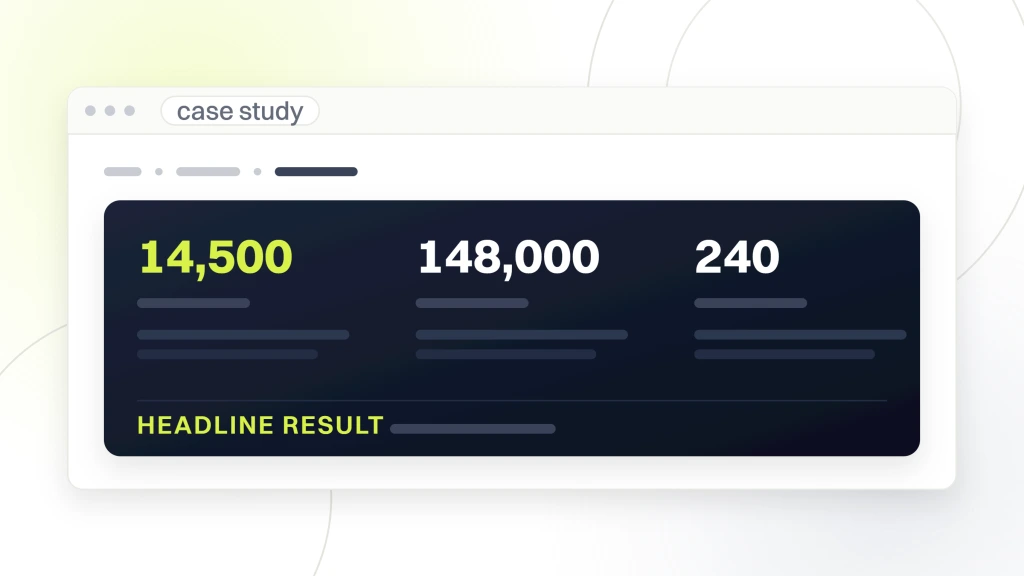
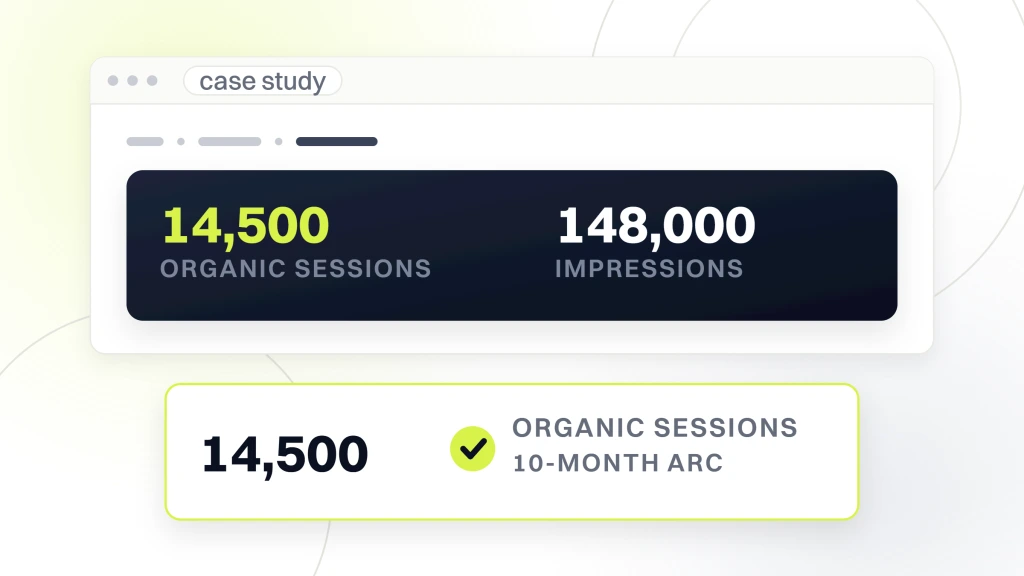
Month 10. Content wave three complete plus first backlink campaign wave. 240 listing pages indexed, 60 hub-and-variant pages ranking, 4 specialty pages ranking positions 1 to 3. Organic sessions at 14,500 monthly, Search Console impressions at 148,000 monthly. Qualified tenant leads at 22 to 30 per month via organic form-fills. First large office lease deal closed on a tenant sourced entirely through the tenant-rep services page (organic entry, tenant profile in the 15,000 to 40,000 sq ft band).
Revenue attribution inside the case study
Revenue attribution ran through CallRail (dynamic-number insertion by traffic source) and a leasing intake form tagged by landing page. Across months 6 through 12, organic sessions produced 148 total qualified tenant inquiries. Of those, 12 progressed to signed representation agreements and 4 closed as executed office leases inside the same 12-month window. Average commission per closed lease sat at $58,000. Total attributed commission revenue from year-one organic in the case study. $232,000. Retainer investment for the same window. $54,000. Payback ratio 4.3x on year one, with the compounding effect of the ranked URLs continuing to produce qualified leads through year two at a marginal cost near zero.
Comparison of success case studies SEO for commercial real estate websites
Every account we’ve run since 2019 follows a similar arc, sized by scope and specialty. The table below sizes three case-study patterns so you can plan against the one that matches your account.
| Scope | Neighborhoods covered | 10-month sessions | Qualified leads/mo (month 10) | Retainer band |
|---|---|---|---|---|
| Boutique tenant-rep | 4 to 6 | 4,000 to 8,000 | 8 to 15 | $1,499 to $2,499/mo |
| Mid-market brokerage | 8 to 15 | 12,000 to 22,000 | 18 to 32 | $2,499 to $4,500/mo |
| Multi-market brokerage | 15 to 40 | 28,000 to 55,000 | 35 to 70 | Starts at $4,500/mo |
Match the scope to your book realistically. Boutique tenant-rep shops rarely need the multi-market retainer band. Multi-market brokerages waste content velocity at the boutique retainer band. The right scope pick shaves 3 to 4 months off the timeline to first meaningful ranked URLs at any scope.
Cross-scope notes. Boutique shops benefit most from specialty-vertical pages (medical office, life sciences, government-lease specialists). Mid-market brokerages benefit most from neighborhood-plus-size-range depth. Multi-market brokerages benefit most from sitemap architecture and canonical hygiene, and the URL count grows past the point where a single sitemap file makes sense. Every scope needs the same technical foundation (schema stack, inline listing rendering, page-speed vitals), but the content strategy diverges hard by scope.
The landlord-rep sub-plan inside the office-leasing engagement
The landlord-rep sub-plan carried 25 percent of the content budget and produced a slower, higher-value pipeline. Landlord-rep intent searches (leasing agent for [neighborhood] office building, how to lease vacant office space [metro]) run 40 to 300 monthly searches each and convert at 1 to 3 percent to landlord inquiries. Deal size on landlord representation is 3 to 8 times a tenant-rep transaction.
Content build. 6 landlord-rep hub pages covering how to lease vacant office space, how to source qualified tenants, marketing strategies for vacant Class A office, pre-leasing best practices for new developments, sublease programs for underused space, and lease renewal negotiation for existing tenants. Each page ran 1,200 to 1,800 words with real-world numbers pulled from the brokerage’s landlord-rep deal history.
Landlord-rep results by month 10. 3 of the 6 hub pages ranked positions 1 to 5 for their primary phrase. 8 qualified landlord inquiries in month 10 alone. Two of those inquiries converted to signed landlord representation agreements inside the 12-month window, each worth commission math of 6 to 12 percent of first-year rent on the leased space. Landlord-rep deals close slower but hit harder on the P&L.
One landlord-rep inquiry in month 8 was a Class A building owner tired of a leasing agent who arrived every quarter with a fresh set of business-magazine ads and no actual tenants. He typed leasing agent for [neighborhood] office building into Google, landed on our client’s hub page, and booked a call inside 20 minutes. His parting line at the call. “You are the first commercial real estate SEO case study I have ever read where the numbers matched the promise.” That building has been on retainer with the brokerage ever since.
Lessons from the office-leasing SEO engagement
Five lessons carried out of the engagement, applicable to any office-leasing SEO work.
Lesson 1. Skip the head terms. Every retainer hour spent chasing office space [big metro] is an hour not spent on medical office space [neighborhood] or office space 15,000 to 40,000 sq ft [neighborhood] that would rank position 2. Portal domination on head terms is baked into every commercial-property SERP in 2026. Fight where you can win.
Lesson 2. The property inventory is the site’s biggest hidden SEO asset. Most brokerages iframe their inventory feed and never index a single property page. Migrating to inline rendering and adding RealEstateListing schema per URL surfaces 100 to 400 indexable pages inside 60 days. That expansion alone moves the account past most single-metro competitors.
Lesson 3. Specialty verticals convert 3 to 5x general office. Medical office space, life sciences lab space, tenant representation services, government-lease specialists, all pulled higher conversion rates than the general office space pages. Build specialty pages in the first content wave, not the third. The specialty search intent is already there.
Lesson 4. Landlord-rep content pays back on a longer curve. Landlord-rep deals close 90 to 180 days after inquiry versus 30 to 90 for tenant-rep. Build landlord-rep pages knowing the pipeline shows results in months 9 to 12 of the retainer, not month 6. Budget the retainer conversation accordingly.
Lesson 5. Call tracking with dynamic-number insertion is not optional. Without it, you cannot tell which of your 60 pages produced which of your 148 qualified inquiries. Every retainer conversation past month 4 needs page-level attribution to survive scrutiny. Install CallRail (or an equivalent) in week 2 before any content ramp begins.
Portfolio proof behind the commercial real estate SEO case studies
Compounding results across our wider real estate portfolio confirm the pattern from this engagement. Two named accounts back the same shape of work.
McCarthy Court, a 7-unit luxury Sidcup development, sold out 100 percent in 3 months of pre-completion via an immersive virtual showcase website. The site generated 60 qualified buyer leads and pulled 10,000 targeted campaign visits, all before the physical units were finished. That result came from the same technical spine you see in this engagement. Custom property pages with lead capture, eco-conscious feature detail, and lifestyle-driven storytelling. Pre-construction commercial and residential accounts share more strategy DNA than most brokerages assume, right down to the property-plus-feature schema stack.
Abels Residential, a new London-based letting agency, launched with a conversion-focused website and a paired on-page plus off-page SEO push. Inside the first 12 months the site pulled 20 or more qualified rental leads every month, ranked 300+ keywords on Google’s first page across London letting terms, and held sub-2-second page load times sitewide. The same strategy shape (conversion-focused site, deep on-page work, off-page authority build) that filled McCarthy Court and the office-leasing engagement filled Abels Residential’s pipeline. The vertical changes. The playbook does not.
Both accounts back up the underlying rule. Results compound when the technical foundation is solid, the content plan targets modifier-layer keywords, and the account tracks call attribution back to landing pages. Skip any one of those and the account stalls in the 4 to 6 month window. Do all three and the payback ratio typically clears 3x on year one and compounds after. See Search Engine Optimization Services for the underlying methodology.
Open your own commercial real estate SEO case study this week
Three actions to finish by Friday. Audit your current property inventory system for inline versus iframe rendering (right-click a listing, view source, search for the address). Pull a list of your top 10 closed transactions from the past 12 months indexed by neighborhood plus size range plus property class. Identify the 3 specialty verticals your book actually converts on (medical office, life sciences, government, industrial, and so on).
Those three lists shape the entire 10-month SEO plan. The inventory audit sets the technical scope. The closed-transaction data sets the keyword universe (real demand, not tool-guessed volume). The specialty vertical pick sets the highest-converting content wave. Do them in that order and week two starts with a keyword-to-URL map anchored in real deal history.
For brokerages that want the case-study replication plus the execution handled together, our Real Estate SEO Services for Brokerages team runs the segment call, the inventory audit, the schema stack install, and the first 24 URLs inside a 12-week engagement. For the wider retainer motion behind a working brokerage account, see Real Estate Marketing Agency for Brokerages. And for the paid-search layer that pairs with organic on most brokerage accounts, see Real Estate PPC Agency for Brokerages. Retainer bands run $999, $1,499, $2,499, or from $4,500 per month depending on scope. Ad spend is billed separately.