
AI PPC Management and What the Human Still Owns in a Google Ads Account
- AI ppc management is Smart Bidding plus tools plus a human specialist.
- Human owns structure, hygiene, ad copy strategy, and landing pages.
- Smart Bidding needs 30 conversions per month and clean tracking.
- Berks Plumbing hit 99 percent more conversions on Smart Bidding.
- Skip the human and the model overspends by 30 to 50 percent.
- AI-assisted ad copy inside ai ppc management
- Audience signals that ai ppc management uses in 2026
- Performance Max is the biggest AI change in ai ppc management
- Where ai ppc management still falls short
- Red flags in agencies selling ai ppc management
- Timeline to see real results from ai ppc management
- In-house versus outsourced ai ppc management
- Wrapping up ai ppc management as a service
AI ppc management is the practice of running paid search accounts on top of Google Smart Bidding, Microsoft Copilot for Ads, Meta Advantage+, and third-party AI tools like Optmyzr and Adalysis, where the human specialist sets guardrails and the algorithms handle the bid math. In 2026, most accounts spending over 5,000 dollars per month already touch AI somewhere in the stack. The question is not whether to use AI. The question is which parts of the account belong to the model and which parts belong to the human.
Real numbers help ground this. Berks Plumbing pushed Google Ads conversions up 99 percent with a 67 percent lower cost per acquisition on Smart Bidding plus a rebuilt account structure. Gwinnett Area Plumbers cleared 141 qualified leads in four months at 14.6 percent conversion rate on Smart Bidding plus disciplined negative keyword hygiene. AI did not carry the account. AI plus a human specialist did.
AI-assisted ad copy inside ai ppc management
Ad copy generation with tools like ChatGPT, Claude, and Google Responsive Search Ad recommendations changed the workflow for ad copy at scale. A specialist can now generate 15 headline variants and 5 description variants in 20 minutes instead of two hours. The model does not decide which copy wins. The account does that through A/B testing over 500 impressions per variant. But the model handles the ideation step much faster than the human.
Where AI-generated copy works well
Variant generation. Rewriting existing headlines for different angles. Adapting one ad group copy across five ad groups with similar themes. Localizing copy for different city or state modifiers. These are all places where AI-generated copy saves a specialist two to four hours a week and produces variants that perform within 5 to 10 percent of hand-written copy in A/B tests.
Where AI copy still needs a human editor
Brand voice consistency. Compliance language for regulated industries (healthcare, legal, finance). Local dialect. Emotional hooks that speak to a specific customer journey. Any copy that touches these needs a human editor before it goes live. Autopiloted AI copy in a regulated industry gets accounts flagged or shut down inside 30 days, and the cost of an account reinstatement takes weeks. Not worth the four hours of savings. Every AI copy variant that ships live carries the same brand risk any human-written variant would, so the editorial review stays in place.
Audience signals that ai ppc management uses in 2026
AI in paid search feeds on audience signals. First-party data. Customer match lists. Google Analytics audiences. In-market segments. Life events. Demographic overlays. The specialist decides which signals get fed into which campaigns. Smart Bidding uses those signals in the auction to bid up or down on the user in front of the ad. First-party data is worth 3x to 5x more than any pre-built Google audience because it reflects the actual customer profile.
Customer match and first-party lists
Customer match lets an account upload a hashed customer email list to Google Ads. Smart Bidding then bids up on lookalikes of the uploaded list. A 5,000-name customer list unlocks a Similar Audiences pool of roughly 500,000 lookalikes, which usually drives cost per acquisition down 20 to 30 percent inside 60 days. Every serious ai ppc management engagement uploads the customer match list in week one and refreshes it monthly.
In-market and life-event overlays
Google in-market audiences segment users by what they are actively researching. Life-event audiences segment by moves, weddings, births, and other triggers. Layering these as observation-only audiences at first tells the specialist which segments convert best. Then the specialist promotes the top two or three to targeted audiences and bids up on them. Pre-built audiences alone rarely move the needle, but layered on top of Smart Bidding they compound the model performance.
Performance Max is the biggest AI change in ai ppc management
Performance Max campaigns run across every Google surface at once: Search, Display, YouTube, Discover, Gmail, and Maps. The model decides which asset shows on which surface. The specialist provides the ingredients (asset groups, audience signals, conversion values, negative keywords via account-level lists) and the model handles the rest. PMax now accounts for 25 to 40 percent of Google Ads spend on most accounts we run.
What PMax does well
PMax finds incremental conversions that pure Search cannot capture. It works especially well for e-commerce accounts with a large product feed and clean revenue tracking. Home services accounts see 20 to 40 percent lower cost per acquisition on PMax compared to pure Search, provided the tracking is clean and the audience signals are strong. Skip PMax on brand-defense campaigns where the goal is impression share on branded queries only.
What PMax needs from the specialist
Asset group hygiene. Audience signals wired in during setup. Account-level negative keywords to block junk queries. Conversion value assignment on every conversion so the model knows what to optimize for. A weekly search term insight report (yes, PMax now exposes this) so the specialist can add negatives that block spam. Skip any one of these and PMax spends aggressively on the wrong queries. Get them all right and PMax becomes the biggest win in the 2026 stack.
Smart Bidding fails when your negatives list is empty. Pull the search terms report from last 30 days. Any junk term over 5 clicks means you skipped the human part.
Where ai ppc management still falls short
AI in paid search does not solve every problem. The model does not know the sales cycle. The model does not know which lead sources convert to actual signed deals. The model cannot rewrite a landing page. The model cannot decide which offers to run this quarter. Accounts that assume Smart Bidding replaces a specialist tend to overspend by 30 to 50 percent inside 90 days because the model optimizes for the wrong outcome without human oversight.
The hallucination problem in AI-generated copy
AI-generated copy sometimes invents claims the business cannot back up. A tool that writes 20 dental practice headlines might include one that promises a five-star review from a fictional patient, which is a policy violation and a legal risk. Every AI-generated copy variant needs a human editor to catch these before publish. Skip this step and the account gets flagged inside 30 days.
The black-box problem in Smart Bidding decisions
Smart Bidding does not tell the specialist why it bid up or down on a given auction. When performance drops, the specialist has to reverse-engineer from segment reports, device and geo splits, and search term reports. That takes hours per account. Third-party tools like Optmyzr surface some of the reasoning, but not all. Accepting the black box is part of the job, because the alternative (manual bidding across thousands of auctions per day) does not scale.
Red flags in agencies selling ai ppc management
Every founder reads a proposal that sells AI as a magic bullet. The pitch says AI will 10x the account inside 60 days and cut the retainer in half. The red flags below catch the majority of AI-flavored sales pitches that do not survive contact with a real account.
- No mention of conversion tracking QA in month one. The AI cannot outrun broken tracking.
- Fees below 750 dollars per month with a promise of full management plus AI tooling. That budget covers 4 to 5 hours of specialist time. The license fees alone eat 300 dollars.
- Vague description of which specific AI tools sit in the stack. If they cannot name Smart Bidding strategies and third-party licenses, they do not run them.
- No mention of guardrails on the Smart Bidding campaigns. The model without guardrails wanders.
- Account owned by the agency instead of the client through an MCC link. Agencies that hide behind AI often keep account ownership hostage as a discount.
Every founder gets one really tempting AI-flavored pitch: a proprietary bidding algorithm the agency invented last month that promises a 20x return with zero human labor for 99 dollars a month. The math says the algorithm is Smart Bidding with a rebranded PowerPoint, and the specialist is a ChatGPT tab in a browser somewhere. Neither scales.
Green flags in a real ai ppc management pitch
A written scope naming Smart Bidding strategy plus one or two third-party tools. A conversion tracking QA in week one. Guardrail specifications for Smart Bidding campaigns. A weekly one-page report format sample. A client-owned MCC link with 24-hour termination. Case studies with real accounts, real spend, and real returns across at least six months. Any pitch that hits five of these six is worth a follow-up call.
Timeline to see real results from ai ppc management
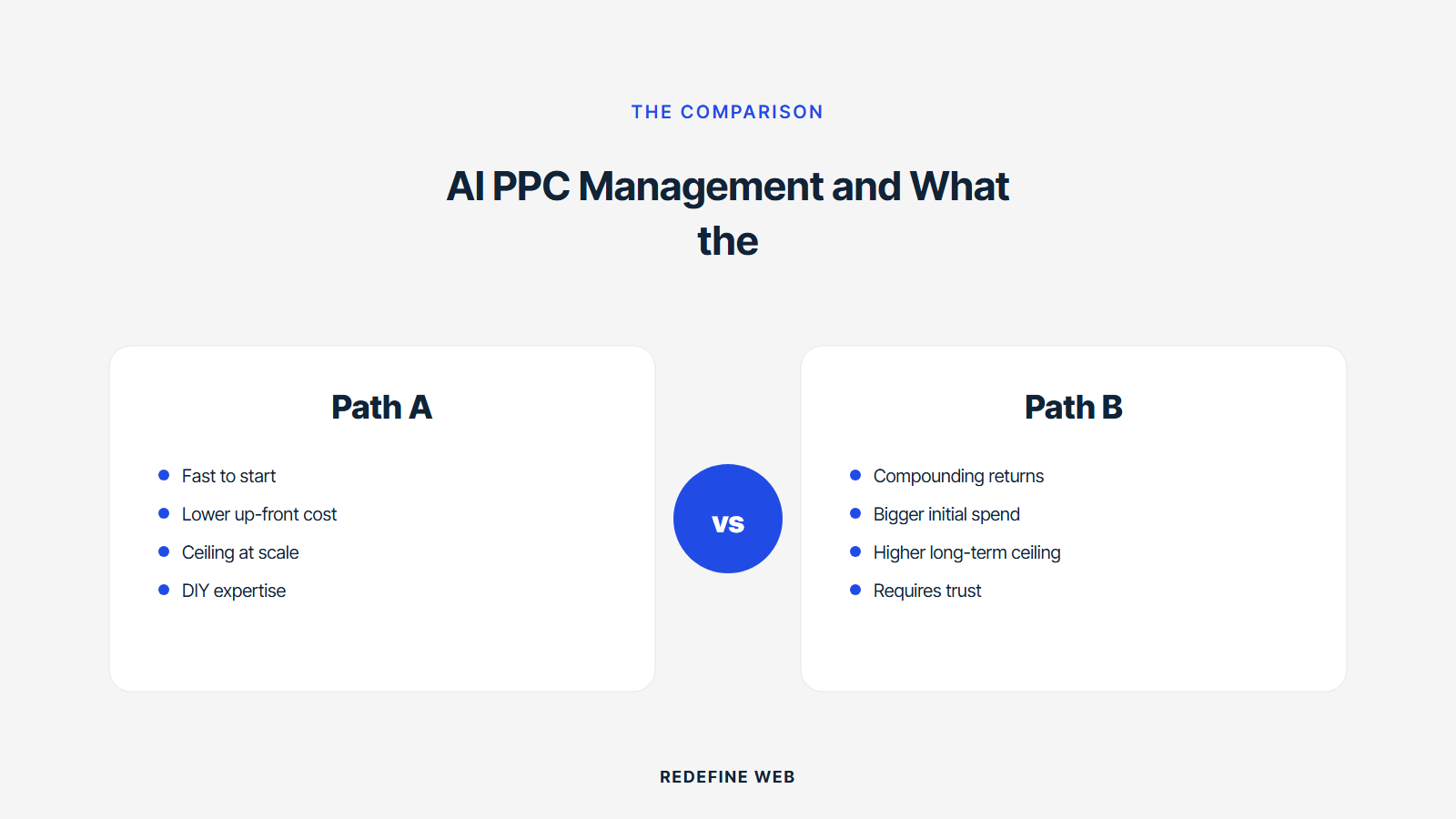
Founders arrive at ai ppc management with wildly different expectations. Some expect a 20x return in month one because the pitch promised it. Others expect nothing because prior vendors let them down. Real outcomes sit in a narrow window shaped by industry, spend level, and how well the tracking wired up. The bands below reflect roughly 40 accounts we manage or have audited in the last 18 months.
The Smart Bidding learning curve
Smart Bidding needs 4 to 6 weeks of learning time on 30 or more conversions per month to start performing. Restart the learning phase (by changing bid strategy, budget over 20 percent, or targeting) and the clock resets. That is why disciplined ai ppc management makes small changes, not big changes. Big changes look decisive on a strategy call and cost the account two weeks of learning downtime.
Returns by industry with AI in the stack
Home services (plumbing, HVAC, electrical) sees 4x to 7x on ad spend after six months with Smart Bidding plus clean tracking. Legal (personal injury) sees 3x to 5x. Healthcare (dental, med spa) sees 3x to 6x after landing pages get rebuilt for paid intent. E-commerce depends heavily on product margin and PMax setup quality: 2x to 4x at the low end, 6x to 10x on high-margin niche products with clean feeds. According to Think with Google paid search benchmarks, accounts running Smart Bidding on clean tracking outperform industry averages by 40 to 60 percent on cost per acquisition.
In-house versus outsourced ai ppc management
Every founder eventually asks whether to run AI-driven PPC in-house or at an agency. The honest answer depends on account spend, technical appetite, and whether the business has volume to keep a specialist plus AI tooling busy. Below 10,000 dollars in monthly spend, an agency retainer wins on math because the tool licenses alone eat 300 to 500 dollars per month. Above 50,000, a hybrid model with an in-house lead plus agency oversight usually wins.
The tool license math for in-house
Optmyzr, Adalysis, plus a Google Ads scripts library run 500 to 1,000 dollars per month in license costs for a single-account in-house lead. An agency spreads those license costs across 15 to 20 accounts, so the per-account share drops to 30 to 60 dollars. That is one of the biggest cost efficiencies an agency delivers. Founders who insist on in-house AI tooling below 25,000 dollars in monthly ad spend usually spend 3x what they need to.
When in-house wins
In-house wins when the account spends over 50,000 dollars per month, custom conversion logic needs daily internal collaboration, and the founder wants a permanent AI-plus-PPC capability on the team. Even then, an agency oversight arrangement (fractional PPC director, quarterly audits) catches blind spots a solo in-house lead misses. Full replacement of external oversight rarely pays off below 200,000 dollars in monthly spend. Our B2B PPC agency team runs into this decision often with mid-market clients.
Wrapping up ai ppc management as a service
Ai ppc management in 2026 is not a magic bullet. It is a stack of AI features (Smart Bidding, PMax, Copilot for Ads, Optmyzr, Adalysis, ChatGPT for copy) that a human specialist orchestrates on top of clean account structure and tracking. AI handles bid math, budget pacing, and audience selection. The human handles structure, hygiene, ad copy strategy, and landing pages. Skip the human and the model overspends. Skip the AI and the specialist wastes hours on bid math.
Real accounts see 3x to 7x return on ad spend inside six months when both the human and the AI show up every week. Berks Plumbing pushed conversions up 99 percent with Smart Bidding on top of a clean structure. Gwinnett Area Plumbers cleared 141 leads in four months on the same pattern. Ask three vendors for line-item scopes, look for the green flags above, and pick the one that gives you full account ownership through an MCC link. Redefine Web offers a fixed-scope PPC management services package with the AI stack included, a Google-specific Google Ads management services package, and a B2B-focused B2B Google Ads services program. Book a call and we will walk through the last three AI-heavy accounts we ran, line by line, with the exact Smart Bidding strategies, the exact tool stack, and the numbers each one produced across six months.
Frequently asked questions
What is ai ppc management in 2026?
AI ppc management is the practice of running paid search accounts where machine learning handles bid math, budget pacing, and audience selection, while a human specialist owns campaign structure, ad copy strategy, negative keyword hygiene, and landing page work. The AI stack includes Google Smart Bidding, Performance Max, Microsoft Copilot for Ads, Meta Advantage+, plus third-party tools like Optmyzr and Adalysis. The model runs the mechanics inside guardrails the human wires up during setup and adjusts every week. Skip the human and the model overspends by 30 to 50 percent inside 90 days on queries that look convertible but never close.
How much does ai ppc management cost per month?
Ai ppc management runs 1,000 to 5,000 dollars per month as a flat retainer for accounts spending under 30,000 dollars on ads. Percent-of-spend pricing sits at 10 to 20 percent of monthly ad budget for accounts in the 30K to 250K range. AI tool licenses add 200 to 500 dollars per month on top, often bundled into the retainer. Agencies spread license costs across 15 to 20 accounts, so the per-account share drops to 30 to 60 dollars, which is one of the biggest efficiency wins an agency delivers on AI-heavy engagements.
How does Smart Bidding actually work?
Google Smart Bidding runs Target CPA, Target ROAS, Maximize Conversions, and Maximize Conversion Value strategies on real-time auction-time signals. The model uses signals a human specialist cannot see: device, location, time of day, browser, operating system, and audience overlap. The model needs 4 to 6 weeks of learning time on 30 or more conversions per month to perform well. Feed it clean conversion tracking and enough volume, and Smart Bidding beats manual bidding by 20 to 40 percent on cost per acquisition inside 90 days. Feed it broken tracking and the model optimizes for the wrong outcome.
What does the human specialist still do in ai ppc management?
The human specialist owns account structure, negative keyword hygiene, ad copy strategy, landing page decisions, offline conversion imports, cross-channel budget allocation, and client communication. Every one of these still needs a human because the model does not know the business goals, the sales cycle, the margin math, or the brand voice. The human also sets the guardrails on Smart Bidding campaigns: maximum daily budget, maximum cost per click ceiling, location targeting, language and device targeting, and ad schedule. Skip the guardrails and Smart Bidding wanders into cheap conversions on the wrong queries.
Is Performance Max part of ai ppc management?
Performance Max is the biggest AI change in ai ppc management right now. PMax campaigns run across every Google surface at once (Search, Display, YouTube, Discover, Gmail, Maps) and the model decides which asset shows on which surface. The specialist provides asset groups, audience signals, conversion values, and account-level negative keyword lists. PMax now accounts for 25 to 40 percent of Google Ads spend on most accounts we run. It works especially well for e-commerce accounts with clean product feeds and revenue tracking. Skip PMax on brand-defense campaigns where the goal is impression share only.
What are red flags in agencies selling ai ppc management?
No mention of conversion tracking QA in month one is the biggest red flag. Fees below 750 dollars per month with a promise of full management plus AI tooling is the second. Vague description of which specific AI tools sit in the stack is the third. No mention of guardrails on Smart Bidding campaigns is the fourth. Account owned by the agency instead of the client through an MCC link is the fifth. Any agency selling a proprietary bidding algorithm they invented last month with a promise of 20x returns is selling Smart Bidding with a rebranded PowerPoint. Walk away.
How long does ai ppc management take to show real results?
Smart Bidding needs 4 to 6 weeks of learning time on 30 or more conversions per month to start performing. Month one shows setup and tracking work with modest volume changes. Month two shows the first real signal as the model learns off cleaner data. Month three is where most accounts hit break-even against the retainer plus ad spend. Months four through six are where compounding kicks in and cost per acquisition drops meaningfully. Home services accounts routinely see 4x to 7x return by month six with Smart Bidding plus clean tracking and disciplined human oversight.
Book your free 30-minute strategy call.
No spam, no sales rep. We use your email to schedule your call with a senior strategist. That is it.
More from the blog
View all articles → PPC
PPC Healthcare PPC Advertising Channels Compliance and Targeting
Read article PPC
PPC Dental Facebook Ads Guide for Practices That Book Patients
Read article PPC
PPC