
Automated Compliance Solutions for Healthcare Websites
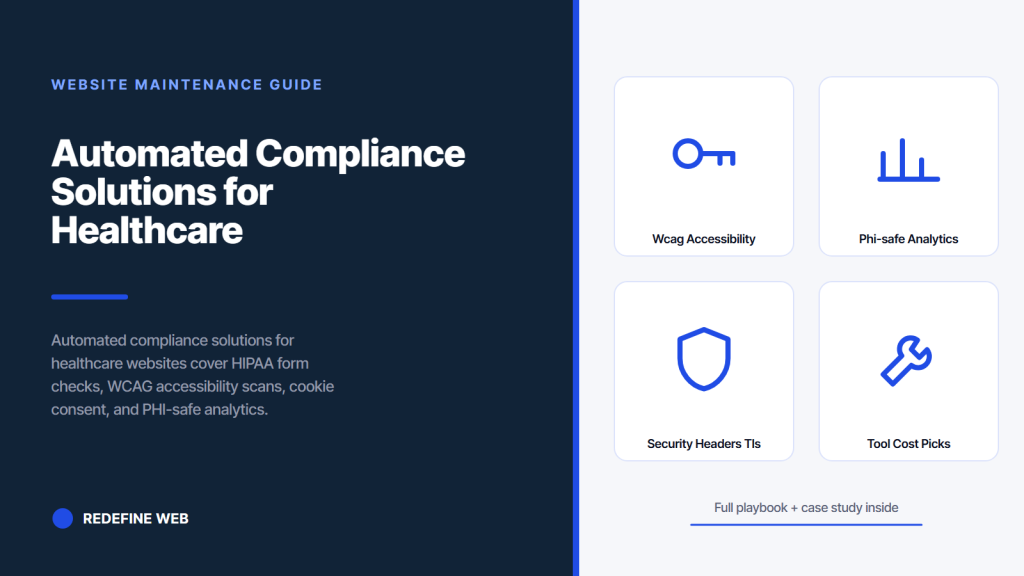
- Automation handles nightly HIPAA drift detection cheaply.
- Automated WCAG scanners catch 40 percent of violations.
- Cookie consent wiring needs Google Consent Mode v2.
- Audit trail retention is the compliance baseline.
- Humans still own BAA judgment and remediation choices.
- WCAG accessibility scanning for ADA compliance for healthcare websites
- Cookie consent management platforms for healthcare websites HIPAA compliance
- PHI-safe analytics validation
- Security headers and TLS automation
- Tool and cost picks for automated compliance solutions for healthcare websites
- How automated compliance solutions worked on a multi-location practice
- Common mistakes on healthcare website compliance automation
- Where automated compliance for healthcare websites is heading
Automated compliance solutions for healthcare websites turn a quarterly HIPAA sweep and a WCAG audit from a Google Doc checklist someone forgot into a continuous system that flags drift the same day it happens. Practices that treat compliance as an annual project keep losing to practices that treat it as a nightly cron job. The gap between those two postures is where most of the small-practice HIPAA incidents happen: a plugin update ships, a tracking script starts firing on the appointment page, and nobody checks until a compliance officer asks.
This guide covers what automated compliance solutions for healthcare websites should watch, which pieces still need a human eye, cookie consent management platforms for healthcare websites HIPAA compliance considerations, ADA compliance for healthcare websites, and the tool combinations that hit 80 percent of the workload on a $200 monthly budget. Every recommendation comes from real client sites we maintain today, not vendor sales sheets.
WCAG accessibility scanning for ADA compliance for healthcare websites
ADA compliance for healthcare websites is a legal exposure and a UX obligation at the same time. The DOJ took a formal position in 2022 that websites of public-facing businesses fall under Title III of the ADA. Healthcare practices sit squarely inside that ruling. WCAG 2.1 AA is the working standard. Automated scanning catches roughly 40 percent of WCAG violations at machine speed, leaving the harder 60 percent for manual review.
What automated WCAG scanners catch
Missing alt text on images. Insufficient color contrast between text and background. Missing form labels. Missing skip links. Missing heading hierarchy. Missing ARIA landmarks. Missing lang attributes. These are the machine-detectable violations that axe-core, WAVE, Lighthouse accessibility audits, and Deque Axe DevTools all catch reliably. Running one of them weekly against the top 30 pages plus new content catches the drift that happens as marketing teams add pages without an accessibility check.
What humans still have to check
Whether alt text actually describes the image accurately. Whether tab order makes sense in a complex form. Whether a video has meaningful captions and audio descriptions. Whether an interactive component announces state changes to a screen reader properly. Whether error messages are clear and actionable. Those all need a human running a screen reader (VoiceOver, NVDA, JAWS) against the site quarterly. Automation flags the machine-detectable half. Humans handle the meaningful half.
Cookie consent management platforms for healthcare websites HIPAA compliance
Cookie consent management platforms for healthcare websites HIPAA compliance are the layer that keeps analytics and marketing tags from firing until the patient consents. On a healthcare site the consent gate is a bigger deal than on a general marketing site because a fired-too-early tracking pixel can carry PHI to a third party without a signed BAA in place. Getting the consent gate right is non-negotiable in 2026.
Popular platform picks include OneTrust, Cookiebot, Osano, Termly, and Complianz for WordPress-specific setups. All of them handle the basic consent banner and cookie gating. The difference between them shows up in granular consent categories, geo-based rule sets, and the audit trail they keep for compliance reporting. For a US-only practice site, the free tier of Complianz or Termly covers the base case. For a multi-region health system, OneTrust or Cookiebot at $100 to $500 monthly makes sense.
- Block analytics scripts by default. Google Analytics 4, Meta Pixel, HubSpot, all held until the patient clicks accept.
- Category-based consent. Necessary, functional, analytics, marketing. Patient can accept some and reject others.
- Geo-based rules. California residents get a CCPA-specific banner. EU residents get a GDPR-specific banner.
- Consent log retention. Every consent decision timestamped and stored for at least 12 months.
- Google Consent Mode v2 integration. Signals to Google whether ads consent and analytics consent are granted so Google Ads bidding behaves correctly.
- Cookie audit auto-scan. Weekly scan detects any new cookies the site starts setting, prompting a category assignment.
The Google Consent Mode documentation is the reference for the analytics-side integration. Cookie consent management platforms for healthcare websites HIPAA compliance work best when they are wired to Consent Mode from day one rather than bolted on later.
PHI-safe analytics validation
Even with consent gates and BAAs in place, healthcare analytics setups drift over time. A new event tag gets added by a marketing consultant. A new URL parameter shows up on an appointment confirmation page. A field label gets pushed into an analytics event payload by a form plugin update. Any of the three can push PHI into Google Analytics or Meta silently. PHI-safe analytics validation is the automation layer that catches those patterns before compliance officers do.
What the validator scans
Every event payload sent to Google Analytics 4 gets sampled and checked for patterns that look like PHI: potential names, potential symptom words, potential appointment types tied to diagnosis codes. Every URL that lands on the confirmation page gets checked for query strings that could carry PHI. Every third-party tag manager container gets diffed weekly against the last known-good version so unexpected tag additions get caught the same day.
Reporting and audit trail
Every scan run generates a JSON audit report stored for 12 months. Every flagged event gets a screenshot and a payload capture. When HHS OCR opens an investigation or when a compliance officer runs an internal audit, the audit trail is what proves the practice was actively monitoring PHI exposure rather than hoping for the best. A 12-month audit trail is the compliance baseline. Longer retention costs almost nothing in cloud storage.
Manual quarterly audits miss the plugin update that broke your tracking last Tuesday. Set up a daily headless check on your forms before you buy any compliance tool.
Security headers and TLS automation
Healthcare website security depends on the boring layer of HTTP security headers and TLS certificate management running correctly every day. Missing headers, weak TLS ciphers, or an expired certificate breaks patient trust and Google rankings in the same afternoon. Automation handles the recurring work so the maintenance team only touches it when something changes.
What to automate on security headers
Content Security Policy (CSP) enforcement, Strict-Transport-Security (HSTS), X-Content-Type-Options, X-Frame-Options, Referrer-Policy, and Permissions-Policy all get set at the CDN or origin server and tested weekly by an automated scanner. Mozilla Observatory and securityheaders.com both offer free scanners the maintenance team can run on a schedule via API. A weekly check catches a missing header the moment a hosting migration or a plugin change drops it.
TLS certificate management
Let’s Encrypt with automated renewal via certbot or the hosting platform’s built-in tooling covers 95 percent of healthcare sites. The remaining 5 percent are enterprise setups running EV certificates from a commercial CA. Either way the automation piece is the same: monitor the certificate expiry date daily, alert 30 days before expiry, and validate the renewal actually installed correctly. Expired certificates cause immediate ranking drops and patient trust damage.
Beyond the renewal itself, the automation should also check the chain of trust, verify the certificate matches the served hostname, and confirm the TLS version negotiated is 1.2 or higher. Weak ciphers still get negotiated on misconfigured servers and Mozilla Observatory catches those in the same weekly scan.
Tool and cost picks for automated compliance solutions for healthcare websites
The stack we run on client healthcare sites costs $150 to $400 monthly total, covering all four workstreams above. The table breaks down the categories, the tool picks, and the price bands. Every price assumes a single-location practice site. Multi-location groups scale up on the log volume and check frequency.
How to sequence the tool rollout
Start with HIPAA form and tracking auditing because it catches the compliance failures that carry the highest dollar risk. Add cookie consent management second because it feeds into HIPAA form auditing (uncontrolled scripts fire tracking calls before consent). Add WCAG scanning third because ADA demand letters run cheaper on average than HIPAA fines. Add PHI-safe analytics validation fourth as the confidence layer over the other three. Security header monitoring plugs in at any point.
DIY vs vendor picks by practice size
Single-practice sites run fine on DIY setups using Puppeteer, axe-core, and Complianz. Multi-location groups and DSOs at 5 or more locations benefit from vendor picks (Feroot, OneTrust, Deque Axe DevTools) because the compliance reporting UI matters when a compliance officer needs monthly evidence. Health systems standardize on OneTrust plus ObservePoint plus Deque for a $2,000 to $5,000 monthly total that covers the audit trail requirements enterprise procurement teams want.
| Workstream | Tool picks | Monthly cost | Check frequency |
|---|---|---|---|
| HIPAA form and tracking | Feroot, ObservePoint, or DIY Puppeteer | $0 to $500 | Nightly |
| WCAG accessibility | axe-core, WAVE, Deque Axe DevTools | $0 to $80 | Weekly |
| Cookie consent management | Cookiebot, OneTrust, Complianz, Termly | $0 to $500 | Every page load |
| PHI-safe analytics | DIY GTM auditor, Feroot | $0 to $300 | Weekly diff |
| Security headers + TLS | Mozilla Observatory API, Let’s Encrypt | $0 to $30 | Weekly + daily cert check |
How automated compliance solutions worked on a multi-location practice
Pelvic Rehabilitation Medicine runs 14 locations on WordPress multisite treating pelvic pain and endometriosis. The automated compliance solutions stack layered on top of the maintenance retainer runs the four workstreams nightly. Total cost sits at $180 monthly across four vendor and DIY tools combined for full coverage.
Over 18 months of continuous compliance monitoring, the stack caught three plugin updates that would have introduced HIPAA-violating tracking calls (rolled back within the same day), 27 WCAG violations that got fixed in the next content deploy, one cookie consent misconfiguration where a marketing tag was firing before consent (fixed within 4 hours), and two TLS certificate near-expirations that renewed correctly after the 30-day alert. The practice preserved the 174 percent keyword growth and 166 percent organic traffic gains earned during the initial rebuild.
Zero compliance incidents were reported to HHS OCR during the 18-month window. Zero ADA demand letters landed. Zero cookie consent complaints came in from patients. The stack ran quietly, doing the boring work every night so the practice manager could focus on running the clinical side. That is the whole point of automation: it makes compliance a scheduled task rather than a fire drill. The math on cost versus avoided incident writes itself.
The postmortem culture around every flagged violation was as valuable as the tooling. Every alert that fired got documented in a shared runbook so the pattern would not repeat. That documentation became the training material for new engineers joining the maintenance team. Boring, weekly, incremental improvement compounded into a compliance posture other practices spend $30,000 to $50,000 in consulting fees trying to reach.
Common mistakes on healthcare website compliance automation
The same six failure patterns show up on every practice site we audit. Each one is cheap to fix once identified. Skipping any one of them turns automation into theater rather than actual coverage.
- Consent banner blocks analytics but not marketing tags. Meta Pixel keeps firing before consent, which defeats the whole purpose.
- WCAG scanning only against the homepage. Interior pages accumulate violations that never get flagged.
- No audit trail retention. When HHS OCR asks for evidence of monitoring, screenshots from three months ago do not exist.
- Security headers set once, never re-tested. Hosting migrations and CDN changes silently drop headers weekly.
- TLS certificate renewal not validated post-renewal. A failed renewal on Sunday morning becomes a full site outage on Monday.
- Consent Mode not wired to Google Ads. Bidding behaves incorrectly and campaign performance drops without an obvious cause.
Every year the practice manager attends a HIPAA compliance webinar in September, buys a $2,000 policy binder in October, and forgets to open it again until the next September. Meanwhile the plugin update in November silently starts sending appointment types to Google Analytics, the WCAG scanner nobody set up misses three months of accumulated violations, and the cookie consent banner shows up on the site but does not actually block anything because nobody wired it correctly. A binder does not check itself. Automation does. Somewhere at a HIPAA consulting firm a sales rep is quoting $50,000 for the same coverage a $180 monthly stack delivers on the weekend.
The joke lands because it maps to what most practice compliance actually looks like. A binder in a drawer plus a hope that nothing shipped without notice. Automation replaces the hope with a nightly check. Nothing dramatic, just the boring work that compounds into real compliance posture year after year.
Where automated compliance for healthcare websites is heading
HHS OCR guidance on web tracking technology has tightened repeatedly since 2023. The HHS bulletin on tracking technology is essential reading for every practice manager. Automated compliance solutions for healthcare websites now need to keep pace with guidance updates from OCR, DOJ ADA enforcement patterns, and browser vendor changes to cookie behavior.
Third-party cookies deprecation on Chrome (finally rolling through in 2025-2026) reshapes what tracking scripts do and how consent management works. State privacy law expansion (California, Virginia, Colorado, Connecticut, Utah, plus 15 more states adopting similar laws through 2027) makes geo-based consent rules the new baseline. The compliance stack needs quarterly updates just to stay current, which is another reason automation earns its keep.
The practical next step for most practices is a two-week compliance audit against the four workstreams above. Map current coverage against the working stack. Fix the biggest gap first (usually HIPAA tracking script auditing). Move to the second (usually cookie consent wiring). Iterate through WCAG and PHI analytics. Six months from audit to fully automated compliance solutions for healthcare websites is a realistic timeline on most practice sites. The WCAG 2.1 quick reference on W3.org covers the accessibility side of the audit.
Ready to run the audit and stand up the automation stack. Our Healthcare Website Maintenance Services engagement covers the automation layer as part of the working plan. For deeper reading on the security side, our Healthcare Website Security covers the governance layer. The Accessibility (ADA/WCAG) guide covers the compliance side in detail. For the technical hardening layer see Website Security Features and Maintenance Checklist. The healthcare marketing agency hub ties compliance into the broader acquisition side.
Frequently asked questions
What are automated compliance solutions for healthcare websites?
Automated compliance solutions for healthcare websites cover four workstreams that run on a schedule from real-time to weekly. HIPAA-safe form and tracking behavior scans check every network call the site makes and diffs against the last known-good baseline. WCAG accessibility scanning runs axe-core or a similar tool against every page weekly. Cookie consent management gates analytics and marketing tags on every page load. PHI-safe analytics validation samples event payloads for patterns that look like patient data. Together they replace roughly 70 percent of manual quarterly review.
How much do automated compliance solutions for healthcare websites cost?
A working automation stack for a single-location practice site costs $150 to $400 monthly total. HIPAA form auditing runs $0 to $500 depending on vendor choice or DIY setup. WCAG scanning runs $0 to $80. Cookie consent management runs $0 to $500 on the popular platforms. PHI-safe analytics validation runs $0 to $300. Security headers and TLS monitoring run under $30. Multi-location DSOs and health systems typically spend $600 to $1,500 monthly because page count and consent complexity both scale up.
Can automated tools handle full HIPAA compliance?
No, automation handles the flagging layer. A HIPAA form checker flags a new outbound host but cannot judge whether the practice signed a Business Associate Agreement covering it. A WCAG scanner flags a missing alt attribute but cannot judge whether the alt should be decorative or informational. Humans still own BAA judgment, remediation choices, and cookie policy language. The right split is automation flags, humans decide. Practices that skip the human review step tend to miss the harder compliance decisions.
Do healthcare websites need cookie consent management?
Yes. Cookie consent management platforms for healthcare websites HIPAA compliance gate analytics and marketing tags until the patient consents. On a healthcare site a fired-too-early tracking pixel can carry PHI to Google or Meta without a signed BAA in place. The consent gate is what prevents that. Google Consent Mode v2 integration lets Google Ads bidding behave correctly when consent is not granted. Popular platforms include OneTrust, Cookiebot, Complianz, Termly, and Osano, ranging from free tiers to $500 monthly.
What is ADA compliance for healthcare websites?
ADA compliance for healthcare websites means meeting WCAG 2.1 AA as the working standard. The DOJ took a formal position in 2022 that public-facing business websites fall under Title III of the ADA, and healthcare practices sit squarely inside that ruling. Automated WCAG scanners catch roughly 40 percent of violations at machine speed: missing alt text, insufficient color contrast, missing form labels, missing landmarks. The remaining 60 percent needs human review with a screen reader running quarterly against the site.
How often should healthcare website compliance run?
HIPAA form and tracking scans should run nightly because plugin updates and marketing changes can drift daily. WCAG accessibility scans should run weekly on the top 30 pages plus every new content deploy. Cookie consent management runs on every page load by design. PHI-safe analytics validation runs weekly with a diff against the previous baseline. Security headers get tested weekly. TLS certificate expiry gets checked daily with a 30-day alert threshold. Full quarterly human review still owns final judgment on BAA coverage and WCAG remediation.
What happens if we skip automated healthcare website compliance?
Three things happen over 12 to 24 months. HIPAA tracking drift silently starts sending patient data to third parties without BAAs in place. WCAG violations accumulate as marketing teams add pages without accessibility review. Cookie consent misconfigurations let analytics fire before patient consent. Any of the three can trigger an HHS OCR investigation, an ADA demand letter, or a state privacy law complaint. Automation prevents all three at a cost of $150 to $400 monthly, compared to $30,000 to $50,000 in consulting fees to remediate after an incident.
Book your free 30-minute strategy call.
No spam, no sales rep. We use your email to schedule your call with a senior strategist. That is it.
More from the blog
View all articles → Website Maintenance
 WordPress Website Maintenance Packages That Keep the Site Safe and Fast
Read article Website Maintenance
 Pet Website Maintenance Checklist for Ecommerce Pet Brands
Read article Website Maintenance