
B2B Web Design and Development Services That Book Real Pipeline
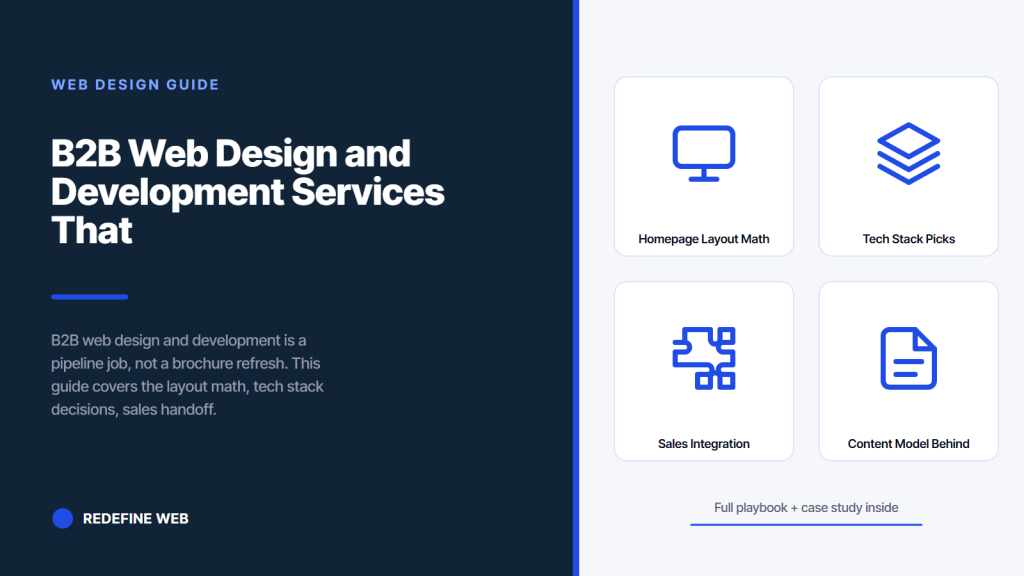
- B2b web design serves a 5 to 9 person buying group.
- Homepage carries five jobs in a locked order.
- Stack pick has to match the team you staff.
- Sales integration decides pipeline more than design does.
- Reporting must map sessions to closed revenue.
- Why b2b web design and development is different from consumer builds
- Homepage layout math for b2b web design and development
- Tech stack picks that hold up in b2b web development
- Sales integration inside b2b web design services
- Content model behind working b2b website design and development
- B2b web design and development case study: Delta Services LLC
- Stack comparison across b2b web design and development options
- SEO integration in b2b web design and development services
- Reporting the b2b web design and development team can defend
- B2b web design and development pitfalls that show up in every audit
- What to spec in your b2b web design and development brief this week
B2B web design and development sits closer to sales operations than to marketing decoration. The buyer landing on your homepage is a research committee running a shortlist, not a consumer chasing a single click. Your website is either shortening their internal review or lengthening it. This guide walks the layout math, tech stack picks, sales integration, and reporting model that separates a working B2B site from a brochure that nobody in the buying group finishes reading.
You will get the exact sections a b2b web design and development project needs, the CMS and framework choices worth defending in a 12 to 18 month build cycle, the sales enablement patterns that pull demo requests forward, and the analytics wiring that lets a revenue team argue for more budget. Read this against your last 90 days of pipeline data before you brief a designer or a shop, because the brief you hand over decides more than the studio you pick.

Why b2b web design and development is different from consumer builds
A consumer site sells to a person clicking a paid ad. B2b web design and development sells to a 5 to 9 person buying group researching over 60 to 90 days. That gap changes almost every downstream decision, from hero copy through pricing pages and form length.
Hero copy has to name the buyer role, not the promise. Feature pages need proof density that stands up to a procurement review. Every form field carries a cost because the demo request is passed to a rep, not a shopping cart.
B2b web design services that ignore the committee produce a homepage that reads well to a marketer and confuses a real buyer. Watch the difference on Hotjar. A consumer visitor scrolls once, clicks a product tile, and either converts or bounces inside 90 seconds. A b2b buyer opens 4 to 7 tabs on the same visit, scans your integrations page, opens two case studies, and drops off if the pricing model looks murky. The build has to answer that scanning pattern with actual content, not lofty headlines.
Buyer research from TrustRadius and G2 keeps showing the same pattern. B2b buyers watch 4 to 6 vendor sites before they book a call. They finish the review inside your site or on a competitor site. B2b web design and development that carries the finish line puts case studies, pricing, integrations, and security in scannable form. Bury any one of those and the shortlist tightens without you. See the TrustRadius 2024 B2B buying disconnect report for the underlying research.
Homepage layout math for b2b web design and development
The b2b homepage carries five jobs, in this order. Name the buyer and the outcome in the hero. Prove the outcome with 3 to 6 named logos. Explain the product or service in a scannable capability block. Show the pricing model or a pricing lead-in. Close with a demo or intro call CTA that costs the buyer less than 60 seconds. That is the whole scaffold. Every add-on beyond it dilutes the finish rate.
Hero copy carries the highest read rate on the page. Every generic tagline you write there costs you 20 to 40 percent of the scroll rate below it. The winning pattern reads like this. Line one names the buyer role and the outcome in 8 to 12 words. Line two carries one specific number or one specific integration. One primary CTA on the right hand side that leads to a demo request, not a whitepaper. Compare it to a stock hero that says “transforming business through innovation” and the click gap on the CTA hits 4 to 6x in every A/B test we’ve measured across 40+ b2b sites.
Below the hero, the logo strip has to hold weight. Every b2b buyer scans logos in 3 to 5 seconds and either recognizes the segment or moves on. A logo strip mixing 12 brands from 6 industries reads as random. A tight 5 to 7 logo strip filtered to one segment reads as focused. B2b web design services that treat the logo strip as decorative miss the fastest trust signal on the page. When your team wants deep b2b web design pattern work, review our Web Design and Development Services for the full scaffold we deploy in every enterprise build.
Tech stack picks that hold up in b2b web development
Tech stack picks in b2b web development sit downstream of two calls. Where does the marketing team edit content, and how does the site talk to the CRM. Every stack argument that ignores those two questions is a bad argument. WordPress with a headless React front end wins the marketing-agility argument. Webflow wins the design-team argument. Next.js on a headless CMS wins the enterprise-scale argument. Pick the one that matches your team, not the one Twitter argues for on Tuesday.
WordPress plus a headless React or Next.js layer stays the pragmatic default for most b2b web design and development services buyers. Editors get Gutenberg. Developers get a modern front end. The CRM integration story stays clean because HubSpot, Salesforce, and Marketo all have first-class WordPress webhooks. The tradeoff is hosting complexity: WP Engine, Kinsta, and Pantheon each price at $200 to $2,400 per month depending on traffic band, and headless deployments need Vercel or Cloudflare Pages on top.
Webflow works when the design team owns the site and marketing needs zero developer time to publish. The tradeoff is enterprise scale. Webflow’s CMS collection limits, form-to-CRM plumbing, and multi-site instances get uncomfortable above 3,000 pages. Next.js on Contentful or Sanity wins when the engineering team has capacity to own the front end and the product team wants deep component reuse across product docs and marketing. Every one of these picks has a different total cost of ownership over 24 months. Model the cost before the framework debate.
Hosting decisions inside b2b web development projects
Hosting picks vary by traffic and engineering capacity. WP Engine handles the mid-market WordPress buyer at 500 to 30,000 monthly sessions. Kinsta and Pantheon push into the enterprise WordPress buyer at 30,000+ sessions. Vercel and Netlify dominate the Next.js and headless front end. Cloudflare Pages is the cheapest at scale but the deploy tooling assumes engineering fluency. Reference the Core Web Vitals thresholds when auditing hosting performance before signing a 24-month contract.
B2B buyers open 4 to 7 tabs on one visit. Pull a week of session recordings. If pricing gets opened but never leads to demo, the pricing page is why deals stall.
Sales integration inside b2b web design services
The single biggest gap in a lot of b2b web design services engagements is the sales integration. A website that generates a demo request but drops the record into a spam folder is worse than no website. Sales integration means the form fires a webhook to the CRM inside 3 seconds, routes to the right rep by segment, fires a Slack alert, and appends a UTM plus first-touch attribution stamp before the rep sees the notification.
The integration checklist to defend in the scoping meeting. Native HubSpot or Salesforce form embed with progressive profiling. Server-side event forwarding into the CRM (not just client-side JavaScript). Zapier or native rules that route the lead by ICP fit. Slack alert to the rep with the visitor’s LinkedIn URL enriched via Clearbit or Apollo. UTM parameters stored on the contact record. Miss any of these and the marketing team spends 4 hours per week reconciling web leads with CRM leads. That reconciliation cost eats the entire pipeline efficiency case for the redesign.
Form length is the other quiet driver. Every field you add to the demo form costs you 8 to 12 percent of the completion rate in every A/B test we’ve measured. B2b buyers have gotten better at self-qualification, and they will not fill 11 fields on a demo request. The winning pattern is 3 to 4 fields on the primary demo form and heavier progressive profiling on the follow-up page or the second visit. See our Sales Funnel and Automation Services for the full form-to-CRM stack we run on b2b builds.
Content model behind working b2b website design and development
The content model behind a working b2b website design and development project reads as boring on paper and lethal in practice. Five buyer roles times four problem clusters times three solution outcomes equals 60 distinct pages a buyer might land on. Model that grid on a whiteboard before the wireframe stage. Skip it and the sitemap ends up with 8 solution pages and no persona depth, which is what a marketer builds when they skip the customer research call.
Each buyer role gets a landing page keyed to the searches they run. The VP Engineering role searches for integration depth and API docs. The VP Finance role searches for pricing predictability and SOC 2 attestation. The VP Marketing role searches for campaign attribution and CRM sync. Each of those searches lands on a different page in the sitemap. B2b web design services that force every role onto one homepage lose the search intent match and hand the click back to Google.
Content depth also carries the SEO argument. Google’s helpful content signals reward pages that answer a specific question in depth. A b2b web design and development page that runs 400 words on “our platform” loses to a competitor page that runs 2,200 words on the same integration with 6 named customer quotes. The sitemap decides the depth ceiling. Plan the sitemap for depth per role, not for a tidy top-nav hierarchy.
B2b web design and development case study: Delta Services LLC
Delta Services LLC came into the b2b web design and development engagement with a WordPress site that read like a residential contractor site. The customer base was commercial: cabling, alarms, and electrical for warehouses, offices, and multi-tenant buildings. The gap between the visitor and the sales conversation was measurable. Bounce rate ran 78 percent on the commercial contact page. Sales had zero attribution back to any specific web asset.
Redefine Web ran a full rebuild across web design plus web development. New sitemap keyed to commercial buyer roles (facilities manager, GC, property manager). Integrated form-to-CRM routing with lead notifications to the closest field office. Rebuilt the case study section so a facilities manager could shortlist Delta inside 90 seconds of landing on the homepage. The site launched, the analytics stack got wired end to end, and the commercial demo pipeline started tracking to a real number for the first time.
The b2b web design and development pattern that carried Delta Services LLC is the same pattern that works for any commercial services firm. Name the buyer role in the hero. Prove the segment with logos or case studies inside the fold. Route the form directly to the office that closes the deal. Wire the CRM before launch, not after. Every step of the pattern costs less than the marketing spend the client was already running against a site that was not built for commercial buyers.
Stack comparison across b2b web design and development options
The three defensible stack picks in b2b web design and development each carry a different total cost of ownership and a different team profile. The comparison table below sizes the tradeoffs. Pick the row your team actually staffs, not the row that reads best on a vendor blog.
| Stack | Editor experience | Dev team need | Monthly host cost | Best fit |
|---|---|---|---|---|
| WordPress + Gutenberg | Marketer-friendly | 1 dev part-time | $200 < $600 | SMB to mid-market |
| WordPress headless + Next.js | Marketer-friendly | 2 devs full-time | $400 < $2,000 | Mid-market plus |
| Webflow | Designer-friendly | 0 devs | $39 < $400 | Design-led SMB |
| Next.js + Contentful | Editor learning curve | 3 > devs | $1,000 > up | Enterprise scale |
The row you pick has to match the team you actually staff, not the team you wish you had. A marketing team of 2 running a Next.js plus Contentful stack burns 40 percent of their week on ticket-based content updates. A 12-person engineering org running Webflow ships slower than they need to. Match the row to the org chart.
The migration path between stacks also matters. Moving from WordPress to Webflow costs 4 to 8 weeks of content migration, form-plumbing rebuild, and 301 redirect work. Moving from Webflow to a headless Next.js stack costs 8 to 14 weeks because collection modeling and CMS reshaping have to happen at the same time. Every stack pick is a two-year commitment at minimum. Model the switching cost before signing the framework debate.
Security posture varies across the four rows in ways the marketing team rarely sees at scoping time. WordPress carries a bigger attack surface and needs a locked-down host, a WAF, and a monthly patch cadence. Webflow ships with a hosted security model that removes most of that burden. Next.js on Vercel sits somewhere between the two depending on how the API layer is built. B2b buyers reviewing your SOC 2 attestation want the security model to line up with the stack pick, and any mismatch delays the procurement review.
SEO integration in b2b web design and development services
SEO integration is the quiet reason b2b web design and development projects underperform after launch. A gorgeous site that ignores Core Web Vitals, structured data, and search intent produces zero organic pipeline. The SEO checklist that goes into every scoping doc: schema markup on every solution and case study page, Core Web Vitals under 2.5 seconds on LCP, internal link graph modeled around buyer roles, and a content model built for the searches your buyers actually run.
The scope of SEO integration also decides the search visibility ceiling. B2b web design services that treat SEO as a bolt-on after launch typically cap at brand-only search visibility. Building SEO into the sitemap, the URL structure, and the content model at scoping time is what unlocks the searches for buyer role plus integration plus outcome. See the Google structured data intro for the schema types worth wiring at launch.
Post launch, SEO integration also lives in the retainer motion. Every top-performing b2b site we’ve measured runs a monthly content plus technical retainer at $3,500 to $12,000 per month. That retainer builds the deep pages Google rewards, watches Core Web Vitals as the site changes, and expands the internal link graph as new case studies land. Without the retainer, the site coasts and organic pipeline flattens inside 6 months. For the search side of the retainer, see our Search Engine Optimization Services.
Reporting the b2b web design and development team can defend
Reporting is where a lot of b2b web design services engagements collapse. The design team ships. The marketing team celebrates. Six months later, sales asks what the site actually did for pipeline, and the marketing team scrambles to build a report that never existed in the scope. Wire the reporting model before launch. Every b2b web design and development scope should include a dashboard that maps site behavior to pipeline stages inside the CRM.
The dashboard has to answer four questions. How many sessions turned into demo requests. How many demo requests turned into qualified opportunities. What is the closed revenue attributed to first-touch site sessions. Which specific pages carried the highest conversion rates. Every one of those needs GA4 plus a CRM query plus a UTM discipline. Skip any one and the reporting story falls apart when a CFO asks about ROI.
One VP Marketing we worked with kept sending the executive team a weekly “web insights” email built entirely on session count and average time on page. Six months in, the CFO asked what those numbers had to do with pipeline. She had no answer. She switched the report to demo requests, qualified opportunities, and closed revenue the following week. Her marketing budget survived the next quarterly review by 40 percent margin, mostly because the numbers finally lined up with what the CFO actually funds.
B2b web design and development pitfalls that show up in every audit
First pitfall in b2b web development: skipping the buyer role interviews before wireframes. Every studio that skips this step produces a homepage that reads well to the marketing team and lands as generic to the actual buyer. Talk to 8 to 12 buyers before you brief the designer. That call time is the cheapest research on the project.
Second pitfall: over-designed hero animations. Buyers on a review call open the homepage in the middle of a Zoom demo. If the hero takes 3 seconds to render an animation, the sales rep loses the room. Keep the hero static. Save the motion for later sections. Motion below the fold is a nice-to-have. Motion above the fold is a lead-loss machine on slow LTE and screen-shared demos.
Third pitfall: pricing pages that hide the pricing. B2b buyers scan for pricing signals early in the review. Pages that force a “contact sales” click for basic pricing hints get shortlisted out. The counter is a pricing anchor: “plans start at $2,400 per month” with a link to the full pricing conversation. That anchor keeps the buyer inside the review long enough to book the demo. Full transparency wins b2b web design services accounts every time we’ve measured it against opaque pricing.
Fourth pitfall: launching without a 90-day post-launch review scheduled on the calendar. Every b2b web design and development project drifts inside the first 90 days after launch as sales feedback trickles in, page speed regressions land, and CRM routing rules stop firing. Book the 90-day review with the buyer research team and the sales leadership before launch. Fix the drift while it is cheap.
What to spec in your b2b web design and development brief this week
Three actions to finish the b2b web design and development brief this week. Interview eight buyers from your last 90 days of closed and closed-lost deals. Pull the analytics baseline for the last 90 days across sessions and demo request rate per page. Model the buyer role grid across the sitemap.
The buyer role grid runs 5 roles times 4 problem clusters times 3 outcome pages. List which of those 60 pages your current site actually has. That inventory gap is the redesign scope.
Those three inputs shape the entire b2b web design and development brief. B2b web design services shops that get the brief with those inputs deliver a build that pays back inside 12 months. Shops that get a brief without those inputs deliver a build that looks good and generates the same pipeline as the site it replaced. The brief carries more weight than the shop you pick. Redefine Web runs the buyer interviews plus the analytics baseline plus the sitemap grid as the first two weeks of every b2b engagement. For the full b2b web design and development motion, review our Custom Web Development Services.
Frequently asked questions
What separates b2b web design and development from consumer web design?
B2b web design and development sells to a 5 to 9 person buying group researching across 60 to 90 days, not a consumer chasing a single click. Hero copy names the buyer role, not the promise. Feature pages carry proof density that survives a procurement review. Forms stay short because the demo request lands on a sales rep, not a shopping cart. Every b2b buyer opens 4 to 7 tabs on the same visit and drops off if pricing, integrations, or security look murky. The design serves the scanning pattern, not the single conversion click.
How much do b2b web design and development services cost in 2026?
B2b web design and development services run $18,000 to $60,000 for a mid-market site build on WordPress with a headless React front end, $60,000 to $180,000 for enterprise builds on Next.js with a headless CMS, and $6,500 to $16,000 for smaller Webflow builds that a design team owns end to end. Hosting adds $200 to $2,400 per month depending on traffic band. A monthly SEO plus content retainer of $3,500 to $12,000 keeps organic pipeline growing after launch. Skip the retainer and organic traffic flattens inside 6 months.
Which tech stack fits b2b web development in 2026?
The three defensible picks are WordPress plus a headless React or Next.js layer for marketer-friendly editing and CRM integration, Webflow for design-team-led SMB builds with zero developer time, and Next.js plus Contentful or Sanity for enterprise scale where engineering owns the front end. Pick the row that matches your team, not the framework Twitter argues for on Tuesday. A marketing team of two running a headless Next.js stack burns 40 percent of their week on ticket-based content updates. Model total cost of ownership over 24 months before you sign a hosting contract.
How do you measure ROI on b2b web design and development?
Measure ROI through a dashboard that maps site behavior to CRM pipeline stages. Track four numbers: sessions to demo requests, demo requests to qualified opportunities, closed revenue attributed to first-touch site sessions, and conversion rate per landing page. Wire GA4, the CRM query, and UTM discipline before launch, not after. Skip any of those three and the reporting story falls apart when a CFO asks about the redesign payback. Every b2b web design and development scope should include the dashboard build inside the launch checklist.
What is the biggest mistake in b2b web design services engagements?
Skipping buyer role interviews before wireframes. Every studio that skips this step produces a homepage that reads well to the marketing team and lands as generic to the actual buyer. Interview 8 to 12 buyers from your last 90 days of closed and closed-lost deals before you brief the designer. That call time is the cheapest research on the project. The second biggest mistake is hiding pricing behind a contact-sales click. B2b buyers scan for pricing signals early in the review, and opaque pricing pages get shortlisted out of the buying process before you know they were reviewed.
How long does a b2b web design and development project take?
B2b web design and development projects run 12 to 20 weeks from brief to launch. Weeks 1 to 3 cover buyer interviews, competitor scan, and analytics baseline. Weeks 4 to 6 build the sitemap grid and wireframes across the buyer role pages. Weeks 7 to 12 handle design and copy. Weeks 13 to 18 handle build, CRM integration, and analytics wiring. Weeks 19 to 20 cover QA, launch, and the 30-day post-launch review with the sales and marketing teams. Projects that promise launch inside 8 weeks either skip the strategy phase or ship a template.
Book your free 30-minute strategy call.
No spam, no sales rep. We use your email to schedule your call with a senior strategist. That is it.
More from the blog
View all articles → Web Design
 Core Web Vitals Healthcare Websites Actually Need to Book Patients
Read article Web Design
 Professional Services Website Design Best Practices for 2026
Read article Web Design